

False DV Act cases in India are often used to pressure husbands for money, property, residence and settlement. Know the law, case laws, rights and strategy.
NEW DELHI: A law made to protect genuine victims should never become a weapon to destroy innocent husbands and their families.
The Protection of Women from Domestic Violence Act, 2005 was enacted to give quick civil relief to women facing domestic violence inside the family. It covers physical abuse, sexual abuse, verbal and emotional abuse, and economic abuse. It gives remedies like protection orders, residence orders, monetary relief, custody orders, compensation and interim orders.
But in many matrimonial disputes, the DV Act is no longer used only as a shield. It is used as pressure.
- Pressure for settlement.
- Pressure for money.
- Pressure for property.
- Pressure to keep the husband and his old parents trapped in court for years.
This is the bitter courtroom reality which thousands of husbands face in India.
WHAT IS THE DV ACT ACTUALLY MEANT FOR?
The DV Act is a welfare law. Its object is to protect women who are victims of domestic violence occurring within a domestic relationship.
Under Section 3, domestic violence includes physical, sexual, verbal, emotional and economic abuse. Under Section 12, an aggrieved woman can approach the Magistrate. Under Sections 18 to 23, the court can pass protection, residence, monetary, custody, compensation and interim orders.
The Supreme Court has also held that DV proceedings are predominantly civil in nature, though they are filed before a Magistrate.
This means one thing very clearly:
- The DV Act is not meant to punish every husband first and verify facts later.
- It is meant to provide genuine protection after judicial scrutiny.
HOW DV ACT IS USED TO PRESSURE HUSBANDS
In real matrimonial litigation, a DV case is often filed along with 498A, maintenance, divorce, child custody and property claims.
The husband suddenly faces multiple cases in different courts. His parents are added. His sisters are added. Sometimes even relatives who never lived with the wife are made parties.
The purpose is simple: make litigation so exhausting that the husband agrees to any settlement.
A false DV case usually creates pressure in five ways.
1. By Making General Allegations Against The Whole Family
Many complaints do not give clear dates, clear incidents or clear roles. They simply say that the husband, mother-in-law, father-in-law, sisters-in-law and other relatives harassed the woman.
This is where the misuse begins.
A person who never lived in the shared household cannot be dragged merely because he or she is related to the husband. Courts have repeatedly criticised omnibus allegations in matrimonial litigation.
In February 2025, the Allahabad High Court observed that relatives who are not even living in the shared household are often implicated in DV Act cases to harass the husband’s family.
This is not justice.
This is litigation by dragnet.
2. By Using Residence Rights As Property Pressure
Section 17 gives a woman the right to reside in the shared household. Section 19 allows residence orders.
But this right is often converted into a property weapon.
In many cases, the wife claims residence in the husband’s parental house even when the property belongs to old parents. The fight then shifts from matrimonial protection to property control.
The Supreme Court in Satish Chander Ahuja v. Sneha Ahuja gave a broad interpretation to “shared household.” But that does not mean that every daughter-in-law gets ownership rights in the in-laws’ property. Residence right is not title. Residence right is not ownership. Residence right is not a licence to capture property.
This distinction must be understood.
3. By Claiming Monetary Relief Without Full Financial Disclosure
Section 20 allows monetary relief. It can include loss of earnings, medical expenses, maintenance and loss caused due to destruction or removal of property.
But in many cases, income is hidden.
The wife may suppress her job, bank accounts, rental income, business income, lifestyle, foreign stay or family support. The husband is then projected as the only earning person, and inflated maintenance is demanded.
This is why the Supreme Court in Rajnesh v. Neha directed disclosure of assets and liabilities in maintenance proceedings. The idea was simple: maintenance cannot be decided on emotional allegations alone. It must be decided on financial truth.
A husband must not fight maintenance blindly. He must collect income proof, social media lifestyle proof, travel proof, bank clues, employment details and contradictions in affidavits.
4. By Taking Ex Parte Interim Orders
Section 23 allows interim and ex parte orders.
This provision is necessary in genuine urgent cases. But in false cases, it becomes a shock weapon.
A husband may suddenly receive an order for residence, maintenance or restraint without proper opportunity to place his full defence. Then the litigation becomes about compliance, arrears, execution and fear.
The husband starts fighting from a defensive position.
This is why documentation from day one is critical.
Messages, call recordings where legal threats are made, settlement chats, proof of separate residence, rent records, medical documents, income records and travel history can become decisive.
5. By Keeping The Case Pending For Years
A false DV case is not always filed to win. Sometimes it is filed to keep the husband under pressure.
Dates keep coming.
Evidence does not move.
Cross-examination is delayed.
The wife remains absent.
But the husband has to appear, spend money, and live under the shadow of litigation.
In September 2025, a Delhi court dismissed a domestic violence case after the woman remained absent for years and observed that the DV Act cannot be used to harass a spouse. This is exactly what many husbands face: litigation as punishment.
IMPORTANT SUPREME COURT CASE LAW FOR HUSBANDS FACING DV CASES
Shaurabh Kumar Tripathi v. Vidhi Rawal, Supreme Court, 2025
The Supreme Court held that High Courts can use Section 482 CrPC or Section 528 BNSS to quash proceedings arising from a Section 12 DV Act application.
But the Court also warned that this power must be used cautiously because the DV Act is welfare legislation.
Meaning: false DV cases can be challenged, but only where there is gross illegality, gross abuse of process or clear injustice.
Hiral P. Harsora v. Kusum Narottamdas Harsora, Supreme Court, 2016
The Supreme Court struck down the words “adult male” from the definition of respondent under Section 2(q). After this, even women can be respondents in DV Act proceedings.
This means a mother-in-law can also file a DV case against a daughter-in-law if the legal ingredients are satisfied.
Satish Chander Ahuja v. Sneha Ahuja, Supreme Court, 2020
The Supreme Court expanded the meaning of shared household and held that the earlier narrow view in S.R. Batra was not correct.
But the judgment does not give ownership rights to the wife in the in-laws’ property. It deals with residence, not title.
Rajnesh v. Neha, Supreme Court, 2020
The Supreme Court issued guidelines to streamline maintenance cases and directed disclosure of assets and liabilities.
This judgment is crucial when monetary relief is claimed under the DV Act.
Kunapareddy v. Kunapareddy Swarna Kumari, Supreme Court, 2016
The Supreme Court recognised that DV Act proceedings are predominantly civil in nature and are meant to provide civil remedies to women.
This helps husbands understand that a DV case is not the same as a criminal conviction.
WHAT SHOULD A HUSBAND DO IMMEDIATELY AFTER A DV CASE?
- First, stop emotional reactions.
- Second, start documentation.
- Third, do not send abusive messages.
- Fourth, do not threaten settlement.
- Fifth, do not ignore court notices.
- Sixth, file a detailed reply with documents.
- Seventh, challenge vague allegations.
- Eighth, expose contradictions.
- Ninth, file income documents properly.
- Tenth, use appeal, revision or quashing remedy where legally maintainable.
A husband loses many cases not because the wife has truth, but because he has no documents.
Court does not run on pain.
Court runs on pleadings, evidence and strategy.
COMMON DEFENCE POINTS IN FALSE DV CASES
A husband can contest the case on multiple legal and factual grounds:
- There was no domestic relationship with some respondents.
- Certain relatives never lived in the shared household.
- Allegations are vague, general and without dates.
- The wife is already living separately for years.
- There is no recent act of domestic violence.
- The wife has independent income.
- The wife has suppressed material facts.
- Parallel maintenance is already granted.
- Property claimed is not owned by the husband.
- The complaint is filed only after divorce, settlement talks or another litigation.
- Each case depends on facts. But one rule is universal: never fight a DV case casually.
THE HARD TRUTH ABOUT DV ACT MISUSE
- Every woman is not lying.
- Every man is not innocent.
- But every husband is also not guilty merely because a complaint has been filed.
- The DV Act was made for protection, not extortion.
- It was made for genuine victims, not legal blackmail.
- It was made to stop violence, not to create a litigation industry where husbands, parents and families are forced to buy peace.
- A false DV case does not only damage a man financially. It attacks his reputation, mental health, parents, career, children and future.
- That is why men must stop begging for sympathy and start fighting with evidence.
CONCLUSION
The Domestic Violence Act is a powerful law. In genuine cases, it protects women. In false cases, it becomes a pressure machine against husbands.
The solution is not to weaken protection for genuine victims.
The solution is to punish misuse, demand strict scrutiny, insist on specific allegations, protect elderly parents, stop property pressure, and make false litigants accountable.
Justice cannot be gender-blind only when men suffer.
Justice must protect victims.
But justice must also protect innocent husbands from false cases.
FAQs
Yes. The Supreme Court has held that High Courts can quash DV Act proceedings under Section 482 CrPC or Section 528 BNSS in cases of gross illegality, abuse of process or clear injustice.
Yes, but only if legal ingredients exist. Relatives cannot be dragged only because they are related to the husband. Specific allegations and domestic relationship are important.
No. DV Act may give residence protection in a shared household, but it does not give ownership or title in the property.
Yes. Section 20 allows monetary relief. But income, needs, liabilities and existing maintenance orders must be considered.
Do not panic. Preserve evidence, avoid abusive communication, collect financial documents, prepare a detailed reply and consult a matrimonial litigation expert immediately.
Supreme Court
Bench: Sanjay Karol | Augustine George Masih
Case Title: Sivaraman Nair and Others v. State of Kerala and Another
Neutral Citation: 2026 INSC 412
Case Number: Criminal Appeal No. __ of 2026 (Arising out of SLP (Crl.) No. 9195 of 2025)
Judgement
AUGUSTINE GEORGE MASIH, J.
1. Leave granted.
2. The present appeal assails the judgment and order dated 25.11.2024 passed by the High Court of Kerala at Ernakulam in Crl.MC. No.5826 of 2023 whereby the High Court declined to quash the proceedings arising out of FIR No.1318 of 2016 registered at Museum Police Station, Thiruvananthapuram, Kerala under sections 494 and 498A read with section 34 of the Indian Penal Code,1860 (hereinafter referred to as ‘IPC’) lodged at the instance of Respondent no.2 herein against her husband, her father-in-law (Accused-appellant no.1 herein), mother-in-law (Accused-appellant no.2 herein) and sister-in-law (Accused-appellant no.3 herein).
3. The facts in brief are that Respondent no.2 married Syam Sivaraman Nair on 19th December 2007.
4. On 24th August 2016, she filed a complaint before the police station alleging that she was subjected to dowry harassment from the inception of her marriage. She stated that her husband took her to Abu Dhabi after her marriage while the accused-appellants resided in Kawdiar, Kerala. While she was residing with her husband, she was often physically assaulted and mentally tortured by him. It was alleged that he would take drugs and torture her with demand of Rs.30 lakhs and 47 sovereigns of gold.
5. She further stated that on her becoming pregnant, she came to live in her native village in October 2008. While she was living there, her husband would frequently call her and harass her regarding dowry. He took her back with him in September 2009 under the impression of arranging for a job for her but she was again mentally and physically harassed there.
6. Thereafter, in April 2010 she was taken to the house in Saudi Arabia where the accusedappellants were residing. There she overheard them discussing the sale of 153 gold sovereigns and was subjected to assault and threatened by her husband regarding the matter.
7. It was alleged that in June 2010 she was taken back to India and upon her objections to discussions regarding sale of the gold sovereigns, she was threatened of being abandoned with her child. The 153 gold sovereigns were sold and a Volkswagen car was purchased in the name of her husband from the amount received. The balance amount was given to her sister-in-law for purchasing a flat.
8. She again went abroad in October 2010 with her husband where she was frequently assaulted for dowry by him. It was alleged that pursuant to this her elder brother gave the parents of her husband Rs. 5 lakhs on 26th May 2011, Rs.15 lakhs on 31st August 2011 and Rs. 9 lakhs on 22nd June 2011. Thereafter, she was left in her native village while her husband went abroad.
9. In February 2015, her husband took her back to reside in Mavelikkara, Kerala. While residing there, a lawyer’s notice was received in the name of her husband which was sent by one Simran G. who claimed to be his wife. Photos of them standing together were also received. When she enquired regarding this, she was told that they were sent by somebody to fool her. Later on, her brother discovered that her husband had gotten married to one Simran in Andhra on 21st May 2013 by suppressing that he was already married.
10. After a few months, in September 2015, her husband again started demanding money and assaulting her, after which her elder brother paid them Rs.2 lakhs in instalments. She also alleged that she was assaulted by her husband in the presence of the accused-appellants when she inquired regarding the second marriage.
11. Based on this complaint, an FIR was registered against the husband and the accusedappellants. Upon investigation, a chargesheet came to be filed on 11th September 2018 before the Judicial Magistrate of First Class. Charges were framed and the accused persons pleaded not guilty and claimed trial. In July 2023, the accused-appellants approached the High Court of Kerala by filing a petition under Section 482 of the Code of Criminal Procedure, 1973 (hereinafter referred to as ‘CrPC’) bearing Crl. M.C. No.5826 of 2023 seeking quashing of proceedings against them.
12. By the impugned judgment and order dated 25.11.2024, the High Court noted that the prosecution records did not justify the contentions of the accused-appellants that the allegations of cruelty were not made out against them and that the second marriage was not known to them. On this basis, the High Court refused to quash the proceedings, underscoring the need for trial against the accusedappellants.
13. Aggrieved, the accused-appellants have now approached this Court by way of the present appeal.
14. The Learned Counsel for the accused-appellants submits that the accused-appellants are aged individuals who were not residing with the complainant during the relevant time and had no role in her marital life. There are no specific allegations of cruelty against them. Rather, the complaint consists of vague allegations that are not supported by any independent material. The mere presence of the accused-appellants as the relatives of the husband does not establish common intention. Reliance is placed on Geddam Jhansi and Another v. State of Telangana and Others1 to contend that criminal proceedings in matrimonial disputes must be based on specific allegations supported by material evidence and allowing the present criminal proceedings to continue would amount to an abuse of process of law.
15. Furthermore, it is submitted that there is a significant delay in lodging the FIR as the allegations pertain to incidents that are alleged to have taken place between 2007 and 2010, whereas the FIR was registered only on 24th August 2016. This unexplained delay in filing the complaint raises serious doubts regarding the credibility of the allegations and suggests an afterthought to harass the accused-appellants.
16. With regard to the allegations under Section 494 of the IPC, reliance is placed on S. Nitheen and Others v. State of Kerala and Another2, to contend that liability under the section cannot extend to any person other than the spouse alleged to have contracted the second marriage. There are no allegations or evidence of the participation or facilitation of the accusedappellants in the marriage and they are sought to be implicated solely on the basis of their familial relationship with the accused-husband.
17. It is submitted that the accused-appellants cannot be penalised for non-disclosure of bigamy and failure to interfere between husband and wife when he allegedly inflicted violence on the complainant.
18. The Learned Counsel for the Complainant, on the other hand, submits that the accusedappellants were not strangers to her marital life and resided with them at the matrimonial home at Mavelikkara, Kerala. Their conduct directly contributed to the physical and mental cruelty inflicted upon her. Their involvement was active and continuous as they always encouraged the cruelty inflicted by the accused-husband upon her.
19. It is submitted that they received the instalments of the amounts paid by her brother. They also colluded with her husband and sold the gold which was gifted to her by her parents at the time of her marriage without her consent. It is also submitted that it is apparent from the photographs that the accused-appellants were fully aware of the second marriage. They manipulated her and convinced her to reside with the accused-husband. These actions are sufficient to attract the offences under Sections 494, 498A read with 34 of the IPC.
20. It is also submitted that the alleged delay in lodging the complaint does not vitiate the prosecution as the FIR and Final Report disclose a continuous pattern of physical and mental cruelty which continued until her separation. Prayer, on the basis of these submissions, is made for dismissal of the appeal.
21. It is a settled position of law as laid down by this Court in State of Haryana and Others v. Bhajan Lal and Others3 that the inherent powers of the Court under section 482 CrPC are to be exercised ‘to prevent the abuse of the process of any court or otherwise to secure the ends of justice.’ Paragraph 102 is extracted herein below:
“102. In the backdrop of the interpretation of the various relevant provisions of the Code under Chapter XIV and of the principles of law enunciated by this Court in a series of decisions relating to the exercise of the extraordinary power under Article 226 or the inherent powers under Section 482 of the Code which we have extracted and reproduced above, we have given the following categories of cases by way of illustration wherein such power could be exercised either to prevent abuse of the process of any court or otherwise to secure the ends of justice, though it may not be possible to lay down any precise, clearly defined and sufficiently channelised and inflexible guidelines or rigid formulae and to give an exhaustive list of myriad kinds of cases wherein such power should be exercised.(1) Where the allegations made in the first information report or the complaint, even if they are taken at their face value and accepted in their entirety do not prima facie constitute any offence or make out a case against the accused.
(2) Where the allegations in the first information report and other materials, if any, accompanying the FIR do not disclose a cognizable offence, justifying an investigation by police officers under Section 156(1) of the Code except under an order of a Magistrate within the purview of Section 155(2) of the Code.
(3) Where the uncontroverted allegations made in the FIR or complaint and the evidence collected in support of the same do not disclose the commission of any offence and make out a case against the accused.
(4) Where, the allegations in the FIR do not constitute a cognizable offence but constitute only a non-cognizable offence, no investigation is permitted by a police officer without an order of a Magistrate as contemplated under Section 155(2) of the Code.
(5) Where the allegations made in the FIR or complaint are so absurd and inherently improbable on the basis of which no prudent person can ever reach a just conclusion that there is sufficient ground for proceeding against the accused.
(6) Where there is an express legal bar engrafted in any of the provisions of the Code or the concerned Act (under which a criminal proceeding is instituted) to the institution and continuance of the proceedings and/or where there is a specific provision in the Code or the concerned Act, providing efficacious redress for the grievance of the aggrieved party.
(7) Where a criminal proceeding is manifestly attended with mala fide and/or where the proceeding is maliciously instituted with an ulterior motive for wreaking vengeance on the accused and with a view to spite him due to private and personal grudge.”
22. We have heard Learned counsel for the parties and have carefully perused the material on record. In light of the abovementioned position of law, two questions fall for consideration: first, whether the allegations contained in the FIR and the chargesheet prima facie disclose the commission of offences under Sections 498A and 494 read with Section 34 of the IPC against the accused-appellants specifically, as distinct from the accused-husband; and second, whether, in the facts and circumstances of the present case, the continuation of criminal proceedings against the accused-appellants would amount to an abuse of the process of law within the meaning of Section 482 of the CrPC.
23. At the outset, it is to be noted that the gravamen of the complaint lies against the accusedhusband. Specific allegations regarding physical assault, demand of dowry and mental torture have been made against him pertaining to specific dates and incidents. The allegations against the accused-appellants however are less of that of active involvement and are mostly that of them being present or encouraging the harassment meted out by the accusedhusband. This Court in Dara Lakshmi Narayana and Others v. State of Telangana and Another4 has laid a word of caution in a similar case involving quashing of proceedings against members of the husband’s family, by noting that:
“ 27. A mere reference to the names of family members in a criminal case arising out of a matrimonial dispute, without specific allegations indicating their active involvement should be nipped in the bud. It is a wellrecognised fact, borne out of judicial experience, that there is often a tendency to implicate all the members of the husband’s family when domestic disputes arise out of a matrimonial discord. Such generalised and sweeping accusations unsupported by concrete evidence or particularised allegations cannot form the basis for criminal prosecution. Courts must exercise caution in such cases to prevent misuse of legal provisions and the legal process and avoid unnecessary harassment of innocent family members. …”24. In the present case, accused-appellant no. 1, the father-in-law, and accused-appellant no. 2, the mother-in-law, are alleged to have been present during certain incidents of harassment and to have received amounts paid by the complainant’s brother. However, the FIR does not attribute to them any specific act of demand, threat, or physical assault on any identifiable occasion.
25. Accused-appellant no. 3, the sister-in-law, is alleged to have received money for the purchase of a flat from the proceeds of the sale of gold, but no specific act of cruelty or coercion on her part has been alleged. No other allegations have been made against her except for the receipt of such money. In all three instances, the allegations consist of general statements of presence and encouragement rather than specific acts that individually constitute the offence of cruelty under Section 498A of the IPC.
26. Coming to the allegations under Section 494 of the IPC, it has been held in S. Nitheen (supra) that in order to bring home the said charge, the complainant is required to prima facie prove the overt act or omission of the accused persons in the second marriage ceremony. The prosecution has failed to provide any cogent evidence to establish such overt act or intention on part of the accused-appellants.
27. The High Court relied upon the statement of a witness to infer knowledge on the part of the accused-appellants. However, such inferential knowledge, without more, is insufficient to satisfy the threshold established in S. Nitheen (supra), which requires evidence of an overt act or omission. While it has been alleged that the accused-appellants were aware of the second marriage, mere knowledge that an act is being or has been committed by another person does not, by itself, establish the requisite common intention. Even proceeding on the basis that the accused-appellants were aware of the second marriage, there is no allegation, let alone any material, to suggest that they actively participated in, facilitated, or encouraged the solemnisation of that marriage.
28. In view of the aforementioned reasons, the impugned order dated 25.11.2024 is set aside and the proceedings arising out of FIR No. 1318 of 2016 registered at Museum Police Station, Thiruvananthapuram stand quashed qua the accused-appellants herein.
29. The appeal is allowed in the aforesaid terms.
30. Pending application(s), if any, shall stand disposed of.
Supreme Court
Bench: Rajesh Bindal | Vijay Bishnoi
Case Title: Dhananjay Rathi v. Ruchika Rathi
Neutral Citation: 2026 INSC 360
Case Number: Cr. Appeal No. 1924 of 2026 (Arising out of SLP (Crl.) No. 1878 of 2026)
Judgement
VIJAY BISHNOI, J.
2. This appeal has been preferred by the AppellantHusband challenging the order dated 07.01.2026 (hereinafter referred to as “Impugned Order”) passed in Crl. M.C. No. 116 of 2026 by the High Court of Delhi at New Delhi (hereinafter referred to as “the High Court”) wherein the High Court issued notice and granted an interim order directing that the proceedings initiated in DV Complaint No. 3186 of 2025 (hereinafter referred to as “DV Proceedings”) under the Protection of Women from Domestic Violence Act, 2005
(hereinafter referred to as “the DV Act”) by the RespondentWife against the Appellant-Husband and his mother (motherin-law of the Respondent-Wife) shall proceed, subject to deposit of ₹89,00,000/- by the Respondent-Wife before the Registrar General of the High Court.
FACTUAL BACKGROUND
3. The marriage between the Appellant-Husband and the Respondent-Wife was solemnized on 19.02.2000 in
accordance with the Hindu rites and ceremonies and from the wedlock, a daughter was born on 06.06.2003 and a son was born on 01.01.2006. Thereafter, due to temperamental differences, matrimonial disputes arose between the parties and they started living separately from the year 2022-23. Consequently, the Appellant-Husband filed Divorce Petitio bearing H.M.A. No. 275/2023 under Sections 13(1)(i-a) & 13(1)(i)(ia) of the Hindu Marriage Act, 1955 (hereinafter referred to as “the Act”) before the Court of Principal Judge,
Family Court, Saket Court House, Delhi.
4. The Court of Principal Judge, Family Court, Saket Court House, Delhi vide order dated 13.07.2023 referred the matter to mediation. Pursuant to mediation, a settlement was entered into between the parties on 16.05.2024, settling all the disputes between them (hereinafter referred to as “Settlement Agreement”). It is not the case of either of the party that the said Settlement Agreement is not accepted by the Principal Judge, Family Court, Saket Court House. The terms of the Settlement Agreement are summarised as
follows:
4.1 Both agreed to dissolve their marriage by a Decree of Divorce by Mutual Consent as per Sections 13B(1) and 13B(2) of the Act.
4.2 The Appellant-Husband agreed to withdraw the Divorce Petition bearing H.M.A. No. 275/2023 filed under Sections 13(1)(i-a) & 13(1)(i)(ia) of the Act.
4.3 The Appellant-Husband agreed to pay and the Respondent-Wife agreed to accept ₹1,50,00,000/- (including ₹4,77,129/- invested in the PPF Account) towards full and final settlement of all the claims arising out of the matrimonial discord, in two installments:
4.3.1 A sum of ₹75,00,000/- at the time of recording of statement under First Motion.
4.3.2 A sum of ₹70,22,871/- at the time of recording of statement under Second Motion.
4.4 A Gift Deed would be executed by the Respondent-Wife for an amount of ₹2,52,38,794/- in favour of the Appellant-husband to validate the accounts which stand reflected in the business account of Appellant-Husband on account of their relations as husband and wife.
4.5 The Appellant-Husband agreed to pay 14,00,000/- for ₹ purchase of a car.
4.6 The Appellant-Husband agreed to hand over jewellery items as per APPENDIX A to P to the Respondent-Wife.
4.7 Pursuant to the grant of the First Motion, the Respondent-Wife agreed to present herself for executing Gift Deeds and such other documents required for transfer of properties, shares and policies bought in her name by the Appellant-Husband, which are as follows:
4.7.1 Project Manorath: Flat No. E-2002, Mascot GH04B/1, Sector 16, Greater Noida.
4.7.2 Project Neo Town: Flat No. 02/1704 Patel GH-03 Tech zone, Greater Noida.
4.7.3 Project Neo Town: Flat No. D2/1705 Patel GH-03 Tech zone, Greater Noida.
4.7.4 LIC Policy No. 117410693 and Bajaj Allianz Policy No. 0506426223
4.7.5 Shares held in Globe Capital, K.L. Rathi Steels and Rathi Steels Ltd.
4.7.6 Jewellery account as maintained by the Appellant Husband in favor of their daughter.
4.8 Both the parties further agreed to put an end to all the disputes between them and their family members, and additionally both the parties also agreed to refrain from instituting any case (civil or criminal) against each other or their family members.
5 Thereafter, on 04.07.2024, the Divorce petition bearing H.M.A. No. 235/2023 filed under Sections 13(1)(i-a) & 13(1)(i) (ia) of the Act was withdrawn by the Appellant-Husband and furthermore, a petition for Divorce under Section 13-B(1) of the Act was jointly filed by the Appellant-Husband and the Respondent-Wife, which was registered as H.M.A. No. 1185/2024, in the Court of Principal Judge, Family Court,
Saket Court House, Delhi. Both the parties therein signed an Affidavit of Undertaking dated 03.07.2024, agreeing to comply with the terms of the Settlement Agreement.
6. Thereafter, the Court of Principal Judge, Family Court, Saket Court House, Delhi, vide order dated 14.08.2024, allowed the First Motion of the petition filed under Section 13B(1) of the Act, in view of the settlement arrived at between the parties. In compliance with the terms of the Settlement Agreement, the Appellant-Husband paid 75,00,000/- as first ₹ installment of the final settlement amount along with a sum
of 14,00,000/- for purchase of the car. The Appellant- ₹ Husband has also returned the Jewellery Items as described in APPENDIX A to P to the Respondent-Wife. At the same time, the Respondent-Wife, in compliance with her obligations under the Settlement Agreement, transferred a sum of ₹ 2,52,38,794/- to the Appellant-Husband.
7. Subsequently, the Respondent-Wife withdrew her consent for the mutual divorce and in response, the Appellant-Husband filed a Contempt Petition No. 07/2025 before the Principal Judge, Family Court, South District, Saket District Court, New Delhi. Later, a complaint bearing DV Complaint No. 3186 of 2025, was filed, before the Chief Metropolitan Magistrate, Saket Courts, Delhi, by the Respondent-Wife under Section 12 of the D.V. Act, against the Appellant-Husband and his mother on 16.10.2025 wherein, vide order dated 13.11.2025, summons were issued against them.
8. Thereafter, the Appellant-Husband withdrew the Contempt Petition No. 07/2025 filed before the Principal
Judge, Family Court, South District, Saket District Court, New Delhi and proceeded to file a Quashing Petition bearing Crl. M.C. No. 116 of 2026 before the High Court. The Appellant-Husband also filed a Contempt Petition bearing Contempt Case (C) No. 19 of 2026 before the High Court seeking initiation of contempt proceedings against the Respondent-Wife for alleged breach of the Settlement Agreement, which is still pending.
9 The High Court in the Quashing Petition, vide Impugned Order passed an interim order issuing notice, and agreeing to continue the D.V. proceedings while directing the Respondent-Wife to deposit ₹ 89,00,000/- and retain the jewellery received by her in terms of the Settlement Agreement. The relevant portions from the judgment are reproduced hereinunder:
“CRL.M.A. 392/2026 (exemption) Exemption granted, subject to just exceptions. Let requisite compliances be made within 01 week. The application stands disposed-of.
CRL.M.C. 116/2026 & CRL.M.A. 391/2026 (stay) By way of the present petition filed under section 528 of the Bharatiya Nagarik Suraksha Sanhita 2023, the petitioner seeks quashing of domestic violence complaint bearing CT Case No.3186/2025 pending before the learned Judicial Magistrate First Class-02/Mahila Court, South District, Saket Courts, New Delhi.
2. Mr. Prabhjit Jauhar, learned counsel appearing for the petitioner submits, that the parties had resolved their disputes vide a Settlement Agreement dated 16.05.2024 signed under the aegis of the Delhi Mediation Centre, Saket Courts, New Delhi, as per which the parties were to seek divorce by mutual consent. It is submitted that under the said settlement, the petitioner has paid to the respondent Rs. 89 lacs and has also handed-over to her jewellery as referred to in clause ‘B’ of the settlement.
3. Mr. Jauhar submits, that pursuant to the settlement, parties filed the first motion seeking divorce by mutual consent under 13B(1) of the Hindu Marriage Act 1955 (‘HMA’), wherein the respondent also filed an affidavit of undertaking as required by law, agreeing to abide by the terms of the settlement; and the first motion was passed by the learned Family Court vide order dated 14.08.2024.
4. Mr. Jauhar submits, that one of the terms of the settlement was that the parties will put to an end all disputes between them and with their respective family members; and further the respondent had also agreed as follows:
“12. The Parties agree and acknowledge that by signing of the present Settlement Agreement shall put an end to all disputes between the Parties and their family members and relatives. The Second Party undertakes and acknowledges that neither she nor her parents or any of her family members, relatives, friends shall institute any case or proceedings (civil or criminal) in future against the First Party, his family members, relatives and friends with respect to the present matrimonial discord between the Parties. Similarly, the First Party undertakes and acknowledges that neither he nor his parents or any of his family members, relatives, friends shall institute any case or proceedings (civil or criminal) in future against the Second Party, her family members, relatives and friends with respect to the present matrimonial discord between the Parties.”5. Counsel submits however, that despite the aforesaid position, the respondent has now reneged on the terms of settlement and has filed a complaint under section 12 of the Protection of Women from Domestic Violence Act, 2005 (‘DV Act’) alleging acts of domestic violence and seeking various reliefs against the petitioner.
6. It is argued, that having signed the mediated settlement agreement and having received benefits thereunder, the respondent cannot now be permitted to file the complaint under section 12 of the DV Act, since that would amount to abuse of the process of law.
7. Mr. Jauhar further submits, that as part of the terms of settlement, the petitioner has in fact withdrawn a petition that he had filed under section 13 of the HMA vide order dated 04.07.2024, whereby the petitioner had sought dissolution of his marriage with the respondent on the ground of adultery; and that the petitioner is accordingly now put to serious disadvantage.
8. Issue notice.
9. Mr. Prashant Mendiratta learned counsel appears for the respondent on advance copy; accepts notice; and opposes the grant of any interim relief. 10. Mr. Mendiratta submits, that in addition to the terms contained in the settlement agreement, there were certain other terms that were also agreed upon between the parties by exchange of e-mails, which the petitioner is now dithering on; and by reason of the petitioner’s conduct, the respondent is no longer willing to abide by the mediated settlement and will not concede to a divorce by mutual consent.
11. In support of their respective submissions, learned counsel for the parties have cited certain judgments of the Supreme Court as well as of Coordinate Benches of this court.
12. After hearing learned counsel for the parties, on a prima-facie view of the matter, and in the interests of justice, this court is of opinion that the following directions are required to be passed at this stage:12.1. The respondent shall, by way of disgorgement, deposit the sum of Rs. 89 lacs that have admittedly beenreceived by her from the petitioner under the terms of Settlement Agreement dated 16.05.2024, with the Registrar General of this court within 04 weeks from today;12.2. The Registrar General is directed to retain the amount so deposited in a fixed deposit account in a nationalised bank, initially for a period of 01 year; to be renewed for the same period from time-to-time, without awaiting any further directions from this court in that behalf, unless otherwise directed by the court;12.3. Though the respondent shall continue to hold the jewellery, which also she admits to having received from the petitioner in terms of clause ‘B’ of the settlement agreement, she is restrained from selling, transferring or parting with possession of any part of that jewellery during the pendency of the present proceedings, without prior permission of this court;12.4. Since this court considers it inadvisable to restrain a party from exercising their legal rights by prosecuting legal proceedings, subject to compliance of the above, the respondent shall be entitled to proceed with the complaint filed by her under section 12 of the DV Act.13. Let reply to the petition as well as CRL.M.A. No. 391/2026 be filed within 04 weeks; rejoinder thereto, if any, be filed within 03 weeks thereafter; with copy to the opposing counsel. 14. Whether or not the petition filed by the petitioner under section 13 of the HMA (which was subsequently withdrawn by him) should be restored, will be considered subsequently. For the record, Mr. Mendiratta submits, that they have no objection to the petitioner reviving the said divorce case. 15. Re-notify on 05th May 2026. JANUARY 7,2026 CRL.M.C. 116/2026”10. Aggrieved by the Impugned Order, the AppellantHusband approached this Court by filing the present SLP. In addition to this, the Appellant-Husband also preferred an application bearing I.A. No. 35342 of 2026 in the present SLP seeking Decree of Divorce under Article 142(1) of the Constitution of India. This Court vide order dated 06.02.2026, issued notice and stayed the DV proceedings pending before the Chief Metropolitan Magistrate, Saket Courts, Delhi. Subsequently, a Counter-Affidavit and Rejoinder Affidavit have been filed by the respective parties.
A. On behalf of the Appellant-Husband
11. The learned counsel for the Appellant-Husband vehemently submitted that the Impugned Order suffers from an error of law as it failed to appreciate that the parties have been living separately since 21.12.2022, with no intention whatsoever to resume cohabitation. It was submitted that the Respondent-Wife indulged in an extramarital relationship, leading to the filing of a divorce petition dated 30.01.2023 on the grounds of adultery and cruelty. The matter was thereafter referred to mediation, culminating in a Settlement Agreement dated 16.05.2024, whereby, under Clause 11, the Respondent-Wife agreed to accept a lump sum amount of ₹1,50,00,000/- towards full and final settlement of all claims, along with jewellery and ₹ 14,00,000/- for the purchase of a new car, as provided under Clause 7 of the Settlement Agreement.
12. It was further submitted that Clause 12 of the Settlement Agreement clearly stipulated that neither the Respondent-Wife nor her family members would initiate any civil or criminal proceedings against the husband or his family members. It has been submitted that the Respondent Wife admittedly received ₹ 75,00,000/- as first installment of the lump sum amount, ₹ 4,00,000/- for the car, and her entire jewellery at the time of the First Motion, which was duly allowed by the Family Court, Saket. It was argued that, despite having accepted ₹ 89,00,000/- and all her jewellery, the Respondent-Wife, with malafide intentions, refused to proceed with the Second Motion Petition and instead filed a vexatious complaint under the DV Act, solely to extract a more financially lucrative settlement. The learned counsel contended that such conduct amounts to a clear abuse of the process of law and is contumacious in nature, and thus, liable to be nipped in the bud, as held by this Court in Ruchi Agarwal v. Amit Kumar Agarwal and others, reported as (2005) 3 SCC 299, and Mohd. Shamim and others v. Nhahid Begum and another, reported as (2005) 3 SCC 302.
13. The allegations made by the Respondent-Wife is that she provided her consent to the Settlement Agreement and the consequent divorce only on the basis of assurances given by 14 the Appellant-Husband that he would return her jewellery worth ₹ 120 crores and gold biscuits worth ₹ 50 crores, were vehemently denied. Per contra, it was argued that no such agreement ever existed, nor was there any evidence to suggest that jewellery of such value was ever given, and that these claims were merely tactics to extort additional money from the Appellant-Husband. It was further contended that the Respondent-Wife listed all her items to be returned by the Appellant-Husband, which were not specified under the Settlement Agreement, by way of WhatsApp messages dated 17.02.2025, wherein there is not even a whisper of the jewellery worth 120 crores and the gold biscuits worth 50 ₹ ₹ crores.
14. The learned counsel further submitted that the marriage between the parties has irretrievably broken down, with both parties having made serious allegations of cruelty, incompatibility, and irreconcilable differences, and neither party having expressed any willingness to resume marital obligations at any stage. Reliance was placed upon the judgment of this Court in Trisha Singh v. Anurag Kumar, 15 reported as 2024 SCC OnLine SC 1191, wherein this Court exercised powers under Article 142 to dissolve the marriage when there existed no scope of reconciliation between the parties and directed compliance with the terms of a concluded settlement. It was further submitted that the Appellant-Husband herein is ready and willing to comply with the Settlement Agreement by paying the balance amount of ₹75,00,000/-.
15. It was argued that the High Court erred in permitting the Respondent-Wife to continue with the DV proceedings subject to deposit of 89,00,000/-, instead of quashing the ₹ same in exercise of powers under Section 528 of the Bharatiya Nagarik Suraksha Sanhita, 2023 (hereinafter referred to as “BNSS”), despite the proceedings being ex facie an abuse of process in light of the binding Settlement Agreement as well as the Affidavit of Undertaking dated 03.07.2024. The Appellant-Husband has also initiated contempt proceedings for breach of the Settlement Agreement and the Undertaking. The learned counsel finally argued that loss of finality in litigation would ensue if parties are permitted to renege from mediated settlements. As a result, it was prayed that this Court should exercise its extraordinary powers under Article 142 of the Constitution of India to dissolve the marriage and quash the DV proceedings to secure the ends of justice.
B. On behalf of the Respondent-Wife
16. It is submitted by the learned counsel on behalf of the Respondent-Wife that the Appellant-Husband had assured the Respondent-Wife that he will return the jewellery gifted to the Respondent-Wife by his parents, relatives and family members and by her parents worth ₹120 crores at the time of signing of the Settlement Agreement and gold biscuits worth ₹50 crores before signing of the Second Motion Petition. However, the same was not included in the Settlement Agreement and the Respondent-Wife was told by the Appellant-Husband that including the same would alert the Income Tax Department and he may have to give a wealth tax on the same. It was also made clear that in case the Appellant-Husband fails to return the said jewellery, the Respondent-Wife need not sign the Second Motion Petition. Accordingly, it was contended that believing the said assurances being made by the Appellant-Husband, the Respondent-Wife signed the Settlement Agreement and the First Motion Petition.
17. The learned counsel further submitted that after the recording of the statements for the First Motion, the Respondent-Wife asked the Appellant-Husband to hand over the jewellery and the gold biscuits as promised by him. However, the Appellant-Husband completely refused and said that he would hand over the jewellery and gold biscuits only after the grant of decree of divorce by mutual consent. Therefore, the Respondent-Wife refused to sign the Second Motion Petition and withdrew her consent to the mutual divorce because of the conduct and ill-intention of the Appellant-Husband and reliance was placed on the email dated 21.02.2025 sent by the counsel for the AppellantHusband, wherein it was expressly stated that all payments, terms or personal items agreed upon and not specifically mentioned in the Settlement Agreement shall be made good in toto by 02.03.2025.
18. It is also submitted by the learned counsel that the Respondent-Wife, that in compliance with the direction given by the High Court and within the stipulated time period, she has deposited the amount of 89,00,000/- by way of two ₹ Demand Drafts ( 75,00,000/- and 14,00,000/-, ₹ ₹ respectively) before the Registrar General of the High Court.
19. Furthermore, it is submitted that in terms of settled principles governing divorce by mutual consent, the consent of the parties must subsist not only at the stage of filing of the petition but also, is required to continue to exist till the passing of the final decree. Reference in this regard was made to the judgment of this Court in Smt Sureshta Devi v. Om Prakash, reported as (1991) 2 SCC 25, wherein it was held as follows:
“14. Sub-section (2) requires the court to hear the parties which means both the parties. If one of the parties at that stage says that “I have withdrawn my consent”, or “I am not a willing party to the divorce”, the court cannot pass a decree of divorce by mutual consent. If the court is held to have the power to make a decree solely based on the initial petition, it negates the whole idea of mutuality and consent for divorce. Mutual consent to the divorce is a sine qua non for passing a decree for divorce under Section 13-B. Mutual consent should continue till the divorce decree is passed. It is a positive requirement for the court to pass a decree of divorce. “The consent must continue to decree nisi and must be valid subsisting consent when the case is heard”. [See (i) Halsbury’s Laws of England, 4th edn., vol. 13 para 645; (ii) Rayden on Divorce, 12th edn., vol. 1, p. 291; and (iii) Beales v. Beales [(1972) 2 All ER 667, 674].”
20. It is also submitted that the Settlement Agreement is entirely one-sided, whereby the Respondent-Wife alone was required to relinquish her rights, share in properties and financial interests in favour of the Appellant-Husband, including transfer of a sum of 2,52,38,794/- by diluting and ₹ liquidating her mutual funds and shares, despite having no independent source of income, and without receiving any commensurate or reciprocal consideration in return and thus, withdrawal of consent by the Respondent-Wife was a legally justified and inevitable consequence of the conduct of the Appellant-Husband.
21. Moreover, it is submitted that the unlawful retention of the Respondent-Wife’s stridhan, jewellery, gold biscuits, and monies, coupled with her continued deprivation thereof, amounts to continuing economic abuse as recognised under Section 3 of the DV Act and the cause of action continues to subsist and the rights of the Respondent-Wife to seek redressal under the DV Act remain unaffected by the cessation of cohabitation or the alleged severance of matrimonial ties.
ANALYSIS
22. We have heard the parties and perused the materials available on record and the issues arising for consideration before this Court are as follows:
I. Whether the proceedings initiated by the Respondent Wife under the DV Act should be quashed?
II. Whether any party can back out from the Settlement Agreement arrived at in the mediation proceedings? If yes, in what situation?
III. Whether this Court, in the case in hand, can exercise its powers under Article 142(1) of the Constitution of India to grant a decree of divorce to the parties herein on the ground of irretrievable breakdown of marriage, upon an application filed by the Appellant-Husband? If yes, then on what terms and conditions?
23. In the present case, the marriage between the parties was solemnized on 19.02.2000 and they have two issues, a daughter aged 23 years and a son aged 20 years. On 30.01.2023, the Appellant-Husband filed a Divorce Petition on grounds of cruelty and adultery. In the said case, the concerned trial Court referred the parties for mediation at the mediation centre. During mediation, both the parties agreed to settle all their disputes and accordingly, a Settlement Agreement was entered between the parties, wherein, subject to the compliance with the terms thereof, the parties were to apply for divorce by mutual consent.
24. The First Motion Petition in the petition for divorce by mutual consent was allowed on 14.08.2024 after fulfilling the terms as per the Settlement Agreement to that effect and the Second Motion Petition was to be filed on or before 20.02.2025. However, the Respondent-Wife refused to sign the Second Motion Petition within the stipulated time period and withdrew her consent to the mutual divorce. 25. Subsequently, the Appellant-Husband filed a contempt petition being Contempt Petition No. 7/2025, which was later withdrawn by the Appellant-Husband to pursue his remedy before the High Court. Soon after filing the contempt petition, the Respondent-Wife initiated proceedings under Section 12 of the DV Act and filed a case bearing D.V. Complaint No. 3186/2025 on 16.10.2025.
26. This Court in the case of Ruchi Agarwal (supra) was caught up with a similar situation wherein the husband performed his part of the compromise agreed for mutual consent divorce, however, the wife partly performed her obligations and did not withdraw certain cases. It was argued by the wife that the said compromise was obtained by the husband and his family through threat and coercion. This Court therein held that it was difficult to accept the argument that the compromise was signed under coercion since the wife partly performed the obligations mentioned thereunder. The relevant portions from the judgment are reproduced hereinunder:
“7. It is based on the said compromise the appellant obtained a divorce as desired by her under Section 13-B of the Hindu Marriage Act and in partial compliance with the terms of the compromise she withdrew the criminal case filed under Section 125 of the Criminal Procedure Code but for reasons better known to her she did not withdraw that complaint from which this appeal arises. That apart after the order of the High Court quashing the said complaint on the ground of territorial jurisdiction, she has chosen to file this appeal. It is in this background, we will have to appreciate the merits of this appeal.
8. Learned counsel appearing for the appellant, however, contended that though the appellant had signed the compromise deed with the abovementioned terms in it, the same was obtained by the respondent husband and his family under threat and coercion and in fact she did not receive lump sum maintenance and her stridhan properties. We find it extremely difficult to accept this argument in the background of the fact that pursuant to the compromise deed the respondent husband has given her a consent divorce which she wanted, thus had performed his part of the obligation under the compromise deed. Even the appellant partially performed her part of the obligations by withdrawing her criminal complaint filed under Section 125. It is true that she had made a complaint in writing to the Family Court where Section 125 CrPC proceedings were pending that the compromise deed was filed under coercion but she withdrew the same and gave a statement before the said court affirming the terms of the compromise which statement was recorded by the Family Court and the proceedings were dropped and a divorce was obtained. Therefore, we are of the opinion that the appellant having received the relief she wanted without contest on the basis of the terms of the compromise, we cannot now accept the argument of the learned counsel for the appellant. In our opinion, the conduct of the appellant indicates that the criminal complaint from which this appeal arises was filed by the wife only to harass the respondents.
9. In view of the abovesaid subsequent events and the conduct of the appellant, it would be an abuse of the process of the court if the criminal proceedings from which this appeal arises is allowed to continue. Therefore, we are of the considered opinion to do complete justice, we should while dismissing this appeal also quash the proceedings arising from criminal case Cr. No. 224 of 2003 registered in Police Station Bilaspur (District Rampur) filed under Sections 498-A, 323 and 506 IPC and under Sections 3 and 4 of the Dowry Prohibition Act against the respondents herein. It is ordered accordingly. The appeal is disposed of.”
27. The case of Anurag Vijaykumar Goel v. State of Maharashtra, reported in 2025 SCC OnLine SC 1611, was also based on an almost identical set of facts. In that case, the first motion for divorce by mutual consent was moved by both the parties along with the Settlement Agreement and the same was allowed by the Family Court. Before moving the Second Motion Petition, the wife resiled from the settlement agreement. A three-judge Bench of this Court therein noting down that the marriage has irretrievably broken, granted divorce and quashed all the proceedings between the parties arising out of the matrimonial relationship. The relevant portion from the judgment is reproduced hereinunder:
The first motion dated 03.09.2022 for divorce on mutual consent under Section 13B of the Hindu Marriage Act, 1955 was moved by both the parties along with settlement entered into between them, which was recorded by the Family Court on 14.09.2022. But before the second motion, the respondent-wife resiled from the agreement which prompted the appellant to approach the High Court of Bombay for quashing the criminal proceedings pending before the Metropolitan Magistrate, 15th Court at Sewree, Mumbai arising out of CR No. 63 of 2018 dated 19.04.2018. The principal ground raised before the High Court was the appellant’s withdrawal from the divorce on mutual consent, which according to the appellant justified the quashing of the criminal proceedings. The appellant also moved the High Court of Delhi alleging contempt insofar as withdrawing from the consent and refusing to follow it up on the second motion before the Family Court. A learned Single Judge of the Delhi High Court punished the respondent for contempt which order was set aside by the Division Bench on an appeal filed by the respondent.
13. We have already found that the allegations in the statement of 19.04.2018 based on which the crime was registered against the appellant inter-alia under Section 498-A are common-place, banal and vague, without any specific instances mentioned and filed one year after the admitted separation of the couple. The High Court in the impugned order has rejected the contention of the appellant to quash the criminal proceedings with respect to the agreement having been resiled from, at the second motion. We cannot fault the findings of the High Court that the ground raised of the respondent-wife having withdrawn from her consent on the second motion, is perfectly in exercise of the statutory right of the respondentwife. However, but for a casual reference to the other grounds set out in the petition, the High Court has not considered those at all. It was observed peremptorily that the contrary statements of the witnesses should be tested in a trial and there is no question of the veracity of the allegations in the FIR or charge-sheet being considered, at this stage. This cannot be upheld especially when the statement leading to the chargesheet does not have any grounds leading to an allegation under Section 498-A of the IPC.
14. We have already held, but for marital squabbles blown out of proportion there is nothing substantial in the complainant leading to the registration of crime under Section 498-A. Reference can be usefully made to the trite principle for exercise of powers under Section 482 of Cr. P.C. from the oft quoted decision in State of Haryana v. Bhajan Lal2. Suffice to refer to one of the grounds laid down by the Constitution Bench, but with a caveat that there cannot be any precise, clearly defined and sufficiently channelized and inflexible guideline or rigid formulae :
“(1) Where the allegations made in the first information report or the complaint, even if they are taken at their face value and accepted in their entirely do not prima facie constitute any offence or make out a case against the accused.” 15. The respondent who appeared in person has specifically taken us through the Division Bench order of the High Court of Delhi which absolved her from the contempt proceedings; especially the observation that the attempt of initiating the contempt is only a coercion to participate in the second motion for divorce. It was also found that an affidavit of undertaking contempt which order was set aside by the Division Bench on an appeal filed by the respondent.
13. We have already found that the allegations in the statement of 19.04.2018 based on which the crime was registered against the appellant inter-alia under Section 498-A are common-place, banal and vague, without any specific instances mentioned and filed one year after the admitted separation of the couple. The High Court in the impugned order has rejected the contention of the appellant to quash the criminal proceedings with respect to the agreement having been resiled from, at the second motion. We cannot fault the findings of the High Court that the ground raised of the respondent-wife having withdrawn from her consent on the second motion, is perfectly in exercise of the statutory right of the respondentwife. However, but for a casual reference to the other grounds set out in the petition, the High Court has not considered those at all. It was observed peremptorily that the contrary statements of the witnesses should be tested in a trial and there is no question of the veracity of the allegations in the FIR or charge-sheet being considered, at this stage. This cannot be upheld especially when the statement leading to the chargesheet does not have any grounds leading to an allegation under Section 498-A of the IPC. 14. We have already held, but for marital squabbles blown out of proportion there is nothing substantial in the complainant leading to the registration of crime under Section 498-A. Reference can be usefully made to the trite principle for exercise of powers under Section 482 of Cr. P.C. from the oft quoted decision in State of Haryana v. Bhajan Lal2. Suffice to refer to one of the grounds laid down by the Constitution Bench, but with a caveat that there cannot be any precise, clearly defined and sufficiently channelized and inflexible guideline or rigid formulae : “(1) Where the allegations made in the first information report or the complaint, even if they are taken at their face value and accepted in their entirely do not prima facie constitute any offence or make out a case against the accused.” 15. The respondent who appeared in person has specifically taken us through the Division Bench order of the High Court of Delhi which absolved her from the contempt proceedings; especially the observation that the attempt of initiating the contempt is only a coercion to participate in the second motion for divorce. It was also found that an affidavit of undertaking recorded at the first motion would crystallise into an undertaking only if the terms are agreed upon and divorce is consented to by both the parties at the second motion. We are quite in agreement with the finding regarding the second motion, as already observed. But on the question of the maintainability of contempt proceedings, we need not say anything further, since it has been informed across the Bar that there is an SLP filed from the said order and that in the event of closure of all proceedings under Article 142, the appellant would not pursue the same.
16. The facts as detailed by us herein above and the acrimonious relations between the parties for the last 8 years without any let-up and the multiple legal proceedings pending, clearly indicate that the relationship has irretrievably broken down. We are convinced that the invocation of Article 142 is imperative in the above case to do complete justice to both the parties, on being satisfied that the marriage has been rendered totally unworkable, emotionally dead and beyond salvation as held in Shilpa Sailesh 1. What remains is only the terms on which the parties could go their separate ways to live their lives independently, without the yoke of a troubled marriage. The terms of the settlement agreed upon according to us, does justice to the estranged wife and does not unduly burden the husband.
21. We hence quash the criminal proceedings initiated as CC No. 136/PW/2018 pending before the Metropolitan Magistrate, 15thCourt at Sewree Mumbai for offence punishable under Section 498-A, 406 r/w Section 34 of the IPC. We also allow the application filed under Article 142 of the Constitution of India dissolving the marriage between the appellant and the second respondent finding the marriage to have irretrievably broken down, in the best interest of both the parties and for doing complete justice, but subject to the following terms:
I) The appellant shall deposit the entire arrears to the Society as on today and upto 1st September, 2025, with the Society as the maintenance charges for the apartment namely A-52, Kalpataru Habitat, Dr. S.S. Rao Road, Mumbai, alongwith the two car parking areas upon which the Society shall give a noencumbrance certificate to the appellant as also issue the ownership certificate in his name.
II) Along with the above documents the appellant shall execute a gift deed on or before 30.08.2025 on any date informed by written notice; by the appellant to the respondent, with due acknowledgment taken.
III) We have seen from the records that the draft of the deed was exchanged between the parties and both the appellant and the respondent No. 2 shall be present before the jurisdictional Registrar for execution and registration on the date notified.
IV) If the respondent No. 2 does not turn up on the said date, the jurisdictional Registrar shall acknowledge and record the presence of the appellant and in that event the appellant and the respondent shall be present on 15.09.2025 before the Registrar for execution of the deed.
V) If the appellant does not comply with the above, then the order of divorce shall not come into effect. However, if the respondent does not present herself on the date notified by the appellant and on such failure even on the date specified by us, the divorce shall come into effect.
VI) All proceedings, civil and criminal, initiated by the parties to the marriage now dissolved, in relation to or arising out of such marriage, shall stand closed. There shall also be no further proceedings, both civil and criminal instituted, by the respective parties, on any aspect arising out of in relation to the marriage.
22. The Criminal Appeal stands allowed along with the application under Article 142 of the Constitution of India dissolving the marriage between the appellant and the second respondent on the ground of irretrievable break down, subject to the terms and conditions specified above. All proceedings pending between the parties shall stand closed and there shall be no further proceedings initiated by either parties, relatable to their marriage, which stands dissolved by this judgment, on the terms and conditions being complied with.”
28. Again coming to the facts of the case, even at the cost of repetition, we would like to mention that as per the Settlement Agreement, the Appellant-Husband was to pay ₹75,00,000/- as first installment of the final settlement amount along with a sum of 14,00,000/- for purchase of the ₹ car, both of which had been complied with. The Appellant Husband has also returned the jewellery items as per APPENDIX A to P to the Respondent-Wife. The RespondentWife, as part of her obligations under the Settlement Agreement, transferred 2,52,38,794/- to the Appellant- ₹ Husband at the time of filing the First Motion Petition.
29. However, the Respondent-Wife refused to honour the terms of the Settlement Agreement and refused to sign the Second Motion Petition stating that she had withdrawn her consent from the divorce. Though it is well within the law, for any party, to withdraw consent at any stage before grant of divorce by mutual agreement, however, in case a compromise deed or a settlement agreement has been entered in between the parties regarding the full and final settlement of their disputes, then in that case it is not open for the party to step back from the terms and conditions so arrived between them.
30. It is trite law that once the parties have entered into a settlement agreement which was duly authenticated by the mediator, in case of any resilement from such terms as agreed upon in the settlement, the resiling party must be encumbered with heavy costs. Any deviation from the terms of the settlement arrived in mediation and later confirmed by the Court should be dealt with strictly as such deviation harbors an attack to the foundational basis of the entire process of mediation. This Court in the case of Gimpex Private Limited v. Manoj Goel, reported as (2022) 11 SCC 705, while dealing with a compromise entered between the parties in case of cheque dishonour, held that the parties cannot be allowed to reverse the effect of a settlement agreement by pursuing either original or subsequent complaints. A three-Judge Bench of this Court therein emphasized that a settlement once entered and authenticated by a mediator subsumed the original complaint. The relevant portion of the said judgment is reproduced herein under:
“41. When a complainant party enters into a compromise agreement with the accused, it may be for a multitude of reasons — higher compensation, faster recovery of money, uncertainty of trial and strength of the complaint, among others. A complainant enters into a settlement with open eyes and undertakes the risk of the accused failing to honour the cheques issued pursuant to the settlement, based on certain benefits that the settlement agreement postulates. Once parties have voluntarily entered into such an agreement and agree to abide by the consequences of non-compliance of the settlement agreement, they cannot be allowed to reverse the effects of the agreement by pursuing both the original complaint and the subsequent complaint arising from such non-compliance. The settlement agreement subsumes the original complaint. Noncompliance of the terms of the settlement agreement or 30 dishonour of cheques issued subsequent to it, would then give rise to a fresh cause of action attracting liability under Section 138 of the NI Act and other remedies under civil law and criminal law.
C.2. Liability arising from the settlement agreement 49. Once a settlement agreement has been entered into between the parties, the parties are bound by the terms of the agreement and any violation of the same may result in consequential action in civil and criminal law.”
31. The exception to the above rule is that a party can resile from the Settlement Agreement arrived in the mediation proceedings is, if it successfully demonstrates that the said Settlement Agreement was procured by force, fraud or undue influence. The party can also resile from the Settlement Agreement on account of non-fulfillment of any of the conditions by the opposite party as set out in the Settlement Agreement. 32. The Respondent-Wife alleged that the AppellantHusband assured the Respondent-Wife that apart from the considerations specified in the Settlement Agreement, the Appellant-Husband would give 120 Crores worth of jewellery ₹ along with gold biscuits worth 50 Crores in lieu of the ₹ stridhan (apart from those mentioned in the Settlement Agreement) to her before signing of the Second Motion Petition. However, since the Appellant-Husband did not adhere to his promise, the Respondent-Wife did not sign the Second Motion Petition.
33. Another argument raised by the Respondent-Wife, that she only agreed to exclude these terms from the Settlement Agreement upon being asked so by the Appellant-Husband in order to avoid alerting the Income Tax Department and to evade any liability towards wealth tax, is highly egregious. We are appalled at the sheer audacity of such a submission being advanced before a court of law and deplore the evident disregard exhibited towards the legal system.
34. We are not impressed by the reasons given by the learned counsel of the Respondent-Wife for resiling out of the Settlement Agreement. It is difficult to comprehend as to why in the Settlement Agreement the condition for return of jewelleries and gold biscuits have not been mentioned. It is an admitted position that the Respondent-Wife had signed the Settlement Agreement and we are not sure as to why she, being a mature and educated woman assisted by her advocate, did not press for the inclusion of these conditions in the Settlement Agreement.
35. In addition, we find no plausible explanation as to why the Respondent-Wife waited for eight long months from the date of the Second Motion Petition before initiating the DV proceedings. It is evident from the WhatsApp chats dated 17.02.2025 between them, wherein the Respondent-Wife listed all articles she sought to be returned, that were not a part of the Settlement Agreement, that the said list did not make any mention whatsoever of any jewellery worth 120 ₹ crores or gold biscuits worth 50 crores, which she claims ₹ were assured to her by the Appellant-Husband. Notably, these allegations were raised for the first time only in the DV complaint. This prolonged delay in raising such a substantial ground raises serious suspicion as to the credibility and authenticity of the allegations made therein in blatant disregard of the terms of the Settlement Agreement. In addition to this, with regard to the email sent by the counsel for the Appellant-Husband dated 21.02.2025, wherein it was mentioned that the Appellant-Husband would make good all other obligations, apart from those mentioned in the Settlement Agreement, it must have been in pursuance of the list of items sent by the Respondent-Wife through the WhatsApp chat dated 17.02.2025 and it cannot be construed in such a manner that it would have included the demands for jewellery worth ₹120 Crores or gold biscuits worth ₹50 Crores.
36. Reliance was placed upon by the learned counsel for the Respondent-Wife on certain judgments, however, all the said cases would not apply in the present case for the following reasons:
A. Smt Sureshta Devi v. Om Prakash, reported as (1991) 2 SCC 25: The Respondent-Wife relied on the said judgment to the effect that the consent of the parties must subsist not only at the stage of filing of the petition but also, is required to continue to exist till the passing of the final decree. However, in the present case, regarding the withdrawal of consent before the Second Motion, the Respondent-Wife could not prove any fraud, force, or undue influence and her withdrawal of consent is merely on the ground of non adherence to the promise made by the Appellant-Husband which was not even the part of the Settlement Agreement and thus, cannot benefit her to initiate another proceeding.
B. Hitesh Bhatnagar v. Deepa Bhatnagar, reported as (2011) 5 SCC 234: The Respondent relied on the said judgment to the effect that one of the parties could withdraw his/her consent at any time before passing of the decree. In the said case, the agreement was entered into between the parties independently, however, in the present case the settlement was arrived upon mediation between the parties on specific order of the Court and which was also later ratified by the Court.
C. Smruti Pahariya v. Sanjay Pahariya, reported as (2009) 12 SCC 338: The said judgment of the Court was given after following the reasoning given in the case of Surestha Devi (supra) which has been already distinguished above.
Proceedings under the DV Act
37. A careful perusal of the complaint filed by the Respondent-Wife under the DV Act depicts that there are no specific allegations regarding any sort of domestic violence that could emanate from the pleadings. The Respondent-Wife has failed to mention any event describing any sort of violence carried out either by the Appellant-Husband or his mother. A criminal complaint regarding domestic violence, with mere reference to the names of the family members or the husband without any specific allegation that points towards their active involvement in commission of such an act of violence, shall be nipped in the bud.
38. While we are conscious of the fact that the parties to a long standing marital dispute are often fuelled by emotions, we cannot allow such emotions to take a drastic turn in as much as allowing the bursts of emotions to form the basis of criminal prosecution. Such criminal prosecution, if allowed, would lead to an abuse of law and cause harassment.
39. It is evident from the petition filed by the RespondentWife that apart from the Appellant-Husband’s noncompliance with the condition of giving 120 Crores and gold ₹ biscuits worth 50 Crores, all the other allegations seems to ₹ be trivial disagreements exaggerated, solely to justify the institution of the complaint under the DV Act.
40. Moreover, we cannot be oblivious to the fact that, admittedly, since the last couple of years (from 2022-23), the Respondent-Wife is living separately from the AppellantHusband. The proceedings under the DV Act appear to be premeditated, one filed in order to sustain some sort of litigation between the parties after she had resiled from the Settlement Agreement, as it was evidently for the first time in a long span of about 23 years of their sustained marriage, that such a petition alleging domestic violence has been filed by the Respondent-Wife. The proceedings initiated under the DV Act were merely an afterthought, as they were filed after notice was issued in the contempt petition filed by the Appellant-Husband.
41. Therefore, we are of the view that the proceedings under the DV Act as initiated by the Respondent-Wife are liable to be quashed, the continuance of which would be an abuse of the process of law.
ARTICLE 142(1) AND IRRETRIEVABLE BREAKDOWN OF MARRIAGE
42. Now we shall proceed on to adjudicate upon the application filed by the Appellant-Husband under Article 142(1) to examine if in the instant case, exercise of powers under Article 142(1) of the Constitution of India for dissolution of marriage would be justified.
43. Article 142(1) of the Constitution of India grants powers to the Supreme Court to pass any orders or decree in order to achieve complete justice. Article 142(1) has been reproduced hereinbelow for easy reference:
“142. Enforcement of decrees and orders of the Supreme Court and orders as to discovery, etc.—(1) The Supreme Court in the exercise of its jurisdiction may pass such decree or make such order as is necessary for doing complete justice in any cause or matter pending before it, and any decree so passed or order so made shall be enforceable throughout the territory of India in such manner as may be prescribed by or under any law made by Parliament and, until provision in that behalf is so made, in such manner as the President may by order prescribe. (2) Subject to the provisions of any law made in this behalf by Parliament, the Supreme Court shall, as respects the whole of the territory of India, have all and every power to make any order for the purpose of securing the attendance of any person, the discovery or production of any documents, or the investigation or punishment of any contempt of itself.”
This vast power vested in the highest court of the country by the insertion of the phrase “such order as is necessary for doing complete justice” has been done with the intent to protect the interests of the persons (and not merely “the litigants”) approaching the institution of judiciary with the hopes of seeking justice. Having been empowered with these extraordinary powers, it is the quintessential duty of this Court to ensure that the parties who are present before it are not left remediless merely because certain statutory gaps exist and their rights are adequately safeguarded. 44. Irretrievable breakdown of marriage is not a valid ground under the Act for the ground of divorce. The Act permits a decree of divorce to be passed either when certain matrimonial offences have been committed by either party or through mutual consent. The jurisprudence pertaining to the grant of divorce under Article 142(1) on the ground of irretrievable breakdown of marriage has been developed with caution through various judgments. 45. A Constitution Bench of this Court in the judgment of Shilpa Sailesh v. Varun Sreenivasan, reported as (2023) 14 SCC 231 held that the power to grant divorce under the aegis of Article 142(1) is exercisable by this Court only in those cases where in the opinion of the Court, there has been a “complete and irretrievable breakdown” of the marriage. This Court therein however specified that irretrievable breakdown of marriage has to be ascertained factually while weighing all the underlying circumstances. This relevant paragraphs from Shilpa Sailesh to this effect are reproduced hereinbelow:
“62. Having said so, we wish to clearly state that grant of divorce on the ground of irretrievable breakdown of marriage by this Court is not a matter of right, but a discretion which is to be exercised with great care and caution, keeping in mind several factors ensuring that ‘complete justice’ is done to both parties. It is obvious that this Court should be fully convinced and satisfied that the marriage is totally unworkable, emotionally dead and beyond salvation and, therefore, dissolution of marriage is the right solution and the only way forward.
63. That the marriage has irretrievably broken down is to be factually determined and firmly established. For this, several factors are to be considered such as the period of time the parties had cohabited after marriage; when the parties had last cohabited; the nature of allegations made by the parties against each other and their family members; the orders passed in the legal proceedings from time to time, cumulative impact on the personal relationship; whether, and how many attempts were made to settle the disputes by intervention of the court or through mediation, and when the last attempt was made, etc. The period of separation should be sufficiently long, and anything above six years or more will be a relevant factor. But these facts have to be evaluated keeping in view the economic and social status of the parties, including their educational qualifications, whether the parties have any children, their age, educational qualification, and whether the other spouse and children are dependent, in which event how and in what manner the party seeking divorce intends to take care and provide for the spouse or the children. Question of custody and welfare of minor children, provision for fair and adequate alimony for the wife, and economic rights of the children and other pending matters, if any, are relevant considerations. We would not like to codify the factors so as to curtail exercise of jurisdiction under Article 142(1) of the Constitution of India, which is situation specific. Some of the factors mentioned can be taken as illustrative, and worthy of consideration.”
46. In Rinku Baheti v. Sandesh Sharda, reported in (2025) 3 SCC 686, it was held that the Court is required to take a holistic view on the relationship between the parties and then conclude whether there is an irretrievable breakdown of marriage. The relevant portion from the judgment is reproduced herein below:
“43. Unlike a divorce proceeding before the Family Court, where the court is bound by the fault-divorce provisions contained in the HMA and other allied legislations and thus has to necessarily appreciate the evidence to give a finding about whether a party had indeed committed the alleged matrimonial offence or not, this Court while dealing with an application seeking divorce under Article 142(1) of the Constitution can depart from the said procedure as well as the substantive laws by acting as a problem solver and balancing out the equities between the conflicting claims. This Court is therefore not required to look deep into the veracity of the detailed allegations made by the parties against each other to find as to who is at fault, but is required to take a holistic view on the relationship between the parties and conclude if there is an irretrievable breakdown of the marriage and the parties have no scope of reconciliation. Thus, the thrust of considering an application under Article 142(1) of the Constitution is in order to ascertain whether there is an irretrievable breakdown of 41 marriage between the parties and as a result, it is in their interest that they should part ways by passing a decree of divorce by exercising jurisdiction under Article 142(1) of the Constitution and thereby doing complete justice between the parties.”
47. Even recently, in the case of Trisha Singh (supra) this Court was faced with a similar situation wherein the wife resiled from the terms of settlement as agreed before the mediator, and this Court while relying upon Ruchi Agarwal (supra) held that such conduct from wife proves that the marriage has been irretrievably broken down and therefore granted divorce under Article 142(1) of the Constitution of India. The relevant portions from the judgment are reproduced hereinunder:
“3. It is thus manifest that there was a clear undertaking by the parties before the Mediator that they shall part ways peacefully.
4. It is also clear that the respondent-husband had voluntarily paid a sum of Rs. 20 lakhs for the support of his child during the period from March, 2020 to October, 2023. The respondenthusband also paid a sum of Rs. 50 lakhs to the petitioner-wife in the terms of the settlement. The remaining amount of permanent alimony has been agreed to be paid as per the schedule indicated in the settlement deed. Out of this agreed amount, the respondent-husband has paid a sum of Rs. 50,00,000/-(fifty lacs) only to the petitioner-wife. 5. However, today when the matter was taken up, this Court was apprised that the petitioner-wife seems to have resiled from the settlement agreement.
6. Learned counsel for the petitioner-wife has affirmed that his client has stopped instructing him in the matter. Acting on the terms of the settlement, the respondent-husband has already withdrawn the matrimonial case on 23rd April, 2024 which fact is recorded in the order sheet of the Family Court placed on record with I.A. No. 112620 of 2024 and thus he is abiding by the terms of settlement in letter and spirit.
7. It seems, the petitioner-wife having taken advantage of the settlement executed before the Mediator has managed to get the matrimonial case instituted by the respondent-husband withdrawn. She has also accepted a sum of Rs. 50 lakhs from the respondent-husband towards part payment of the permanent alimony and thereafter, she is trying to resile from the settlement without any justification. The conduct of the petitioner-wife is clearly, recalcitrant inasmuch as she has disregarded the terms and conditions agreed before the Mediator in the settlement proceedings which were undertaken pursuant to the directions of this Court. Not only this, because of her conduct, the respondent-husband has been put to grave disadvantage inasmuch as he has withdrawn the matrimonial case and has also paid a significant proportion of the permanent alimony to the petitioner-wife in terms of the settlement agreement.
8. Learned counsel for the respondent-husband on instructions states that his client undertakes to abide by the remaining terms and conditions of the settlement agreement in letter and spirit and shall make due payments on the schedule dates if the marriage is dissolved. 9. A similar situation was examined by this Court in the case of Ruchi Agarwal v. Amit Kumar Agrawal….
XXXX
10. On going through the material available on record, we find that the matrimonial relations between the spouses have broken down irrevocably and there is no possibility of reconciliation and revival of the spousal relationship. Hence, looking at the conduct of the petitioner-wife as indicated supra and the other attending facts and circumstances, we are inclined to exercise the powers under Article 142 of the Constitution of India so as to grant decree of divorce and hence, the marriage between the petitioner and the respondent is dissolved.
11. However, it is made clear that the respondent in terms of the settlement shall make the remaining payment to the petitioner. 12. The petition is allowed in these terms.”
48. The aforesaid line of reasoning has been continuously adopted by this Court in a catena of judgments including but not limited to Vishal Shah v. Monalisha Gupta reported in 2025 SCC OnLine SC 383; Vineet Taneja v. Ritu Johari reported in (2025) 3 SCC 732; Neha Lal v. Abhishek Kumar reported in 2026 SCC OnLine SC 95.
49. A perusal of the dicta laid down by this Court in the above mentioned judgments and several others holding authority on the said law point makes it crystal clear that the Court while exercising its power under Article 142(1) for grant of divorce has to first conclude that there has been an irretrievable breakdown of marriage.
50. In the case at hand, the Appellant-Husband had first filed a divorce petition being H.M.A. No. 275/2023 under Sections 13(1)(i-a) & 13(1)(i)(a) of the Act, which was later withdrawn as per the terms of the Settlement Agreement. Further, in the petition for divorce by mutual consent filed onwithdrawn as per the terms of the Settlement Agreement. Further, in the petition for divorce by mutual consent filed on joint petition by both the parties, First Motion Petition has been allowed vide order dated 14.08.2024 and the Second Motion Petition has not been filed as yet.
51. Apart from the above, the parties have been admittedly living separately from around 2022-23. Both the children of the parties have attained majority and are now living their respective lives. Moreover, even after the Settlement Agreement, the Respondent-Wife proceeded to file a case of domestic violence against the Appellant-Husband and his mother. Thus, we are convinced that the sacrosanct thread tying the parties in this martial relationship has been snapped for long now and we perceive no possibility that they could be united (for good) in a matrimonial relationship.
52. On going through the materials on record, it is evident that there has been a complete and irretrievable breakdown of the matrimonial relationship between the parties. In such a case, when there is no scope of parties peacefully co-existing together, we see no point in continuation of any sorts of litigation in between the parties arising solely out of the matrimonial discord.
53. Thus, in the light of the abovestated facts, we conclude that the present is a fit case for exercise of powers under Article 142(1) to grant a divorce as there had been an irretrievable breakdown of the marriage. Prevailing Position of the Settlement between the Parties
54. We notice that various terms and conditions have been set out in the Settlement Agreement and out of all such conditions, some have been already performed by the parties and the rest are yet to be completed. The following table indicates the terms of the Settlement Agreement between the parties and their status:
| S. No. | Condition of the Settlement Agreement | Status of Completion |
| 1. | Dissolution of Marriage by Mutual Consent: Parties agreed to dissolve their marriage under Section 13B(1) and 13B(2) of the Hindu Marriage Act by filing a joint petition. | Partially Completed: The First Motion was jointly filed and granted by the Family Court on 14.08.2024, However, the Second Motion was not signed as the Respondent-Wife withdrew her consent. |
| 2. | Withdrawal of Fault-Based Divorce Petition: The Appellant-Husband undertook to withdraw his pending Divorce Petition (H.M.A. No. 275/2023) filed on grounds of adultery and cruelty | Completed |
| 3. | Payment of First Installment (Alimony): Appellant-Husband agreed to pay 75,00,000/- via Demand ₹ Draft towards full and final settlement at the time of recording the First Motion. | Completed |
| 4. | Payment for Purchase of a New Car: Appellant-Husband agreed to pay an additional 14,00,000/- via Demand ₹ Draft for the purchase of a car at the time of the First Motion. | Completed |
| 5. | Handing over of Jewellery (Appendix A to P): Appellant Husband agreed to hand over specific jewellery items listed in Appendix A to P to the Respondent-Wife at the time of the First Motion. | Completed |
| 6. | Execution of Gift Deed/Indemnity for Funds: Respondent-Wife agreed to execute a Gift Deed/forfeit her claim to 2,52,38,794/- to validate ₹ accounts reflected in the AppellantHusband business. | Completed |
| 7. | Relinquishment of Properties, Shares, and Policies: Respondent Wife obligated to forfeit her rights and execute transfer documents/gift deeds for properties (in Mascot & Neo Town), LIC/Bajaj Allianz policies, and company shares (Globe Capital, K.L. Rathi Steels) back to the Husband. | Pending/Not Complete |
| 8. | Investment in PPF Account & Handover of Passbook: A Sum of ₹4,77,129/- has been invested in the PPF Account No. 152900PPF00000031787 under the name of the Respondent-Wife. The Appellant-Husband was required to hand over the PPF passbook to the Wife at the time of recording the Second Motion | Pending/Not Complete |
| 9. | Payment of Second Installment (Alimony): Appellant-Husband agreed to pay the remaining balance of ₹70,22,871/- via Demand Draft at the time of recording the Second Motion. | Pending/Not Complete |
| 10. | Bar on Future Litigation: Both parties undertook that neither they nor their family members would institute any civil or criminal proceedings against each other regarding the matrimonial discord in the future. | Breached/Not Completed |
DIRECTIONS
55. In the above situation, we pass the following directions:
i. The criminal appeal stands allowed and the proceedings initiated by the Respondent-Wife pursuant to DV Complaint No. 3186/2025 are quashed hereby and the Impugned Order is set aside.
ii. The application filed by the Appellant-Husband under Article 142(1) for grant of divorce stands allowed and the marriage between the party is dissolved subject to the terms specified hereunder.
iii. Contempt Case (C) No. 19 of 2026 pending before the High Court of Delhi filed by the Appellant-Husband and all consequential proceedings thereto stands closed.
iv. The Appellant-Husband shall pay the remaining amount of 70,22,871/- (after deduction of a sum of ₹ ₹4,77,129/- towards PPF Account) and he shall also handover the passbook of the said PPF Account in the bank account of the Respondent-Wife within two (2) weeks from the date of the judgment. In case the Appellant-Husband fails to comply with the same, the divorce shall not come into effect.
v. Immediately after the transfer of the amount mentioned in the preceding clause, on the next working day, the parties shall appear before the jurisdictional Registrar to execute all the relinquishment deeds as agreed between the parties as per Clause 8(E) of the Settlement Agreement within four (4) weeks from the date of the judgment. If the Respondent-Wife fails to appear on the said date, the jurisdictional Registrar shall acknowledge and record the presence of the parties and the Registrar shall register such deed in the favour of the AppellantHusband on the said date itself and the rights of the Respondent-Wife would be relinquished.
vi. The amount of 89,00,000 as deposited by the ₹ Respondent-Wife before the High Court of Delhi shall be returned back to her along with the interest accrued on the said amount within two (2) weeks from the date of receipt of the bank details submitted by the Respondent-Wife to the Registrar General of the High Court.
vii. All proceedings, civil and criminal, initiated by the Appellant-Husband or the Respondent-Wife, their family members, relatives, friends, in relation to or arising out of such marriage between the parties, shall stand closed and quashed. In addition to this, there shall be a complete bar on all future proceedings, either civil or criminal, by the AppellantHusband or the Respondent-Wife, their family members, relatives, friends, on any aspect arising out of or in relation to the marriage.
viii. A copy of this judgment shall be sent to the Courts concerned for taking action as per the directions in this judgment. However, if there is any other case arising out of the matrimonial dispute, though not mentioned in the list, but pending, the same shall also stand disposed of on production of a copy of this judgment by the parties.
56. Pending application(s), if any, shall also stand disposed of.
Know the legal remedies available for men in India against false 498A, maintenance, domestic violence, custody battles, divorce cruelty and malicious criminal cases.
NEW DELHI: Indian law does not give men a separate “men’s rights statute”. That is the problem. But it does give men constitutional protection, criminal defence remedies, civil remedies, matrimonial remedies, custody remedies and remedies against false prosecution.
The bigger problem is not absence of law. The bigger problem is that most men wake up only after FIR, arrest threat, maintenance notice, DV complaint, child custody battle or divorce case has already hit them.
A man who is falsely accused should not beg for sympathy. He should build evidence, use the law, protect his family, and fight strategically.
1. REMEDY AGAINST ARREST IN 498A / SECTION 85 BNS CASES
Earlier, cruelty by husband or his relatives was prosecuted under Section 498A IPC. After the new criminal laws, the corresponding provision is Section 85 of the Bharatiya Nyaya Sanhita, 2023, while Section 86 defines cruelty.
The first remedy for a man is not panic. It is arrest protection.
Police cannot arrest mechanically merely because a wife has made allegations. In Arnesh Kumar v. State of Bihar, the Supreme Court clearly held that arrest in offences punishable up to seven years must not be automatic. The police must examine whether arrest is necessary.
Under BNSS Section 35, notice of appearance is a major safeguard. If a man cooperates with investigation, arrest should not be used as punishment before trial.
Practical remedies:
- File anticipatory bail where arrest is likely.
- Seek compliance of BNSS Section 35 notice.
- Keep proof of cooperation with investigation.
- File quashing petition if allegations are vague, omnibus or revenge-based.
- Do not run away unless advised legally. Absconding helps the complainant more than the accused.
2. QUASHING OF FALSE FIR
If the FIR is vague, exaggerated, impossible, filed after delay, or ropes in the entire family without specific allegations, the husband and relatives can approach the High Court under Section 528 BNSS, corresponding to old Section 482 CrPC, for quashing.
The Supreme Court has repeatedly warned courts against allowing criminal law to become a weapon in matrimonial disputes. In Dara Lakshmi Narayana v. State of Telangana, the Supreme Court deprecated the practice of implicating husband’s relatives in dowry cases without specific role or material.
This remedy is powerful when:
- allegations are general;
- relatives live separately;
- no dates, places or incidents are mentioned;
- complaint is filed after husband initiates divorce;
- FIR looks like a pressure tactic;
- criminal case is being used for settlement bargaining.
A false case should not be allowed to become a lifelong punishment.
3. DIVORCE ON GROUND OF CRUELTY BY WIFE
Men often think only women can claim cruelty. That is legally wrong.
Under Hindu Marriage Act, 1955, a husband can seek divorce on the ground of cruelty, desertion, adultery, conversion, mental disorder, renunciation, presumption of death and other statutory grounds.
Mental cruelty by wife may include:
- false criminal complaints;
- character assassination;
- public humiliation;
- denial of marital relationship without just cause;
- threats of false cases;
- turning child against father;
- physical violence;
- abusive behaviour towards husband or his parents;
- filing repeated malicious complaints.
In K. Srinivas v. K. Sunita, the Supreme Court held that filing a false criminal complaint can amount to matrimonial cruelty and can justify divorce.
In Samar Ghosh v. Jaya Ghosh, the Supreme Court explained mental cruelty broadly and made it clear that cruelty is not limited to physical violence.
4. DEFENCE AGAINST MAINTENANCE CLAIMS
Maintenance law is often used as a pressure tool. But maintenance is not meant to become lifelong extortion.
A husband can contest maintenance by showing:
- wife is earning;
- wife has concealed income;
- wife is qualified and intentionally unemployed;
- wife has sufficient assets;
- wife deserted without valid reason;
- husband has liabilities;
- husband is maintaining children or parents;
- wife has filed multiple overlapping maintenance claims.
In Rajnesh v. Neha, the Supreme Court directed both parties to file detailed disclosure of assets, income and liabilities. This judgment is important because it prevents one-sided financial storytelling.
A man should never fight maintenance casually. He should file proper income affidavit, bank records, liabilities, expenses, medical expenses, parents’ dependency proof and proof of wife’s earnings.
5. CHILD CUSTODY AND VISITATION RIGHTS
A father is not an ATM with visitation rights. He is a parent.
Under Indian law, child welfare is the paramount consideration. Courts do not decide custody only on gender. A father can seek custody, joint parenting, interim visitation, overnight access, vacation access, video calls and school participation rights.
Important remedies:
- petition under Guardians and Wards Act;
- custody petition under personal law;
- interim visitation application;
- application for school access;
- application against parental alienation;
- contempt/enforcement if visitation order is violated.
If the mother is poisoning the child against the father, denying access, changing school without consent, or using the child as a litigation weapon, the father must document everything and move court quickly.
Delay kills custody cases.
6. REMEDIES AGAINST FALSE DOMESTIC VIOLENCE CASES
The Protection of Women from Domestic Violence Act, 2005 is women-centric. A man cannot file a DV case as an aggrieved husband under this Act. But he can defend himself strongly.
He can contest:
- false residence claims;
- inflated maintenance;
- false allegations of violence;
- property misuse;
- attempt to convert matrimonial dispute into property grab;
- overlapping claims in multiple courts.
If the husband’s parents are senior citizens and the daughter-in-law is illegally occupying their self-acquired property, remedies may also be available under senior citizen welfare law and civil property law, depending on facts.
7. PERJURY, FALSE EVIDENCE AND FALSE AFFIDAVITS
If a wife files false income affidavit, hides job, hides property, gives false statement on oath, creates forged documents or suppresses material facts, legal action may be possible.
Remedies include:
- application for dismissal or adverse inference;
- application for production of documents;
- cross-examination;
- perjury proceedings where legally maintainable;
- complaint for forgery if forged documents are used;
- use of contradictions in trial.
Falsehood in court is not “strategy”. It is abuse of judicial process.
8. DEFAMATION AND MALICIOUS PROSECUTION
If a man is falsely accused publicly, defamed in society, workplace or social media, he may consider civil or criminal defamation, depending on facts.
If he is acquitted in a false criminal case, he may explore malicious prosecution, compensation or damages. These remedies are difficult but not impossible. They require strong proof that the case was false, malicious and caused real damage.
A man should preserve:
- certified copies of complaints;
- acquittal order;
- messages showing threats;
- public posts;
- employer notices;
- medical records of mental trauma;
- financial loss records;
- travel and litigation expenses.
9. POLICE COMPLAINT AND COUNTER FIR
Men can also file criminal complaints where they are victims of assault, threats, extortion, criminal intimidation, theft, trespass, blackmail, stalking, cheating, forgery or data misuse.
Being a husband does not mean losing the right to complain.
If the wife or her relatives threaten false cases for money, property or custody leverage, the man should preserve recordings where legally permissible, WhatsApp chats, emails, bank trails and witness details.
10. RESTITUTION OF CONJUGAL RIGHTS
A husband may file restitution of conjugal rights if the wife has withdrawn from society without reasonable cause. This remedy is not suitable in every case, but it may be strategically relevant in desertion, maintenance and divorce disputes.
However, it must not be filed mechanically. A wrong RCR case can later harm the husband’s divorce strategy.
11. PROTECTION OF PARENTS AND FAMILY MEMBERS
False matrimonial cases often do not stop at the husband. Parents, sisters, brothers, distant relatives and even people living abroad are dragged into litigation.
Remedies for family members include:
- anticipatory bail;
- quashing;
- discharge;
- exemption from personal appearance;
- separate defence showing separate residence;
- proof of no involvement;
- travel records;
- medical records;
- employment proof;
- passport/immigration records.
The law does not permit punishment by relationship. Being mother, sister or brother of the husband is not a crime.
12. THE REAL STRATEGY FOR MEN
Men lose cases not only because law is biased. Many lose because they react emotionally and act late.
A man facing matrimonial litigation should immediately:
- collect documents;
- stop verbal fights;
- avoid threats;
- avoid emotional WhatsApp essays;
- preserve chats, emails and call records;
- maintain financial discipline;
- avoid illegal recordings in private spaces;
- file replies on time;
- attend proceedings;
- keep certified copies;
- build a chronology;
- consult before signing settlement.
The system may be slow. It may be painful. It may be biased in practice. But law still gives remedies to the man who fights with evidence, not emotion.
CONCLUSION
Indian men have legal remedies. They have constitutional rights. They have arrest safeguards. They have divorce remedies. They have custody remedies. They have remedies against false complaints, false evidence and malicious prosecution.
But remedies work only when men stop behaving like victims and start behaving like litigants.
Sympathy does not win cases. Evidence does.
FAQs
Not automatically. Police must follow arrest safeguards and record reasons. Arrest cannot be mechanical merely because allegations are made.
Yes. False criminal complaints can amount to mental cruelty and may become a ground for divorce, depending on proof and facts.
Yes, especially where allegations are vague, general, omnibus or there is no specific role attributed to them.
Yes. Courts decide custody on welfare of the child, not gender alone. Fathers can seek custody, visitation, overnight access and parenting rights.
Yes. Depending on facts, he may explore defamation, perjury, malicious prosecution, compensation or other civil/criminal remedies.
Can a husband reduce or cancel maintenance later in India? Know Section 146 BNSS, Section 127 CrPC, HMA Section 25, DV Act, Supreme Court cases, wife’s job, remarriage, adultery and changed circumstances.
NEW DELHI: Maintenance is not a life sentence against the husband.
It is not meant to punish a man forever. It is not meant to become permanent income without scrutiny. It is not meant to continue mechanically when circumstances have changed.
Indian courts have repeatedly recognised that maintenance is a measure of social justice. But social justice cannot become one-sided economic punishment. If the wife starts earning, remarries, hides income, receives maintenance in another case, obtains a divorce settlement, refuses to live with the husband without sufficient reason, or if the husband’s income genuinely falls, the maintenance order can be revisited.
The real question is not whether maintenance can be reduced or cancelled later.
The real question is: can you prove the changed circumstances before the correct court, with correct documents, under the correct provision?
CURRENT LAW: SECTION 125 CRPC IS NOW SECTION 144 BNSS
For years, people commonly referred to criminal maintenance as “Section 125 CrPC maintenance.”
After the Bharatiya Nagarik Suraksha Sanhita, 2023 came into force from 1 July 2024, the corresponding provision is now Section 144 BNSS for new proceedings.
Section 144 BNSS deals with maintenance of wife, children and parents where a person having sufficient means neglects or refuses to maintain them.
But the law also recognises that life changes. Income changes. Employment changes. Marital status changes. Liabilities change. Court orders in other proceedings may also change the financial equation.
That is where Section 146 BNSS becomes important.
THE MAIN PROVISION: SECTION 146 BNSS ALLOWS ALTERATION OF MAINTENANCE
Section 146 BNSS is the new corresponding provision to old Section 127 CrPC.
It allows the Magistrate to alter maintenance or interim maintenance when there is proof of change in circumstances of any person receiving maintenance or ordered to pay maintenance.
This means maintenance can be:
- increased;
- reduced;
- modified;
- varied; or
- cancelled in legally recognised situations.
The law does not say that once maintenance is fixed, the husband must pay the same amount forever.
It says the court can alter the amount if circumstances justify it.
WHEN CAN MAINTENANCE BE REDUCED?
Maintenance may be reduced when the husband proves a genuine and material change in circumstances.
Common grounds include:
1. Wife Starts Earning
If the wife gets a stable job or begins earning sufficient income, maintenance can be reduced or even stopped, depending on facts.
A wife’s mere educational qualification may not defeat maintenance. But actual income is different. A wife with regular salary, government employment, business income, rental income, or professional earnings cannot claim poverty as a matter of routine.
Courts examine whether her income is sufficient for self-maintenance and whether she still needs supplementary support.
2. Husband’s Income Falls Genuinely
If the husband loses his job, suffers business collapse, salary reduction, disability, medical crisis, or unavoidable financial burden, he can seek reduction.
But courts do not accept vague excuses.
A husband must produce documents such as termination letter, bank statements, ITRs, salary slips, medical records, loan documents, and proof of dependants.
A self-created loss or intentional unemployment may not help.
3. Earlier Order Was Passed On Incorrect Income Assumption
Many maintenance orders are passed on estimated income because one party fails to disclose properly.
If later documents show that the husband’s real income was wrongly assessed, he can seek modification.
But he must come with clean hands. Suppression of income by the husband can seriously backfire.
4. Wife Is Already Receiving Maintenance In Another Case
A wife may initiate proceedings under different laws, such as BNSS/CrPC, Domestic Violence Act, Hindu Marriage Act, or personal laws.
But she cannot enjoy double recovery without disclosure.
In Rajnesh v. Neha, the Supreme Court directed that previous maintenance orders must be disclosed, and courts should consider adjustment or set-off while deciding subsequent maintenance.
This is one of the most important judgments for husbands facing multiple maintenance proceedings.
5. Children Become Major Or Financially Independent
Maintenance for children may also be reconsidered when a child becomes major, starts earning, or where statutory entitlement changes.
However, major children with disability or special needs may still be entitled under law.
6. Wife’s Financial Position Improves
If the wife acquires property, receives inheritance, earns rent, starts a business, receives large settlement, or obtains substantial assets, the husband can seek reduction.
The burden is on the husband to prove this through reliable evidence.
WHEN CAN MAINTENANCE BE CANCELLED?
Cancellation is more serious than reduction. Courts do not cancel maintenance casually. But Indian law recognises clear situations where maintenance can stop.
1. Wife Remarries After Divorce
If a divorced wife remarries, her right to claim maintenance from the former husband generally ceases.
Section 146 BNSS specifically provides cancellation where a woman, after divorce, remarries.
This is also consistent with the settled principle that a divorced wife can claim maintenance only so long as she has not remarried.
2. Wife Is Living In Adultery
Under Section 144(4) BNSS, no wife is entitled to receive maintenance from her husband if she is living in adultery.
This does not mean one allegation is enough.
The husband must prove the conduct. Courts require evidence, not suspicion. One message, one photograph, or one rumour may not be sufficient unless it forms part of a strong chain of proof.
3. Wife Refuses To Live With Husband Without Sufficient Reason
Section 144(4) BNSS also disentitles a wife if she refuses to live with the husband without sufficient reason.
But this is fact-sensitive.
If the wife proves cruelty, second marriage, mistress, serious neglect, violence, or other just grounds, the court may still grant maintenance.
4. Parties Are Living Separately By Mutual Consent
If husband and wife are living separately by mutual consent, maintenance under this route may be denied.
But there is an important caution.
In Vanamala v. H.M. Ranganatha Bhatta, the Supreme Court held that a divorced wife who has not remarried is not automatically disqualified merely because the divorce was by mutual consent. “Living separately by mutual consent” in Section 125(4) CrPC was interpreted in context of subsisting marriage, not post-divorce status.
So husbands must not assume that mutual consent divorce automatically cancels maintenance unless the settlement and statutory conditions support that result.
5. Wife Receives Full Divorce Settlement Under Applicable Law
Section 146 BNSS recognises cancellation where, after divorce, the woman has received the whole sum payable under customary or personal law applicable to the parties.
Settlement clauses matter. Drafting matters. Proof of payment matters.
A vague oral settlement will not protect the husband.
6. Wife Voluntarily Surrenders Maintenance After Divorce
Section 146 BNSS also allows cancellation where the woman obtained divorce and voluntarily surrendered her maintenance rights after divorce.
But courts examine whether the surrender was lawful, voluntary, and supported by facts.
MAINTENANCE UNDER HINDU MARRIAGE ACT CAN ALSO BE CHANGED
Under Section 25 of the Hindu Marriage Act, 1955, permanent alimony can be varied, modified or rescinded if circumstances change.
Section 25(3) also allows variation, modification or rescission where the party receiving alimony remarries.
If the recipient is the wife and she has not remained chaste, or if the recipient is the husband and he has had sexual intercourse with any woman outside wedlock, the court may also revisit the order.
This applies to permanent alimony under HMA, not every maintenance order in every statute.
MAINTENANCE UNDER DOMESTIC VIOLENCE ACT CAN ALSO BE MODIFIED
Section 25(2) of the Protection of Women from Domestic Violence Act, 2005 allows alteration, modification or revocation of orders if there is a change in circumstances.
The Supreme Court has clarified that such change must relate to a period after the order. In simple words, you cannot use Section 25(2) to reopen earlier periods by pretending that later events existed earlier.
COURTROOM REALITY: WHAT ACTUALLY HAPPENS
A husband usually says:
“My wife is now earning. She has concealed her income. She is already receiving money in another case. My income has reduced. I have dependent parents and liabilities. The old order must be reduced.”
The wife usually says:
“My income is not sufficient. The husband is hiding income. My expenses have increased. I am entitled to the same standard of life. Maintenance should continue or increase.”
The court then asks the real question:
“Where is the proof?”
This is where cases are won or lost.
Maintenance is not reduced because a husband feels it is unfair. Maintenance is reduced when he proves changed circumstances with documents.
IMPORTANT SUPREME COURT PRINCIPLES
Rajnesh v. Neha
This is the leading judgment on maintenance disclosure, overlapping proceedings, adjustment and realistic assessment.
The Supreme Court made financial disclosure affidavits important and directed that previous maintenance orders must be disclosed in later proceedings.
This helps husbands who face multiple cases and duplicate maintenance demands.
Bhagwan Dutt v. Kamla Devi
The Supreme Court recognised that the wife’s own income and means can be considered while deciding maintenance.
Maintenance is meant to prevent destitution, not create unjust enrichment.
Rohtash Singh v. Ramendri
The Supreme Court held that a divorced wife can claim maintenance if she has not remarried and is unable to maintain herself.
This is important because divorce alone does not automatically end maintenance.
Vanamala v. H.M. Ranganatha Bhatta
The Supreme Court clarified that mutual consent divorce does not automatically disqualify a divorced wife from claiming maintenance if she has not remarried.
This is a warning against social media half-knowledge.
DOCUMENTS A HUSBAND SHOULD COLLECT BEFORE FILING REDUCTION OR CANCELLATION
A husband should prepare:
- salary slips;
- ITRs;
- bank statements;
- termination letter or business-loss documents;
- loan and EMI records;
- medical records;
- proof of dependent parents;
- proof of wife’s employment;
- wife’s salary slips, if available;
- LinkedIn or public employment records;
- company records;
- property documents;
- rent records;
- proof of remarriage;
- certified copies of previous maintenance orders;
- settlement deed;
- proof of full payment;
- evidence of concealment;
- school fee and child expense records.
Do not file a weak application based only on anger.
File it based on evidence.
WHERE SHOULD THE APPLICATION BE FILED?
If the maintenance order was passed under old Section 125 CrPC, alteration was under Section 127 CrPC.
For new BNSS matters, the corresponding provision is Section 146 BNSS.
If the order is under HMA Section 25, file before the matrimonial court under Section 25(2) or 25(3), as applicable.
If the order is under the Domestic Violence Act, file under Section 25(2) DV Act before the appropriate Magistrate court.
Wrong forum means delay. Delay means arrears. Arrears mean coercive proceedings.
CAN ARREARS ALSO BE CANCELLED?
Usually, reduction or cancellation operates from the date directed by the court. Arrears already accrued are not automatically wiped out.
If there is a settlement, appeal, revision, recall, or specific statutory ground, the court may examine the matter.
But husbands should not assume that filing a reduction application automatically stops old dues.
Unless the court modifies or stays the order, compliance remains important.
FINAL WORD
Maintenance can be reduced. Maintenance can be cancelled. But not through shouting, social media posts, or emotional arguments.
It is done through law.
It is done through Section 146 BNSS, Section 127 CrPC, Section 25 HMA, Section 25 DV Act, and other applicable provisions.
The husband must prove changed circumstances.
The wife must disclose her true income and previous maintenance orders.
The court must balance need, capacity, lifestyle, liabilities and fairness.
Maintenance law is not meant to destroy men. It is meant to prevent destitution. When destitution ends, concealment begins, remarriage happens, income improves, or facts change materially, the order must also be capable of changing.
That is the law.
FAQs
Yes. If there is proof of changed circumstances, maintenance can be reduced under Section 146 BNSS or Section 127 CrPC, depending on the case.
It can be cancelled or reduced if her income is sufficient for self-maintenance. Mere qualification is not enough; actual income matters.
No. A divorced wife may still claim maintenance if she has not remarried and cannot maintain herself.
She can file under different laws, but previous maintenance orders must be disclosed and adjusted to prevent double recovery.
Yes. A divorced wife’s remarriage is a strong statutory ground for cancellation of maintenance from the former husband.
If your wife has taken your child away without consent, do not panic, threaten, or file emotional complaints. Indian courts decide custody on child welfare, not gender sympathy. Here are the legal remedies available to a father.
NEW DELHI: If a wife removes the child without consent, the father must act fast but legally. The right remedy may be a custody petition, visitation application, injunction, habeas corpus, or police complaint depending on facts.
A child is not property. A child is also not a weapon to be used in matrimonial litigation.
In India, many fathers wake up one day and find that the wife has left the matrimonial home with the child, blocked all calls, changed school, changed city, or started using the child as negotiation pressure in divorce, maintenance, 498A, domestic violence, or settlement talks.
The first mistake most fathers make is emotional reaction. The second mistake is delay. The third mistake is filing the wrong case.
Indian courts do not decide child custody merely by saying “mother” or “father”. The real test is welfare of the child. But welfare does not mean erasing the father. The Supreme Court has repeatedly recognised that the child needs love, affection, company and protection of both parents.
IS IT ILLEGAL IF WIFE TAKES CHILD AWAY?
Not every act of the wife taking the child is automatically “kidnapping” or “illegal detention”.
If there is no custody order and the child is with the mother, courts may not always treat it as illegal custody, especially when the child is very young. Under Section 6 of the Hindu Minority and Guardianship Act, the father is the natural guardian of a legitimate Hindu minor child, but custody of a child below five years is ordinarily with the mother.
This does not mean the father has no rights. It only means the father must use the correct legal remedy.
If the wife removes the child secretly, denies access, changes location, blocks communication, threatens to permanently alienate the child, or violates an existing custody/visitation order, the father should immediately move the competent court.
FIRST STEP: DO NOT CREATE EVIDENCE AGAINST YOURSELF
Do not threaten the wife.
Do not forcibly take the child back.
Do not enter her parental house aggressively.
Do not send abusive messages.
Do not stop child expenses just to teach her a lesson.
Do not make false police allegations.
In custody cases, your conduct becomes evidence. A father who wants custody must look stable, responsible, financially capable, emotionally balanced and child-focused.
Courts do not reward revenge. Courts reward responsibility.
SECOND STEP: SEND A CALM WRITTEN COMMUNICATION
Immediately send a polite written message or legal notice asking:
Where is the child?
Is the child safe?
Which school or city is the child in?
When can you speak to the child?
When can you meet the child?
Whether she intends to permanently relocate the child?
This creates contemporaneous record that you acted as a concerned father, not as an angry husband.
THIRD STEP: FILE FOR CUSTODY OR VISITATION WITHOUT DELAY
Delay kills custody cases.
If the child remains away for months or years, courts may say the child has settled with the mother and disturbing custody may not be in the child’s welfare. That is why a father must move quickly.
Depending on facts, the father can file:
- A custody petition under the Guardians and Wards Act, 1890.
- An interim custody and visitation application.
- An application under Section 26 of the Hindu Marriage Act, 1955 if matrimonial proceedings are pending.
- An injunction application to stop the wife from changing school, changing city, or taking the child abroad.
- A passport/travel restraint application if there is risk of international removal.
- A habeas corpus petition in the High Court in exceptional cases.
WHEN CAN HABEAS CORPUS BE FILED?
Habeas corpus is not a shortcut for every custody dispute.
It can be used when the child is illegally detained or removed from lawful custody, or where urgent intervention is required. But if the child is with one natural parent and detailed custody questions need evidence, High Courts may direct the father to approach the Family Court or Guardian Court.
The Supreme Court in Yashita Sahu v. State of Rajasthan held that habeas corpus can be maintainable in child custody matters, but the welfare of the child remains paramount.
The Supreme Court also said that a child is not an inanimate object to be tossed from one parent to another. Even when custody is with one parent, the other parent must get meaningful visitation and contact rights.
This is important for fathers. Even if you do not get immediate custody, you must press for video calls, phone calls, weekend access, vacation access, school participation and medical updates.
WHAT IF WIFE VIOLATES EXISTING CUSTODY OR VISITATION ORDER?
If there is already a court order and the wife violates it, the father has stronger remedies.
He can file:
Contempt petition.
Execution application.
Application for modification of custody.
Police assistance application, if permitted by court.
Application seeking make-up visitation for denied access.
Application to restrain relocation or school transfer.
Violation of court orders shows disregard for the child’s welfare and the authority of the court.
CAN FATHER FILE POLICE COMPLAINT?
Yes, but only where facts justify it.
Under the Bharatiya Nyaya Sanhita, kidnapping from lawful guardianship is an offence. But in matrimonial custody disputes, police may hesitate where the child is with the mother and there is no clear custody order.
A police complaint is stronger where:
The child is missing.
The wife’s location is unknown.
The child is being hidden.
The child has been taken by a third person.
There is a threat to the child’s safety.
The wife has violated a custody order.
False documents are used for school, passport or travel.
The child is being taken abroad without consent or court permission.
Do not convert a custody case into a criminal case unless facts support it. False or exaggerated complaints can damage the father’s custody case.
WHAT SHOULD FATHER ASK FROM COURT?
A well-drafted petition should not read like a divorce petition or 498A reply. The focus must be the child.
Ask for:
Immediate production of the child.
Interim visitation.
Daily video call access.
Weekend physical meeting.
Half school vacations.
School and medical records.
Participation in parent-teacher meetings.
Non-alienation direction against the wife.
Direction not to change school/city without court permission.
Direction not to take child abroad without consent or court order.
Final custody or shared parenting arrangement.
WHAT EVIDENCE SHOULD FATHER COLLECT?
Collect only lawful evidence.
Keep:
Birth certificate.
School records.
Medical records.
Photographs showing bonding.
Fee receipts and expense proofs.
Chats asking for access.
Call logs showing denied contact.
Messages where wife threatens alienation.
Travel or relocation proof.
Proof of your income and residence.
Proof of your availability to care for the child.
Any prior order regarding custody or visitation.
A father must show that he is not fighting to defeat the wife. He is fighting to preserve the child’s relationship with both parents.
WHAT COURTS USUALLY LOOK AT
Courts generally consider:
Age of child.
Wishes of child, if mature enough.
School continuity.
Emotional bonding.
Financial stability.
Moral and physical welfare.
Past conduct of parents.
Capacity to provide care.
Whether one parent is alienating the child.
Whether the child is being used in matrimonial litigation.
The courtroom question is not: “Who has more rights?”
The courtroom question is: “Where is the child’s welfare better protected?”
FATHER’S STRONGEST ARGUMENT
The strongest argument for a father is not “I am the natural guardian.”
The strongest argument is:
“My child should not lose the father merely because the marriage has broken down.”
This is legally correct, emotionally powerful and child-centric.
The Supreme Court has clearly recognised that contact rights are important. A parent denied custody should normally have regular communication with the child, including phone or video calls, unless there are special circumstances.
COMMON MISTAKES FATHERS MAKE
They wait too long.
They focus only on wife’s cruelty.
They do not file custody early.
They stop paying for child expenses.
They look unstable in court.
They use custody only as settlement pressure.
They do not ask for interim visitation.
They ignore school and medical involvement.
They file habeas corpus without facts of illegal detention.
They do not document denial of access.
If you want custody, behave like a guardian from day one.
FINAL WORD
If your wife has taken the child away, do not collapse emotionally and do not act illegally.
Move fast. Document everything. File the right case. Ask for interim access immediately. Keep sending money for the child. Keep your conduct clean. Show the court that you are not merely fighting your wife; you are fighting for your child’s welfare.
A marriage may fail. Fatherhood does not end.
FAQs
She may physically leave with the child, but she cannot permanently deny the father’s legal rights. The father can seek custody, visitation, injunction and contact rights from court.
Yes, in exceptional cases. But if the child is with the mother and detailed custody issues require evidence, the High Court may send parties to Family Court or Guardian Court.
Yes. The father should immediately seek interim visitation, video calls, phone calls, school access and vacation access.
If there is risk of foreign relocation, the father should urgently seek an injunction and passport/travel restraint order from the court.
The welfare of the child. Courts consider emotional, educational, physical, moral and psychological welfare, not just the legal rights of parents.
False 498A, DV, dowry or maintenance case filed by wife? Know the immediate legal steps, BNS-BNSS remedies, Supreme Court judgments and mistakes husbands must avoid.
WIFE FILED FALSE CASE? FIRST, STOP PANICKING. START DOCUMENTING.
A false matrimonial case is not just a legal problem. It is an attack on reputation, career, parents, peace of mind and future litigation strategy.
But the first mistake most husbands make is emotional reaction.
They call her.
They threaten counter-cases.
They post on social media.
They delete chats.
They run away from police notice.
They give statements without legal preparation.
That is exactly how a defendable case becomes a damaged case.
If your wife has filed a false case, your first job is not revenge. Your first job is preservation of evidence, protection from arrest, and building a legally sustainable defence.
1. FIND OUT EXACTLY WHAT HAS BEEN FILED
Do not fight rumours. Fight records.
Immediately confirm whether it is:
- FIR under old Section 498A IPC or new Section 85 BNS
- Dowry Prohibition Act complaint
- Domestic Violence Act case
- Maintenance under Section 125 CrPC / Section 144 BNSS
- Divorce petition
- Child custody case
- Complaint before CAW Cell / Mahila Thana
- Criminal complaint before Magistrate
After 1 July 2024, new criminal cases are generally under the Bharatiya Nyaya Sanhita, 2023 and Bharatiya Nagarik Suraksha Sanhita, 2023. Old Section 498A IPC is now substantially reflected in Section 85 BNS, while cruelty is defined in Section 86 BNS. Section 85 BNS punishes cruelty by husband or his relatives with imprisonment up to three years and fine. Section 86 defines cruelty as conduct likely to drive the woman to suicide or cause grave injury, or harassment connected with unlawful property demand.
2. IF POLICE CALLS YOU, DO NOT IGNORE IT
In offences punishable up to seven years, arrest is not automatic. The Supreme Court in Arnesh Kumar v. State of Bihar held that police must not mechanically arrest in 498A-type cases and must satisfy the statutory conditions for arrest.
Under Section 35 BNSS, where arrest is not required, police must issue notice of appearance. If you comply with the notice, you should not be arrested unless the police record reasons for arrest.
So the rule is simple:
Do not abscond.
Do not argue with police.
Do not go alone.
Do not give an unprepared written statement.
Attend with counsel and documents.
3. PRESERVE EVIDENCE BEFORE IT DISAPPEARS
Immediately make a case folder with:
- WhatsApp chats
- call recordings, where legally usable
- emails
- bank statements
- travel records
- medical records
- photographs
- CCTV footage
- witnesses
- rent agreements
- proof of separate residence
- proof of wife’s employment or income
- proof of no dowry demand
- proof of gifts, transfers and expenses
- earlier threats of false case
- mediation messages
- audio/video threats, if available
Do not edit screenshots. Preserve original devices and backups.
False cases are defeated by chronology, not anger.
4. DO NOT FILE RANDOM COUNTER-CASES IMMEDIATELY
Many husbands destroy their defence by filing ten counter-cases in panic.
Counter-action must be strategic. Depending on facts, remedies may include:
- anticipatory bail
- quashing petition before High Court
- discharge application
- protest/representation before senior police officer
- complaint for false evidence or perjury at the correct stage
- defamation action, where maintainable
- custody or visitation petition
- divorce on cruelty, where facts justify it
Never file a criminal case only to “teach a lesson”. Courts can see through reaction litigation.
5. CHECK WHETHER ALLEGATIONS ARE SPECIFIC OR OMNIBUS
This is critical.
The Supreme Court has repeatedly warned that vague, general and omnibus allegations against husband’s relatives should not be allowed to become a criminal trial.
In Kahkashan Kausar v. State of Bihar, the Supreme Court noted the concern over false implication by general allegations in matrimonial disputes.
In Preeti Gupta v. State of Jharkhand, the Court noted that the tendency to implicate the husband and his immediate relations is not uncommon in 498A complaints.
In Geeta Mehrotra v. State of U.P., proceedings against relatives were quashed where allegations were general and did not justify putting them through trial.
In Rajesh Chaddha v. State of Uttar Pradesh, decided on 13 May 2025, the Supreme Court set aside conviction in a 498A/Dowry Act case where allegations were found vague, general and unsupported by credible evidence.
6. WHEN CAN FIR BE QUASHED?
A false FIR can be challenged before the High Court.
The classic judgment is State of Haryana v. Bhajan Lal, where the Supreme Court laid down categories where criminal proceedings may be quashed, including cases where allegations do not disclose an offence or where proceedings are manifestly attended with mala fide.
Under the new procedural law, the inherent power provision corresponding to old Section 482 CrPC is Section 528 BNSS.
But remember: quashing is not automatic. Courts usually look for:
- no specific role
- no date, place or incident
- relatives living separately
- allegations copied against everyone
- matrimonial dispute converted into criminal pressure
- no ingredients of cruelty or dowry demand
- contradiction between FIR and documents
7. PROTECT YOUR PARENTS FIRST
False matrimonial litigation often targets old parents, married sisters, brothers-in-law and relatives who never lived with the couple.
If your parents are named, collect:
- medical records
- age proof
- separate residence proof
- travel records
- proof they were not present
- proof of independent household
- earlier cordial communication
- bank records showing no dowry transaction
Courts are increasingly cautious where entire families are dragged without specific allegations.
8. WHAT NOT TO DO
Do not threaten suicide.
Do not threaten your wife.
Do not contact her repeatedly after complaint.
Do not delete evidence.
Do not violate bail conditions.
Do not miss police notices.
Do not make emotional social media posts.
Do not transfer property in panic.
Do not sign settlement terms without understanding criminal, civil, custody and maintenance consequences.
One wrong message can become prosecution evidence.
9. MAINTENANCE AND DV CASES NEED SEPARATE STRATEGY
Even if criminal allegations are false, maintenance and Domestic Violence cases do not automatically vanish.
For maintenance defence, collect:
- wife’s income proof
- qualifications
- job history
- lifestyle documents
- your liabilities
- dependent parents’ medical expenses
- child expenses
- actual take-home income
- loan obligations
Never go to maintenance court with only emotions. Go with numbers.
10. THE LEGAL POSITION IS BALANCED: MISUSE IS RECOGNISED, BUT LAW IS NOT DEAD
The Supreme Court has recognised misuse of 498A-type provisions in several cases. But the Court has also held that mere possibility of misuse is not a ground to strike down the law.
In Sushil Kumar Sharma v. Union of India, the Supreme Court upheld the constitutional validity of Section 498A IPC while recognising concern about misuse.
So the correct defence is not “all women misuse law”. The correct defence is:
These allegations are false.
These facts are vague.
These dates are missing.
These documents contradict the complaint.
These relatives were wrongly implicated.
This prosecution is an abuse of process.
That is how cases are won.
IMMEDIATE CHECKLIST FOR HUSBAND
- Get FIR/complaint copy.
- Do not ignore police notice.
- Apply for anticipatory bail where required.
- Preserve all chats, calls, bank records and travel proof.
- Prepare a date-wise chronology.
- Identify false allegations point by point.
- Protect parents and relatives separately.
- Do not contact wife without legal advice.
- Prepare maintenance defence with financial documents.
- Explore quashing only where facts support it.
FINAL WORD
A false case is fought with discipline.
Not with rage.
Not with panic.
Not with WhatsApp forwards.
Not with social media drama.
The system may be slow. It may be biased in practice. It may allow innocent husbands and families to suffer before truth comes out.
But law still gives remedies.
Use them properly.
If your wife has filed a false case, the first 72 hours matter. Preserve evidence, comply with procedure, protect liberty, and build a record-based defence.
False allegations survive on emotion.
Defence survives on documents.
FAQs
Not automatically. For offences punishable up to seven years, Arnesh Kumar guidelines and Section 35 BNSS require reasons for arrest and notice where arrest is not necessary.
Yes, if allegations are vague, omnibus, mala fide, or do not disclose legal ingredients. Quashing depends on facts and documents.
Yes. Courts have quashed cases against relatives where allegations are general and no specific role is shown.
Get the complaint/FIR copy, preserve evidence, prepare chronology, comply with police notice, and consult a matrimonial criminal defence lawyer immediately.
Section 498A IPC, now Section 85 BNS, protects women from cruelty. But repeated misuse, vague allegations and mass implication of in-laws show why structural reform is urgently needed.
NEW DELHI: Section 498A IPC was created to protect women from cruelty, dowry harassment and abuse. But when vague allegations are used to drag husbands, parents, sisters and distant relatives into criminal cases, the law itself needs structural safeguards.
Section 498A IPC, now carried forward as Section 85 of the Bharatiya Nyaya Sanhita, was never meant to become a shortcut for revenge, settlement pressure or family-wide criminal prosecution. It was created to punish cruelty by a husband or his relatives. Under BNS, Section 85 provides punishment up to three years and fine, while Section 86 defines cruelty as conduct likely to drive a woman to suicide, cause grave injury or danger to life, limb or health, or harassment connected with unlawful demand for property or valuable security.
I say this clearly: genuine victims must get protection. Dowry harassment and cruelty are real social evils. The Supreme Court itself recently refused to strike down Section 498A and observed that dowry continues to be deeply entrenched in India. The Court also held that misuse alone cannot make a protective provision unconstitutional.
But that is only half the truth.
The other half is what thousands of husbands and their families face every year: vague FIRs, omnibus allegations, elderly parents named without role, married sisters dragged in, distant relatives added, and criminal law used as leverage in matrimonial disputes.
In Arnesh Kumar v. State of Bihar, the Supreme Court said Section 498A has become a provision “used as weapons rather than shield by disgruntled wives.” The Court also noted that the “simplest way to harass is to get the husband and his relatives arrested.”
That is not men’s rights rhetoric. That is the Supreme Court of India.
The Court therefore directed police not to automatically arrest in 498A cases and mandated compliance with Section 41 CrPC principles. The same logic now continues under the new criminal procedure regime: arrest cannot be mechanical, liberty cannot be casual, and matrimonial allegations cannot be treated as conviction before trial.
In Kahkashan Kausar v. State of Bihar, the Supreme Court again warned against the growing tendency of implicating relatives of the husband in matrimonial disputes. The Court held that false implication through general and omnibus allegations, if unchecked, results in misuse of the process of law.
This is the core problem.
The law punishes cruelty. But the system often starts punishing the accused before cruelty is proved.
A husband loses reputation before trial. Parents lose peace before evidence. Sisters and relatives face summons before any specific role is shown. Careers suffer. Passports suffer. Bail becomes the first battle. Settlement pressure becomes the hidden objective.
That is why I do not ask for repeal. I ask for structural reform.
Section 85 BNS should remain for genuine cruelty. But misuse prevention must be built into the process itself. Every FIR or complaint should clearly disclose date, place, role of each accused, nature of cruelty, link with dowry demand if alleged, and supporting material where available.
- No person should be added only because he or she is related to the husband.
- No arrest should happen merely because a 498A/85 BNS allegation exists.
- No elderly parent, married sister, NRI relative or distant family member should be forced into criminal trial on copy-paste allegations.
- No settlement should be extracted under fear of jail.
The Supreme Court in Social Action Forum also recognized the need to balance protection of women with lawful investigation and safeguards against arbitrary arrest. The Court did not approve weakening the law, but it also accepted that arrest and investigation must follow legal discipline.
This is exactly where reform must happen.
Structural reform means:
- First, mandatory allegation-specific scrutiny before summoning relatives.
- Second, written reasons before arrest.
- Third, accountability for false, exaggerated or knowingly vague complaints.
- Fourth, separate treatment for husband and relatives where allegations are not identical.
- Fifth, fast quashing of proceedings where allegations are general, omnibus and legally insufficient.
- Sixth, equal recognition of reputational harm caused by false criminal prosecution.
- Seventh, data collection on acquittals, quashing, settlements and false implication patterns.
India does not need a weaker law. India needs a cleaner law.
- A law that protects genuine women.
- A law that does not destroy innocent men.
- A law that punishes cruelty, not entire families by default.
- A law that respects due process as much as it respects protection.
The question is not whether women need protection. They do.
The question is whether innocent husbands and families deserve protection from misuse. They do too.
Justice cannot be gender-selective. Due process cannot be optional. And criminal law cannot become a matrimonial bargaining counter.
That is why Section 498A IPC / Section 85 BNS needs structural reform.
Not to protect cruelty.
But to protect justice.
FAQs
Yes. Its successor under BNS is Section 85, with cruelty defined under Section 86.
must
No automatic arrest is permitted. The Supreme Court in Arnesh Kumar directed police to justify arrest through legal necessity.
Yes. Courts have repeatedly quashed cases where allegations are general, omnibus and lack specific role.
No. Genuine victims need protection. The correct solution is structural reform, not blind repeal.
Atul Subhash, Judge Aman Kumar Sharma and Twisha Sharma all died in disturbing matrimonial circumstances. Why does India react differently when the deceased is male?
NEW DELHI: India cannot claim to be a constitutional republic if the value of a human life changes with gender.
Atul Subhash died by suicide on 9 December 2024. Before his death, he left behind a long note and video alleging harassment, false cases, extortionate demands and denial of access to his child. His wife and in-laws were arrested in the abetment case and later granted bail.
Judge Aman Kumar Sharma, a 30-year-old judicial officer, died by suicide in Delhi in May 2026. His family alleged harassment by his wife, also a judicial officer, and interference by his sister-in-law, an IAS officer. Police registered a case under Section 108 BNS for abetment of suicide and Section 61 BNS for criminal conspiracy.
Then came the death of Twisha Sharma in May 2026. Her husband, Advocate Samarth Singh, and family members came under immediate public and institutional scrutiny. An FIR was registered under BNS Section 80(2) for dowry death, Section 85 for cruelty, Section 3(5) for common intention, and Sections 3 and 4 of the Dowry Prohibition Act. The Bar Council of India suspended Samarth Singh from legal practice even while the case remained at the stage of allegations and investigation.
The question is not whether Twisha Sharma deserves justice. She absolutely does.
The question is:
Why did Atul Subhash and Judge Aman Kumar Sharma not receive the same national urgency?
THE UNEQUAL PUBLIC REACTION
When a woman dies in her matrimonial home, the system moves quickly. FIRs are registered. Arrests are demanded. Careers are damaged. Families are socially convicted. Media frames the husband and in-laws not merely as accused, but almost as already guilty.
But when a man dies after alleging matrimonial torture, financial extortion, false cases, denial of child access, harassment by wife and in-laws, or pressure from powerful relatives, the public response is colder.
Atul Subhash was not just another statistic. He spoke before dying. He documented his pain. He named people. He described the legal process itself as part of his suffering.
Judge Aman Kumar Sharma was not an ordinary litigant. He was part of the judiciary. Yet even his death did not create the kind of sustained national outrage that follows many female victim cases.
This selective outrage is not justice. It is prejudice dressed as sensitivity.
WHAT INDIAN LAW ACTUALLY SAYS
Under Indian criminal law, suicide by itself does not automatically prove abetment.
Section 108 of the Bharatiya Nyaya Sanhita, 2023 corresponds to the earlier offence under Section 306 IPC. For abetment of suicide, the prosecution must prove instigation, conspiracy, or intentional aid. The Supreme Court has repeatedly held that mere harassment is not enough unless there is a clear, proximate and active link between the accused conduct and the suicide.
That principle must apply to everyone.
If a wife is accused of driving a husband to suicide, she is entitled to due process.
If a husband is accused after the wife’s death, he is also entitled to due process.
Gender cannot replace evidence.
DOWRY DEATH LAW AND THE PRESUMPTION AGAINST HUSBAND’S FAMILY
In cases like Twisha Sharma’s, BNS Section 80 on dowry death becomes important. It applies where a woman dies under abnormal circumstances within seven years of marriage and it is shown that soon before her death she was subjected to cruelty or harassment in connection with dowry.
The law creates a serious presumption once foundational facts are shown. That is why dowry death cases are treated with gravity.
But gravity is not guilt.
An FIR is not conviction. Arrest is not conviction. Suspension is not conviction. Media trial is not conviction.
The same country that remembers “innocent until proven guilty” for some accused must not forget it when the accused is a husband.
THE ATUL SUBHASH CASE: A MAN WHO SPOKE BEFORE DYING
Atul Subhash’s case shook many men because he said what thousands silently feel: that matrimonial litigation can become punishment before trial.
His allegations included financial pressure, multiple cases, denial of meaningful access to his child, and demands for settlement money. Whether each allegation is ultimately proved is for the court to decide.
But one fact cannot be ignored: he died before he got justice.
There was outrage, yes. But did it translate into institutional reform? Did it lead to gender-neutral domestic violence laws? Did it force serious debate on false cases, child access, maintenance litigation and misuse of criminal process?
No.
THE JUDGE AMAN KUMAR SHARMA CASE: IF EVEN A JUDGE COULD BREAK, WHAT ABOUT ORDINARY MEN?
Aman Kumar Sharma’s death should have forced India to pause.
Here was a judicial officer, legally trained, institutionally placed, and familiar with the court system. His family alleged harassment by his wife and interference by an influential IAS sister-in-law. Police registered an abetment and conspiracy case.
If even a judge allegedly felt helpless inside a matrimonial conflict, what happens to an ordinary man with no legal training, no social power, no media access and no institutional backing?
This case deserved national debate.
It did not get enough.
THE TWISHA SHARMA CASE: JUSTICE IS NECESSARY, BUT MEDIA CONVICTION IS DANGEROUS
Twisha Sharma’s death is tragic. Her family deserves a fair investigation. If dowry harassment, cruelty or abetment is proved, the guilty must face the full force of law.
But the concern is the speed at which the husband and family were publicly treated as guilty.
The husband’s bar licence was suspended at the allegation stage. News coverage repeatedly described serious accusations before trial. Public opinion moved faster than evidence.
This is exactly what many men face: once accused, they are not treated as accused; they are treated as convicted.
That is not rule of law.
THE REAL QUESTION: WHY NOT EQUAL OUTRAGE?
Why was Atul’s 24-page note not enough to create sustained reform?
Why did Aman’s death not trigger nationwide judicial introspection?
Why does society understand matrimonial cruelty only when the deceased is a woman?
Why does a man’s suicide become “mental health”, but a woman’s suicide becomes “crime” before trial?
Why is a husband immediately answerable, but a wife accused in a husband’s suicide is treated with caution, sympathy and delay?
These are uncomfortable questions. But justice begins exactly where selective comfort ends.
MY STAND
Twisha Sharma deserves justice.
Atul Subhash deserves justice.
Judge Aman Kumar Sharma deserves justice.
The families of all three deserve a fair investigation, not selective outrage.
No accused should be declared guilty by television studios, social media mobs, professional bodies or public sentiment before trial.
But no male victim should be erased merely because his pain does not fit the popular narrative.
Justice cannot be gender-specific.
Law cannot be outrage-driven.
And society cannot demand due process only when it likes the accused.
LEGAL TAKEAWAY
Indian law requires evidence, proximity, mens rea and due process.
For abetment of suicide, there must be active instigation or intentional aid.
For dowry death, statutory presumptions may arise, but only after legal conditions are met.
For arrests, the Supreme Court in Arnesh Kumar cautioned against automatic arrests in offences punishable up to seven years.
For bail and liberty, Satender Kumar Antil reaffirmed that arrest is not meant to be punitive.
The courtroom standard is evidence.
The media standard should not be gender.
CONCLUSION
Atul Subhash died before Twisha Sharma.
Judge Aman Kumar Sharma also died before Twisha Sharma.
Both were men. Both deaths involved allegations of matrimonial harassment. One case also involved allegations against an influential IAS sister-in-law.
Yet the outrage was not equal.
That is the problem.
A civilised society does not ask whether the dead person was male or female before demanding justice.
It asks only one question:
Was a human being pushed to death, and will the truth be found without bias?
Until India asks that question equally, justice will remain selective.
FAQs
Atul Subhash was a Bengaluru techie who died by suicide in December 2024 after alleging matrimonial harassment, false cases and financial pressure.
Aman Kumar Sharma was a Delhi judicial officer who died by suicide in May 2026. His family alleged harassment by his wife and interference by his IAS sister-in-law.
Twisha Sharma was found dead at her matrimonial home in Bhopal in May 2026. Her husband and family members face allegations under dowry death and cruelty provisions.
No. Indian courts require proof of instigation, intentional aid, mens rea and a proximate link between the accused conduct and the suicide.
Yes. Justice must be evidence-based and gender-neutral. Victims deserve compassion, and accused persons deserve due process.
Real Indian court judgments with correct case titles and citations where courts protected men and families from false or exaggerated matrimonial and criminal allegations.
NEW DELHI: False accusations are not “rare exceptions” anymore. Indian courts themselves have repeatedly acknowledged the misuse of criminal law in matrimonial and relationship disputes.
The Supreme Court has repeatedly warned against vague allegations, omnibus FIRs, indiscriminate implication of relatives, and criminal prosecution being used as a pressure tactic in matrimonial warfare.
This article contains only real Indian judgments, correct case titles, and legally accurate references.
1. Arnesh Kumar v. State of Bihar & Anr.
Citation: (2014) 8 SCC 273
Court: Supreme Court of India
What Happened
A husband facing allegations under Section 498A IPC challenged the routine arrest mechanism being followed by police.
The Supreme Court noticed that arrests in matrimonial disputes had become mechanical and abusive.
What The Supreme Court Said
The Court held that arrest is not automatic merely because a 498A FIR is registered.
Police officers must satisfy the conditions under Section 41 CrPC before arresting the accused.
Landmark Observation
The Court specifically warned against misuse of Section 498A and observed that the provision had become a weapon rather than a shield in several cases.
Why This Judgment Matters
This remains the most important protection against automatic arrest in matrimonial cases.
2. Rajesh Sharma & Ors. v. State of U.P. & Anr.
Citation: (2018) 10 SCC 472
Court: Supreme Court of India
What Happened
The Supreme Court examined growing misuse of Section 498A IPC and false implication of husbands and relatives.
What The Supreme Court Said
The Court acknowledged:
“There is a growing tendency to rope in all family members of the husband.”
The Court also discussed how criminal complaints were being used as settlement pressure.
Why This Judgment Matters
This judgment became one of the strongest judicial acknowledgments of misuse of matrimonial laws.
3. Social Action Forum for Manav Adhikar v. Union of India
Citation: (2018) 10 SCC 443
Court: Supreme Court of India
What Happened
Certain directions issued in Rajesh Sharma were challenged.
What The Supreme Court Said
The Court protected genuine victims while still recognising misuse concerns.
The Court clarified that safeguards against arbitrary arrests must continue.
Why This Judgment Matters
The judgment balanced women’s protection with due process rights for accused husbands and families.
4. Kahkashan Kausar @ Sonam & Ors. v. State of Bihar & Ors.
Citation: (2022) 6 SCC 599
Court: Supreme Court of India
What Happened
A wife implicated multiple relatives of the husband with broad and vague allegations.
What The Supreme Court Said
The Supreme Court quashed proceedings against relatives and held:
“False implication by way of general omnibus allegations made in the course of matrimonial dispute, if left unchecked, would result in misuse of the process of law.”
Why This Judgment Matters
This judgment is now routinely cited in quashing petitions involving false implication of in-laws.
5. Dara Lakshmi Narayana & Ors. v. State of Telangana & Anr.
Citation: 2024 INSC 1006
Date: 10 December 2024
Court: Supreme Court of India
What Happened
The Supreme Court examined allegations under Section 498A IPC against the husband’s family.
What The Supreme Court Said
The Court warned that matrimonial cases increasingly involve exaggerated and sweeping allegations against the husband’s relatives.
The Court reiterated that criminal prosecution cannot continue without specific allegations and credible material.
Why This Judgment Matters
This is one of the latest Supreme Court judgments directly acknowledging misuse concerns under matrimonial criminal law.
6. K. Subba Rao v. State of Telangana
Citation: (2018) 14 SCC 452
Court: Supreme Court of India
What Happened
Relatives of the husband were implicated in a matrimonial prosecution without clear evidence.
What The Supreme Court Said
The Supreme Court held:
“The Courts should be careful in proceeding against distant relatives in crimes pertaining to matrimonial disputes.”
Why This Judgment Matters
The judgment protects elderly parents and distant relatives from mechanical prosecution.
7. Preeti Gupta & Anr. v. State of Jharkhand & Anr.
Citation: (2010) 7 SCC 667
Court: Supreme Court of India
What Happened
The Court examined misuse patterns in Section 498A prosecutions.
What The Supreme Court Said
The Court observed:
“A serious relook of the entire provision is warranted by the Legislature.”
The Court also noted exaggerated versions of incidents in matrimonial complaints.
Why This Judgment Matters
This remains one of the strongest judicial criticisms of misuse of 498A IPC.
8. Sushil Kumar Sharma v. Union of India
Citation: (2005) 6 SCC 281
Court: Supreme Court of India
What Happened
The constitutional validity of Section 498A IPC was challenged due to misuse concerns.
What The Supreme Court Said
The Supreme Court upheld the provision but clearly acknowledged misuse.
Landmark Observation
“Merely because the provision is constitutional and intra vires, does not give a licence to unscrupulous persons to wreck personal vendetta.”
Why This Judgment Matters
This was among the earliest Supreme Court warnings regarding false matrimonial prosecutions.
9. Jaspal Singh Kaural v. State (NCT of Delhi)
Citation: 2025 SCC OnLine SC ___ (Decision dated 21 January 2025)
Court: Supreme Court of India
What Happened
The accused faced rape allegations based on an alleged false promise of marriage.
What The Supreme Court Said
The Supreme Court reiterated:
“A promise to marry will not amount to rape in every case.”
The Court clarified that prosecution must prove the promise was false from the beginning.
Source Supreme Court order dated 21 January 2025.
Why This Judgment Matters
The judgment protects against criminalisation of every failed relationship.
10. Dr. Sagar Das & Ors. v. State of West Bengal & Anr.
Citation: 2024 SCC OnLine Cal 4253
Court: Calcutta High Court
What Happened
The husband’s relatives were implicated through broad allegations.
What The Court Said
The Court reiterated that relatives cannot be roped in merely through omnibus allegations without specific incidents.
Source Indian Kanoon judgment extract.
THE GROUND REALITY COURTS ARE NOW RECOGNISING
Indian courts are increasingly acknowledging three dangerous trends:
- Entire families being named without evidence
- Criminal law being used as leverage in matrimonial settlements
- False or exaggerated allegations causing irreversible damage before trial even begins
The law exists to punish cruelty.
But the law cannot become cruelty itself.
A false criminal case does not merely attack one man. It attacks elderly parents, careers, mental health, finances, children, and constitutional liberty.
The courtroom eventually restores innocence.
But for many men, the punishment begins long before the judgment.
FAQs
No. After Arnesh Kumar v. State of Bihar, arrest is not automatic.
Yes. High Courts regularly quash vague and omnibus FIRs.
No. Courts repeatedly hold that specific allegations are necessary.
No. Courts require proof that the promise was false from the very beginning.
Yes. Multiple Supreme Court judgments have expressly acknowledged misuse concerns.
India’s domestic violence law protects women, but male victims, senior citizens and abused parents remain legally invisible. Here is why reform is overdue.
NEW DELHI: India’s Protection of Women from Domestic Violence Act, 2005 was enacted to protect women from violence within the family. Its objective was necessary. Its present limitation is not.
Under Section 2(a), an “aggrieved person” means any woman in a domestic relationship who alleges domestic violence. That means a husband, father, brother, son or elderly male parent cannot approach the Magistrate as a victim under the DV Act, even if he is beaten, threatened, financially abused, dispossessed, falsely implicated or mentally tortured inside his own home.
This is the legal contradiction: the Act recognises domestic violence as physical, verbal, emotional, sexual and economic abuse, but recognises only women as complainants. Violence is gender-neutral in reality, but gender-specific in remedy.
THE SUPREME COURT HAS ALREADY OPENED ONE DOOR
In Hiral P. Harsora v. Kusum Narottamdas Harsora, the Supreme Court struck down the words “adult male” from Section 2(q) of the DV Act, holding that limiting the “respondent” only to adult males violated Article 14. After this judgment, even a woman can be proceeded against as a respondent in a DV case.
But the Court did not make the complainant side gender-neutral. The victim under the Act still remains a woman. So today, a woman can be accused under the DV Act, but a man cannot be an aggrieved person under the same Act.
That is not equality. That is half-reform.
THE COURTROOM REALITY NOBODY WANTS TO DISCUSS
In matrimonial litigation, the common courtroom exchange is brutally familiar:
“Where is the injury report?”
“Where are the messages?”
“Where is the recording?”
“Why did you not complain earlier?”
Men face these questions too. But unlike women under the DV Act, men do not have a dedicated civil protection mechanism for residence orders, protection orders, monetary relief, compensation or emergency intervention.
The Supreme Court has repeatedly warned that matrimonial laws can be misused. In Preeti Gupta v. State of Jharkhand, the Court noted the tendency to implicate husband’s relatives on exaggerated allegations and called for a serious relook at Section 498A IPC.
In Rajesh Sharma v. State of U.P., the Court examined safeguards against misuse of Section 498A. Later, in Social Action Forum for Manav Adhikar v. Union of India, the Court modified some directions but did not deny the problem of misuse.
The legal position is clear: genuine women victims must be protected, but false or exaggerated matrimonial litigation is also a judicially recognised reality.
BNS CHANGED THE NUMBER, NOT THE BIAS
After the Bharatiya Nyaya Sanhita, 2023, the old IPC Section 498A framework continues through Section 85 BNS, which punishes a husband or his relative for cruelty to a woman. Section 86 BNS defines cruelty. The structure remains gender-specific: only cruelty by husband or his relatives towards a woman is covered.
So even after criminal law reform, India still has no equivalent domestic cruelty provision for a husband, father or male partner abused inside a domestic relationship.
GENDER-NEUTRAL LAW DOES NOT WEAKEN WOMEN. IT STRENGTHENS JUSTICE.
A gender-neutral domestic violence law does not mean removing protection from women. It means extending protection to every genuine victim.
The law can still preserve special safeguards for women where necessary. But the remedy must not be denied merely because the victim is male.
A reformed law should allow:
- Men, women and senior citizens to file domestic violence complaints.
- Protection against physical, emotional, verbal, sexual and economic abuse.
- Strict penalties for false complaints and perjury.
- Emergency protection orders for all victims.
- Gender-sensitive procedure, not gender-blind denial.
INDIA CANNOT CALL ITSELF EQUAL WHILE IGNORING MALE VICTIMS
The Constitution promises equality before law. A victim’s pain does not become legally irrelevant because he is male.
- If a woman is beaten, she deserves protection.
- If a man is beaten, he also deserves protection.
- If a senior citizen father is thrown out, he deserves protection.
- If a husband is blackmailed, assaulted or economically abused, he deserves protection.
The solution is not anti-woman. The solution is anti-abuse.
India needs gender-neutral domestic violence laws because justice cannot be selective. Law must protect the victim, punish the abuser, and stop treating gender as proof of guilt or innocence.
FAQs
No. The complainant or “aggrieved person” under the DV Act is only a woman.
Yes. After Hiral P. Harsora, the respondent need not be only an adult male.
Not as an “aggrieved person” under the DV Act. He must use other civil or criminal remedies depending on facts.
No. It means protecting all genuine victims while keeping strong remedies against real abuse.
Because domestic violence can be physical, emotional, verbal and economic, and these abuses are not limited to one gender.
A false 498A FIR can destroy a man’s reputation, career, and family before trial even begins. This legal guide explains how innocent husbands can challenge vague allegations, seek FIR quashing, and legally remove their names using Supreme Court-backed remedies.
NEW DELHI: A 498A FIR is not just a police case. For an innocent husband, it becomes a weapon of fear, arrest threats, social humiliation, career damage, passport problems, family pressure, and settlement blackmail.
But the law is clear: a name in the FIR is not proof of guilt. If the allegations are vague, impossible, retaliatory, delayed, or unsupported by material, the High Court can remove your name by quashing the FIR or proceedings.
Section 498A IPC punishes cruelty by the husband or his relatives, with imprisonment up to three years and fine. “Cruelty” means conduct likely to drive the woman to suicide or cause grave injury, or harassment linked with unlawful demand for property or valuable security.
After the new criminal laws, the equivalent provision is Section 85 BNS, while cruelty is defined under Section 86 BNS. For older FIRs, Section 498A IPC still applies depending on the date of offence.
CAN A HUSBAND’S NAME BE REMOVED FROM A 498A FIR?
Yes, but not by simply requesting the police to “delete” the name. In serious matrimonial FIRs, the practical legal remedy is usually:
- High Court quashing petition under Section 482 CrPC for old procedure cases, or Section 528 BNSS after the new criminal procedure law.
- Article 226 writ petition in suitable cases.
- Discharge application after charge-sheet, if the case has reached the trial court.
- Closure report / cancellation report by police, if investigation itself finds no case.
- Settlement-based quashing, where both parties settle and the complainant supports quashing.
Section 482 CrPC preserves the inherent power of the High Court to prevent abuse of process and secure the ends of justice.
THE BIGGEST MISTAKE INNOCENT HUSBANDS MAKE
Most men panic after FIR and start running for compromise. That is the trap. First, read the FIR like a judge:
- Is there a specific date?
- Is there a specific dowry demand?
- Is there a specific act of cruelty?
- Is there medical proof?
- Is there independent evidence?
- Is the FIR filed after divorce notice, maintenance case, custody dispute, or refusal to pay money?
- Are all family members casually named?
If the FIR only says “husband and family harassed me for dowry” without details, it is weak. Criminal law does not run on slogans. It runs on ingredients, evidence, and prima facie material.
SUPREME COURT ON 498A MISUSE: WHAT HELPS THE HUSBAND?
The Supreme Court has repeatedly warned that 498A should not become a tool for personal vendetta. In a 2024 judgment, the Court observed that vague and generalised allegations during matrimonial conflict, if not scrutinised, encourage misuse and arm-twisting tactics. The Court held that proceedings used as a weapon in personal discord can amount to abuse of process.
In another 2025 Supreme Court judgment, the Court quashed FIR and charge-sheet where it found the FIR vexatious and apparently filed with an ulterior motive after the husband had filed divorce proceedings.
In August 2025, the Supreme Court again quashed proceedings against a father-in-law where continuation of criminal proceedings against family members, especially without specific and proximate allegations, served no legitimate purpose and only prolonged bitterness.
BEST GROUNDS TO REMOVE NAME FROM 498A FIR
1. Vague And Omnibus Allegations
If the FIR names the husband, parents, sisters, brothers, and relatives without individual roles, this is a strong ground. Courts repeatedly hold that relatives cannot be prosecuted merely because they are related to the husband.
2. FIR Filed As Counterblast
If the 498A FIR comes after divorce notice, restitution petition, custody dispute, maintenance resistance, or settlement refusal, show the chronology. Timing can expose motive.
3. No Ingredient Of Cruelty
Every domestic quarrel is not 498A. Disagreement, incompatibility, ego clash, normal marital discord, or refusal to obey unreasonable demands cannot automatically become criminal cruelty.
4. Delay In Complaint
A delayed FIR is not automatically false, but unexplained delay weakens the prosecution story, especially where serious allegations were never reported earlier.
5. No Medical, Documentary Or Independent Support
If there are allegations of assault, miscarriage, confinement, or severe cruelty but no medical record, no timely complaint, and no independent witness, the High Court can examine whether continuation is abuse of process.
6. Separate Residence
If husband’s relatives were living separately, or the husband himself was posted elsewhere, location evidence can be decisive.
7. Settlement Between Parties
498A is non-compoundable in many jurisdictions unless state amendment applies, but High Courts and the Supreme Court can quash matrimonial criminal proceedings on settlement in appropriate cases to secure justice.
DOCUMENTS NEEDED FOR 498A QUASHING
Keep these ready before filing:
- FIR copy
- Complaint copy, if separate from FIR
- 41A notice / arrest notice, if issued
- Charge-sheet, if filed
- Marriage documents
- Divorce petition / maintenance case / custody case chronology
- WhatsApp chats, emails, call records, bank records
- Proof of separate residence
- Employment posting proof
- Medical contradictions, if any
- Settlement deed and complainant affidavit, if matter is settled
COURTROOM REALITY: WHAT THE JUDGE LOOKS AT
The High Court normally asks:
Where is the specific allegation?
If the FIR has only general accusations, quashing becomes stronger.
What is the role of this accused?
A husband’s name is treated more seriously than distant relatives, but even against the husband, the FIR must disclose legally recognised cruelty.
Was the FIR retaliatory?
If filed after divorce or other litigation, the court examines motive.
Will trial serve justice or become punishment?
The Supreme Court has said that criminal law should not be used as harassment, and quashing is essential in appropriate cases to uphold fairness.
PRACTICAL STRATEGY FOR INNOCENT HUSBANDS
Do not abscond. Do not threaten the complainant. Do not create emotional WhatsApp evidence. Do not pay cash without written settlement. Do not rely only on police assurances.
First secure protection from arrest, comply with 41A notice, prepare chronology, collect contradictions, and then decide whether to file quashing before charge-sheet or after charge-sheet. In many cases, waiting for charge-sheet gives better material. In some cases, immediate quashing is necessary to stop abuse.
CONCLUSION
An innocent husband can remove his name from a false 498A FIR, but only with facts, documents, chronology, and correct legal strategy.
The High Court is not a complaint counter. It will not quash merely because the husband says he is innocent. But where the FIR is vague, retaliatory, delayed, exaggerated, or unsupported by evidence, the law gives a powerful remedy.
A false 498A case is not the end of life. It is a legal battle. Fight it with evidence, not emotion.
FAQs
Yes. He can approach the High Court for quashing if the FIR lacks specific allegations, is retaliatory, or does not disclose ingredients of cruelty.
Yes. The High Court can quash before charge-sheet in appropriate cases, but the facts must clearly show abuse of process.
No. Settlement is one ground. Even without settlement, courts can quash false, vague, or malicious 498A proceedings.
Police may file a closure report or not charge-sheet you if evidence is absent, but formal quashing usually requires High Court intervention.
The strongest ground is absence of specific allegations showing cruelty or dowry-linked harassment, especially when the FIR appears to be a counterblast.
Complete legal guide for NRI husbands on serving divorce notice or court summons to wife living in India, with Indian laws, case law, procedure and FAQs.
THE FIRST TRUTH: LEGAL NOTICE IS NOT DIVORCE
Many NRI husbands make one costly mistake. They believe sending a “divorce notice” to the wife in India is enough to start divorce.
It is not.
A private legal notice is only a communication from an advocate. The real divorce case begins when a proper divorce petition is filed before the competent Indian court and the court issues summons/notice to the wife.
For an NRI husband, defective service can destroy months of litigation. If the wife later proves that summons were never properly served, even an ex-parte decree can be challenged.
WHICH COURT CAN AN NRI HUSBAND FILE DIVORCE IN INDIA?
If the marriage is under the Hindu Marriage Act, Section 19 decides jurisdiction. A divorce petition may be filed where the marriage was solemnised, where the respondent resides, where the parties last resided together, or in limited situations where the petitioner resides when the respondent is outside India.
If the wife is living in India, the safest jurisdiction is usually where she resides, where marriage took place, or where the couple last lived together.
Under the Family Courts Act, Family Courts generally follow CPC procedure in matrimonial proceedings, subject to the Act and court rules.
STEP-BY-STEP: HOW AN NRI HUSBAND CAN SERVE DIVORCE NOTICE TO WIFE IN INDIA
1. Decide Whether You Need A Legal Notice Or Court Case
A legal notice may be useful for settlement, mutual consent divorce, return of articles, or recording your stand. But for contested divorce, the real weapon is a properly drafted petition.
Do not send emotional WhatsApp threats. Do not write “I divorce you” casually. Put facts, dates, cruelty, desertion, evidence and reliefs in legal language.
2. Execute Vakalatnama And Power Of Attorney
Since the husband is abroad, he can authorise an advocate or trusted person in India through Vakalatnama and, where needed, Special Power of Attorney. The document should be properly notarised/attested as per the country of execution and Indian court requirements.
3. File Divorce Petition In The Correct Family Court
The petition must clearly mention:
- Date and place of marriage
- Last cohabitation
- Wife’s present Indian address
- Grounds of divorce
- Pending cases, if any
- Children, custody, maintenance or property issues
- Exact prayer before the court
For Hindu marriages, common grounds include cruelty, desertion for at least two years, adultery, conversion, mental disorder, renunciation and other statutory grounds under Section 13 HMA.
4. Court Issues Summons To Wife
After filing, the court issues summons/notice to the wife. This is the legally important notice. Service can generally be attempted through court process, registered post/speed post, approved courier, dasti service where permitted, and electronic modes where the court rules or order allow it.
Order V Rule 9 CPC recognises service through registered post, speed post, courier, fax or electronic mail subject to applicable rules.
5. Keep Proof Of Every Attempt
Preserve:
- Postal receipts
- Tracking reports
- Acknowledgment due card
- Courier delivery proof
- Process server report
- Email delivery record
- WhatsApp screenshots, only if court permits/accepts
- Wife’s refusal/avoidance report
- Affidavit of service
In matrimonial cases, service is not a formality. It is the foundation of natural justice.
6. If Wife Refuses Or Avoids Service
If the wife deliberately avoids summons, the husband can move an application for alternate/substituted service. Under Order V Rule 20 CPC, substituted service such as newspaper publication is not the first step.
The court must be satisfied that ordinary service is not possible or that the respondent is keeping out of the way.
7. Ex-Parte Divorce Is Possible, But Only After Valid Service
If the wife is validly served and still does not appear, the court may proceed ex-parte. But the husband must still prove his case through pleadings and evidence.
Divorce is not granted merely because the wife is absent.
THE NRI HUSBAND’S BIGGEST MISTAKE: FOREIGN DIVORCE WITHOUT INDIAN RECOGNITION
A foreign divorce decree is not automatically valid in India.
In Y. Narasimha Rao v. Y. Venkata Lakshmi, the Supreme Court held that a foreign matrimonial judgment may not be recognised if the foreign court is not a court of competent jurisdiction under the matrimonial law governing the parties.
In Satya v. Teja Singh, the Supreme Court refused to recognise a foreign divorce where jurisdiction was founded on incorrect/fraudulent facts.
The lesson is simple: do not think that an overseas decree will automatically end an Indian marriage. If the wife is in India and the marriage was under Indian law, plan recognition and enforceability before rushing abroad.
CAN NRI HUSBAND ATTEND PROCEEDINGS THROUGH VIDEO CONFERENCING?
Courts increasingly use technology, but it is not automatic. In matrimonial matters, the Supreme Court in Krishna Veni Nagam v. Harish Nagam encouraged video conferencing, but later in Santhini v. Vijaya Venketesh, the Supreme Court limited automatic VC directions in transfer petitions and left discretion with the Family Court after considering facts.
Practical rule: ask for VC with reasons, documents, travel difficulty and bona fides. Do not assume it as a right in every hearing.
COURTROOM REALITY: WHAT THE JUDGE WILL ACTUALLY TEST
The court will ask:
- Does this court have jurisdiction?
- Was the wife properly served?
- Is the husband hiding foreign proceedings?
- Are pleadings specific or vague?
- Is cruelty/desertion proved by evidence?
- Is maintenance, residence or child custody pending elsewhere?
- Is the NRI husband willing to submit to Indian court process?
If the husband wants relief from an Indian court, he must respect Indian procedure.
MEN’S RIGHTS VIEW: DUE PROCESS PROTECTS INNOCENT MEN TOO
A wife living in India cannot be allowed to indefinitely block a husband’s life by avoiding summons. At the same time, a husband abroad cannot expect shortcuts.
The answer is not drama. The answer is procedure.
Serve properly. Record every attempt. File clean pleadings. Prove your case. If she appears, contest on merits. If she avoids, move for substituted service. If she still does not appear, proceed ex-parte legally.
That is how an NRI husband protects himself.
FINAL LEGAL CHECKLIST FOR NRI HUSBANDS
- Confirm personal law: HMA, SMA, Christian law, Muslim law or other applicable law
- Choose correct jurisdiction
- Prepare evidence before filing
- Execute proper Vakalatnama/POA
- File divorce petition in India
- Serve wife through court-approved modes
- Preserve proof of service
- Avoid illegal pressure, threats or social media allegations
- Be ready for maintenance, DV, 498A/BNS cruelty or custody counter-cases
- Do not rely blindly on foreign divorce
FAQs
Yes. But an advocate’s legal notice is only a private notice. The actual divorce process starts when a petition is filed and the court serves summons.
She can refuse to accept it, but refusal may go against her if properly recorded. The husband must preserve postal/court service proof.
Yes, but only after valid service and proof of grounds. Wife’s absence alone does not guarantee divorce.
WhatsApp may support communication, but court summons must be served as per court procedure. Use WhatsApp only with legal strategy and court permission where required.
Not automatically. Indian courts test jurisdiction, notice, merits, fraud and whether the foreign decree violates Indian matrimonial law principles.
Can a husband stop paying maintenance if wife is working in India? Read the latest legal position, Supreme Court judgments, High Court rulings, and practical defence strategy.
NEW DELHI: Yes, a husband can seek cancellation, reduction, or denial of maintenance if the wife is working and earning sufficient income to maintain herself. But no, maintenance does not automatically stop merely because the wife has a job.
This is where many husbands lose the battle.
They go to court saying:
“My wife is working.”
The court asks:
“Is her income sufficient? Is there income disparity? Has she disclosed everything? Are there children? What was the marital standard of living?”
Maintenance law in India is not a lottery ticket for the wife. It is also not automatic punishment for the husband. It is a need-based remedy.
The law does not say that every wife must be maintained by the husband forever. The law says that a wife who is unable to maintain herself may claim maintenance. Under Section 125 CrPC, maintenance applies where a person with sufficient means neglects or refuses to maintain his wife who is unable to maintain herself.
Under Section 24 of the Hindu Marriage Act, either husband or wife can claim interim maintenance only if that spouse has no independent income sufficient for support and litigation expenses.
THE REAL LEGAL TEST: WORKING WIFE OR FINANCIALLY DEPENDENT WIFE?
A working wife is not automatically disqualified. A financially independent wife is different.
The Supreme Court in Shailja v. Khobbanna made an important distinction: “capable of earning” and “actually earning” are not the same thing. Merely saying that the wife is educated or capable of earning is not enough. The husband must show actual income, earning capacity, suppression, lifestyle, assets, or lack of financial dependency.
This means a husband should not walk into court with emotion. He should walk in with documents.
WHEN CAN MAINTENANCE BE DENIED TO A WORKING WIFE?
Maintenance can be denied or reduced when the wife is earning enough to maintain herself, has comparable income, hides her employment, suppresses bank accounts, owns assets, has professional qualifications and no genuine disability, or has no financial dependency on the husband.
Recently, the Madhya Pradesh High Court denied interim maintenance to a wife earning around ₹1.25 lakh per month, finding no real income disparity or dependency. The Court described the claim as “nothing, but an attempt to extract a pound of flesh from the husband.”
This is the exact point men must understand: maintenance is not meant to become legal extortion through litigation pressure.
BUT WHAT IF WIFE IS WORKING AND STILL GETS MAINTENANCE?
Yes, that can happen. If the wife earns less than the husband, has child-care responsibilities, cannot maintain the same reasonable standard of living, or her income is insufficient, courts may still grant maintenance.
The Delhi High Court has held that an employed wife may still receive maintenance where there is a huge income disparity and the husband’s income is far higher. In one case, the wife was earning around ₹1.2 lakh per month, but the husband was earning over ₹1 crore annually; maintenance was enhanced considering lifestyle and disparity.
So the issue is not “job or no job.” The issue is sufficiency.
SUPREME COURT POSITION: MAINTENANCE IS FACT-BASED
In Rajnesh v. Neha, the Supreme Court issued detailed guidelines on maintenance and made financial disclosure mandatory. Both parties must file affidavits of assets and liabilities so courts can assess income, expenses, liabilities, standard of living, dependents, and other relevant factors.
This judgment is extremely important for husbands because many maintenance cases are won or lost on disclosure. If the wife hides salary, bank accounts, business income, investments, rent, freelance work, or professional practice, the husband must expose it through documents.
HIGH COURTS ARE NOW ASKING THE RIGHT QUESTIONS
The Calcutta High Court recently set aside maintenance granted to a highly qualified wife, noting that financial transparency is mandatory even at the ad-interim stage. The Court observed that law does not expect a highly qualified person to sit idle and remain a financial burden on the other spouse when there is no physical or mental disability preventing work.
The Allahabad High Court also ruled that a wife earning ₹36,000 per month with no major liabilities was not entitled to maintenance under Section 125 CrPC, because she was financially capable of maintaining herself.
But courts have also held the opposite where the wife’s qualification alone was used against her without proof of actual income. That is why evidence is everything.
WHAT SHOULD A HUSBAND PROVE?
A husband must prove that the wife is not merely educated, but financially capable. The strongest evidence includes salary slips, LinkedIn profile, appointment letters, bank statements, ITRs, GST details, company records, professional registration, social media business activity, UPI payments, rental income, demat statements, property documents, and proof of concealed lifestyle.
If she claims “no income” but travels, invests, runs a business, practices as a professional, or receives money regularly, the husband must place that material before the court.
In maintenance litigation, truth without documents is often treated as noise. Documents speak.
CAN HUSBAND FILE FOR CANCELLATION OR REDUCTION?
Yes. If maintenance has already been ordered and the wife later gets a job, starts earning more, remarries, suppresses income, or circumstances materially change, the husband can seek modification, reduction, or cancellation depending on the law under which maintenance was granted.
Under the Hindu Marriage Act, Section 25 permits variation, modification, or rescission of permanent alimony orders if circumstances change.
For Section 125 CrPC proceedings, the husband can move for alteration when circumstances change. Under the new criminal procedure framework, courts are also dealing with maintenance under Section 144 BNSS in newer matters.
THE MEN’S RIGHTS REALITY
A working wife can still drag a husband into years of litigation if he is unprepared. The law may be need-based, but the courtroom battle is evidence-based.
Do not argue emotionally that “she is working.” Prove that she is earning sufficiently. Prove suppression. Prove comparable income. Prove no dependency. Prove that maintenance is being used as leverage, not survival.
A husband should not be reduced to an ATM merely because a marriage has failed. Maintenance is support for genuine need, not a reward for litigation.
FINAL LEGAL POSITION
A husband cannot stop maintenance merely because the wife is working. But he can strongly challenge maintenance if the wife is earning enough to maintain herself, has concealed income, has comparable financial status, or is misusing maintenance proceedings despite financial independence.
Indian courts are not bound to grant maintenance blindly. The right question is not whether the wife is working. The right question is whether she truly needs maintenance.
FAQs
Yes, if her income is not sufficient to maintain herself according to the facts of the case.
Yes. If she earns enough and has no real financial dependency, maintenance can be denied or reduced.
No. Courts distinguish between being capable of earning and actually earning.
Yes. He can seek modification or cancellation by proving change in circumstances and sufficient income of the wife.
Financial documents proving wife’s actual income, assets, lifestyle, concealment, and lack of dependency.
NCRB data shows men form nearly three-fourths of suicide deaths in India. Here is the legal, social and family-court reality behind India’s male suicide crisis.
NEW DELHI: India’s suicide crisis has a gender which is rarely discussed honestly. NCRB data shows that men, especially married and working-age men, are dying by suicide in alarming numbers while law, society and policy continue to ignore male distress.
WHY IS MALE SUICIDE RATE HIGHER IN INDIA?
India does not have a “gender-neutral” suicide crisis. It has a very visible male suicide crisis which is repeatedly softened, ignored or diverted in public debate.
According to the NCRB’s Accidental Deaths and Suicides in India 2023 data, India reported 1,71,418 suicides in 2023, slightly higher than 1,70,924 suicides in 2022. The national suicide rate marginally declined from 12.4 in 2022 to 12.3 in 2023, but the absolute loss of life remained frightening.
The gender split is even more disturbing. NCRB 2023 data shows the male-female suicide ratio at about 72.8 : 27.2, meaning nearly three out of every four persons dying by suicide in India are men.
This is not a small statistical variation. This is a pattern.
Men are dying in silence because Indian society still teaches men to earn, provide, tolerate, absorb humiliation, fight cases, pay maintenance, lose access to children, and remain emotionally unavailable even to themselves.
THE BIGGEST CAUSE: FAMILY PROBLEMS AND ILLNESS
NCRB data repeatedly shows that family problems and illness together account for nearly half of suicides in India.
This is important because male suicide is often wrongly reduced to only “mental health”. Mental health matters, but men are not breaking in isolation. They are breaking inside families, marriages, financial pressure, litigation, unemployment, debt, social shame and the fear of criminal prosecution.
For many Indian men, the crisis is not one event.
It is a chain:
- A failed marriage.
- A false or exaggerated complaint.
- Loss of reputation.
- Police pressure.
- Maintenance proceedings.
- Child access denial.
- Job instability.
- Social isolation.
- No emotional support.
- No institutional support.
When all this comes together, the man is not merely “depressed”. He is legally, socially and financially cornered.
MARRIED MEN ARE NOT BEING SEEN AS VICTIMS
Public sympathy is easily available for women in matrimonial disputes. A woman in distress is quickly seen as a victim. A man in distress is first tested, mocked, doubted or blamed.
That is one reason married men often suffer quietly.
Many men trapped in matrimonial litigation are not only fighting one case. They are fighting a complete legal package: cruelty allegations, dowry harassment, domestic violence proceedings, maintenance, child custody, property pressure, police complaints and social stigma.
Even before conviction, a man can lose his dignity, job prospects, family peace, mental balance and access to his own child.
The law may say “innocent until proven guilty”, but society often treats the husband as guilty from the first allegation.
THE 498A REALITY: PROTECTION LAW, BUT ALSO A PRESSURE WEAPON
Section 498A IPC was enacted to protect married women from cruelty. After the Bharatiya Nyaya Sanhita, 2023 came into force, the corresponding offence is now placed under Sections 85 and 86 BNS, dealing with cruelty by husband or relatives of husband.
Genuine cruelty must be punished. No serious legal discussion should deny that.
But it is equally true that the Supreme Court has repeatedly recognised misuse of Section 498A-type litigation.
In Sushil Kumar Sharma v. Union of India, the Supreme Court upheld the validity of Section 498A but warned that complaints filed with an oblique motive can create “legal terrorism”.
In Social Action Forum for Manav Adhikar v. Union of India, the Supreme Court again noted that while the provision is constitutional and meant to prevent dowry harassment, many instances had come to light where complaints were not bona fide and were filed with oblique motives.
In Rajesh Sharma v. State of U.P., the Supreme Court specifically dealt with the issue of misuse of Section 498A and the need to prevent unnecessary harassment of husband’s relatives.
In Arnesh Kumar v. State of Bihar, the Supreme Court had to remind police officers that arrest is not automatic merely because Section 498A is invoked. This itself shows the ground reality: arrest and criminal process were being used as punishment before trial.
VAGUE ALLEGATIONS DESTROY MEN AND THEIR FAMILIES
One of the most common patterns in matrimonial criminal litigation is the use of vague and omnibus allegations.
The complaint does not say who did what, when, where, how and why. It simply names the husband, parents, sisters, brothers, sometimes even distant relatives.
Courts have repeatedly warned against this practice. Recent Supreme Court and High Court rulings continue to hold that vague allegations without specific overt acts cannot be allowed to become a criminal trial against the entire family.
But by the time the case is quashed, the damage is often already done.
- The father has retired but is running to court.
- The mother is old but standing in criminal proceedings.
- The sister is married elsewhere but named in the FIR.
- The husband is fighting criminal law, family court, maintenance and custody together.
This is not justice. This is process becoming punishment.
WHY MEN DO NOT SPEAK BEFORE IT IS TOO LATE
The Indian man is trained to remain silent.
- If he cries, he is weak.
- If he complains, he is irresponsible.
- If he speaks against false cases, he is anti-woman.
- If he asks for child custody, he is told children belong with the mother.
- If he asks for help, he is told to “adjust”.
- If he breaks, everyone asks why he did not speak earlier.
This hypocrisy kills men.
Male suicide is higher because men have fewer socially acceptable exit points from humiliation, financial collapse, litigation and emotional abuse.
Women are encouraged to share. Men are expected to survive.
ECONOMIC PRESSURE IS A MAJOR FACTOR
NCRB 2023 data shows that daily wage earners accounted for 47,170 suicide deaths, about 28% of all suicides, making them the largest occupational group affected. It also shows that the lowest income group, earning ₹1 lakh or less annually, constituted 66% of total suicides.
This shows that suicide prevention cannot be reduced to counselling alone.
A man without income is not only unemployed. In Indian society, he is often treated as useless.
- A husband without income is still expected to pay.
- A father without income is still expected to provide.
- A litigant without income is still expected to fight.
- A son without income is still expected to support parents.
The economic burden on men is real, measurable and deadly.
FALSE CASES, MAINTENANCE PRESSURE AND CHILD ALIENATION
In matrimonial disputes, many men face three simultaneous wounds.
- First, criminal allegations destroy reputation.
- Second, maintenance litigation creates continuous financial pressure.
- Third, denial of child access creates emotional devastation.
A man may survive one of these. Many do not survive all three together.
Child alienation is especially brutal. A father who was present in the child’s life is suddenly reduced to a visitor, an ATM, or a litigant begging for visitation. The emotional collapse caused by separation from children is rarely acknowledged in courts or society with the seriousness it deserves.
THE LAW MUST PROTECT WOMEN WITHOUT DESTROYING INNOCENT MEN
This debate is not about removing protection for genuine victims. It is about stopping misuse and building balance.
- A genuine victim deserves protection.
- A falsely accused man deserves protection too.
- A child deserves both parents unless one is unfit.
- Old parents should not be dragged into criminal trials without specific material.
- Arrest should not be used as negotiation pressure.
- Maintenance should not become extortion.
- Mediation should not become coercion.
Justice cannot be gender-selective.
WHAT INDIA NEEDS IMMEDIATELY
India needs a serious male suicide prevention framework.
There must be proper study of male suicide linked to matrimonial litigation, false criminal cases, unemployment, child access denial and maintenance pressure.
India also needs gender-neutral mental health outreach, gender-neutral domestic violence recognition, faster quashing of false cases, penalties for malicious prosecution, better father-child access enforcement and legal aid for falsely accused men.
Most importantly, India needs to stop treating male pain as comedy.
A man dying by suicide is not a statistic. He is someone’s son, father, brother, friend or husband.
And many times, he did not want to die. He wanted the torture to stop.
FINAL WORD
The male suicide rate is higher in India because men are expected to carry unbearable pressure without complaint.
- They carry family pressure.
- They carry financial pressure.
- They carry false case pressure.
- They carry social shame.
- They carry the burden of being presumed strong even when they are collapsing.
The law must remain strong against genuine cruelty. But the same law must also be strong against false implication, legal harassment and misuse.
A society that ignores male suicide cannot call itself just.
If India wants to prevent suicides, it must first accept one uncomfortable truth: men are also victims, and many of them are dying because nobody listened in time.
If any person is in immediate distress, call emergency services or contact Tele- MANAS at 14416 / 1800-89-14416 for free mental health support in India.
Tele-MANAS is a Government of India mental health helpline under the Ministry of Health and Family Welfare.
Or the Sahodar 24/7 Helpline at +91-9811850498 for immediate support.
FAQs
Because men face heavy financial, family, marital, legal and social pressure but are rarely encouraged to seek help or speak openly.
NCRB 2023 data shows that nearly three-fourths of suicide deaths in India are by men, with a male-female ratio of about 72.8 : 27.2.
Married men can be highly vulnerable due to family pressure, marital disputes, litigation, maintenance, child custody issues and social shame.
Yes. Section 498A IPC has been replaced in substance by Sections 85 and 86 of the Bharatiya Nyaya Sanhita, 2023.
Yes. False or exaggerated criminal cases can create severe mental, financial and social pressure, especially when combined with arrest fear, court cases, job loss and child access denial.
Section 41A CrPC, now Section 35(3) BNSS, protects accused persons from automatic arrest in offences punishable up to 7 years. Know the law, Supreme Court rulings, and men’s rights safeguards.
NEW DELHI: Section 41A of the CrPC was one of the most important protections against automatic arrest in India. After the new criminal laws came into force on 1 July 2024, the same protection now substantially continues under Section 35(3) of the Bharatiya Nagarik Suraksha Sanhita, 2023.
For men facing matrimonial criminal cases, especially allegations under Section 498A IPC / Section 85 BNS, dowry-related allegations, breach of trust, intimidation, or other offences punishable up to 7 years, this provision is not a small technicality. It is often the difference between lawful investigation and illegal arrest.
The law is simple: police cannot arrest mechanically merely because an FIR has been registered. Arrest must be justified. Notice is the rule. Arrest is the exception.
WHAT WAS SECTION 41A CRPC?
Section 41A CrPC required the police to issue a notice of appearance where arrest was not required. The accused had to appear before the police and cooperate with investigation. If he complied with the notice, he could not be arrested unless the police recorded reasons showing why arrest had become necessary.
This became a major safeguard in 498A and matrimonial cases, because the Supreme Court repeatedly noticed the problem of unnecessary arrest and mechanical detention.
WHAT IS SECTION 35(3) BNSS?
Section 35(3) BNSS now provides that where arrest is not required under Section 35(1), the police officer shall issue a notice directing the person to appear before him or at the place specified in the notice.
In plain language: if police want your cooperation but your arrest is not legally necessary, they must issue notice first.
SUPREME COURT: NOTICE IS THE RULE, ARREST IS THE EXCEPTION
In Satender Kumar Antil v. CBI, 2026, the Supreme Court clarified the position under the BNSS. The Court held that for offences punishable up to 7 years, notice under Section 35(3) BNSS is the rule, while arrest under Section 35(6) read with Section 35(1)(b) is a clear exception.
The Court also made it clear that arrest cannot be based on the subjective convenience of the police officer. The officer must objectively show that investigation cannot proceed effectively without custody.
This is crucial. Police cannot arrest merely to “ask questions”. Investigation is not a licence to destroy liberty.
ARNESH KUMAR: THE JUDGMENT THAT CHANGED ARREST LAW
The foundation of this protection is Arnesh Kumar v. State of Bihar, (2014) 8 SCC 273. The case itself arose from a 498A IPC matter. The Supreme Court held that in offences punishable with imprisonment up to 7 years, arrest cannot be automatic.
The police must first satisfy themselves that arrest is necessary for reasons such as preventing further offence, proper investigation, preventing destruction of evidence, preventing witness influence, or ensuring presence of the accused.
The Supreme Court directed that police officers must not mechanically arrest in 498A cases and that Magistrates must not authorise detention casually. These directions apply not only to 498A, but to all offences punishable with imprisonment up to 7 years.
THE COURTROOM EXCHANGE THAT MATTERS
In the 2026 Satender Kumar Antil proceedings, the issue before the Supreme Court was whether notice under Section 35(3) BNSS is mandatory in offences punishable up to 7 years, and whether arrest is legally justified without the conditions under Section 35(1)(b). The Amicus Curiae argued that notice cannot be bypassed merely by recording reasons for arrest.
The Union submitted that Arnesh Kumar and Satender Kumar Antil had already settled the law: arrest is permissible only when statutory conditions exist and reasons are recorded.
The Supreme Court approved the view that notice under Section 35(3) BNSS must ordinarily be issued, and as long as the person complies with the notice, arrest is not open unless reasons are recorded.
WHY THIS MATTERS FOR MEN
A man accused in a matrimonial case often faces punishment before trial. FIR first. Social humiliation second. Arrest threat third. Settlement pressure fourth.
Section 41A CrPC and now Section 35(3) BNSS are safeguards against this exact abuse. They do not say that investigation will stop. They say investigation must remain lawful.
For a husband, father, brother, elderly parent, or relative named in a matrimonial FIR, this notice can prevent unnecessary arrest, custodial pressure, job loss, passport complications, family trauma, and forced settlements.
WHAT SHOULD A MAN DO AFTER RECEIVING SECTION 35(3) BNSS NOTICE?
Do not ignore it. Attend through proper legal strategy. Carry documents. Give a controlled written reply. Do not make emotional admissions. Do not sign blank papers. Keep proof of appearance. If more time is needed, request it in writing.
Compliance strengthens your legal position. Non-compliance gives police an argument to arrest.
WHAT IF POLICE ARREST WITHOUT NOTICE?
If the offence is punishable up to 7 years and there was no lawful reason for immediate arrest, the arrest can be challenged. In Satender Kumar Antil v. CBI, 2022, the Supreme Court held that non-compliance with Sections 41 and 41A CrPC would entitle the accused to bail. The Court also said investigating agencies are duty-bound to comply with these provisions.
Under the BNSS regime, the same principle continues through Section 35. Courts are expected to examine whether the arrest was necessary, whether reasons were recorded, and whether statutory safeguards were followed.
CAN WHATSAPP NOTICE REPLACE LEGAL NOTICE?
Courts have repeatedly frowned upon casual service of arrest-related notices. A notice affecting personal liberty must follow proper legal procedure.
Recent reporting from Rajasthan High Court proceedings also records that WhatsApp communication was not treated as valid legal service of Section 41A notice where statutory safeguards were breached.
Do not treat a random phone call or WhatsApp message as proper legal compliance. At the same time, do not ignore police communication. Respond legally and preserve proof.
PRACTICAL MEN’S RIGHTS CHECKLIST
If you are named in a 498A, dowry, domestic dispute, breach of trust, intimidation, or related FIR punishable up to 7 years:
- Ask whether Section 35(3) BNSS notice has been issued.
- Do not abscond.
- Cooperate strategically, not emotionally.
- Submit documents through counsel where required.
- Preserve every notice, reply, call record, and attendance proof.
- If police threaten arrest despite cooperation, move appropriate legal remedies.
- If arrest happens without compliance, raise Section 35 / Arnesh Kumar / Satender Kumar Antil before the Court immediately.
FINAL WORD
Section 41A CrPC was not a favour to accused men. Section 35(3) BNSS is not a loophole. It is constitutional protection flowing from Article 21: personal liberty cannot be sacrificed to police convenience.
For men facing false or exaggerated matrimonial criminal cases, this provision is a shield. Use it properly. Fight legally. Fight early. Fight with documents.
The law does not say that every accused man is innocent. But it certainly says that no man should be arrested merely because an allegation has been made.
FAQs
For new cases under the BNSS regime, the corresponding protection is mainly under Section 35(3) BNSS.
For offences punishable up to 7 years, the Supreme Court has held that notice is the rule and arrest is the exception.
Yes, but only if reasons are recorded and statutory conditions for arrest exist.
Yes. The protection is highly relevant in 498A / Section 85 BNS and other matrimonial criminal cases punishable up to 7 years.
The arrest can be challenged, and non-compliance can support bail and action against unlawful arrest.
A legal analysis of gender-biased Indian laws, Section 85 BNS, Section 69 BNS, rape presumptions, 498A misuse, and Supreme Court warnings on false cases against men.
NEW DELHI: In theory, Indian criminal law says every accused is innocent until proven guilty. In practice, many men discover the opposite the day an FIR is registered.
The punishment starts before conviction: arrest threat, bail battle, passport issues, job loss, family humiliation, litigation cost, and social branding. Years later, even an acquittal cannot return reputation, career, or peace.
This is the core problem with India’s gender-specific legal framework. It does not formally abolish the presumption of innocence, but in matrimonial, sexual offence, domestic violence and maintenance disputes, the process itself often treats the man as the offender first and the accused later.
1. SECTION 85 BNS: OLD 498A IN A NEW NUMBER
Section 498A IPC has now substantially moved into Section 85 of the Bharatiya Nyaya Sanhita, 2023. It punishes the husband or his relatives for cruelty against a woman with imprisonment up to three years and fine.
The problem is not that cruelty should go unpunished. The problem is that vague, omnibus allegations have repeatedly dragged husbands, parents, sisters, brothers, distant relatives and sometimes people living separately into criminal cases.
The Supreme Court in Sushil Kumar Sharma v. Union of India warned that misuse of Section 498A may become “legal terrorism” and said frivolous complaints must be dealt with appropriately.
In Arnesh Kumar v. State of Bihar, the Supreme Court noted that Section 498A had become a weapon rather than a shield in some cases, and issued arrest safeguards under Section 41 CrPC because automatic arrests were destroying liberty.
In Kahkashan Kausar v. State of Bihar, the Supreme Court again warned against the tendency of implicating relatives of the husband through general allegations and held that such false implication, if unchecked, results in misuse of legal process.
The latest trend has not disappeared. In December 2024, the Supreme Court again observed that vague and generalised matrimonial allegations can become a tool for personal vendetta and arm-twisting.
2. SECTION 69 BNS: FAILED RELATIONSHIP CAN BECOME CRIMINAL TRIAL
Section 69 BNS criminalises sexual intercourse obtained by deceitful means or by a promise to marry made without intention to fulfil it. Punishment can extend up to ten years.
The wording is dangerous in practice because many adult consensual relationships end badly. A breakup, family pressure, caste objection, horoscope issue, or emotional dispute can later be converted into a criminal allegation.
The Supreme Court has repeatedly held that every breach of promise to marry is not rape. In Pramod Suryabhan Pawar v. State of Maharashtra, the Court clarified that to vitiate consent, the promise must be false from inception and made in bad faith, not merely broken later.
In January 2025 also, the Supreme Court reiterated that only because physical relations were established on a promise to marry, rape is not automatically made out.
The law must punish deception. But it must not convert every failed adult relationship into a criminal prosecution against a man.
3. RAPE LAW PRESUMPTIONS SHIFT THE BURDEN
Under Section 120 of the Bharatiya Sakshya Adhiniyam, where sexual intercourse is proved in certain rape prosecutions and the woman states before court that she did not consent, the court shall presume absence of consent.
This is a legal presumption. It may be rebuttable, but practically it places a heavy defensive burden on the accused man. In cases based on past relationships, WhatsApp chats, delayed FIRs, family opposition, or promise-to-marry allegations, the man often has to reconstruct years of personal history just to prove that the relationship was consensual.
4. DOMESTIC VIOLENCE LAW IS GENDER-SPECIFIC
The Protection of Women from Domestic Violence Act, 2005 defines an “aggrieved person” as a woman in a domestic relationship who alleges domestic violence.
Again, genuine victims must be protected. But men facing domestic abuse, false residence claims, property pressure, and retaliatory litigation do not get an equal statutory remedy under the same framework.
The result is a one-way legal architecture: woman as complainant, man as respondent.
5. THE PROCESS BECOMES THE PUNISHMENT
The Supreme Court and High Courts have repeatedly acknowledged misuse, but the man still suffers first.
A false or exaggerated case can trigger:
- Arrest risk
- Anticipatory bail litigation
- Family members named as accused
- Passport and job consequences
- Maintenance and residence pressure
- Custody battles
- Social death before trial
- Years of hearings before discharge or acquittal
That is why the phrase “guilty until proven innocent” resonates with men. It is not a technical legal doctrine. It is the lived reality of men who enter the criminal justice system through gender-specific allegations.
6. WHAT COURTS ARE SAYING NOW
Courts are increasingly scrutinising vague allegations. Recent High Court and Supreme Court rulings have quashed cases where allegations were general, omnibus, or unsupported by specific material. For example, the Bombay High Court recently quashed cruelty charges against family members where accusations were “omnibus, general and vague.”
The Karnataka High Court also recently held that criminal law cannot be invoked merely for failed relationships without evidence of deception, while dealing with allegations under BNS provisions.
This is the correct constitutional approach: protect real victims, punish real offenders, but do not allow criminal law to become a weapon of negotiation, revenge, extortion, or social blackmail.
CONCLUSION
Indian law claims neutrality through constitutional principles, but many gender-specific statutes operate on a presumption that the man is the natural offender.
The issue is not women’s safety versus men’s rights. The issue is justice versus legal misuse.
A civilised legal system must protect women from genuine violence and protect men from false prosecution. Both can coexist. But for that, India must stop treating arrest, stigma and litigation as acceptable collateral damage when the accused is male.
The rule should be simple: investigate first, arrest later; verify first, prosecute later; punish the guilty, not the gender.
FAQs
No. Legally, every accused is presumed innocent. But in practice, several gender-specific laws create heavy pressure on men even before trial.
Broadly, yes. Section 85 BNS carries forward the offence of cruelty by husband or his relatives against a woman.
No. Courts have held that the promise must be false from the beginning and made in bad faith.
They can be named, but courts have repeatedly quashed cases based on vague and omnibus allegations.
The process itself becomes punishment: arrest fear, bail, social stigma, job loss, family harassment and years of litigation before acquittal.
Can a school remove a biological father’s name from child records after divorce or custody dispute? Read Indian law, court rulings, and father’s legal remedies.
NEW DELHI: No, a school cannot casually remove the biological father’s name from a child’s records merely because the parents are separated, divorced, or fighting a custody case.
Divorce ends a marriage. It does not erase fatherhood.
The Delhi High Court in Sarabjeet Singh Sethi v. Deputy Director of Education, North West, GNCTD, decided on 31 January 2024, held that dissolution of marriage does not efface the parental status of the mother and father, and directed the school to reflect the biological father’s name in the child’s school record.
THE LEGAL POSITION: CUSTODY IS NOT OWNERSHIP
Many separated mothers assume that if the child is in their custody, they can remove the father’s name from school forms, block academic access, and replace the father’s identity with a stepfather’s name.
That is legally unsafe.
Custody means day-to-day care. It does not automatically cancel the rights, identity, or legal status of the biological father.
Under the Hindu Minority and Guardianship Act, 1956, the father is recognised as a natural guardian of a Hindu minor child, subject always to the welfare of the child. Section 13 makes the welfare of the minor the paramount consideration.
Under the Guardians and Wards Act, 1890, courts decide guardianship on the welfare of the minor, considering the child’s age, sex, religion, parental capacity, relationship, and circumstances.
WHAT COURTS HAVE SAID
In Gaurav Nagpal v. Sumedha Nagpal, the Supreme Court held that in child custody matters, the paramount consideration is the welfare of the child, not the statutory rights of either parent.
In Yashita Sahu v. State of Rajasthan, the Supreme Court said that even when custody is given to one parent, the other parent must ordinarily have sufficient visitation so that the child does not lose social, physical, and psychological contact with that parent. Denial of contact should happen only in extreme circumstances with reasons.
In Vickramh Kkalmady v. State of Madhya Pradesh, decided on 17 December 2025, the Madhya Pradesh High Court directed insertion of the biological father’s name in school records and held that a child’s correct identity is part of the child’s welfare. The Court also allowed limited school-app access for academic progress while restricting direct school interference where needed.
CAN MOTHER’S NAME ALONE BE USED?
Yes, in certain facts.
Indian courts have recognised that a single mother may be treated as the complete parent where the father is absent, uninvolved, or disclosure of paternal identity is not necessary.
In ABC v. State (NCT of Delhi), the Supreme Court dealt with an unwed mother’s guardianship claim and recognised that compelling disclosure of the father’s identity may not always be required.
In 2026, the Bombay High Court allowed removal of the father’s name from a child’s school record where the child was being raised exclusively by the mother and the father had no real role in the child’s life.
But this cannot be misused against an involved biological father who is paying fees, seeking visitation, attending litigation, or trying to remain part of the child’s life.
WHEN CAN FATHER OBJECT?
A father should object when:
- His name is removed from school records without consent or court order.
- The child is shown as “single parent child” despite the father being alive and involved.
- The stepfather’s name is inserted as father without adoption or legal process.
- School refuses academic records, report cards, parent-teacher access, or school-app access.
- Custody proceedings are pending and one parent is trying to erase the other parent’s identity.
LEGAL REMEDIES FOR FATHER
A father may take these steps:
- Send a written representation to the school with birth certificate, Aadhaar, previous school records, custody/visitation orders, and proof of fee payment.
- Send representation to the District Education Officer or Directorate of Education.
- File an application in pending custody/guardianship proceedings.
- File a writ petition where the school or education authority refuses correction despite statutory duty.
- Seek directions for school records, academic access, PTM access, and non-alienation safeguards.
BOTTOM LINE
A child is not property of either parent.
A mother cannot erase the father merely because the marriage failed. A father cannot demand custody merely because he is the father. The court will test everything on one standard: welfare of the child.
But welfare of the child also includes identity, continuity, emotional balance, and the right to know both parents.
A school record is not a weapon in matrimonial litigation.
FAQs
Not merely because of divorce. A court order or legally valid reason is required.
Not without due legal process, such as adoption or a specific court direction.
Generally yes, unless a court has restricted him for valid reasons.
A blanket denial may be challenged, especially if paternity is admitted and no restraining order exists.
The welfare of the child, not the ego or convenience of either parent.
Costly legal mistakes Indian men make during divorce, maintenance, custody, 498A/BNS cruelty cases and evidence collection, with real Indian case laws.
NEW DELHI: Most men lose divorce battles not because the law gives them no remedy, but because they enter court emotionally, undocumented and badly advised.
Divorce is not only about ending a marriage. It is about evidence, pleadings, maintenance, custody, criminal defence, financial disclosure and timing. One careless WhatsApp message, one hidden bank account, one emotional settlement, or one badly drafted petition can cost a man years of litigation, lakhs of rupees and access to his child.
Under the Hindu Marriage Act, 1955, divorce can be sought under Section 13, while Sections 24, 25 and 26 deal with maintenance during proceedings, permanent alimony and child-related orders respectively. Maintenance can also arise under Section 144 of the Bharatiya Nagarik Suraksha Sanhita, 2023, which replaced the old Section 125 CrPC framework for maintenance of wives, children and parents.
Here are the most costly mistakes men make during divorce.
1. THINKING SILENCE WILL SAVE THEM
Many husbands believe that if they stay quiet, do not reply, and keep “adjusting”, the matter will settle.
That is the first trap.
Silence may look decent in society, but in court, silence often looks like admission. If allegations of cruelty, dowry demand, desertion, adultery, domestic violence or financial neglect are made, they must be answered with facts, dates, documents and evidence.
A man who does not preserve his defence early usually spends years repairing damage later.
2. FILING DIVORCE WITHOUT PROPER GROUNDS
Divorce is not granted because the husband is unhappy. It is granted when statutory grounds are proved.
For Hindus, cruelty under Section 13(1)(ia) of the Hindu Marriage Act is a common ground, but cruelty must be pleaded and proved with specific facts. General statements like “she tortured me” or “she never respected me” are weak unless backed by events, documents, witnesses, medical records, complaints, chats, emails or conduct.
In Samar Ghosh v. Jaya Ghosh, the Supreme Court laid down broad illustrations of mental cruelty. In K. Srinivas Rao v. D.A. Deepa, the Supreme Court disagreed with the High Court’s view that parties who did not live together could not cause cruelty to each other, and recognised that conduct including false criminal complaints may amount to mental cruelty in appropriate facts.
3. IGNORING FALSE CRIMINAL CASE RISK
Many men file divorce and assume the opposite side will only contest divorce.
That is naïve.
A divorce case may trigger allegations under old Section 498A IPC or now Section 85 BNS, domestic violence proceedings, maintenance claims, child custody disputes, dowry allegations and sometimes workplace or social complaints.
Section 85 BNS deals with cruelty by husband or his relatives; cruelty is defined separately under Section 86 BNS.
The Supreme Court in Arnesh Kumar v. State of Bihar held that arrest should not be automatic in 498A-type offences and police must satisfy legal requirements before arrest. But men still make the mistake of waiting casually until arrest becomes a real threat.
4. HIDING INCOME OR ASSETS
This is one of the most expensive mistakes.
Maintenance litigation is document-heavy. Courts examine income, liabilities, lifestyle, dependents, bank statements, ITRs, salary slips, property, loans and standard of living.
In Rajnesh v. Neha, the Supreme Court issued detailed maintenance guidelines and directed disclosure of assets and liabilities to bring transparency in maintenance proceedings.
A man who hides income may lose credibility permanently. Once credibility is lost, even genuine arguments become difficult to prove.
5. ASSUMING EDUCATED WIFE MEANS NO MAINTENANCE
Many husbands think, “She is educated, so she will not get maintenance.”
Wrong.
Education alone is not always enough. Courts look at actual earning, employability, past employment, present income, standard of living and dependence. At the same time, if the wife is genuinely earning well, that must be proved through documents, ITRs, employment records, bank entries, LinkedIn profile, professional registration, business details and lifestyle evidence.
A recent Allahabad High Court report noted denial of interim maintenance to a doctor-wife where tax records showed annual income of ₹31 lakh, while another recent Delhi court report noted that education alone does not automatically prove self-sufficiency.
The law does not work on assumptions. It works on proof.
6. FIGHTING CUSTODY EMOTIONALLY, NOT LEGALLY
Many fathers turn custody battles into emotional wars. That harms the child and the father’s case.
Custody is decided on welfare of the child, not ego of either parent. The father must document school involvement, medical care, financial support, emotional bonding, visitation denial, parental alienation and the child’s routine.
Courts increasingly criticise parents who use children as bargaining tools in matrimonial disputes. A recent Gujarat High Court report condemned the practice of using children as pawns in divorce wars.
A father must fight for custody and visitation with discipline, not anger.
7. LEAVING THE MATRIMONIAL HOME WITHOUT STRATEGY
Sometimes leaving the home is necessary for safety. But leaving without legal planning can create allegations of desertion, neglect, abandonment or refusal to maintain.
Before leaving, a man should preserve proof of circumstances: threats, abuse, complaints, medical records, audio/video where legally obtained, witnesses, messages and financial transfers.
Do not simply walk out and later say, “I was forced.”
Court asks: where is the proof?
8. SETTLING UNDER PRESSURE WITHOUT WRITTEN PROTECTION
Many men agree to oral settlements: “I will pay now, she will withdraw later.”
This is dangerous.
Every settlement must be written, specific and enforceable. It must cover divorce, maintenance, alimony, stridhan, child custody, visitation, pending FIRs, DV case, 125/144 maintenance, execution, quashing, withdrawal timelines and default consequences.
A vague settlement is not settlement. It is future litigation in disguise.
9. SENDING ANGRY MESSAGES
One abusive WhatsApp message can destroy months of legal work.
Men must understand that every message may become evidence. Threats, abuses, emotional blackmail, admissions, desperate apologies, suicide threats, payment promises and angry voice notes can all be used in court.
During divorce, communicate like every word will be read by a judge.
10. NOT PRESERVING DIGITAL EVIDENCE PROPERLY
Screenshots alone may not be enough in serious litigation. Preserve emails, chats, call logs, transaction records, photographs, metadata, cloud backups, original devices and certificates wherever required under evidence law.
Do not edit, crop, forward repeatedly or manipulate evidence. If evidence looks tampered, it becomes a liability.
11. DRAGGING PARENTS AND RELATIVES INTO EVERY FIGHT
A husband often involves parents emotionally, financially and legally. But matrimonial litigation can easily pull old parents, sisters, brothers-in-law and distant relatives into criminal complaints.
The Supreme Court in Preeti Gupta v. State of Jharkhand observed that some matrimonial complaints may be filed with oblique motives and courts must consider pragmatic realities.
Protect your family by keeping documentation, limiting unnecessary involvement and avoiding provocative communication.
12. TREATING MAINTENANCE AS PUNISHMENT INSTEAD OF LITIGATION
Maintenance is not a moral certificate. It is a legal claim.
A husband must contest maintenance with facts: actual income, wife’s income, liabilities, dependents, child expenses, standard of living, medical expenses and genuine financial capacity.
But he must not disobey court orders casually. Non-payment can lead to execution, coercive orders and loss of credibility.
13. NOT TAKING COUNTER-LEGAL REMEDIES
If allegations are false, a man should not only defend. He must evaluate legal remedies: quashing, discharge, anticipatory bail, perjury, defamation, restitution, custody, visitation, divorce on cruelty, complaint against false evidence, or appropriate civil/criminal action.
But counter-cases must be strategic, not emotional revenge.
14. CHOOSING SOCIAL MEDIA OVER COURT STRATEGY
Posting every dispute online may give temporary sympathy but can damage the case. Divorce litigation involves privacy, children, reputation and evidence.
Speak publicly only when legally safe. Do not publish confidential pleadings, child details or unverified allegations.
15. HIRING LATE AND EXPECTING MIRACLES
The biggest mistake: waiting until the case is already damaged.
Men come after arrest threat, after ex parte orders, after maintenance arrears, after missed deadlines, after bad admissions, after signing poor settlements.
Divorce strategy must begin before the first legal notice, not after the tenth court date.
FINAL WORD
A man in divorce litigation must stop behaving like a wounded husband and start behaving like a prepared litigant.
Emotion is not evidence. Anger is not strategy. Silence is not dignity. Poor documentation is self-destruction.
The man who records facts, preserves evidence, files correctly, discloses honestly, protects his child legally and contests false allegations with discipline has a fighting chance.
The man who reacts emotionally pays the cost.
FAQs
The biggest mistake is poor documentation. Without evidence, even genuine suffering becomes only a story.
Yes. Under Section 13(1)(ia) of the Hindu Marriage Act, mental cruelty can be a ground for divorce if properly pleaded and proved.
Yes, education alone does not automatically defeat maintenance. Actual earning capacity and financial independence must be proved.
In appropriate facts, false criminal complaints and reckless allegations may amount to mental cruelty, but the husband must prove falsity and impact.
Only with legal planning. Leaving without evidence and strategy may create allegations of desertion, neglect or abandonment.
Indian men are not afraid of marriage. They are afraid of one-sided legal risk, false 498A/85 BNS cases, maintenance pressure, arrest fear, custody battles and years of courtroom trauma.
NEW DELHI: Marriage was once seen as stability. Today, for many Indian men, it has become a legal risk assessment.
This is not because men hate marriage. This is because men have seen what happens when a private marital dispute enters the police station, family court and criminal court at the same time.
One failed marriage can bring:
498A IPC / Section 85 BNS criminal case, Domestic Violence Act proceedings, maintenance claims, child custody litigation, dowry allegations, arrest threats, social stigma, workplace damage, travel restrictions, settlement pressure and years of legal expenses.
That is the real reason more men are afraid of marriage today.
THE FEAR IS NOT IMAGINARY
Section 498A IPC has now shifted into Section 85 BNS, with cruelty defined under Section 86 BNS. The punishment remains imprisonment up to three years and fine. The offence continues to create serious criminal exposure for the husband and his relatives.
The Supreme Court in Arnesh Kumar v. State of Bihar recognised that arrests in 498A-type cases were being made mechanically and held that police cannot arrest automatically merely because a complaint is filed.
That judgment did not come in vacuum. It came because men and their families were being arrested first and heard later.
MARRIAGE TODAY CAN BECOME MULTI-FRONT LITIGATION
A man facing matrimonial litigation is often not fighting one case. He may be fighting multiple proceedings at once:
criminal cruelty case, dowry case, Domestic Violence Act case, maintenance under Section 125 CrPC / BNSS equivalent provisions, divorce, child custody, property allegations and sometimes workplace complaints.
The law must protect genuine victims. No serious person disputes that.
But the law must also protect innocent men from weaponised litigation. Courts exist for justice, not revenge.
WHAT THE SUPREME COURT HAS ACTUALLY SAID
In Sushil Kumar Sharma v. Union of India, the Supreme Court refused to strike down Section 498A, but clearly warned that misuse of the provision can become “legal terrorism.”
In Preeti Gupta v. State of Jharkhand, the Supreme Court expressed concern about exaggerated allegations in matrimonial complaints and the tendency to rope in relatives.
In Social Action Forum for Manav Adhikar v. Union of India, the Supreme Court balanced the issue by refusing to dilute genuine women’s protection, but it did not deny the concern of misuse altogether.
This is the exact legal reality: genuine cruelty must be punished, but false implication cannot be ignored.
NCRB DATA SHOWS WHY THE FEAR HAS SPREAD
NCRB’s Crime in India 2023 data reported about 1.33 lakh cases under “cruelty by husband or relatives,” forming the largest category of crimes against women at 29.8%.
That number tells two stories at once.
First, genuine domestic cruelty remains a serious problem.
Second, matrimonial criminal litigation has become one of the largest criminal law categories in India. For men, this means marriage breakdown is not merely emotional failure; it can become criminal exposure.
ARREST IS NOT SUPPOSED TO BE AUTOMATIC
Under the new BNSS regime, Section 35(3) provides that where arrest is not required, police must issue notice directing the person to appear.
In 2026, the Supreme Court again clarified that for offences punishable up to seven years, notice is the rule and arrest is the exception.
But on the ground, the fear remains: police notice, anticipatory bail, relatives dragged in, reputation damaged, and compromise pressure begins before trial even starts.
MAINTENANCE FEAR IS ALSO REAL
Many men are not afraid of supporting a genuinely dependent wife or child.
They are afraid of being treated as an ATM despite disputed allegations, concealed income, earning capacity of the wife, short marriages, or parallel litigation pressure.
Indian courts have repeatedly held that financial status, income, earning capacity and disclosure of both parties matter in maintenance litigation. Your own legal news coverage shows recent High Court focus on earning capacity and financial disclosure in maintenance cases.
The fear is not maintenance. The fear is unfair maintenance.
WHY YOUNG MEN ARE RECALCULATING MARRIAGE
Men today are asking practical questions:
- What happens if the marriage fails within six months?
- What happens if my parents are named in the FIR?
- What happens if I lose access to my child?
- What happens if my wife earns but still claims maintenance?
- What happens if one allegation destroys my career before trial?
- What happens if I win after 10 years, but lose my youth, money and peace?
These are not anti-woman questions. These are legal survival questions.
THE PROBLEM IS NOT MARRIAGE. THE PROBLEM IS LEGAL IMBALANCE.
A good marriage is still a beautiful institution.
But a bad marriage under one-sided litigation pressure can become a legal battlefield where the man is presumed guilty socially long before any court decides evidence.
This is why more men are delaying marriage, avoiding marriage, insisting on financial clarity, documenting communications and consulting lawyers before taking life decisions.
Men have learnt a harsh lesson: love may be emotional, but litigation is documentary.
FINAL WORD
Men are not afraid of marriage.
Men are afraid of false cases, automatic stigma, arrest pressure, maintenance misuse, child alienation, family harassment and a system where acquittal after years does not restore lost life.
The answer is not to weaken laws meant for genuine victims.
The answer is equal accountability.
Punish real cruelty. Punish false cases. Protect women. Protect men. Protect families from litigation abuse.
That is justice.
FAQs
Because one failed marriage can trigger criminal cases, maintenance claims, DV proceedings, custody battles and years of litigation.
Yes. 498A IPC is now reflected in Section 85 BNS, with cruelty defined under Section 86 BNS.
No. Arrest is not automatic. Arnesh Kumar guidelines and Section 35 BNSS require safeguards before arrest.
It depends on facts. Courts examine income, earning capacity, liabilities, lifestyle and disclosures of both spouses.
No. Genuine cruelty cases exist and must be punished. But false and exaggerated cases also exist and must face consequences.
Full timeline of Delhi Judge Aman Sharma suicide case, family allegations, FIR under BNS Section 108, legal position on abetment of suicide, and men’s rights perspective.
DELHI JUDGE AMAN SHARMA SUICIDE CASE: WHAT REALLY HAPPENED?
A 30-year-old Delhi Judicial Services officer, Aman Kumar Sharma, was found dead at his Safdarjung/Green Park residence in Delhi. Police initially said preliminary inquiry suggested death by hanging and that no foul play had been established so far, but all angles were being examined.
His family, however, has raised serious allegations of harassment and domestic distress before his death.
This case is not merely about one tragic death. It is about a larger, uncomfortable truth: men’s mental health inside marriage is still not taken seriously unless the man dies.
WHO WAS AMAN KUMAR SHARMA?
Aman Kumar Sharma was a Delhi Judicial Services officer.
He joined the service on 19 June 2021 and was serving as Full-Time Secretary, District Legal Services Authority, North-East District, Karkardooma Courts, since October 2025.
FULL TIMELINE OF THE CASE
| Date / Time | Event |
| Around 10 PM, night before death | Aman allegedly called his father and said: “I am very troubled and it has become difficult for me to live. I’ve been harassed for two months.” |
| Around midnight | His father reportedly rushed from Alwar to Delhi and reached the residence. Family claims there was a dispute between Aman and his wife. |
| During the night | A relative alleged: “His wife was very angry and was shouting, while Aman was crying. Then suddenly everything went quiet.” |
| After silence | Family says Aman was missing from the room. His phone ringtone allegedly came from the locked bathroom. |
| Bathroom discovery | A glass pane was broken and Aman was allegedly found hanging with a dupatta. |
| 2 May 2026 | Aman Kumar Sharma was found dead; police began inquest proceedings. |
| After death | Aaj Tak reported that FIR allegations were made against his wife Swati Malik and her cousin Nidhi Malik, described as an IAS officer, for abetment of suicide. |
| 6 May 2026 | Lawyers’ group reportedly demanded probe and raised the issue of mental health support for judicial officers. |
FIR AND LEGAL SECTIONS REPORTED
As per reports, allegations relate to abetment of suicide.
BNS Section 108 — Abetment Of Suicide
BNS Section 108 corresponds to old IPC Section 306. It punishes abetment of suicide with imprisonment which may extend to 10 years and fine.
BNS Section 61(2) — Criminal Conspiracy
Section 61 deals with criminal conspiracy. It becomes relevant only if investigation shows an agreement between two or more persons to commit an unlawful act or legal act by unlawful means.
BNSS Section 194 — Inquest In Unnatural Death
BNSS Section 194 requires police inquiry and report in suicide or suspicious death cases. It is meant to record apparent cause of death and surrounding circumstances.
IMPORTANT LEGAL POSITION: HARASSMENT ALONE IS NOT ALWAYS ABETMENT
The Supreme Court has repeatedly held that for abetment of suicide, prosecution must show mens rea, active instigation, intentional aid, or a proximate act which pushed the deceased to suicide.
In M. Mohan v State, the Supreme Court held that conviction under Section 306 IPC requires clear mens rea and an active or direct act which led the deceased to commit suicide seeing no option.
In Madan Mohan Singh v State of Gujarat, the Court held that the accused must have intended to aid, instigate or abet the suicide.
In Amalendu Pal v State of West Bengal, the Supreme Court held that a more active role, amounting to instigation or aiding, is required before a person can be said to have abetted suicide.
In Geo Varghese v State of Rajasthan, the Supreme Court held that mere allegation of harassment is not enough unless there is cogent proof of incitement or proximate conduct.
WHAT IS CONFIRMED AND WHAT IS STILL ALLEGED?
Confirmed From Reports
- Aman Kumar Sharma died by suspected suicide.
- Police initiated inquiry/inquest.
- Family has alleged harassment and distress.
- Police said no foul play had been established at the initial stage.
- A FIR was reportedly registered naming his wife and her cousin.
Still Alleged / Under Investigation
- Whether harassment actually took place.
- Whether any person legally abetted the suicide.
- Whether there was conspiracy.
- Whether the reported note saying no one was responsible affects the prosecution case.
MEN’S RIGHTS PERSPECTIVE: THE QUESTION NOBODY WANTS TO ASK
If a woman says she is harassed in marriage, society immediately listens.
But when a man says, “I am troubled, it has become difficult to live,” even that cry is often treated as a weak complaint until his dead body is found.
Aman Sharma was not an ordinary man without legal awareness. He was a judge. He knew the system. He knew the law. If even such a man allegedly felt cornered, the question is brutal:
Where does a married man go when his own home becomes the place of mental torture?
This case must not be buried under polite words like “domestic dispute”.
If evidence shows harassment, humiliation, threats or coercive control, the law must act. Gender cannot become a shield from accountability.
NO COURTROOM EXCHANGE YET
As of the present reports, no detailed courtroom exchange in this specific case is publicly available. The matter is at investigation stage.
Any claim of judicial findings against the wife or relatives would be premature and legally unsafe.
CONCLUSION
The Aman Sharma case must be investigated without gender bias, status bias or institutional silence.
A man is dead. A family is alleging harassment. Police are investigating. The law requires evidence. But society must also learn one thing:
Men do not become immune to mental cruelty merely because they are educated, employed, successful or legally trained.
When men cry, listen before they die.
FAQs
Aman Kumar Sharma was a 30-year-old Delhi Judicial Services officer posted with DLSA North-East District
He was found dead by suspected suicide at his Delhi residence. His family alleged harassment before death.
Reports state that allegations were made against his wife Swati Malik and her cousin Nidhi Malik. Investigation is pending.
BNS Section 108 applies. It corresponds to old IPC Section 306.
No. Supreme Court law requires mens rea, active instigation, intentional aid or proximate conduct leading to suicide.
Download anticipatory bail application format under Section 482 BNSS with affidavit, grounds, court procedure, conditions, and Supreme Court case laws after new criminal laws.
NEW DELHI: After 1 July 2024, anticipatory bail is no longer filed under Section 438 CrPC for new proceedings under the Bharatiya Nagarik Suraksha Sanhita, 2023. It is now filed under Section 482 BNSS, which gives a person the right to approach the Sessions Court or High Court when he has reason to believe that he may be arrested in a non-bailable offence.
Let me say this clearly: anticipatory bail is not a luxury. It is often the difference between fighting a case legally and being crushed first, heard later.
WHAT DOES SECTION 482 BNSS SAY?
Section 482 BNSS says that when any person has reason to believe that he may be arrested for a non-bailable offence, he may apply to the High Court or Court of Session for a direction that in the event of arrest, he shall be released on bail. The Court may impose conditions such as joining investigation, not threatening witnesses, not leaving India without permission, and other bail conditions.
A major statutory bar exists: Section 482(4) BNSS excludes anticipatory bail in accusations involving Section 65 BNS and Section 70(2) BNS.
SUPREME COURT LAW ON ANTICIPATORY BAIL
In Gurbaksh Singh Sibbia v. State of Punjab, (1980) 2 SCC 565, the Constitution Bench held that anticipatory bail is a device to secure individual liberty and the Court’s discretion should not be cut down by rigid formulas.
In Sushila Aggarwal v. State (NCT of Delhi), 2020, the Supreme Court held that anticipatory bail need not be time-bound as a rule and can continue till the end of trial unless special reasons justify limitation.
In Arnesh Kumar v. State of Bihar, the Supreme Court restricted routine arrests in offences punishable up to seven years, especially in matrimonial cases like 498A. This principle remains critical under the BNSS arrest framework.
In Satender Kumar Antil v. CBI, the Supreme Court again stressed that arrest is not automatic and bail jurisprudence must protect liberty, not punish before trial.
ANTICIPATORY BAIL APPLICATION FORMAT UNDER SECTION 482 BNSS
IN THE COURT OF SESSIONS JUDGE AT _______ / HIGH COURT OF _______
Anticipatory Bail Application under Section 482 of the Bharatiya Nagarik Suraksha Sanhita, 2023
In the matter of:
Applicant:
Name: _______
Father’s Name: _______
Address: _______
Versus
State / Complainant: _______
FIR Details:
FIR No.: _______
Police Station: _______
Sections Invoked: _______
Date of FIR: _______
Most Respectfully Showeth:
- That the applicant is a law-abiding citizen and has been falsely implicated in the present case.
- That the applicant has reason to believe that he may be arrested in connection with FIR No. _______ registered at Police Station _______ under Sections _______.
- That the allegations are false, exaggerated, motivated, and do not require custodial interrogation.
- That the applicant undertakes to join investigation as and when directed by the Investigating Officer.
- That the applicant shall not tamper with evidence, threaten any witness, or misuse liberty.
- That the applicant has deep roots in society and is not a flight risk.
- That the applicant is ready to comply with any condition imposed by this Hon’ble Court.
Grounds
A. Because arrest is not automatic merely because an FIR has been registered.
B. Because custodial interrogation is not necessary in the facts of the case.
C. Because the applicant is willing to cooperate with investigation.
D. Because the allegations are vague/general/unsupported by documentary material.
E. Because the applicant has no criminal antecedents.
F. Because denial of pre-arrest protection would cause irreparable injury to liberty and reputation.
G. Because personal liberty under Article 21 of the Constitution cannot be destroyed on untested allegations.
Prayer
It is, therefore, most respectfully prayed that this Hon’ble Court may be pleased to:
a. Grant anticipatory bail to the applicant under Section 482 BNSS in FIR No. _______;
b. Direct that in the event of arrest, the applicant be released on bail;
c. Pass any other order deemed fit in the interest of justice.
Filed by:
Counsel for the Applicant
Place: _______
Date: _______
AFFIDAVIT FORMAT FOR ANTICIPATORY BAIL UNDER SECTION 482 BNSS
I, _______ S/o _______ R/o _______, do hereby solemnly affirm and state as under:
- That I am the applicant in the accompanying anticipatory bail application and am fully conversant with the facts of the case.
- That the contents of the application from paragraph 1 to paragraph ___ are true and correct to my knowledge and belief.
- That no material fact has been concealed from this Hon’ble Court.
- That I undertake to join investigation and comply with all conditions imposed by this Hon’ble Court.
- That I shall not tamper with evidence, influence witnesses, or leave India without permission if directed by the Court.
Deponent
Verification:
Verified at _______ on this ___ day of _______ that the contents of this affidavit are true and correct.
Deponent
Documents To Attach
Attach FIR copy, notice if received, complaint copy, identity proof, address proof, medical documents if relevant, proof of cooperation, prior litigation record, WhatsApp/email evidence, call records where legally available, and any document showing false implication.
FINAL WORD
A false case does not become true because police registered an FIR. Arrest is not investigation. Jail is not justice. Section 482 BNSS is the first legal shield for a person who is ready to cooperate but refuses to surrender his liberty to pressure tactics.
FAQs
Yes. For new criminal procedure after 1 July 2024, anticipatory bail is under Section 482 BNSS, not Section 438 CrPC.
Yes. Supreme Court law permits anticipatory bail even before FIR if there is a reasonable apprehension of arrest.
The Sessions Court or High Court can grant anticipatory bail under Section 482 BNSS.
It need not be time-bound as a rule. In Sushila Aggarwal, the Supreme Court held that anticipatory bail can continue till trial unless the Court limits it for specific reasons.
Arrest is not automatic. Arnesh Kumar restricts routine arrests in offences punishable up to seven years, and police must justify arrest legally.
Modern relationships can expose Indian men to criminal cases, maintenance claims, DV Act proceedings, false promise to marry allegations, and arrest risk. Know the law, case laws, and precautions.
NEW DELHI: Modern relationships in India are no longer only emotional. They are legal minefields.
A man may enter a relationship thinking it is private, consensual and personal. But when the relationship breaks down, it can suddenly become a criminal complaint, a maintenance case, a domestic violence petition, a rape allegation on promise of marriage, or a family-wide 498A/BNS 85 prosecution.
This is not fear-mongering. This is courtroom reality.
1. False Promise To Marry: A Breakup Can Become A Criminal Case
Under Section 69 of the Bharatiya Nyaya Sanhita, 2023, sexual intercourse by deceitful means or by making a promise to marry without intention to fulfil it can invite punishment up to 10 years and fine.
But the Supreme Court has drawn a clear line. In Pramod Suryabhan Pawar v. State of Maharashtra, the Court held that a promise to marry becomes criminal only when it was false from the beginning and made in bad faith. Mere failure of a relationship is not automatically rape or cheating.
Men must understand this: casual chats, romantic assurances, “future planning”, family discussions and intimate relationships can all become evidence later.
2. 498A Is Now BNS 85: Marriage Can Bring Criminal Exposure
Earlier, cruelty by husband or relatives was prosecuted under Section 498A IPC. Under the new criminal law regime, the corresponding provision is Section 85 BNS, which punishes cruelty by husband or relatives with imprisonment up to 3 years and fine.
The Supreme Court in Sushil Kumar Sharma v. Union of India warned that misuse of this provision can unleash “legal terrorism” and that the law is a shield, not an assassin’s weapon.
In Kahkashan Kausar v. State of Bihar, the Supreme Court again cautioned against vague, general and omnibus allegations against relatives in matrimonial disputes.
The risk is not only to the husband. Parents, sisters, brothers and even distant relatives may be dragged into litigation.
3. Arrest Risk: Notice Is The Rule, Arrest Is Not Automatic
In Arnesh Kumar v. State of Bihar, the Supreme Court held that arrest should not be mechanical in offences punishable up to seven years.
Now, Section 35 BNSS continues the arrest-safeguard framework. For many offences up to seven years, police must consider notice and record reasons before arrest.
However, on the ground, men still face fear of police pressure, family humiliation, workplace embarrassment and settlement coercion. Legal safeguards exist, but they must be asserted immediately.
4. Maintenance: Even Separation Can Create Long-Term Financial Liability
Maintenance law is one of the biggest risks men face after relationship breakdown.
Under Section 144 BNSS—the successor framework to Section 125 CrPC—a Magistrate may order maintenance for a wife, children or parents who are unable to maintain themselves.
In Rajnesh v. Neha, the Supreme Court issued detailed maintenance guidelines and mandated financial disclosure through affidavits of assets and liabilities.
The danger for men is simple: income, lifestyle, bank entries, property, ITRs, social media, foreign travel and even earning capacity may be used to calculate maintenance.
5. Live-In Relationships Are Not Legally Risk-Free
Many men believe live-in relationships avoid legal consequences. That is wrong.
In D. Velusamy v. D. Patchaiammal, the Supreme Court held that a relationship “in the nature of marriage” may attract legal consequences if certain conditions are satisfied.
In Indra Sarma v. V.K.V. Sarma, the Supreme Court examined when a live-in relationship may come within the Domestic Violence Act framework.
So, a man may think he was only in a relationship. The court may later examine whether it looked like marriage: shared residence, social representation, financial dependency, duration and conduct.
6. Domestic Violence Act: Civil Case, Serious Consequences
The Protection of Women from Domestic Violence Act, 2005 is civil in structure but powerful in effect. It can lead to residence orders, protection orders, monetary relief, compensation and litigation pressure.
A man may not be arrested immediately merely because a DV case is filed, but the orders can affect his home, income, family property and peace of life.
The risk increases when the relationship includes cohabitation, shared finances, messages showing control, alleged abuse, or dependency.
7. Digital Evidence Can Save Or Destroy A Man
Modern relationships leave digital trails.
WhatsApp chats, call recordings, UPI transfers, hotel bookings, Instagram posts, emails, location history and CCTV can become evidence. Men often delete material emotionally. That is a mistake.
Preserve:
- chats showing consent and context
- proof of payments
- travel records
- medical records
- threats or extortion messages
- attempts at settlement
- proof of separate residence
- police complaints or diary entries
Never fabricate evidence. Courts punish falsehood. But never walk into litigation empty-handed.
8. Biggest Mistakes Men Make
The biggest mistakes are:
- ignoring early threats
- apologising in writing without legal advice
- transferring money without proper narration
- deleting chats
- meeting alone after threats
- involving family members emotionally
- delaying anticipatory bail or protection strategy
- believing “she will not file a case”
In modern relationships, legal preparation is not paranoia. It is survival.
Final Word
A relationship may end. But a false case, maintenance order, arrest, reputation loss or family prosecution can continue for years.
The law must protect genuine victims. But it must also protect innocent men from weaponised allegations.
Men should not misuse women. Women should not misuse law. Courts exist for justice, not revenge.
FAQs
Yes. If allegations involve cheating, false promise to marry, sexual exploitation, cruelty, threats or harassment, a breakup may become criminal litigation.
No. The Supreme Court has held that the promise must be false from the beginning and made in bad faith.
Yes, but vague and omnibus allegations against relatives can be challenged for quashing.
Yes, if the relationship qualifies as a relationship in the nature of marriage under law.
Preserve evidence, avoid private meetings, do not send emotional admissions, consult a criminal/family law expert, and prepare anticipatory protection strategy immediately.
Every Indian husband must know these 5 ignored legal rights in 498A, maintenance, arrest, custody and false matrimonial cases.
NEW DELHI: Most husbands enter litigation too late. They react after FIR, arrest threat, maintenance notice, child separation, orfalse allegations. The truth is simple: Indian law is not only about allegations; it is also about procedure, evidence, defence, and rights.
Here are 5 legal rights every husband in India must know before matrimonial litigation destroys his liberty, reputation and family life.
1. RIGHT AGAINST AUTOMATIC ARREST IN 498A / CRUELTY CASES
A husband cannot be arrested mechanically just because a wife has filed a cruelty case.
Earlier, cruelty by husband or relatives was under Section 498A IPC. Under the new criminal law, it is now covered under Sections 85 and 86 of the Bharatiya Nyaya Sanhita, 2023, where cruelty is punishable with imprisonment up to three years and fine.
In Arnesh Kumar v. State of Bihar, the Supreme Court made it clear that arrest is not automatic in offences punishable up to seven years. Police must satisfy legal conditions before arrest.
Under Section 35 BNSS, if arrest is not required, police must issue notice of appearance. If the person complies, he shall not be arrested unless reasons are recorded.
Ignored truth: Notice is not a formality. It is a legal shield. Never ignore it. Always appear through proper legal strategy.
2. RIGHT TO CHALLENGE MAINTENANCE WITH INCOME, ASSETS AND LIABILITIES
Maintenance is not charity. It is decided on evidence.
In Rajnesh v. Neha, the Supreme Court laid down guidelines for financial disclosure in maintenance cases. Courts must consider income, assets, liabilities, standard of living, dependents and previous maintenance orders.
The husband has the right to demand full financial disclosure from the wife. If she is earning, hiding income, suppressing assets, or filing multiple maintenance cases, that must be brought before the court.
However, the law is balanced. Merely saying that the wife is educated is not enough. In Chaturbhuj v. Sita Bai, the Supreme Court held that the test is whether the wife can maintain herself in the manner consistent with the status of the family.
Ignored truth: Maintenance cases are won with documents, not emotions.
3. RIGHT TO CHILD VISITATION AND CONTACT
A father is not an ATM. A father is a parent.
In Yashita Sahu v. State of Rajasthan, the Supreme Court held that even if one parent gets custody, the other parent must normally get meaningful visitation and contact rights. Denial of contact should happen only in extreme circumstances, and courts must give reasons.
The Court stressed that the child should not lose social, physical and psychological contact with either parent.
Ignored truth: If custody is denied, visitation must be fought immediately. Delay allows alienation to become normal.
4. RIGHT TO QUASHING OF VAGUE AND OMNIBUS ALLEGATIONS
Not every family member can be dragged into a criminal case without specific allegations.
In Kahkashan Kausar v. State of Bihar, the Supreme Court warned against casually implicating relatives in matrimonial disputes through general and omnibus allegations. Such misuse can be checked through quashing where allegations lack specific role and material.
This principle is vital in 498A-type cases where aged parents, married sisters, brothers, and distant relatives are often named only to create pressure.
Ignored truth: A vague FIR is not the end. It can be attacked legally.
5. RIGHT TO DEFEND WITH EVIDENCE, CONTRADICTIONS AND PERJURY STRATEGY
A husband has the right to collect and use lawful evidence: chats, bank records, travel records, medical records, call details through court process, photographs, emails, previous complaints, and contradictions in statements.
Under modern criminal law, electronic evidence has become even more important. The husband must preserve original devices, backups, metadata, and certificates wherever required.
False allegations are not defeated by shouting “false case.” They are defeated by contradictions.
Ignored truth: In matrimonial litigation, the man who documents survives. The man who only explains suffers.
FINAL WORD
Indian husbands must stop entering court like victims and start entering court like litigants.
The law gives rights. But rights are useless if you do not invoke them at the right stage.
In 498A, maintenance, custody, the Domestic Violence Act, false rape allegations, dowry allegations or divorce litigation, the first mistake of most men is silence. The second mistake is emotional reaction. The third mistake is poor documentation.
A husband must know the law before the case knows him.
FAQs
Not automatically. Arrest must satisfy legal conditions, and notice under Section 35 BNSS may apply where arrest is not required.
Yes, if her income is insufficient to maintain the marital standard of living. But the husband can challenge concealment, income, assets and liabilities.
Yes. The Supreme Court has held that a child should normally maintain contact with both parents.
Yes, where allegations are vague, omnibus and without specific role, quashing can be sought.
They react emotionally and fail to preserve evidence. Documentation is often the difference between defence and destruction.
Real Indian court cases where false 498A, dowry, cruelty and defamatory allegations against husbands backfired, leading to divorce, quashing, costs and findings of mental cruelty.
NEW DELHI: False cases do not merely create litigation. They destroy reputations, careers, families, liberty and mental peace. For years, men have been told to “adjust”, “settle” or “pay and move on”. But Indian courts have repeatedly made one thing clear: when allegations are found to be false, reckless, defamatory or used as a weapon, they can legally backfire.
This is not about denying genuine cruelty. Genuine victims deserve protection. But false allegations are not women’s empowerment. They are legal abuse.
Under Indian matrimonial law, especially Section 13(1)(i-a) of the Hindu Marriage Act, 1955, cruelty is a valid ground for divorce. Indian courts have held that false criminal complaints, false allegations of dowry demand, false allegations against character, and repeated malicious litigation can amount to mental cruelty.
After the new criminal laws came into force, cruelty by husband or relatives is now dealt with under Section 85 of the Bharatiya Nyaya Sanhita, 2023, with cruelty defined under Section 86 BNS; older cases continue to refer to Section 498A IPC because those prosecutions arose under the earlier IPC regime. The Bharatiya Sakshya Adhiniyam, 2023 also carries forward presumptions in matrimonial offences, including dowry death presumptions under Section 118.
1. K. Srinivas Rao v. D.A. Deepa: False 498A And Job Complaints Became Mental Cruelty
In K. Srinivas Rao v. D.A. Deepa, the Supreme Court dealt with a marriage where the wife had made serious allegations and pursued multiple proceedings against the husband and his family.
The Family Court had found that the dowry demand story was false and that filing a false Section 498A complaint and complaints affecting the husband’s employment caused mental cruelty. The Supreme Court noted that repeated false complaints and defamatory allegations can amount to cruelty.
The Court clearly held:
“Making unfounded indecent defamatory allegations against the spouse or his or her relatives in the pleadings, filing of complaints or issuing notices or news items which may have adverse impact on the business prospect or the job of the spouse and filing repeated false complaints and cases in the court against the spouse would, in the facts of a case, amount to causing mental cruelty to the other spouse.”
The Supreme Court also said staying together is not necessary for cruelty to happen. A spouse can cause mental cruelty even while living separately by filing cases and making defamatory allegations. The marriage was dissolved and divorce was granted to the husband.
Backfire: False allegations and repeated complaints helped the husband get divorce on cruelty.
2. Raj Talreja v. Kavita Talreja: Self-Inflicted Injury Allegation Backfired
In Raj Talreja v. Kavita Talreja, the Supreme Court dealt with reckless and defamatory allegations made by the wife against the husband, his family members and colleagues.
The Court drew an important distinction: merely filing a complaint is not cruelty if there is a genuine reason. But if allegations are patently false, then they become cruelty.
The Supreme Court held:
“Mere filing of complaints is not cruelty, if there are justifiable reasons to file the complaints.”
But the Court immediately added:
“However, if it is found that the allegations are patently false, then there can be no manner of doubt that the said conduct of a spouse levelling false accusations against the other spouse would be an act of cruelty.”
In that case, police found that one complaint was false and that injuries were self-inflicted. Proceedings were launched under Section 182 IPC.
Backfire: False accusations became mental cruelty and supported divorce.
3. Rani Narasimha Sastry v. Rani Suneela Rani: Acquittal In 498A Became Ground For Divorce
In Rani Narasimha Sastry v. Rani Suneela Rani, the wife had filed a criminal case under Section 498A IPC. The husband faced trial and was eventually acquitted because the prosecution failed to prove the charge.
The Supreme Court held that mere filing of an FIR cannot automatically be called cruelty. But where the husband undergoes a criminal trial and is acquitted, the court cannot ignore the cruelty caused to him.
The Court held:
“But when a person undergoes a trial in which he is acquitted of the allegation of offence under Section 498-A of IPC, levelled by the wife against the husband, it cannot be accepted that no cruelty has meted on the husband.”
The husband was granted divorce.
Backfire: The failed 498A prosecution became a major ground for divorce in favour of the husband.
4. Vishwanath Agrawal v. Sarla Vishwanath Agrawal: False Character Allegations Became Cruelty
In Vishwanath Agrawal v. Sarla Vishwanath Agrawal, the wife alleged that the husband had an illicit relationship. The Supreme Court examined whether such an allegation was proven by acceptable evidence.
The Court noted that the wife had also filed a complaint under Section 494 IPC, but the husband was discharged and that order was not challenged.
The larger principle is clear: allegations of adultery, womanising or immoral conduct cannot be thrown casually in pleadings or public spaces. If not proved, they can cause serious mental agony and amount to cruelty.
Backfire: Unsupported allegations against the husband’s character strengthened the case for mental cruelty.
5. Parteek Bansal v. State of Rajasthan: Supreme Court Quashed FIR And Imposed Rs. 5 Lakh Cost
In Parteek Bansal v. State of Rajasthan, the Supreme Court dealt with multiple complaints on similar allegations against the husband. The case involved FIRs under Sections 498A, 406, 384, 420 and 120B IPC.
The Supreme Court found that the proceedings were an abuse of process. It noted that the complainant side had allowed proceedings to continue in Hisar and then initiated another complaint at Udaipur. The Court said their only intention was to harass the appellant.
The Court used strong words:
“The High Court and the Rajasthan Police were expected to at least read the complaint carefully.”
The Supreme Court quashed the Udaipur FIR and imposed costs of Rs. 5,00,000, with 50% payable to the appellant.
Backfire: FIR quashed, abuse of process recorded, and Rs. 5 lakh cost imposed.
6. RINKU BAHETI V. SANDESH SHARDA: SUPREME COURT RECOGNISED CRIMINAL COMPLAINTS BEING USED FOR NEGOTIATION
In Rinku Baheti v. Sandesh Sharda, the Supreme Court made a strong observation on the misuse of serious criminal complaints in matrimonial disputes.
The Court observed:
“In certain cases, the wife and her family tend to use a criminal complaint with all the above serious offences as a platform for negotiation and as a mechanism and a tool to get the husband and his family to comply with their demands, which are mostly monetary in nature.”
This observation matters because it reflects what many men face in real life: criminal law used not for justice, but for bargaining.
Backfire: The Supreme Court judicially recognised the misuse pattern in matrimonial criminal complaints.
What These Cases Prove
False allegations can backfire in several ways:
- The husband may get divorce on the ground of mental cruelty.
- False FIRs may be quashed.
- Courts may impose costs on the complainant side.
- Acquittal in criminal cases may support matrimonial cruelty.
- False allegations may damage the wife’s own credibility in maintenance, custody, divorce and settlement proceedings.
The law is not that every complaint by a wife is false. The law is also not that every acquittal automatically proves cruelty. The correct legal position is this: where allegations are found to be false, reckless, defamatory, malicious or part of a pressure strategy, Indian courts can and do treat them seriously.
Legal Remedies For Husbands Facing False Allegations
A husband falsely implicated in matrimonial litigation may consider, depending on facts:
- Quashing petition under Section 482 CrPC / Section 528 BNSS
- Divorce on ground of cruelty under Section 13(1)(i-a) HMA
- Perjury proceedings where false evidence is proved
- Defamation action in appropriate cases
- Compensation or costs where abuse of process is established
- Proper evidence collection: certified copies, cross-examination, contradictions, call records, messages, medical records and witness statements
The biggest mistake men make is emotional reaction. The correct response is record, preserve, contest, expose.
Conclusion
False allegations are not a shortcut to justice. They are an attack on the justice system itself.
Indian courts have repeatedly shown that when a wife files false, defamatory or malicious allegations, the legal consequences can come back strongly: divorce, quashing, costs, adverse findings and loss of credibility.
A man trapped in false matrimonial litigation should not beg for sympathy. He should build evidence, fight legally, and expose the falsehood on record.
As I always say: if you don’t fight for what you want, don’t cry for what you’ve lost.
FAQs
Yes. If the court finds that false 498A allegations caused mental cruelty, the husband can get divorce under Section 13(1)(i-a) of the Hindu Marriage Act.
Not always. But if the husband underwent trial and the allegations failed, courts may treat it as strong evidence of mental cruelty.
Yes. Courts can quash proceedings, impose costs, and in appropriate cases allow perjury or other legal action.
No. Genuine complaints are lawful. But false, reckless, defamatory or malicious complaints can amount to cruelty.
He should collect evidence, avoid emotional messages, secure certified copies, take legal advice, and fight the case on record rather than only seeking sympathy.
Can a child decide whether to live with mother or father in India? Know the real law, child preference age, custody cases, father’s rights and Supreme Court rulings.
NEW DELHI: In India, there is no fixed age at which a child gets an absolute legal right to choose whether to live with the mother or the father.
This is the biggest misconception in child custody cases.
A child’s wish matters, but it is not final. The final decision is always taken by the court on the basis of the welfare of the child.
Under Section 17(3) of the Guardians and Wards Act, 1890, if the minor is old enough to form an intelligent preference, the court may consider that preference. The law does not say “12 years”, “14 years” or“18 years”. It says the child must be mature enough to give an intelligent preference.
THE REAL ANSWER: NO FIXED AGE, ONLY INTELLIGENT PREFERENCE
Courts generally become more serious about a child’s opinion when the child is older, emotionally aware, and capable of understanding the consequences of choosing one parent over the other.
But even then, the court will examine:
- Whether the child is speaking freely.
- Whether the child has been tutored.
- Whether the child is afraid of one parent.
- Whether one parent is poisoning the child’s mind.
- Whether the chosen parent can actually provide stability, education, safety and emotional care.
So, the legal answer is clear: a child can express preference when mature enough, but cannot legally “decide” custody like an adult.
WHAT INDIAN LAW SAYS ON CHILD CUSTODY
The Guardians and Wards Act, 1890 says the court must be guided by the welfare of the minor. While deciding welfare, the court considers age, sex, religion, character and capacity of the proposed guardian, closeness of relationship, wishes of deceased parents, and existing relations with the child.
For Hindus, Section 6 of the Hindu Minority and Guardianship Act, 1956 says the father is the natural guardian of a minor boy or unmarried girl, and after him, the mother; but custody of a child below five years shall ordinarily be with the mother.
But the word is “ordinarily”, not “always”.
That means even in a child below five years, custody can go to the father if the court finds that the mother is unfit or the child’s welfare is safer with the father.
MOTHER DOES NOT GET AUTOMATIC CUSTODY
Indian society may assume that mother always gets custody. Indian law does not.
The Supreme Court has repeatedly held that custody is not a reward to one parent and punishment to another. It is a welfare decision.
In Vivek Singh v. Romani Singh, the Supreme Court said the child may feel tormented because of strained relations between parents, and although welfare is paramount, courts sometimes face difficult and conflicting circumstances while deciding custody.
In Gaurav Nagpal v. Sumedha Nagpal, the Supreme Court explained that the word “welfare” must be understood in the widest sense, including moral, ethical and physical well-being of the child.
FATHER’S RIGHTS IN CHILD CUSTODY
A father is not a visitor in his child’s life.
A father can seek:
- Physical custody.
- Legal custody.
- Joint custody.
- Visitation rights.
- Overnight access.
- Vacation custody.
- School access and medical decision rights.
The law does not treat a father as an ATM and a mother as the default parent. Courts decide on facts.
On my own website, I have repeatedly maintained that Indian law does not give automatic custody to the mother, and a father can get custody if he proves that the child’s welfare is safest with him.
WHAT IF THE CHILD SAYS “I WANT TO LIVE WITH MOTHER”?
The court will consider it.
But the court will still ask:
Is the mother financially stable?
Is the child properly educated?
Is the home environment safe?
Is the child being used against the father?
Is the father being deliberately alienated?
Has the mother obeyed visitation orders?
If the answer is negative, the child’s statement alone may not decide the case.
WHAT IF THE CHILD SAYS “I WANT TO LIVE WITH FATHER”?
Again, the court will consider it.
But the father must show:
- Stable residence.
- School continuity.
- Emotional bonding.
- Time availability.
- Family support.
- Clean conduct.
- No revenge litigation against the mother.
- Capacity to protect the child from conflict.
A father must not merely say “I love my child”. He must prove that the child’s life will be better, safer and more stable with him.
LATEST JUDICIAL TREND: WELFARE OVER GENDER
Recent custody decisions continue to show that courts are not blindly applying “mother first” logic.
A recent Punjab & Haryana High Court report on my website notes that custody remained with the father where the mother was living in a paying guest accommodation, working full-time, and had not clearly explained who would care for the child during office hours.
This is the correct legal approach. Custody is not about gender sympathy. Custody is about evidence.
CAN A CHILD ABOVE 18 CHOOSE PARENT?
Yes.
Once a child becomes major, custody law does not apply in the same way. An adult child can decide where to live.
But until the child is a minor, the court remains the final authority.
SUPREME COURT ON CHILD’S PREFERENCE
In Nil Ratan Kundu v. Abhijit Kundu, the Supreme Court held that the trial court should have ascertained the wishes of the child regarding with whom he wanted to stay.
In a 2025 Supreme Court judgment, the Court again reiterated that if the minor is old enough to form an intelligent preference or judgment, the court must consider such preference, but the final decision must rest with the court on what is conducive to the child’s welfare.
The Supreme Court also quoted Yashita Sahu v. State of Rajasthan, observing that a child needs love, affection, company and protection of both parents, and that a child is not an inanimate object to be tossed from one parent to another.
BRUTAL TRUTH FOR PARENTS FIGHTING CUSTODY
Do not ask, “At what age can my child choose me?”
Ask this instead:
Can I prove that my child’s welfare is safer with me?
That is the only question that matters in court.
A father who wants custody must build evidence. A mother who wants custody must also build evidence. Emotional drama does not win custody. Welfare evidence does.
PRACTICAL EVIDENCE COURTS LOOK AT
Courts may examine:
- School records.
- Medical records.
- Living arrangements.
- Income and work schedule.
- Past caregiving role.
- Child’s emotional comfort.
- Conduct during visitation.
- False allegations, if any.
- Parental alienation.
- Compliance with court orders.
- Whether one parent is blocking the other parent.
CONCLUSION
In India, a child cannot automatically choose a parent at a fixed age.
The child’s preference matters only when the child is mature enough to form an intelligent preference. Even then, the court has the final say.
The real rule is simple:
Child’s wish is relevant. Child’s welfare is final.
FAQs
There is no fixed age. The court considers the child’s preference only if the child is mature enough to form an intelligent opinion.
A 12-year-old can express preference, but the court is not bound by it. Welfare of the child remains final.
No. Mother does not get automatic custody. Father can get custody if he proves better welfare of the child.
Yes, but normally custody below five years is with the mother. Father must prove strong welfare-based reasons.
The most important factor is welfare of the child, including safety, education, emotional stability, health and overall development.
Learn the early warning signs of false 498A, BNS Section 85/86 and Domestic Violence cases in India, with Supreme Court case laws, legal strategy and evidence tips.
NEW DELHI: False cases do not begin in court. They begin much earlier — in threats, recordings, planned allegations, selective messages, financial pressure, and sudden involvement of relatives.
Many men realise the danger only after receiving a police call, summons, or notice from court. By then, valuable time and evidence are already lost.
Indian law does protect genuine victims of cruelty and domestic violence. But the Supreme Court has repeatedly warned that matrimonial laws must not become tools of personal vendetta, harassment, or pressure tactics.
Section 498A IPC has now been replaced in substance by Sections 85 and 86 of the Bharatiya Nyaya Sanhita, 2023, which punish cruelty by husband or relatives and define cruelty in terms similar to the earlier Section 498A IPC.
The Domestic Violence Act, 2005 remains a separate civil protection law where a woman can seek protection orders, residence orders, monetary relief, custody, compensation and other remedies through an application before the Magistrate.
The problem is not the existence of law. The problem begins when law is used as a weapon.
SIGN 1: THREATS LIKE “I WILL RUIN YOU AND YOUR FAMILY”
The first warning sign is verbal threat.
Common statements include:
“I will put you and your family in jail.”
“I will file dowry case.”
“I will file domestic violence.”
“I will destroy your career.”
“I will not leave your parents.”
“You will come begging for settlement.”
Never ignore such threats. In many false 498A and DV cases, the FIR or complaint later contains the same allegations that were earlier used as threats.
The Supreme Court in Arnesh Kumar v. State of Bihar recognised the danger of automatic arrests in matrimonial cases and directed that arrest should not be mechanical in offences punishable up to seven years. Police must follow statutory safeguards before arrest.
This is why the first threat itself must be treated as evidence.
Preserve:
- Call recordings where legally permissible
- WhatsApp chats
- SMS
- Emails
- Social media messages
- Voice notes
- Witnesses who heard the threat
- CCTV or building entry records
Do not reply emotionally. Reply factually.
SIGN 2: SUDDEN CREATION OF A FALSE DOWRY STORY
A second major sign is sudden invention of dowry allegations.
For example:
After years of marriage, there was never any complaint. Suddenly, wife or her family starts saying that gold, cash, car, furniture or property was demanded. They begin preparing lists of articles. They start claiming that jewellery is with the husband’s family. They create a story that the husband and his parents always demanded money.
This is a classic pre-litigation pattern.
Under BNS Section 86, cruelty includes harassment with a view to coercing a woman or her relatives to meet unlawful demand for property or valuable security. Therefore, false dowry demand is often inserted because it directly fits the legal ingredients.
Courts now look carefully at vague and omnibus allegations.
In Kahkashan Kausar v. State of Bihar, the Supreme Court held that general allegations against husband’s relatives, without specific and distinct roles, cannot be allowed to continue as criminal prosecution. The Court warned against using Section 498A as a tool to settle personal scores.
In Dara Lakshmi Narayana v. State of Telangana, the Supreme Court again discouraged dragging family members into matrimonial criminal cases merely by naming them without specific allegations showing active involvement.
If dowry allegations suddenly appear after separation, divorce discussion, maintenance dispute, property dispute or child custody dispute, document the timeline immediately.
SIGN 3: WIFE STARTS COLLECTING MEDICAL PAPERS WITHOUT REAL INJURY
Another warning sign is sudden creation of medical records.
This may include:
- Visiting hospital after ordinary arguments
- Claiming anxiety, depression, stress or physical injury
- Taking photographs of old marks
- Creating MLC after a delay
- Sending messages like “you hit me” even when nothing happened
- Calling neighbours or relatives after a staged argument
In a genuine case, medical evidence has value. But in a false case, medical papers are often created to support a later DV or cruelty complaint.
A husband must not panic. He must build his own evidence.
Preserve:
- Your location records
- Office attendance
- CCTV footage
- Cab or travel records
- Chats showing normal conduct after alleged incident
- Medical history of complainant, where legally available
- Witnesses present at home
- Proof of separate residence
In DV cases, courts may examine whether allegations are supported by documents, medical proof, photographs, witnesses, or credible surrounding circumstances. A recent Delhi court report noted dismissal of a DV appeal where allegations were not supported by medical records, photographs or independent witnesses.
Courtrooms do not run on emotions. They run on evidence.
SIGN 4: SUDDEN INVOLVEMENT OF HER PARENTS, LAWYERS, NGOS OR POLICE CONTACTS
The fourth sign is when the dispute stops being between husband and wife and suddenly becomes a pressure campaign.
You may notice:
- Her parents start threatening settlement
- Her relatives demand money
- Someone says “case kar denge”
- Police calls begin before any written complaint is shared
- A local lawyer starts speaking on her behalf
- She sends legal notices with inflated allegations
- She refuses mediation unless money/property is offered
- She threatens to implicate your parents, sisters and married relatives
This is where many men make the biggest mistake. They try emotional negotiation. They apologise without fault. They send desperate messages. They make cash payments without record.
That becomes evidence against them.
In Preeti Gupta v. State of Jharkhand, the Supreme Court expressed concern that exaggerated versions of incidents are reflected in many matrimonial complaints and that courts must scrutinise such allegations carefully.
In State of Haryana v. Bhajan Lal, the Supreme Court laid down categories where criminal proceedings can be quashed, including cases where allegations are absurd, inherently improbable, or maliciously instituted with an ulterior motive.
When pressure starts, stop informal settlement drama. Start documentation.
SIGN 5: SHE CREATES A RECORD THAT SHE WAS “THROWN OUT”
This is one of the most dangerous early signs.
A common false narrative is:
“She was beaten.”
“She was denied food.”
“She was thrown out.”
“She was not allowed to enter matrimonial home.”
“She was harassed for dowry.”
“She was forced to leave.”
Many husbands later discover that the complaint was prepared around this one line: “I was thrown out of my matrimonial home.”
Why is this important?
Because under the Domestic Violence Act, residence rights and protection orders are major remedies. Under Section 12 of the DV Act, an aggrieved person may approach the Magistrate seeking reliefs, and the Magistrate ordinarily fixes the first hearing within three days and endeavours to dispose of the application within sixty days from first hearing.
Therefore, if she leaves voluntarily, record it properly.
Send a calm written message:
“You left the matrimonial home on your own on [date]. I have not stopped you from returning. You may collect your belongings peacefully through proper process.”
Do not block entry illegally. Do not use force. Do not create a scene. Do not give them the evidence they are looking for.
WHAT COURTS HAVE SAID ABOUT FALSE 498A AND VAGUE ALLEGATIONS
The Supreme Court has consistently drawn a line between genuine cruelty and misuse.
In Arnesh Kumar, the Court protected personal liberty by stopping automatic arrest in 498A-type cases.
In Kahkashan Kausar, the Court held that relatives cannot be forced into trial on general allegations.
In Dara Lakshmi Narayana, the Court again warned against merely naming family members without specific roles.
In Bhajan Lal, the Court gave the legal foundation for quashing malicious or abusive criminal proceedings.
Your defence starts before FIR. Not after arrest.
IMMEDIATE LEGAL STEPS IF YOU SEE THESE SIGNS
- Preserve all chats, calls, emails and recordings.
- Create a date-wise timeline.
- Do not threaten, abuse or retaliate.
- Do not make cash settlements without record.
- Keep proof of your income, expenses, loans and liabilities.
- Keep your parents and relatives away from unnecessary confrontation.
- Consult a competent matrimonial criminal lawyer early.
- If police calls you, ask for written notice and cooperate legally.
- Prepare anticipatory bail strategy where required.
- Prepare quashing strategy if allegations are vague, delayed, omnibus or malicious.
Men lose cases not because they are always guilty. Men lose because they wake up late.
Final Word
A false 498A or domestic violence case is not fought with emotion. It is fought with documents, dates, contradictions and strategy.
The man who keeps crying “why me” loses time.
The man who starts preparing evidence survives.
The law may be gender-specific, but courts still require facts. If the complaint is false, vague, delayed, exaggerated or filed as revenge, the defence must expose it from day one.
FAQs
No. After Arnesh Kumar, arrest is not automatic in offences punishable up to seven years. Police must follow legal safeguards.
Old IPC Section 498A is now substantially covered under BNS Sections 85 and 86 for new offences after BNS came into force.
They can be named, but courts have repeatedly held that vague and omnibus allegations against relatives are not enough.
Yes. If allegations are unsupported by evidence, documents, witnesses or credible facts, the case can fail.
Preserve evidence, prepare a timeline, avoid emotional replies, and take legal advice before the complaint is filed.
An NRI husband in Canada facing 498A IPC or Section 85 BNS FIR in India must preserve evidence, check jurisdiction, avoid police panic, seek anticipatory bail, respond legally to notices, and prevent LOC/NBW escalation.
NEW DELHI: When an NRI husband sitting in Canada hears that a 498A FIR has been registered in India, the first reaction is usually fear.
Fear of arrest.
Fear of airport detention.
Fear of parents being harassed.
Fear of passport problems.
Fear of losing immigration status.
Fear of being branded guilty before trial.
But fear is not a defence strategy.
The first legal truth is this: merely living in Canada does not make an Indian matrimonial FIR disappear. Indian law can still operate if jurisdiction exists, if part of the alleged offence occurred in India, or if legal consequences are pleaded in India. Your own website’s earlier legal position correctly states that an Indian complaint can still be filed even if the husband lives in Canada, but filing is not the same as proving a legally sustainable case.
The second legal truth is equally important: a 498A-type case does not give police unlimited power to arrest everyone mechanically. After 1 July 2024, fresh cruelty cases are generally under Section 85 BNS read with Section 86 BNS, not old Section 498A IPC, though older offences and pending matters may still refer to IPC. Section 85 BNS carries punishment up to three years and fine, while Section 86 defines cruelty as wilful conduct likely to drive the woman to suicide or cause grave injury, or harassment connected with unlawful property demand.
FIRST 24 HOURS: DO NOT CALL EVERYONE, DO NOT BEG, DO NOT THREATEN
Most men damage their own case in the first 24 hours.
They call the wife.
They call her family.
They send emotional messages.
They abuse.
They apologise without understanding allegations.
They offer money without legal framing.
They delete chats.
They panic and create evidence against themselves.
After a 498A FIR, the first rule is simple: stop emotional communication and start evidence preservation.
Immediately preserve:
- Marriage documents
- Canada residence proof
- Immigration status proof
- Travel history
- Passport entry-exit stamps
- WhatsApp chats
- Emails
- Call logs
- Bank transfers
- Gifts and jewellery records
- Medical records, if any
- Proof of separate residence
- Proof of wife’s stay in Canada or India
- Proof of her voluntary travel
- Earlier threats of false cases, if any
- Settlement demands
- Audio/video evidence, only if legally obtained
Do not delete anything. Deleted chats often become worse than damaging chats.
STEP 1: GET THE FIR COPY AND READ THE ALLEGATIONS, NOT THE DRAMA
The defence starts from the FIR.
Ask:
- Which police station registered the FIR?
- Is it under old Section 498A IPC or Section 85 BNS?
- Are Sections 406 IPC, 323 IPC, 504 IPC, 506 IPC, 377 IPC, Dowry Prohibition Act, or IT Act sections added?
- Are parents and relatives named?
- Are allegations specific or omnibus?
- Where is the alleged cruelty said to have occurred: India, Canada, online, or both?
- Is there any specific date, incident, medical record, or demand?
- Is the FIR filed at the wife’s parental place merely after separation?
This matters because in Kahkashan Kausar v. State of Bihar, the Supreme Court quashed proceedings where allegations against in-laws were general and omnibus, holding that forcing relatives to face trial without clear role attribution would be abuse of process.
STEP 2: DO NOT ASSUME POLICE CANNOT ACT BECAUSE YOU ARE IN CANADA
Canada is not a magic shield.
If the FIR is ignored, the process can move from notice to summons, then bailable/non-bailable warrants, proclamation proceedings, Look Out Circular pressure, passport issues, and immigration complications.
The correct approach is not to run.
The correct approach is to appear legally through counsel, seek protection, and control the process before it controls you.
STEP 3: USE SECTION 35 BNSS / 41A CRPC PROTECTION PROPERLY
For offences punishable up to seven years, arrest is not automatic. Under Section 35 BNSS, police must satisfy statutory conditions before arrest, such as necessity for investigation, preventing evidence tampering, preventing threats to witnesses, or ensuring court presence. If arrest is not required, police must issue notice of appearance.
For older CrPC cases, the parallel provision was Section 41A CrPC.
In Arnesh Kumar v. State of Bihar, the Supreme Court specifically dealt with 498A arrest misuse and held that police officers should not automatically arrest when a case under Section 498A IPC is registered. The Court required police to satisfy the necessity of arrest under law.
In Satender Kumar Antil v. CBI, the Supreme Court again emphasised liberty and said criminal courts are “guardian angels of liberty”; custody cannot be treated as punishment before trial.
For an NRI husband, this means: your lawyer should immediately send a legally drafted representation to the Investigating Officer offering cooperation through lawful mode, while simultaneously seeking anticipatory bail or protective orders where needed.
STEP 4: APPLY FOR ANTICIPATORY BAIL BEFORE LANDING IN INDIA
Do not land in India casually after a 498A FIR.
Before travel, assess whether you need:
- Anticipatory bail
- Transit protection
- Direction against coercive action
- Permission to join investigation by video conference
- Protection for parents and relatives
- Quashing petition, if allegations are absurd or jurisdictionally defective
If the FIR is in India and you are in Canada, anticipatory bail is often the first real shield before travel. The exact strategy depends on the State, FIR contents, added sections, and whether LOC/NBW already exists.
STEP 5: PROTECT PARENTS FIRST
In many 498A matters, the husband is abroad but the real pressure is applied on elderly parents in India.
If parents are named, they should immediately:
- Seek anticipatory bail, if required
- Cooperate through counsel
- Preserve their medical records, age proof, residence proof
- Show lack of cohabitation, if applicable
- Challenge omnibus allegations
- Avoid police-station visits without counsel where coercion is likely
The Supreme Court has repeatedly cautioned against casual implication of relatives. The line from Kahkashan Kausar is important: general allegations cannot be used to force relatives of the husband to undergo trial.
STEP 6: CHECK JURISDICTION CAREFULLY
In Canada-based marriages, jurisdiction is often the heart of the case.
Ask:
- Did marriage happen in India?
- Did the couple live in India after marriage?
- Were dowry articles allegedly entrusted in India?
- Were demands allegedly made from Canada to India?
- Did the wife return to India claiming continuing cruelty?
- Is the FIR filed where no part of cause of action arose?
- Is the husband an Indian citizen or foreign citizen?
- Are alleged acts wholly outside India?
The earlier legal position on your website correctly notes that if part of the matrimonial cause arose in India, or the wife returned to India alleging continuing consequences, Indian courts may assume jurisdiction; but that does not make every FIR “legally bulletproof.”
STEP 7: DO NOT SETTLE BLINDLY UNDER POLICE PRESSURE
Settlement is not weakness.
Blind settlement is weakness.
Before settlement, check:
- Is the FIR compoundable in that State or will High Court quashing be required?
- Are all cases covered: 498A/85 BNS, DV Act, maintenance, divorce, custody, stridhan, immigration complaints?
- Is there a mutual consent divorce roadmap?
- Is payment linked to quashing and final withdrawal?
- Are passport, LOC, NBW, and PO issues resolved?
- Is the Canadian legal angle addressed?
Never pay large money merely on oral assurance that “case withdraw ho jayega.”
STEP 8: CONSIDER QUASHING ONLY IF FACTS SUPPORT IT
A quashing petition under Section 482 CrPC or Section 528 BNSS is not magic. Courts do not quash every matrimonial FIR merely because the husband says it is false.
Quashing may be considered where:
- Allegations are absurd or inherently improbable
- No specific role is attributed
- FIR is clearly revenge litigation
- Relatives are dragged without factual basis
- Jurisdiction is legally defective
- Settlement has occurred
- Criminal process is being used for extortion or coercion
In Sushil Kumar Sharma v. Union of India, the Supreme Court upheld Section 498A but warned that misuse can become “legal terrorism” and that the provision is meant as a shield, not an assassin’s weapon.
That is the balance: genuine cruelty must be punished, but false criminal pressure cannot be allowed to destroy innocent men and families.
IMMEDIATE ACTION CHECKLIST FOR NRI HUSBAND IN CANADA
- Get FIR copy immediately.
- Stop direct emotional communication with wife/in-laws.
- Preserve all evidence and travel records.
- Engage Indian criminal counsel, not only divorce counsel.
- Check IPC vs BNS applicability.
- Check jurisdiction and place of alleged offence.
- Send lawful cooperation response through counsel.
- Apply for anticipatory bail before travel.
- Protect parents and relatives separately.
- Check whether LOC, NBW, summons, or proclamation exists.
- Do not pay settlement money without written legal closure.
- Prepare Canada-side documents and immigration-safe explanation.
FINAL WORD
An NRI husband in Canada must understand one thing clearly: distance delays the process, it does not defeat the process.
A false or exaggerated 498A case is not fought by shouting on social media, abusing the wife, hiding in Canada, or begging police. It is fought through evidence, jurisdiction, procedure, anticipatory bail, and disciplined litigation.
The man who acts in the first week controls the case.
The man who waits for police pressure usually spends years repairing the damage.
FAQs
Yes. Residence in Canada does not automatically stop an Indian FIR. Jurisdiction depends on facts.
Not automatically. For offences up to seven years, arrest must satisfy legal necessity under Section 35 BNSS or earlier Section 41/41A CrPC principles.
Not without legal protection. Anticipatory bail or protective orders should be assessed before travel.
Yes. If allegations are vague and omnibus, parents and relatives can seek anticipatory bail or quashing depending on facts.
No. For fresh cases after 1 July 2024, the cruelty offence continues mainly as Section 85 BNS read with Section 86 BNS.
Can Section 69 BNS be used to force marriage or money settlements? A deep legal analysis of arrest powers, extortion through FIR threats, and the latest Indian case law.
NEW DELHI: Let me say this clearly at the start. Section 69 of the Bharatiya Nyaya Sanhita, 2023 does not create a legal formula of “marriage or jail.” What it actually criminalises is sexual intercourse obtained by “deceitful means” or by a promise of marriage made without any intention of fulfilling it. The section carries punishment of up to ten years and fine, and the First Schedule classifies it as cognizable, non-bailable, and triable by the Court of Session.
That legal seriousness is precisely why Section 69 has also become a zone of extreme pressure. In practice, once a complaint is made, the accused man and his family may suddenly start hearing the same coercive line in different forms: marry her, pay up, settle, or face arrest, jail, social destruction, and a Sessions trial.
The law does not authorise that bargaining model. If the allegation is genuine, investigation must proceed according to law. If the allegation is being used as leverage for marriage, money, property, or a forced compromise, that is not justice. That is a possible criminal abuse of the process itself.
WHAT SECTION 69 ACTUALLY PUNISHES
Section 69 is not a substitute label for every failed relationship. The text is narrower than the fear built around it. It applies where sexual intercourse is obtained by deceitful means, including a false promise of marriage made without any intention of fulfilling it. The explanation specifically includes false promise of employment or promotion, inducement, or marriage after suppressing identity.
The Supreme Court’s older consent jurisprudence remains crucial in understanding how courts are reading this space. In Pramod Suryabhan Pawar v. State of Maharashtra, the Court drew a sharp line between a false promise made from the beginning to deceive and a later failure to fulfil a promise made in good faith. The Court made it clear that criminal liability depends on dishonest intention at inception, not on every relationship that later collapses.
That line was reinforced again in Mahesh Damu Khare v. State of Maharashtra, where the Supreme Court said the physical relationship must be directly traceable to the alleged false promise and not explained by other circumstances such as mutual affection, personal choice, or a prolonged consensual relationship. That is a major legal checkpoint in these cases. Section 69 cannot be stretched to criminalise every adult relationship that did not end in marriage.
THE HARD TRUTH ABOUT ARREST IN SECTION 69 CASES
Another point must be stated with accuracy. Many people casually apply Arnesh Kumar to every matrimonial or relationship-based FIR. That is legally sloppy. In Arnesh Kumar v. State of Bihar, the Supreme Court specifically directed caution against automatic arrests in offences punishable with imprisonment of less than seven years or up to seven years. Section 69 BNS, however, carries punishment up to ten years. So the standard Arnesh Kumar arrest script does not mechanically fit Section 69 the way it fits 498A-type offences.
But that does not mean the police get a free hand. Under Section 35 BNSS, for offences punishable with more than seven years, police may arrest without warrant if credible information exists and the officer has reason to believe the person committed the offence. Even then, arrest is still a legal act, not a private recovery tool for complainants, middlemen, local police stations, or compromise brokers. The process remains subject to statutory compliance, judicial scrutiny, and constitutional limits on personal liberty.
The Supreme Court in Arnesh Kumar used language that still matters beyond its direct statutory bracket. It called the “attitude to arrest first and then proceed with the rest” “despicable,” and warned that arrest power had become a source of police arrogance and corruption. That warning remains deeply relevant when arrest threats are used to force settlement.
WHEN “SETTLE OR GO TO JAIL” BECOMES ITS OWN OFFENCE
This is where many men and families miss the second layer of law. If a person is told to marry, transfer money, hand over property, sign a settlement, or comply with demands in order to avoid a serious criminal accusation, the relevant legal conversation is no longer limited to Section 69. It may enter the territory of extortion and criminal intimidation.
Section 308 BNS defines extortion as intentionally putting a person in fear of injury and thereby dishonestly inducing delivery of property or valuable security. More importantly for false-case leverage, Section 308(6) and 308(7) specifically deal with putting a person in fear of an accusation of a serious offence in order to commit extortion, or committing extortion by such fear. That is not a minor drafting detail. It goes directly to the reality of FIR-based settlement extraction.
Section 351 BNS separately covers criminal intimidation. A threat to reputation, liberty, property, or safety made to force a person to do what he is not legally bound to do falls within that framework. So if the message is, “Marry her or we will ruin you,” or “Pay or we will ensure arrest,” the law does not merely see a settlement conversation. It may see intimidation.
WHAT COURTS ARE ALREADY SEEING
Courts are already confronting both sides of the Section 69 problem. On one side, where the material shows deception from the beginning, the courts have refused to shut proceedings down. In a recent Allahabad High Court matter, the Court treated the allegation against a married man seriously because if a man knows from the start that he is already married and still procures consent on a promise of marriage, the deceit may exist from inception itself.
On the other side, High Courts have also refused to let Section 69 become a weapon for emotional disappointment, failed engagement politics, or post-breakup retaliation. Recent rulings have stressed that Section 69 punishes deceit, not disappointment.
The Allahabad High Court has quashed an FIR on that reasoning, and the Karnataka High Court has warned against the growing tendency to give failed relationships “the colour of criminality.” The Karnataka High Court said that physical intimacy during a functioning relationship cannot be retrospectively branded criminal merely because the relationship did not culminate in marriage.
That is the legal balance. Genuine deceit can be prosecuted. But a broken relationship is not automatically a criminal case. A failed engagement is not automatically an offence. And a police station cannot become a settlement desk where liberty is traded for marriage or money.
THE DANGEROUS PRESSURE POINT: FIR FIRST, NEGOTIATION LATER
The real abuse often begins after the complaint but before the trial. Once an FIR exists in a serious, non-bailable Sessions-triable offence, fear starts doing the work that evidence has not yet done. Employers panic. Families fracture. Relatives start pushing for surrender in the name of social peace. Brokers appear. “Respectable settlement” suddenly means coercive compliance under threat of arrest and stigma. That is exactly how process becomes punishment before guilt is even tested. The legal system was not designed to reward that tactic.
This is also why documentation matters. Where there are chats, emails, call records, financial demands, third-party mediation messages, property demands, marriage ultimatums, or threats linking police action to settlement, those facts may become central. They do not automatically destroy a complainant’s case, but they can radically alter the legal character of the dispute and expose parallel offences. The line between prosecution and pressure is often proved through the accused’s own records.
MY VIEW
Section 69 was enacted to punish deceitful sexual exploitation, not to create a marketplace where marriage is extracted under fear or money is collected under the shadow of arrest. If the allegation is true, the law must take its course. If the allegation is being weaponised to force compromise, the answer is not surrender to coercion but immediate, evidence-backed legal resistance. The law is not “marriage or jail.” The law is proof, intention, causation, statutory ingredients, and judicial scrutiny.
The courtroom question in these cases is never the social slogan. It is always this: was there deceit from the very beginning, or is criminal law being invoked after a relationship broke down? Indian courts have repeatedly shown that they understand the difference. That distinction must not be blurred by police threats, family pressure, or extortion through FIR.
FAQs
No. Section 69 punishes sexual intercourse obtained by deceitful means or a false promise of marriage made without intention to fulfil it. It does not legally authorise forced marriage as a settlement.
No. The First Schedule classifies it as cognizable, non-bailable, and triable by the Court of Session.
No. The Supreme Court has distinguished a false promise made to deceive from a later breach of a promise made in good faith.
Yes, depending on facts. BNS Section 308 covers extortion, including fear of serious accusation, and Section 351 covers criminal intimidation.
Yes, where the record shows consensual relations and no deceit from the beginning. Recent High Court rulings have said Section 69 punishes deceit, not disappointment.
False 498A is now BNS 85 for new cases after 1 July 2024. Here is what to do immediately: arrest protection, BNSS notice rights, anticipatory bail, family defence, and the latest Supreme Court position.
NEW DELHI: Let me say this clearly. Section 498A has not vanished. For offences after 1 July 2024, the old IPC framework has moved into Section 85 of the Bharatiya Nyaya Sanhita, 2023, and “cruelty” is defined in Section 86.
The offence still carries imprisonment of up to three years and fine. Under the First Schedule to the BNSS, the offence remains cognizable, non-bailable, and triable by a Magistrate of the First Class. But there is one critical legal reality many families still do not understand: non-bailable does not mean automatic arrest.
There is one more transition point that matters. The new criminal laws came into force on 1 July 2024. The IPC stands repealed prospectively, but the BNS repeal-and-savings clause preserves earlier liabilities and proceedings.
The BNSS savings clause also says pending appeals, trials, inquiries and investigations continue under the earlier CrPC framework if they were already pending when BNSS commenced. That is why even today you may still see some matrimonial prosecutions moving under IPC 498A/CrPC and others under BNS 85/BNSS, depending on timing.
So what should a husband or family do when a false case is threatened, a complaint is filed, or a police call comes?
First, stop behaving emotionally and start behaving evidentially. Save every WhatsApp chat, email, call record, bank transfer trail, travel record, medical document, rent record, and message around money demands, threats, separation, child access, or settlement pressure. In matrimonial criminal litigation, the first battle is not in court. It is over the factual record you either preserve or destroy in panic.
The Supreme Court has repeatedly warned against exaggerated, sweeping, or omnibus allegations against the husband’s relatives. In Kahkashan Kausar, the Court held that general allegations against in-laws should not be allowed to drag them into trial; in Geeta Mehrotra, it said mere casual reference to family members is not enough; and in Dara Lakshmi Narayana in December 2024, the Court again said that a mere reference to family members without specific active-role allegations should be “nipped in the bud.”
Second, understand the arrest law before the police use your fear against you. In Arnesh Kumar v. State of Bihar, the Supreme Court directed police “not to automatically arrest” in 498A cases and to test necessity for arrest under the statutory criteria.
Under Section 35 BNSS, where arrest is not required, the police must issue a notice to appear; and if the person complies and continues to comply, he shall not be arrested unless the officer records reasons for arrest. The same BNSS provision also requires reasons in writing when arrest is made for offences punishable below seven years. That means your first task is not blind surrender. Your first task is legal control of the arrest narrative.
Third, do not treat every police phone call as a formality. Ask for the complaint details, the police station, the sections invoked, whether an FIR has already been registered, and whether a formal appearance notice has been issued. If the matter is already an FIR, get the FIR copy immediately. If it is still at complaint stage, respond strategically, not theatrically.
In a post-1 July 2024 case, the police are operating within the BNS/BNSS structure; in an older matter, the savings clauses may keep the old IPC/CrPC framework alive. That distinction changes the paperwork, the citation, and sometimes the procedural route you take.
Fourth, if parents, sisters, or relatives have been casually named, do not assume that all of them need identical defence. Separate the case by role, residence, and documentary reality. The recent Supreme Court line remains consistent: where relatives live separately and there are only vague allegations, courts must be cautious.
In Dara Lakshmi Narayana the Court held that generalized accusations unsupported by concrete evidence cannot be the basis of prosecution and quashed proceedings against relatives who did not reside with the couple. In May 2025, the Supreme Court again reiterated that courts must be “doubly cautious and extremely careful” where matrimonial complaints rope in close and extended family.
Fifth, take anticipatory bail seriously and early. I am not saying every BNS 85 case automatically requires an anticipatory bail filing on day one. I am saying every false BNS 85 or old 498A matter requires an immediate anticipatory bail assessment. Why? Because arrest law is now structured around necessity, reasons, and compliance, but litigation on the ground still moves fast once an FIR is registered.
The Supreme Court has repeatedly linked non-compliance with arrest safeguards to bail consequences. In August 2024, the Court reiterated that arrest power is controlled by a twofold requirement: reasonable belief that the offence was committed, and a real need to arrest. It also recalled the Satender Kumar Antil position that non-observance of arrest safeguards can entitle the accused to bail.
Sixth, do not destroy your defence by making foolish “settlement” moves. Do not threaten. Do not abuse. Do not send revenge messages. Do not fabricate evidence. Do not coach relatives. Do not hide articles that genuinely belong to the wife. Do not give the police a secondary offence through your own conduct. If there are articles, stridhan, documents, or bank entries that may become a point of dispute, document them properly and deal with them through a lawful inventory-based process.
A false 498A/BNS 85 case is often followed by DV, maintenance, custody, and residence-right litigation. Your criminal strategy must therefore be designed with the parallel civil and quasi-criminal fallout in mind. That broader litigation pattern is also visible across your own current site content, where arrest protection, maintenance disclosure, DV residence rights, custody, and NRI consequences are all already part of the same search ecosystem.
Seventh, know what law actually punishes. Section 86 BNS defines cruelty in two compartments only: first, wilful conduct likely to drive the woman to suicide or cause grave injury or danger to life, limb, or health; second, harassment tied to coercing unlawful demand for property or valuable security. That means every ugly marital fight is not automatically cruelty within the penal definition.
Every allegation still has to be mapped to the statutory ingredients. This is exactly why older 498A case law remains highly relevant even after 1 July 2024: the BNS carries forward the same core cruelty structure, and post-2024 Supreme Court decisions continue to rely on the established 498A caution jurisprudence in matrimonial prosecutions. That is a legal inference from the statutory continuity and the recent judgments.
I will add one balance point because responsible legal writing requires it. The Supreme Court has also made it clear that these observations against misuse do not mean a genuinely aggrieved woman should remain silent.
In Dara Lakshmi Narayana, the Court expressly said that was not the intention of its observations. The correct legal position is not “all cases are false.” The correct legal position is this: false implication, over-implication, and casual roping-in of relatives are real judicial concerns, and a husband facing a false case must move immediately on evidence, arrest strategy, and role-specific defence.
WHAT TO DO IMMEDIATELY IF WIFE FILES FALSE 498A / BNS 85
- Preserve every digital and financial record from the marriage and separation period.
- Find out whether it is only a complaint, a counselling call, a Section 35 BNSS appearance notice, or a registered FIR.
- Do an immediate anticipatory-bail risk assessment for the husband and each separately named relative.
- Split defence by person, residence, and role; do not let one omnibus story swallow everyone.
- Prepare for linked litigation: DV, maintenance, child access, stridhan, and divorce.
- Do not make emotional admissions or amateur settlement offers over phone or WhatsApp.
- If the complaint is vague, retaliatory, or loaded with omnibus allegations, build the quashing/discharge record from day one.
THE LINE MOST MEN NEED TO UNDERSTAND
A false 498A/BNS 85 case is won earliest at the stage where most men behave worst:
the first police contact, the first family panic, the first bail decision, and the first evidence-preservation window.
Miss that stage, and you spend years repairing avoidable damage.
FAQs
No. For new offences after 1 July 2024, the equivalent offence sits in BNS 85, with cruelty defined in BNS 86.
No. Under the BNSS First Schedule, BNS 85 is non-bailable and triable by a Magistrate of the First Class.
Not automatically. Arnesh Kumar bars routine arrest, and BNSS 35 requires notice and recorded reasons in the relevant cases.
Yes, where allegations are vague, omnibus, or unsupported. The Supreme Court has repeatedly quashed such proceedings against relatives.
Preserve evidence and get immediate legal control over the arrest stage, notice stage, and anticipatory-bail strategy. That is where the case usually turns.
A new criminal provision was supposed to punish deception. In practice, it is already raising an older question in a new form: where does genuine fraud end, and where does a failed relationship get converted into a criminal case?
NEW DELHI: Section 69 of the Bharatiya Nyaya Sanhita, 2023 came into force on 1 July 2024. It creates a distinct offence where a man, by “deceitful means” or by a promise to marry made without any intention of fulfilling it, has sexual intercourse with a woman, even though the act does not amount to rape.
The punishment can extend to ten years and fine. The statute itself says “deceitful means” includes inducement by false promise of employment or promotion, or marrying by suppressing identity.
On paper, the provision looks simple. In reality, it sits on one of the most dangerous fault lines in criminal law: consent, motive, intimacy, and hindsight. The law is meant to punish fraud.
But the ground-level use of such provisions has always carried a second risk — that a breakup, family opposition, delay, change of mind, or later bitterness gets dressed up as criminal deception. That is exactly why courts, even before BNS, repeatedly insisted on one central test: was the promise false from the very beginning?
WHAT SECTION 69 BNS ACTUALLY SAYS
Section 69 does not criminalise every sexual relationship that does not end in marriage. It criminalises sexual intercourse obtained by deceitful means or by a promise to marry made without intention to fulfil it. That phrase matters. The offence is not “relationship ended.” The offence is deception at inception.
This is where public debate often becomes dishonest. One side pretends that any complaint under this provision is automatically genuine. The other side pretends the law has no legitimate role at all. Both positions are legally wrong.
There are real cases where concealment, fraud, or a knowingly impossible promise can amount to a serious criminal wrong.
There are also cases where the criminal process gets used as leverage after the relationship collapses. The law’s moral legitimacy depends on courts and police being able to tell those two categories apart.
THE SUPREME COURT HAD ALREADY LAID DOWN THE TEST LONG BEFORE SECTION 69
Indian courts were not entering empty territory when Section 69 was enacted. The Supreme Court had already developed a settled distinction between a false promise and a mere breach of promise.
In Pramod Suryabhan Pawar v. State of Maharashtra, the Court made it clear that consent is vitiated only where the promise was false at the time it was made and the woman’s consent was directly based on that misconception. A later failure to marry is not enough by itself.
In Dhruvaram Murlidhar Sonar v. State of Maharashtra, the Court drew the distinction even more sharply: there is a clear difference between rape and consensual sex, and also a difference between a false promise and a promise that could not later be fulfilled because of circumstances beyond control.
In Deepak Gulati v. State of Haryana, the Supreme Court warned that courts must examine whether the promise was false at an early stage and whether consent was given with full understanding of the nature and consequences of the relationship.
And in Mahesh Damu Khare v. State of Maharashtra in November 2024, the Supreme Court again focused on criminal intent at inception. It did not say every allegation is false. It said courts must be careful before converting a consensual relationship into a criminal prosecution merely because it later failed.
That is the legal spine of the issue. If intention from the beginning is missing, criminal law should not be used as therapy for emotional collapse.
WHY SECTION 69 BNS IS ALREADY BECOMING CONTROVERSIAL
The controversy is not hypothetical anymore. It is already visible in court.
Just days ago, the Karnataka High Court flagged the “mushrooming cases” under Section 69 BNS and recorded a line that should disturb anyone who cares about due process: where the relationship ends in a breakup, the man is in the lockup.
Justice M. Nagaprasanna stayed further investigation in the case before him and ordered release of the accused, who had been in custody for over six weeks. That is not men’s rights rhetoric. That is a High Court acknowledging a pattern serious enough to warrant immediate intervention.
At the same time, the Allahabad High Court has shown the other side of the line. In Vipin Kumar v. State of U.P., it refused to quash proceedings where the allegations included concealment of the accused’s existing marriage and sexual relations on a false promise of marriage. In other words, where the allegations indicate deceit from the outset, the case can proceed.
That is the correct legal position. Section 69 cannot be read as either always valid or always abusive. It has to be filtered through intent, facts, and evidence.
THE REAL DANGER FOR MEN: THE PROCESS STARTS PUNISHING BEFORE THE TRUTH IS TESTED
The biggest danger under provisions like Section 69 is not only conviction. It is accusation plus arrest plus social death.
That is why the Karnataka High Court’s observation matters so much. Once the FIR is registered, a man can lose liberty, employment, marriage prospects, family standing, immigration options, and negotiating power long before trial decides whether the promise was truly false from inception. In a country where criminal process itself becomes punishment, a vague and emotionally charged offence can be weaponised with frightening ease.
The Supreme Court itself has been warning against this broader trend.
In April 2025, while quashing a rape case against a former judge, it said that every consensual relationship where a possibility of marriage existed cannot later be coloured as a false pretext to marry after a fallout, and that such litigation can amount to abuse of process.
In February 2026, the Supreme Court also expressed concern over misuse of criminal law where a consenting relationship turns acrimonious, holding that a married woman cannot invoke false promise of marriage in the same manner when she herself was not legally free to marry during the subsistence of her marriage.
Those observations are not anti-woman. They are pro-law.
POLICE PRESSURE, COMPROMISE CULTURE, AND “MARRY HER OR FACE THE CASE”
This is where the system becomes uglier than the statute.
In many such complaints, the real battlefield is not the courtroom but the police station. The pressure is often informal, opaque, and impossible to prove neatly. The accused side alleges threats, moral lectures, family pressure, and coercive “settlement” conversations before the matter even reaches a meaningful judicial test.
A recent case from Uttar Pradesh illustrates how allegations of rape-case threats can be used as pressure in relationship disputes: a constable alleged that a woman coerced him to convert and marry her under threat of a rape case, and police registered a case on his complaint.
That case is not itself a Section 69 prosecution. But it captures the coercive ecosystem around intimate accusations in India. Once the threat of a sexual offence is put on the table, the leverage becomes immediate. Families panic. employers panic. police often stop acting like investigators and start acting like informal marriage counsellors with the power of arrest hanging in the background. The Karnataka High Court’s remark about breakup-to-lockup culture only reinforces why these complaints cannot be brushed aside as fantasy.
If the police response to a complaint becomes “get him to marry,” that is not justice. It is extortion with institutional backing.
GENUINE PROTECTION AND LEGAL OVERREACH CAN BOTH EXIST AT THE SAME TIME
Any honest article on Section 69 must admit an uncomfortable truth: there are real cases where the law is needed.
If a man knows from day one that he is already married, or that he will never marry the complainant, or that he is suppressing a legal or personal fact that makes the promise deceptive, the woman is not consenting to the true situation.
That is why courts have allowed prosecutions to continue where the allegations disclose concealment of existing marriage or conscious deception from inception. The Allahabad High Court’s February 2026 ruling reflects this clearly. So do recent police cases alleging concealment of prior marriage while inducing sexual relations.
But once that point is accepted, the opposite point must also be accepted with equal force: a relationship that lasted months or years, involved mutual intimacy, adult decision-making, and later collapsed due to family resistance, incompatibility, delay, or change of heart is not automatically criminal. The Supreme Court’s jurisprudence has consistently said so.
Law becomes unjust when it abandons distinctions.
THE COURTROOM EXCHANGE THAT MATTERS MORE THAN ACTIVISM
The most important “courtroom exchange” in this entire debate is not dramatic. It is doctrinal.
The recurring judicial question has effectively been this:
Was the promise dishonest from the beginning, or did the relationship fail later?
The Supreme Court’s answer has been consistent. In substance, the Court has said:
- a false promise made only to secure consent can vitiate consent;
- a mere breach of promise cannot automatically become a crime;
- courts must be careful not to criminalise consensual relationships after fallout.
That is the line police must learn. That is the line magistrates must enforce. That is the line defence lawyers must keep pressing.
SO, IS SECTION 69 BNS LEGAL PROTECTION OR A WEAPON AGAINST MEN?
The hard answer is this:
Section 69 BNS is a legitimate legal protection in cases of real deception, but it becomes a weapon against men the moment police and courts stop insisting on proof of fraudulent intent from the beginning.
The provision itself is not the only problem. The bigger problem is the ecosystem around it:
complaint-first policing, arrest-led morality, weak scrutiny at the FIR stage, social presumption of guilt, and pressure to “settle” by marriage. That combination can convert a narrowly drafted offence into a broad instrument of harassment.
And that is precisely why men need to stop treating these cases as private heartbreak. The moment criminal law enters a relationship dispute, the question is no longer romance. It is evidence, intention, chronology, chats, prior marital status, witness statements, and legal strategy.
Sympathy will not save a man from Section 69. Facts might.
WHAT SHOULD CHANGE NOW
The answer is not repeal-by-slogan. It is safeguards.
Police should be required to test basic indicators before rushing into coercive action:
- Was the accused legally free to marry?
- Was there concealment?
- Was there contemporaneous evidence of promise?
- Was the relationship long and consensual?
- Did independent circumstances later intervene?
Courts already ask these questions. Police often do not.
A law intended to punish deception cannot be allowed to become a punishment for failed relationships. If that line collapses, Section 69 will not protect women. It will damage the credibility of genuine complaints, deepen misuse, and turn criminal law into a revenge forum for adult intimacy gone wrong.
And once that happens, everybody loses — genuine victims first, innocent men next, and the justice system most of all.
FAQs
No. The key issue is whether the promise was false from the very beginning, not whether the relationship later failed.
Yes, a complaint can be filed. But courts have repeatedly said consensual relationships cannot automatically be turned into criminal cases after fallout.
Imprisonment up to ten years and fine.
Because accusation alone can trigger arrest, custody, reputational damage, and pressure to compromise even before trial decides intent.
Such coercive pressure is frequently alleged in real disputes, and recent cases show how rape-case threats can be used as leverage in relationship conflicts.
Married in India, living in Canada, or fighting divorce across both countries? Here is the real legal position on jurisdiction, Section 13 CPC, Hindu Marriage Act, Canadian divorce law, and when a Canadian divorce is valid in India.
NEW DELHI: When an India-Canada marriage collapses, the first mistake most people make is asking:
“Can I get divorce in Canada?”
The real question is much sharper: which court will have effective jurisdiction, and will the other country recognise that decree?
In cross-border matrimonial litigation, a paper decree is not enough. If the decree is not recognised in India, you may be divorced in Canada and still treated as married in India.
For Indian marriages, the answer does not turn on slogans like “we now live abroad” or “the foreign court already granted divorce.” Indian courts examine the matrimonial law governing the marriage, the forum’s jurisdiction, the ground on which divorce was granted, whether the case was genuinely contested, and whether the foreign judgment survives the tests in Section 13 of the Code of Civil Procedure, 1908. If it fails those tests, India need not treat the foreign decree as conclusive.
THE SHORT LEGAL ANSWER
If the marriage is governed by Indian matrimonial law, a Canadian court’s divorce decree will generally be recognised in India only if the Canadian court assumed jurisdiction in a manner accepted by Indian law, and the divorce was granted on a ground that is also recognised under the law governing the marriage in India, or the respondent validly consented or effectively contested the matter within the narrow exceptions recognised by the Supreme Court.
That is the rule laid down in Y. Narasimha Rao v. Y. Venkata Lakshmi.
So the practical position is this:
- A Canadian divorce can be valid in India.
- A Canadian divorce is not automatically valid in India.
- A Canadian decree based on a ground alien to the Indian matrimonial statute may fail in India.
That is the difference between legal strategy and false confidence.
WHY THE LAW BECOMES COMPLICATED IN INDIA-CANADA DIVORCE
Canada’s federal Divorce Act allows divorce on the ground of marriage breakdown, and that breakdown is established if the spouses have lived separate and apart for at least one year, or if there is adultery, or physical/mental cruelty. In practice, one-year separation is the standard pathway in Canadian divorce litigation.
Indian matrimonial statutes are different. Under the Hindu Marriage Act, 1955, divorce is governed by statutory grounds under Section 13, mutual consent under Section 13B, and jurisdiction under Section 19. The Act also applies to Hindus domiciled in the territories to which it extends even if they are outside India.
That single difference creates the battlefield. A Canadian decree granted merely because the parties lived apart for one year may fit Canadian law, but Indian recognition still depends on whether that decree passes the Indian test under Section 13 CPC and the Supreme Court’s rule in Narasimha Rao. A foreign decree granted on a ground not available under the matrimonial law governing the parties is vulnerable in India.
THE SUPREME COURT RULE EVERY NRI MUST UNDERSTAND
The most important Indian authority remains Y. Narasimha Rao v. Y. Venkata Lakshmi, where the Supreme Court held that for recognising a foreign matrimonial judgment in India, the jurisdiction assumed by the foreign court and the grounds on which relief is granted must be in accordance with the matrimonial law under which the parties were married.
The Court then carved out limited exceptions: recognition may still follow where the respondent is domiciled or habitually and permanently resident in that forum and relief is granted on a ground available under the parties’ matrimonial law; or where the respondent voluntarily and effectively submits to that forum and contests a claim based on a ground available under that law; or where the respondent consents to the relief.
That is the real courtroom principle. Not “foreign decree equals finality.” Not “NRI status changes everything.” The legal test is narrower and far more disciplined.
SECTION 13 CPC: THE GATE THROUGH WHICH EVERY FOREIGN DIVORCE MUST PASS
Section 13 CPC says a foreign judgment is conclusive between the parties except where it falls within the listed exceptions, including lack of competent jurisdiction, absence of merits, incorrect view of international law or refusal to recognise Indian law where applicable, breach of natural justice, fraud, or a claim founded on breach of Indian law.
In matrimonial cases, those exceptions are not decorative. They do real work. If one spouse obtains an ex parte Canadian decree without real contest, or secures relief on a ground Indian law does not accept for that marriage, or manufactures jurisdictional facts, recognition in India becomes contestable. That is exactly why foreign divorce litigation involving Indians so often produces a second round of litigation in India.
WHAT HAPPENS IF THE MARRIAGE WAS UNDER HINDU MARRIAGE ACT?
If the parties are Hindus and the marriage is governed by the Hindu Marriage Act, Indian courts will usually examine three things first:
- whether the Canadian court was a forum Indian law would treat as competent in the circumstances,
- whether the ground for divorce aligns with HMA-recognised grounds, and
- whether the respondent truly submitted to or consented to that process.
This is where many NRI litigants walk into avoidable damage. They assume that appearing through counsel in Canada, or signing procedural papers without careful reservation, has no recognition consequence in India. That assumption can be costly. The Supreme Court’s language is not casual: it refers to the respondent voluntarily and effectively submitting and contesting, or consenting to relief.
WHAT IF THE MARRIAGE WAS UNDER THE SPECIAL MARRIAGE ACT?
The Special Marriage Act, 1954 has its own divorce and jurisdiction framework. Divorce is governed by Section 27, mutual consent by Section 28, and territorial jurisdiction by Section 31. As with Hindu marriages, a foreign decree still faces Indian recognition scrutiny through Section 13 CPC if enforcement or status recognition is later questioned in India.
So if the marriage was registered under the Special Marriage Act, changing the country of residence does not erase the Indian statutory framework. It simply adds a foreign forum to the conflict-of-laws problem.
WHAT IF BOTH PARTIES ARE ALREADY SETTLED IN CANADA?
This is where the answer becomes fact-sensitive rather than ideological. If both spouses are permanently settled in Canada, actively litigate there, and the respondent genuinely contests or clearly consents, the foreign decree stands on stronger ground for Indian recognition.
The Supreme Court in Dinesh Singh Thakur v. Sonal Thakur also refused anti-suit relief on the facts before it, noting that both parties were permanent U.S. citizens, that the foreign court had concurrent jurisdiction on the facts of that case, and that the foreign proceeding could not automatically be presumed oppressive or vexatious.
But even there, the Supreme Court did not say that every foreign decree automatically binds India. In fact, the same judgment reiterated the Narasimha Rao rule and noted that the husband could resist execution in India on available legal grounds if needed.
That distinction matters. A foreign forum may proceed. Recognition in India is still a separate legal question.
WHAT ABOUT A CANADIAN DIVORCE BASED ON ONE-YEAR SEPARATION?
This is one of the most dangerous areas for bad advice. Under Canada’s Divorce Act, one year’s separate living establishes “marriage breakdown.”
Under Indian law, however, “irretrievable breakdown” is not a general statutory ground available to ordinary matrimonial courts under the Hindu Marriage Act, and the Supreme Court in Narasimha Rao specifically treated a foreign decree founded on a ground not recognised by the governing Indian matrimonial law as unenforceable under the Section 13 CPC framework.
That means a Canadian decree based purely on a no-fault separation framework may still face challenge in India if the marriage is governed by a statute that does not recognise that route in the same way and the case does not fit the recognised exceptions.
EX PARTE CANADIAN DIVORCE? THAT IS WHERE MANY DECREES COLLAPSE IN INDIA
An ex parte foreign divorce is not automatically worthless, but it is far more vulnerable. Indian courts look closely at whether the respondent had real notice, a real opportunity to contest, and whether the matter was decided on merits.
Section 13 CPC expressly withholds conclusiveness from foreign judgments that were not on the merits, violated natural justice, or were procured by fraud.
The older Supreme Court decision in Satya v. Teja Singh is still important here. The Court refused recognition where jurisdictional facts were falsely projected before the foreign court. That case remains a warning against manufactured domicile or residence narratives used to obtain quick foreign decrees.
CAN AN INDIAN COURT STOP A CANADA DIVORCE CASE?
Sometimes parties seek anti-suit injunctions in India to restrain foreign matrimonial proceedings. Indian courts do have that power in appropriate cases, but the Supreme Court has repeatedly said it is a discretionary, equitable, and sparingly used remedy.
In Dinesh Singh Thakur, the Court restated that anti-suit injunctions should be granted cautiously, with due regard to personal jurisdiction, justice, and comity of courts.
Delhi High Court’s Harmeeta Singh v. Rajat Taneja is often cited in this area, especially where the marriage was under Hindu law and the foreign proceeding was seen as unfairly forcing the wife into distant litigation after a short overseas stay.
So yes, an Indian anti-suit strategy is possible. But it is not automatic, and not every foreign proceeding will be injuncted.
DOES CANADIAN DIVORCE ALSO DECIDE ALIMONY, CHILD CUSTODY, AND PROPERTY FOR INDIA?
Not necessarily in a manner that ends all Indian disputes. Canadian courts can pass corollary relief orders, including support and parenting orders, under Canadian law.
But where parties have assets, children, residence claims, or enforcement questions tied to India, separate recognition and enforceability questions may still arise. Cross-border divorce is often not one case but a cluster of proceedings: status, maintenance, custody, property, enforcement, and sometimes criminal litigation.
That is why “I already got divorce abroad” is often only the beginning of the Indian legal battle, not the end of it.
THE REAL LEGAL POSITION: WHICH JURISDICTION APPLIES?
The truthful answer is:
- Both can apply in different ways, but not with equal effect.
Canada may be a competent forum to grant divorce under Canadian law if statutory residence and forum requirements are met there. India may still examine whether that Canadian decree changes marital status for Indian legal purposes.
And if the marriage is governed by Indian matrimonial law, India will apply Section 13 CPC and the Supreme Court’s foreign-divorce jurisprudence before giving that decree full effect.
So the real winner is not the country where someone files first. The real winner is the side whose forum, grounds, evidence, and procedural posture survive recognition scrutiny.
- Practical Situations Where Canada Divorce Is More Likely to Be Respected in India
A Canadian decree stands on stronger footing in India where the facts show one of the recognised safe routes: clear mutual consent, clear consent to relief, genuine contest by the respondent in the foreign forum, or a decree resting on a ground accepted under the matrimonial law governing the parties.
A decree is riskier where it is ex parte, rushed, based purely on foreign no-fault separation logic without Indian-law alignment, built on doubtful residence claims, or obtained while parallel Indian proceedings are already live and jurisdiction is disputed.
MY CLEAR VIEW
In India-vs-Canada divorce litigation, the question is not “Where can I file fastest?” The real question is: Which decree will survive attack later? That is where most bad strategy is exposed.
A Canadian decree may be enough for Canadian status purposes. But if the parties married under Indian law and have Indian legal exposure, you must analyse recognition in India before you celebrate finality. Otherwise, remarriage, property, inheritance, maintenance, child issues, and even criminal litigation may reopen the matter.
In cross-border marriage disputes, speed without jurisdiction is not strategy. It is self-inflicted litigation.
FAQs
No. India tests the decree under Section 13 CPC and the Supreme Court’s rule in Y. Narasimha Rao.
No. Canada may have jurisdiction to grant divorce there, but India can still separately decide whether to recognise that decree for Indian legal purposes.
No. That may satisfy Canadian divorce law, but Indian recognition depends on the governing matrimonial law and Section 13 CPC.
Not safely. Ex parte foreign decrees are more open to challenge on merits, natural justice, fraud, and jurisdiction grounds.
A properly structured mutual-consent or genuinely contested decree aligned with the governing matrimonial law is far safer than a one-sided foreign shortcut.
Can a Section 498A IPC case be filed if the husband lives in Canada? Updated 2026 legal guide for NRI husbands on Indian jurisdiction, Section 85 BNS, arrest risk, sanction, and real court rulings.
NEW DELHI: Yes. A criminal complaint for matrimonial cruelty can still be filed in India even if the husband is living in Canada. But the real legal answer is more nuanced than the panic-driven version most NRI husbands hear.
After 1 July 2024, new cases are governed by the Bharatiya Nyaya Sanhita, 2023, where the old Section 498A IPC has effectively been replaced by Section 85 BNS read with Section 86 BNS. The offence still concerns cruelty by the husband or his relatives, and the punishment can extend to three years with fine.
For men in Canada, the first mistake is assuming distance creates immunity. It does not. Indian criminal law can still operate if jurisdiction exists in India, if part of the cause of action arose in India, or if the statute permits prosecution for conduct beyond India.
The second mistake is assuming that once a complaint is filed, everything the police do is automatically lawful. That is also wrong. Jurisdiction, procedure, sanction, and evidence still matter.
SO CAN A WIFE IN INDIA FILE A CASE IF THE HUSBAND IS IN CANADA?
Yes, she can file a complaint in India. The Ministry of External Affairs has long stated that a wife may initiate criminal proceedings against her husband under the criminal law process in India.
That is the filing side.
But filing a complaint is not the same thing as proving that every Indian police station or every court in India automatically has jurisdiction over every fact alleged against a man living abroad.
That distinction is where most NRI litigation turns.
WHEN INDIAN LAW CAN STILL REACH A HUSBAND LIVING IN CANADA
Under the BNS, a citizen of India can be tried for an offence committed beyond India as if it had been committed within India. Under BNSS Section 208, where an offence is committed outside India by an Indian citizen, he may be dealt with in India as if the offence had been committed at any place within India where he is found or where the offence is registered in India. But BNSS Section 208 also adds a critical safeguard: such an offence cannot be inquired into or tried in India without the previous sanction of the Central Government.
This means the legal answer changes depending on the facts:
- If the husband is an Indian citizen living in Canada, the extra-territorial route is legally clearer.
- If part of the alleged cruelty, dowry demand, retention of property, threats, or consequences took place in India, Indian territorial jurisdiction may also arise independently.
- If the husband is not an Indian citizen and all alleged acts happened wholly outside India, the jurisdiction question becomes much more fact-sensitive and cannot be assumed merely because the marriage has an Indian connection.
JURISDICTION IS NOT A SLOGAN. IT IS A LEGAL TEST.
The Supreme Court has repeatedly treated criminal jurisdiction as a question of where the offence, or part of its cause, arose. In the 2021 order connected with Rupali Devi, the Court reiterated that criminal cases ordinarily ought to be tried where the cause of action accrued, and while referring to Y. Abraham Ajith, it emphasized that the issue is whether any part of the cause of action arose within the jurisdiction of the court concerned.
This matters enormously in Canada-based marriages.
If the marriage took place in India, the spouses lived together in India even briefly, dowry articles were entrusted in India, threats or demands were communicated into India, or the wife returned and continued to suffer the legal consequences of the alleged cruelty in India, the wife will often argue that Indian courts have jurisdiction.
The husband, on the other hand, may still challenge jurisdiction if the allegations are vague, omnibus, or disconnected from the police station where the FIR is lodged.
THE WIFE LIVING IN INDIA CAN STILL STRENGTHEN INDIAN JURISDICTION
In Rupali Devi v. State of Uttar Pradesh, the Supreme Court held that the courts at the place where the wife takes shelter after being driven away can, in appropriate cases, have jurisdiction because the consequences of cruelty continue there. That principle has changed matrimonial jurisdiction battles in India.
So when a wife returns from Canada to India and says the cruelty forced her back, the jurisdiction argument in India becomes significantly stronger than many NRI husbands expect.
WHAT ABOUT ONLINE CALLS, MESSAGES, EMAILS AND WHATSAPP DEMANDS?
BNSS Section 202 specifically deals with offences committed through electronic communications, letters and messages, and provides that certain offences involving deception can be tried where such communications were sent or received.
While matrimonial cruelty cases are fact-specific and not every message automatically creates jurisdiction, digital communications now matter far more than many overseas husbands realise.
In an NRI marriage, a demand, threat, or harassment pattern carried through calls, chats, and emails can become a major jurisdictional and evidentiary battleground.
DOES LIVING IN CANADA PREVENT ARREST OR COERCIVE ACTION?
No. Living in Canada does not make a man untouchable. But it also does not permit automatic arrest merely because an FIR under 498A or Section 85 BNS exists. In Arnesh Kumar v. State of Bihar, the Supreme Court gave one of the most important safeguards in matrimonial criminal law and directed police “not to automatically arrest” in 498A cases.
The Court was responding to the documented misuse and over-arrest problem in such prosecutions.
So the accurate position is this: a husband in Canada may face summons, investigation, warrant attempts, LOC requests, and pressure tactics, but arrest is still supposed to follow statutory safeguards, not police reflex.
CAN INDIA SIMPLY EXTRADITE A HUSBAND FROM CANADA IN A 498A CASE?
This is where many people spread half-truths.
The MEA itself has recorded that several countries argue that cases filed under Section 498A IPC do not satisfy the requirement of dual criminality for extradition. That does not mean there is never any international pressure.
It means that “498A case filed in India” does not automatically equal “he will be extradited from Canada tomorrow.” That fear is often exaggerated to force panic settlements.
At the same time, the practical risks should not be trivialised. MEA materials and parliamentary answers show that in NRI matrimonial disputes, Indian authorities may assist with service of summons, Look Out Circular processes, and passport-related steps, depending on the case and orders obtained.
A REAL DELHI CASE MANY NRI HUSBANDS SHOULD UNDERSTAND
Your own website already reflects a useful Canada-linked pattern from Poonam Singh v. State & Ors., where the husband was residing in Canada, had come to India for the marriage, stayed only a few days, and the proceedings were scrutinised closely.
The judgment is often cited in arguments that courts should not mechanically proceed on broad accusations when the surrounding documents and actual facts show a different picture.
That is the practical lesson for Canada-based husbands: jurisdiction may exist, but weak, exaggerated, or generic allegations are still challengeable.
THE QUESTION MOST CANADIAN CLIENTS ACTUALLY NEED ANSWERED
The real question is not: “Can she file?”
The real question is: “If she files in India while I am in Canada, what part of the case is legally sustainable, what is procedurally defective, and what must be attacked immediately?”
That requires examining:
- citizenship status,
- where the parties last cohabited,
- where marriage ceremonies occurred,
- where dowry articles were allegedly entrusted,
- where messages and threats were sent and received,
- whether there was any actual matrimonial home in the FIR jurisdiction,
- whether the allegations are specific or merely copied against every relative,
- and whether the case depends on extra-territorial prosecution requiring Central Government sanction.
MY CLEAR LEGAL ANSWER
Yes, a 498A-type matrimonial cruelty case can be filed in India even if the husband lives in Canada. But “filed” is not the same as “legally bulletproof.”
If part of the matrimonial cause of action arose in India, or the wife returned to India alleging continuing consequences of cruelty, Indian courts may assume jurisdiction.
If the prosecution is based on acts committed outside India by an Indian citizen, the extra-territorial route exists, but BNSS Section 208 requires previous sanction of the Central Government before inquiry or trial. And even then, arrest cannot be automatic merely because matrimonial allegations have been typed into an FIR.
For Canada-based husbands, delay is usually the worst strategy. The first hours and first documents matter more than later outrage. Once the wrong FIR narrative hardens into process, even a weak case becomes expensive to unwind.
CONCLUSION
If you are an Indian husband living in Canada and your wife has threatened a 498A complaint, already filed one, or started using police pressure in India while you remain abroad, the issue is no longer merely matrimonial. It is now jurisdictional, procedural, strategic, and international.
The right response is not panic. It is immediate record preservation, jurisdiction mapping, anticipatory defence planning, and a facts-first legal strategy in India before process turns into punishment.
FAQs
Yes. Residence in Canada does not by itself block filing in India. Jurisdiction still depends on the facts.
For new offences after 1 July 2024, the current equivalent is Section 85 BNS read with Section 86 BNS.
Yes, but where the offence is wholly outside India, BNSS Section 208 requires previous sanction of the Central Government before inquiry or trial.
No. The Supreme Court in Arnesh Kumar said police should not automatically arrest in such cases.
No. MEA has acknowledged that several countries treat 498A as failing the dual-criminality requirement for extradition.
A prenup in India is not a magic shield. For NRI marriages, enforceability depends on where and how you marry, what you sign, and whether Indian law will honor it. Here is the real legal position, updated with Indian statutes and case law.
NEW DELHI: If an NRI couple is getting married in India, the first truth must be stated without decoration:
India does not give a blanket, nationwide statutory stamp of enforceability to “prenups” the way many Western jurisdictions do.
Outside Goa, a premarital agreement may still have value as a contract, as evidence of disclosure, as proof of intent, and as a settlement framework, but it does not automatically override Indian matrimonial law. That distinction is where most people get trapped.
For NRI marriages, that trap becomes bigger because one careless wedding can later trigger litigation across India, the spouse’s country of residence, immigration systems, passport issues, maintenance claims, custody battles, and foreign decrees that may or may not survive in India. The Ministry of External Affairs has repeatedly highlighted the need for document verification, financial verification, passport and visa scrutiny, and proper marriage registration in overseas-Indian marriages.
The 22nd Law Commission also recorded that India still lacks a central law comprehensively dealing with NRI matrimonial problems and recommended compulsory registration for NRI/OCI marriages with Indian citizens.
So the right question is not, “Should we sign a prenup?”
The right question is: What should an NRI couple sign before the wedding so that the record is clean, the facts are locked, and later lies become harder to manufacture?
THE REAL LEGAL POSITION IN INDIA
Under the Indian Contract Act, an agreement becomes a contract only if it is made by competent parties with free consent, lawful consideration, and a lawful object. If the object or consideration is unlawful or opposed to public policy, the agreement is void. That means a premarital agreement is not automatically meaningless in India; it is examined through ordinary contract principles. But that is only half the story.
The other half is matrimonial law. In the old but still frequently cited decision of Tekait Mon Mohini Jemadai v. Basanta Kumar Singh, the Calcutta High Court stated that under Hindu law, marriage is “not merely a contract but also a sacrament,” and the rights and duties of spouses are “incapable of being varied by their agreement.” That is the line every serious lawyer must remember before selling fairy tales about prenups in India.
That is why, in most of India, a prenup is best understood as a persuasive pre-marital record, not a guaranteed divorce machine. It can help on questions of disclosure, ownership, debt allocation, reimbursement, reimbursement of wedding expenditure, source of funds, and the parties’ mutual understanding. But where the statute gives the court power—especially on maintenance, permanent alimony, custody, education of children, and the validity of foreign judgments—private drafting cannot simply throw the court out of the room.
THE GOA EXCEPTION: THE ONLY SERIOUS PRENUP ZONE IN INDIA
Goa is the major exception. The Portuguese Civil Code, which continues in Goa, expressly recognizes ante-nuptial conventions. Article 1096 says spouses may stipulate, before marriage and within the bounds of law, whatever they think fit regarding their assets. Article 1097 further requires such contracts to be recorded by public deed. That is not casual drafting. That is an actual statutory route for pre-marital asset structuring.
So if someone says, “Prenups are fully enforceable everywhere in India,” that is sloppy.
And if someone says, “Prenups are totally illegal in India,” that is also sloppy.
The accurate position is this: Goa has a statutory framework for ante-nuptial asset conventions; the rest of India does not have a comparable blanket matrimonial-law recognition, though carefully drafted pre-marital agreements may still carry contractual and evidentiary value depending on content and fairness.
Why NRI couples need a pre-wedding paper trail more than resident couples
NRI marriages collapse in a different way. One spouse may be abroad, another in India. One country may issue a divorce decree faster. Another may ignore it. One spouse may claim there was no real disclosure. Another may say jewellery, gifts, or remittances were “entrusted.”
Immigration status may become leverage. Residence, domicile, and forum become weapons. The MEA’s guidance booklet specifically advises verification of marital status, employment, salary, immigration status, property claims, criminal background, passport, visa, voter/alien registration details, and social security information before such marriages are finalized.
And once the fight reaches foreign courts, Indian law does not surrender automatically. Under Section 13 of the Code of Civil Procedure, a foreign judgment is not conclusive if it is from a court lacking competent jurisdiction, not on merits, opposed to natural justice, obtained by fraud, or founded on a breach of Indian law.
In Y. Narasimha Rao v. Y. Venkata Lakshmi, the Supreme Court made it clear that a foreign divorce decree can fail in India if the forum or ground is not recognized by the matrimonial law governing the parties. The Court also stressed that in family-law cases, natural justice means more than technical service of notice; there must be a real opportunity to contest.
That is exactly why an NRI couple should not sign a decorative prenup downloaded from the internet. They need a litigation-proof document stack.
WHAT COUPLES MUST SIGN BEFORE THE WEDDING
1. A Pre-Marital Disclosure Agreement
This is the foundation document. It should record, in schedules, the full picture of both sides:
- movable and immovable assets,
- bank accounts,
- demat holdings,
- loans and personal liabilities,
- business interests,
- trusts, companies, partnerships,
- expected inheritances if the parties choose to disclose them,
- major family obligations,
- prior marriages, divorce decrees, pending matrimonial or criminal cases,
- citizenship, passport, visa, OCI/PIO status, and tax residency.
For an NRI marriage, a “prenup” without full disclosure is a future fraud allegation waiting to happen. Since Indian contract law insists on free consent and lawful object, disclosure is what protects the agreement from later being attacked as induced by concealment, fraud, misrepresentation, or undue influence. That is not expressly listed in one “prenup statute” because India has none; it follows from the Contract Act framework itself.
2. A Property And Debt Schedule
This should separately mark:
- Pre-marital personal property
What each person already owns before marriage. - Joint acquisitions after marriage
How jointly acquired property will be funded, titled, and divided if the marriage fails. - Personal debts and family obligations
Which liabilities remain individual and which will be treated as shared.
In Goa, this can be built into a valid ante-nuptial asset convention through the statutory framework. Outside Goa, this type of schedule may not control every matrimonial remedy, but it can still become valuable evidence of source of funds, beneficial ownership, reimbursement claims, and the parties’ original intention.
3. A Jurisdiction And Forum Declaration
For NRI couples, this matters enormously. The agreement should record:
- where the marriage is solemnized,
- where it is registered,
- the couple’s intended first matrimonial home,
- each party’s citizenship and habitual residence,
- what disputes should first be attempted through mediation,
- what law the parties understand may apply to matrimonial relief.
But this clause must be drafted honestly: a private document cannot force Indian courts to accept an otherwise defective foreign divorce or foreign forum. The Supreme Court’s line in Y. Narasimha Rao makes that danger obvious. A foreign decree on a ground not recognized by the Indian matrimonial law governing the parties may still collapse in India.
4. A Marriage Registration Strategy
This is not optional in practice, even if people pretend it is. Under the Special Marriage Act, marriages solemnized there are registered by the Marriage Officer, and the certificate is conclusive evidence that the marriage was solemnized and formalities were complied with. The Act also allows registration of marriages already celebrated in other forms, and once registered under Chapter III, the marriage is treated as a marriage under that Act from the date of entry. The Foreign Marriage Act separately provides for marriages of Indian citizens abroad and for registration mechanisms there as well.
The Supreme Court in Seema v. Ashwani Kumar directed States and the Central Government to notify procedures for registration, and the Court emphasized the importance of compulsory registration across religions. The Law Commission’s 2024 report also recorded that while states have made marriages in India compulsorily registrable, there is still no central law for registration of NRI marriages solemnized outside India.
For an NRI marriage in India, the smart move is simple: solemnize lawfully, then register immediately and preserve the certified record.
5. A Signed Inventory Of Jewellery, Gifts And High-Value Transfers
This is one of the most underused documents in Indian weddings. Every major item should be described, photographed, valued where necessary, and acknowledged by signature. The reason is not romance. The reason is evidence. When matrimonial litigation starts, expensive items are suddenly renamed, denied, inflated, or recharacterized. A signed inventory narrows that battlefield. This is a best-practice inference from the broader registration, documentary-proof, and disclosure logic that government and courts repeatedly emphasize in matrimonial disputes, especially cross-border ones.
6. A Declaration On Residence, Immigration, And Sponsorship Promises
The MEA guidance specifically stresses checking immigration status, visa type, eligibility to take the spouse abroad, and preserving passport and visa copies. In NRI marriages, false promises about where the couple will live, whether the spouse will be sponsored, whether the spouse can work, and whether dependent status will be converted into independent status often become the first layer of deception. A signed declaration on these points is not glamourous, but it is useful.
7. Independent Legal Advice Certificates
If one party later claims coercion, emotional blackmail, family pressure, or lack of understanding, the agreement weakens. A short certificate from each side’s separate lawyer that the document was explained, understood, and signed voluntarily can become critical because Indian contract law turns heavily on free consent.
8. Wills, Nominations, And Beneficiary Updates
A prenup is not a will. An NRI marriage involving Indian and foreign assets should not stop at one agreement. Bank nominations, insurance nominations, retirement accounts, wills, and emergency authority documents must align with the pre-marital arrangement. Otherwise, one document says one thing, nomination says another, and the litigation multiplies. This is a practical legal necessity flowing from the difference between matrimonial rights, succession, and contractual arrangements. In Goa especially, matrimonial property structure and succession issues must be thought through together because the local civil code has its own integrated property logic.
WHAT A PRENUP IN INDIA USUALLY CANNOT SAFELY DECIDE
A serious Indian prenup should not pretend to do what the statute reserves to courts.
First, maintenance and alimony cannot be wished away by clever drafting. Under the Hindu Marriage Act, Section 24 gives the court power to order maintenance pendente lite and litigation expenses, and Section 25 gives the court power regarding permanent alimony and maintenance. So any clause saying “neither spouse shall ever claim maintenance under Indian law” is exactly the kind of clause likely to face judicial resistance.
Second, child custody cannot be finally pre-sold before the child even exists or before a dispute arises. Section 26 of the Hindu Marriage Act allows the court to make such orders as it deems just and proper regarding custody, maintenance, and education of minor children. The Guardians and Wards Act and the Hindu Minority and Guardianship Act both put the welfare of the minor at the center. The Supreme Court has repeatedly treated child welfare as the controlling principle, not contractual convenience.
Third, a prenup cannot manufacture validity for a foreign divorce that Indian law would reject. NRI couples often make the mistake of inserting a foreign-court clause and thinking the matter is settled. It is not.
WHAT INDIAN COURTS HAVE ALREADY SAID
The old courtroom position under Hindu law was blunt: marriage is “not merely a contract but also a sacrament.” That is why Indian courts do not casually allow spouses to rewrite every legal consequence of marriage by private bargain.
The Supreme Court in Seema then pushed in the other direction on documentation and proof, directing governments to notify registration procedures and making it clear that marriage records matter. In modern matrimonial litigation, an undocumented marriage is an invitation to later factual warfare.
And for NRIs, Y. Narasimha Rao remains a warning shot: foreign decrees do not become untouchable merely because they come stamped by another country’s court. If the forum, ground, or procedure offends Indian law or natural justice, the decree may not hold in India.
THE BLUNT CONCLUSION
For NRI marriages in India, a prenup is useful only when people stop treating it like a movie prop and start treating it like litigation architecture.
If the marriage is in Goa, there is a real statutory path for ante-nuptial asset structuring through public deed.
If the marriage is in the rest of India, the smarter approach is a pre-marital disclosure and documentation package: full disclosure, property schedules, debt schedules, immigration declarations, signed inventories, separate legal advice, and immediate marriage registration. That package may not eliminate future litigation, but it can dramatically improve the evidentiary position of the honest spouse.
The biggest mistake in an NRI marriage is not failing to sign a western-style prenup.
The biggest mistake is entering a cross-border marriage with no verified facts, no signed financial record, no registration strategy, and no jurisdiction planning. That is how family disputes become international legal warfare.
FAQs
No. Goa is the clearest statutory exception; elsewhere, enforceability is limited and clause-specific.
Yes, but outside Goa it should be drafted as a strong disclosure-and-evidence document, not as a fake guarantee against all future claims.
Not safely. Courts retain statutory power over interim and permanent maintenance.
Not finally. Indian courts decide custody on the child’s welfare, not on private pre-marriage drafting alone.
Usually the marriage certificate plus the pre-marital disclosure trail. Without proof, even the truth becomes expensive.
Is alimony really fixed at 25% or decided randomly by courts? Or is there a deeper legal method that most people still don’t understand?
NEW DELHI: In India, the biggest myth in divorce law is that maintenance is calculated by some fixed formula. It is not. There is no universal 25% rule, no automatic half-salary rule, and no one-size-fits-all number.
The Supreme Court has made it clear that there is “no straitjacket formula” for fixing maintenance, and that the object is to prevent destitution, not to punish the other spouse.
That is exactly why so many men walk into family litigation unprepared. They assume alimony is random. It is not random, but it is highly fact-based. Courts look at income, assets, liabilities, lifestyle during marriage, reasonable needs, dependants, child expenses, litigation costs, and even concealment of finances. In short, maintenance is not guessed in the air. It is built from documents, disclosures, and judicial discretion.
Under Hindu law, Section 24 of the Hindu Marriage Act, 1955 allows either the wife or the husband to seek interim maintenance and litigation expenses if that party has no sufficient independent income.
Section 25 allows either spouse to seek permanent alimony, either as a lump sum or periodic payment, and the court can consider the income and property of both sides, the conduct of the parties, and other circumstances of the case. The court can later vary, modify, or rescind that order if circumstances change.
For marriages under the Special Marriage Act, 1954, Section 36 provides alimony pendente lite, and Section 37 provides permanent alimony and maintenance. But unlike the Hindu Marriage Act, the statutory language here is wife-centric. The court considers the wife’s property, the husband’s property and ability, the conduct of the parties, and other circumstances.
For Parsis, Sections 39 and 40 of the Parsi Marriage and Divorce Act, 1936 permit interim and permanent alimony, and these provisions are available to either spouse. The statute expressly speaks of the income and property of both parties, conduct, and surrounding circumstances.
For Christians, Sections 36 and 37 of the Divorce Act, 1869 govern alimony pendente lite and permanent alimony. The statutory text remains wife-centric and directs the court to consider the wife’s fortune, the husband’s ability, and the conduct of the parties.
Alongside personal laws, India also has the secular maintenance route. Since 1 July 2024, the old Section 125 CrPC framework stands replaced by Section 144 of the Bharatiya Nagarik Suraksha Sanhita, 2023. That provision covers maintenance of wives, children and parents where a person with sufficient means neglects or refuses to maintain them. So today, when lawyers casually say “125 CrPC maintenance,” the updated statutory reference is BNSS Section 144 for new matters.
There is also the Protection of Women from Domestic Violence Act, 2005. Section 20 allows the Magistrate to award monetary relief, including maintenance for the aggrieved woman and her children, and the statute says such relief must be “adequate, fair and reasonable” and consistent with the standard of living to which she was accustomed. It can be a lump sum or monthly payment.
So how do courts actually calculate the amount?
The Supreme Court’s decision in Rajnesh v. Neha is the starting point. The Court said maintenance must account for the status of the parties, the reasonable needs of the claimant and dependent children, whether the applicant has any independent income, the respondent’s actual income, reasonable personal expenses, legal liabilities toward other dependants, the standard of living in the matrimonial home, inflation, and the realities of modern living.
The Court also said maintenance should be realistic: neither oppressive for the payer nor so meagre that it drives the claimant to penury.
This is where many maintenance battles are won or lost. Courts do not simply look at salary slips. They look at the complete financial picture: salary, business income, rental income, movable and immovable assets, investments, loan liabilities, education of children, medical expenses, and the actual family lifestyle.
In Rajnesh v. Neha, the Supreme Court went further and made financial disclosure affidavits mandatory in maintenance proceedings across the country. That means income hiding is no longer supposed to be brushed aside as routine matrimonial strategy.
The Court also recognised a practical truth that matters in real litigation: when finances are concealed, “some guess work is not ruled out.” That line is critical. It means suppression of income can backfire badly. If a husband under-discloses, the court may draw adverse inferences. If a claimant suppresses income, assets, employment, or prior maintenance orders, that too can damage the claim. Maintenance litigation is not supposed to be a blind sympathy exercise. It is supposed to be evidence-based.
Another major myth is the so-called “25% rule.” The Supreme Court in Kalyan Dey Chowdhury v. Rita Dey Chowdhury referred to 25% of the husband’s net salary as just and proper in the facts of that case. But even that order itself says maintenance always depends on the factual situation of the case, and the court may mould the claim based on various factors. So 25% is not a universal formula. It is a case-specific benchmark that lawyers often misuse as if it were statutory law. It is not.
The same position is reinforced by the Supreme Court’s broader maintenance jurisprudence. In Rajnesh v. Neha, the Court cited Manish Jain v. Akanksha Jain and recorded that the financial position of the wife’s parents is not material in determining maintenance.
The Court also noted that merely saying the wife is educated is not a complete answer to a maintenance claim. At the same time, the judgment requires a careful balance with the husband’s actual income, expenses, liabilities, and dependants. That balancing exercise is where proper legal strategy matters.
One more important point: maintenance can run in parallel under different statutes, but double recovery is not the legal objective. In Rajnesh v. Neha, the Supreme Court directed that if there is a previous maintenance order, it must be disclosed in the later case, and the later court should consider adjustment or set-off.
The Court specifically noted that it would be inequitable to make a husband pay maintenance independently under every proceeding without accounting for what is already awarded elsewhere.
That is why the real answer to “how is alimony calculated?” is this:
Indian courts do not use a fixed mathematical formula. They use a fact-sensitive judicial formula. The stronger the documents, the clearer the disclosures, and the more honest the financial record, the more predictable the result. The weaker the disclosure and the more tactical the concealment, the more dangerous the outcome.
From a men’s rights perspective, this is exactly why husbands should stop relying on social media myths and start preparing evidence early. Bank statements, ITRs, EPF records, EMI burden, dependent parents, medical costs, rent, prior settlements, children’s actual expenses, and the claimant’s own earnings or assets can change the result drastically. Maintenance is not supposed to be extortion by allegation. It is supposed to be a judicial assessment based on law and proof.
FAQs
No. Indian courts do not follow a universal percentage formula. They assess facts, income, assets, liabilities, standard of living, and needs of dependants.
No. The Supreme Court mentioned 25% in one case on its own facts, but it is not a statutory rule for every divorce case.
Yes, under Section 24 and Section 25 of the Hindu Marriage Act, either spouse may seek interim or permanent alimony if the statutory conditions are met. Under the Parsi Act too, either spouse can apply.
Yes, but earlier orders must be disclosed, and later courts should consider adjustment or set-off to avoid unfair duplication.
For new criminal-procedure maintenance matters, the updated provision is Section 144 of the Bharatiya Nagarik Suraksha Sanhita, 2023, in force from 1 July 2024.
If arrest is “not automatic” now, why are families still rushing for bail and protection? Is Section 85 BNS just a new label, while the pressure, fear, and misuse remain the same?
NEW DELHI: After the new criminal laws came into force on 1 July 2024, many people started searching whether Section 498A has been removed. The simple answer is no.
What earlier existed as Section 498A of IPC is now placed under Section 85 of the Bharatiya Nyaya Sanhita (BNS), along with Section 86 which defines cruelty.
For Families Facing Matrimonial Litigation, The Real Question Is: What Actually Changed?
A lot of people are searching for “498A in BNS” or “85 BNS help” because they want a direct answer. Here it is. The old IPC Section 498A has effectively been carried into the new criminal law framework as Section 85 of the Bharatiya Nyaya Sanhita, 2023, which came into force on 1 July 2024.
The wording of the core offence remains substantially the same:
Husband or relative of the husband subjecting a woman to cruelty is punishable with imprisonment up to three years and fine. The statutory definition of “cruelty” continues in the next section, Section 86 BNS, covering wilful conduct likely to drive a woman to suicide or cause grave injury, and harassment linked to unlawful demands for property or valuable security.
That means one hard truth must be understood at the outset. The section number has changed, but the litigation risk has not vanished. A matrimonial dispute can still quickly escalate into a police complaint, FIR pressure, arrest threats, dowry allegations, stridhan disputes, domestic violence proceedings, maintenance litigation, custody fights, and social stigma.
The law has not become lighter merely because the label changed from 498A IPC to 85 BNS.
At the same time, panic is not a legal strategy. This is where most families fail. They either ignore the complaint in the early stage, or they run from one lawyer to another without understanding whether the case is under the old IPC-CrPC regime or the new BNS-BNSS regime. That distinction matters. Under the BNS repeal-and-savings clause, the IPC stands repealed going forward, but past offences, liabilities and actions under the old code remain legally preserved.
Under BNSS repeal-and-savings, proceedings already pending before the new law came into force continue under the earlier procedural framework. So, in practice, many old matrimonial cases still run with old citations, while post-1 July 2024 complaints are being framed under the new codes.
What Exactly Does Section 85 BNS Say?
Section 85 BNS punishes a husband or his relative if he subjects a woman to cruelty. Punishment remains up to three years and fine.
Section 86 BNS then defines cruelty in two buckets:
- First, wilful conduct likely to drive the woman to suicide or cause grave injury or danger to life, limb, or health, whether mental or physical.
- Second, harassment meant to coerce unlawful demand for property or valuable security, or harassment on account of failure to meet such demand.
In substance, this mirrors the old Section 498A IPC framework.
So no, Section 85 BNS is not a brand-new offence. It is the old cruelty offence carried forward into the new penal code structure. Any article claiming that 498A has been abolished in the practical sense is misleading readers. What happened is renumbering with continuity, not disappearance.
What Changed Procedurally Under The New Regime?
This is where the real defence conversation begins.
Under the First Schedule to the BNSS framework, Section 85 BNS is non-bailable and triable by a Magistrate of the first class. It is cognizable when the information is given by the aggrieved person, or by specified close relations, or in the absence of such relatives, by a notified public servant.
This is important because many people casually assume “cognizable” means instant lawful arrest. That is wrong. Cognizability affects police power to register and investigate; arrest still has to satisfy statutory safeguards.
Under BNSS Section 35, police may arrest without warrant in offences punishable up to seven years only if the officer has reason to believe the person committed the offence and is also satisfied that arrest is necessary on one of the statutorily recognized grounds. If arrest is not required, notice is to be issued. This is the modern procedural battlefield in Section 85 BNS matters.
The Supreme Court has already reinforced that for offences punishable up to seven years, the Section 35(3) BNSS notice mechanism is mandatory in the ordinary course, and arrest is not to be treated as routine.
In its 2025 and 2026 orders clarifying the BNSS arrest framework, the Court emphasized that notice is the rule and arrest is the exception in this class of cases, subject of course to statutory necessity. That principle directly matters in Section 85 BNS complaints because the maximum punishment is three years.
The Most Important Practical Point: Non-Bailable Does Not Mean Automatic Jail
This confusion destroys families every day.
People hear “non-bailable” and assume the husband, parents, sisters, brothers, everyone will be picked up immediately. That is not the law. Even before the new codes, the Supreme Court in Arnesh Kumar v. State of Bihar held that police should not automatically arrest in Section 498A matters and must satisfy the statutory conditions for arrest.
The Court’s concern was not theoretical. It referred to the low conviction rate and warned against mechanical arrests that humiliate people and scar families before trial even starts.
That principle did not become irrelevant after 1 July 2024. It has been carried forward in substance under BNSS Section 35 and reaffirmed by later Supreme Court interpretation of the new law. So if the police are acting as if registration itself equals compulsory arrest, that is legally challengeable.
Courts Have Repeatedly Acknowledged Two Realities At The Same Time
A serious legal discussion on Section 85 BNS must stay honest. The courts have never said cruelty law is useless. They have also never denied misuse.
In Sushil Kumar Sharma v. Union of India, quoted again by the Supreme Court in Social Action Forum for Manav Adhikar, the Court made the position clear: Section 498A is constitutionally valid and aimed at preventing dowry-related cruelty, but complaints filed with oblique motive do occur, and acquittal does not erase the damage caused by the prosecution itself. This is one of the most important judicial recognitions of the reputational and emotional harm caused by false or exaggerated matrimonial criminal litigation.
That is exactly why a serious defence lawyer does not argue in slogans. He argues in facts, timelines, contradictions, jurisdictional issues, medical records, residence records, call records, settlement history, prior civil litigation, delay, and the absence of specific overt acts. That is how weak cruelty allegations collapse. That is also how genuine cases get separated from weaponised complaints.
When Do Courts Interfere And Quash 498A-Type Cases?
The answer is simple: not in every case, but certainly in the right case.
The Supreme Court in Preeti Gupta v. State of Jharkhand warned that many 498A complaints are filed in the heat of the moment and that courts must be careful, especially where relatives living separately are dragged in without specific allegations. In that case, the Court noted that there were no specific allegations against the relatives and that their implication appeared meant to harass and humiliate the husband’s family.
In Kahkashan Kausar v. State of Bihar, the Supreme Court again cautioned against vague, general and omnibus allegations against relatives in matrimonial disputes. The principle is now deeply entrenched: if the complaint merely names family members without clearly stating who did what, when, where, and how, the High Court can intervene to prevent abuse of process.
Then came Achin Gupta v. State of Haryana in 2024, where the Supreme Court quashed proceedings and expressly noted the unexplained delay in filing the FIR after matrimonial litigation had already started. The Court found the delay significant and treated the criminal case as harassment in the factual setting before it. It also emphasized that once a chargesheet is filed, the Court is not helpless; it can still examine whether continuation of the prosecution would amount to abuse of process.
This line of cases matters directly for Section 85 BNS strategy. If the allegations are omnibus, delayed, retaliatory, geographically improbable, unsupported by material, or clearly intended to rope in distant relatives, quashing remains a serious remedy.
What Families Should Check Immediately In A Section 85 BNS Or 498A Complaint
The first check is the date of the alleged offence. If the relevant acts are before 1 July 2024, old IPC/CrPC references may still matter because of the repeal-and-savings clauses. If the allegations are post-1 July 2024, you are in the BNS-BNSS regime. Mixing these up in pleadings is not a small technicality. It can affect the framing of the defence.
The second check is specificity. Does the complaint narrate concrete incidents, or does it just use broad labels like “they harassed me”, “they demanded dowry”, or “all in-laws tortured me”? Courts are far more receptive to quashing where the allegations are collective, generic, and unsupported by particulars.
The third check is cohabitation and residence. Were the named relatives actually living with the couple? Were they in another city or another state for years? The Supreme Court has repeatedly treated separate residence as highly relevant where peripheral relatives are implicated casually.
The fourth check is chronology. Very often, the criminal complaint comes after divorce, restitution, maintenance, domestic violence, or property litigation. Delay by itself is not always fatal. But unexplained delay, especially after prior breakdown and legal action, can strongly support a defence of retaliation or afterthought.
The fifth check is arrest procedure. Has a proper notice been issued? Have statutory reasons for arrest been recorded? Is the police action consistent with Arnesh Kumar and the BNSS Section 35 framework? If not, the defence response must be immediate and procedural, not emotional.
The Mistake Men And Families Keep Making
The biggest mistake is assuming that truth automatically wins. It does not. It must be structured, documented, and presented.
A man may be innocent. His parents may have had no role. His sister may be married and living elsewhere. None of that helps unless the defence is built around documents and procedural pressure points. The system does not reward outrage. It responds to drafting, evidence, contradiction, and timing.
The second mistake is waiting for chargesheet before acting. In many cases, the defence should begin the moment the threat surfaces: preserve chats, record dates, secure travel records, identify independently residing relatives, collect medical and financial documents, and prepare anticipatory bail or quashing strategy depending on the stage. Achin Gupta makes it clear that even after chargesheet, courts can still act, but that is not a reason to stay passive earlier.
The third mistake is treating every case as identical. Some complaints are genuine and serious. Some are inflated. Some are pure negotiation pressure. Some are drafted to trap every available relative. A credible legal defence begins by distinguishing these categories honestly.
So What Is The Bottom Line On “498A – 85 BNS Help”?
The bottom line is this: Section 498A has not vanished. For new offences, it now lives as Section 85 BNS read with Section 86 BNS. The offence still carries up to three years and fine. It remains non-bailable, but arrest is not automatic.
The BNSS arrest safeguards, the Arnesh Kumar discipline, and the Supreme Court’s latest Section 35 rulings give real procedural protection against casual arrest. At the same time, courts continue to recognize misuse, especially where allegations are omnibus, delayed, retaliatory, or aimed at distant relatives without specific material.
Anyone searching “85 BNS help” usually does not want theory. They want direction. The direction is this: identify the applicable legal regime, stop panic-driven mistakes, secure immediate procedural protection, test the complaint for specificity and chronology, and move early where the complaint is being used as a weapon rather than a shield.
That is where real defence begins.
Key Case Laws To Cite In The Article
- Arnesh Kumar v. State of Bihar — no automatic arrest in 498A-type offences; arrest must satisfy statutory conditions.
- Sushil Kumar Sharma v. Union of India — 498A is constitutionally valid, but misuse is real and damaging. Quoted in Social Action Forum for Manav Adhikar.
- Preeti Gupta v. State of Jharkhand — caution against casual implication of relatives; specific allegations matter.
- Kahkashan Kausar v. State of Bihar — vague and omnibus allegations against relatives are abuse of process.
- B.S. Joshi v. State of Haryana — quashing on settlement remains available in appropriate cases.
- Achin Gupta v. State of Haryana — delay, litigation background, and abuse-of-process scrutiny remain powerful quashing grounds.
FAQs
No. For post-1 July 2024 offences, the equivalent provision is Section 85 BNS read with Section 86 BNS.
No. It is non-bailable, though arrest is still not automatic.
Not mechanically. BNSS Section 35 and Supreme Court rulings require statutory justification; notice is the normal rule where arrest is not necessary.
Yes, where allegations are vague, omnibus, delayed, or unsupported by specific material.
Not automatically. Pending old matters are affected by repeal-and-savings rules, so the date and stage of the case matter.
From arrest protection in 498A (85 BNS) cases to maintenance disclosure, child visitation, DV residence rights and foreign divorce validity, these 8 Indian court judgments can change a man’s legal strategy.
NEW DELHI: Most men enter marriage thinking law will protect both sides equally. Most men learn the truth only after an FIR, a maintenance case, a domestic violence case, a custody battle, or a foreign divorce shock lands on their head.
That is exactly why every man must know the judgments that actually govern police action, bail, maintenance, custody, residence rights, cruelty, and foreign decrees in India. These are not social media opinions. These are courtroom principles laid down by the Supreme Court of India, and they can completely change how a man responds from day one.
One update must be made clear at the start. Since 1 July 2024, the new criminal codes are in force. So old references to IPC 498A (Now 85 BNS) and CrPC arrest provisions now sit alongside Bharatiya Nyaya Sanhita, 2023 and Bharatiya Nagarik Suraksha Sanhita, 2023.
The cruelty offence is now in BNS Sections 85 and 86, and the new procedural code is BNSS. Even so, recent Supreme Court proceedings in 2025 and 2026 continue to rely on Arnesh Kumar and Satender Kumar Antil on arrest and bail compliance, which means these precedents remain operationally important even after the statutory transition.
1) Arnesh Kumar v. State of Bihar (2014): Police Cannot Automatically Arrest in 498A (85 BNS)-Type Cases
This is the first judgment every man should know. In Arnesh Kumar, the Supreme Court openly recognised the misuse potential around Section 498A IPC (85 BNS) and held that police cannot make mechanical arrests just because a complaint is registered.
The Court directed that police must satisfy themselves about the necessity of arrest, use a checklist, and that Magistrates must not authorise detention casually. The Court’s operative direction was simple and powerful: police are “not to automatically arrest.”
Why this matters in real life is obvious. The first legal battle for many men is not trial. It is survival in the first 48 hours. If police threaten immediate arrest in a matrimonial complaint, Arnesh Kumar is the judgment that should be placed on the table immediately.
It is also not limited only to 498A (85 BNS); the Court extended the logic to offences punishable up to seven years. That makes it wider than many people realise.
2) Satender Kumar Antil v. CBI (2022): Bail Is Not a Favour, Liberty Is the Rule
If Arnesh Kumar is about stopping needless arrest, Satender Kumar Antil is about stopping needless incarceration. The Supreme Court classified offences for bail purposes, reaffirmed that courts must verify compliance with arrest safeguards, and made it clear that non-compliance with Sections 41 and 41A CrPC would entitle the accused to bail. It also reinforced that filing a chargesheet does not automatically mean the accused must be taken into custody.
This judgment matters because many men are wrongly told: “Chargesheet file ho gayi hai, ab custody leni padegi.” That is not the law. If a man has cooperated, is not absconding, and custody is not genuinely required, the prosecution cannot convert procedure into punishment.
Recent Supreme Court compliance orders in 2024, 2025 and 2026 show the Court is still monitoring whether states and courts are following Satender Kumar Antil.
3) Rajnesh v. Neha (2020): Maintenance Must Be Based on Real Financial Disclosure, Not Blind Guesswork
In maintenance litigation, this is the judgment that changed the landscape. The Supreme Court addressed overlapping maintenance proceedings under multiple statutes, warned against multiplicity and conflicting orders, and directed a uniform Affidavit of Disclosure of Assets and Liabilities in maintenance cases across the country.
It also held that maintenance should ordinarily be awarded from the date of application, not merely from the date of order. The Court made it explicit: “maintenance in all cases” will be awarded from the filing date.
Every man fighting maintenance must understand the practical effect. Income concealment, selective disclosure, and parallel proceedings are exactly where maintenance battles become abusive.
Rajnesh v. Neha gives men a procedural weapon: insist on full affidavits, insist on disclosure of liabilities, insist that prior maintenance orders be placed on record, and insist that courts account for overlapping claims. Maintenance is not meant to be a black box.
4) Kahkashan Kausar v. State of Bihar (2022): Vague Allegations Against the Entire Family Are Not Enough
This judgment is crucial for parents, sisters, brothers and extended relatives of the husband. The Supreme Court held that where allegations are merely “general and omnibus,” prosecution of relatives becomes unjust.
Later Supreme Court decisions in 2023 and 2024 repeatedly relied on Kahkashan Kausar to quash proceedings where the complaint contained bald allegations without specific roles, dates or acts.
This matters because the standard matrimonial FIR pattern in India is familiar: husband, parents, married sister, her husband, distant relatives, sometimes even elderly people living elsewhere, all thrown into one complaint.
Kahkashan Kausar does not say genuine cruelty cases should fail. It says criminal law cannot proceed against relatives when the allegations do not identify what exactly each person did. That distinction is critical.
5) K. Srinivas Rao v. D.A. Deepa (2013): False Complaints Can Amount to Mental Cruelty
Many men still do not know that false criminal complaints and defamatory allegations can themselves become a ground for divorce.
In K. Srinivas Rao, the Supreme Court held that the wife’s conduct in filing false complaints and making serious allegations caused mental cruelty to the husband. The Court restored divorce and described the conduct as “extreme mental cruelty.”
This judgment matters because family litigation is often wrongly presented as if only one side can legally claim cruelty.
That is false.
When one spouse uses police complaints, employment complaints, scandalous pleadings or repeated false accusations as pressure tactics, courts can treat that conduct as matrimonial cruelty.
For men trapped in retaliatory litigation, this judgment is often the bridge between defensive survival and affirmative relief.
6) Satish Chander Ahuja v. Sneha Ahuja (2020): A Wife’s Residence Claim Can Extend Beyond Property Owned by the Husband
A lot of men still rely on old assumptions from S.R. Batra. That is dangerous. The law moved. In Satish Chander Ahuja, as later explained by the Supreme Court in Rajnesh v. Neha, the concept of “shared household” under the Domestic Violence Act was expanded.
The Court held that the woman’s right to reside in a shared household does not depend on her having a legal ownership interest, and the premises need not be owned or tenanted by the husband alone.
This is a judgment every man must know not because it is pro-man, but because ignorance here causes catastrophic mistakes. Many families assume that if the house is in the mother-in-law’s or father-in-law’s name, there can never be a residence claim.
That is no longer a safe assumption. The correct legal question is whether the premises qualifies as a shared household in law. Men and their families must plan litigation with current law, not outdated WhatsApp advice.
7) Yashita Sahu v. State of Rajasthan (2020): Custody Is Not Ownership, and the Non-Custodial Parent Must Get Real Access
In child cases, many fathers are emotionally broken not only by separation from the spouse, but by systematic exclusion from the child. Yashita Sahu is a very important Supreme Court judgment because it stressed that when one parent has custody, the other parent should ordinarily receive meaningful visitation and even contact rights through phone, email or video calling.
The Court said efforts should be made to give “maximum visitation rights” to the parent denied custody.
This matters because in practice, many interim custody orders become de facto parental elimination orders. A father may not get final custody immediately, but Yashita Sahu gives him a strong legal basis to seek structured visitation, video calls, holiday access and continued bonding.
Child welfare remains the controlling principle, but welfare does not mean erasing one parent from the child’s life.
8) Y. Narasimha Rao v. Y. Venkata Lakshmi (1991): A Foreign Divorce Is Not Automatically Valid in India
This is the judgment every NRI man should know before he celebrates a foreign decree. The Supreme Court held that for a foreign matrimonial judgment to be recognised in India, the jurisdiction assumed by the foreign court and the ground on which relief is granted must align with the matrimonial law under which the parties were married.
Where the foreign court acted without jurisdiction recognised by Indian matrimonial law, or granted divorce on a ground unavailable under that law, the decree may not be enforceable in India.
This matters massively in cross-border marriages. A man may think the marriage is over because a US, UK, UAE or other foreign court passed a decree. But if the decree does not satisfy the Narasimha Rao test, Indian proceedings can still continue.
That means 498A-type criminal complaints, maintenance claims, DV litigation and custody disputes may still arise in India despite the foreign order. Men who live abroad make expensive mistakes when they do not understand this judgment before filing or consenting overseas.
Final Word
If a man understands only one thing from these eight judgments, let it be this: the law is not just sections and FIR numbers. The real battlefield is precedent. Arrest can be challenged. Bail can be demanded.
Maintenance must be tested on disclosure. Vague allegations can be quashed. False complaints can become cruelty. Residence claims must be understood under current DV law. Fathers can demand real access. And foreign divorce is not automatically the end in India.
Any man walking blindly into matrimonial litigation is entering a war without reading the map. These eight judgments are part of that map. Ignore them, and you react late. Know them early, and your strategy changes from panic to position.
FAQs
Arnesh Kumar v. State of Bihar is the most important starting point because it says police cannot make automatic arrests in 498A-type cases.
Yes. In the right facts, false criminal complaints and defamatory allegations can amount to mental cruelty, as recognised in K. Srinivas Rao v. D.A. Deepa.
Claims may arise under different statutes, but Rajnesh v. Neha requires disclosure and streamlining so duplicate or overlapping maintenance orders are properly addressed.
They can be named, but vague and omnibus allegations against relatives can be quashed. That is the core importance of Kahkashan Kausar.
No. Under Y. Narasimha Rao, a foreign divorce is recognised in India only if the foreign court’s jurisdiction and grounds fit Indian matrimonial law principles.
Delhi High Court
Bench: Hon’ble Justice Neena Bansal Krishna
Case Title: ABC vs XYZ
Neutral Citation: 2026:DHC:1982
Case Numbers: CRL.M.C. 297/2021 & CRL.M.C. 485/2021
Judgement
The aforesaid two Petitions under Section 482 of the Code of Criminal Procedure, 1973 (hereinafter referred to as “Cr.P.C”) read with Article 227 of the Constitution of India, 1950 have been filed on behalf of the Petitioners seeking quashing of the Complaint Case under Section 12 of the Protection of Women from Domestic Violence Act, 2005 (hereinafter referred to as “DV Act”) and FIR No. 252/2013 dated 25.06.2013, P.S. KN Katju Marg under Section 498A/406/34 Indian Penal Code, 1860 (hereinafter referred to as “IPC”) and the proceedings arising therefrom.
The brief background is that the Petitioner No.1, Sandeep Pathak and the Respondent/Complainant, Lalita Tiwari got married on 25.01.2005 at Haldwani, District Nainital, Uttarakhand, as per Hindu rites and customs. Even though it was mutually agreed that after marriage, the couple would reside at the Petitioner No.1’s house in Ranikhet, District Almora, Uttarakhand, but the Complainant, soon found it difficult to adjust in the small place like Ranikhet, being a girl brought up in Delhi. During her stay of barely 6 days, from 25.01.2005 to 30.01.2005, her behaviour was strange. Despite sincere efforts by the Petitioners to make her comfortable, she remained adamant and refused to discuss the matter with family members. Consequently, the Petitioner No. 1 escorted the Respondent to her parental home, in Delhi
The Respondent/Complainant came intermittently to Ranikhet, in second week of June, 2005 for one week, but again stated that she did not wish to live in a village with those villagers and insisted on returning to Delhi and asked the Petitioner No. 1 to live there. He expressed his inability to relocate and requested her to stay.
On 20.06.2005, the Petitioner No.1 accompanied her to Delhi and requested her parents to intervene. They declined, stating that she had always behaved similarly. That night, the Respondent allegedly threatened to commit suicide and falsely implicate the Petitioner, if he complained about her conduct to her parents. Distressed by this conduct, the Petitioner No. 1 returned alone to Ranikhet, hoping time would improve the situation.
In February 2006, she visited Ranikhet again, but her conduct remained hostile. In December 2006, the Petitioner No. 1 visited the Respondent in her house in Rohini, Delhi seeking reconciliation, but she allegedly abused and ill-treated him.
The Respondent continuously pressurized the Petitioner No. 1 to relocate permanently to Delhi and allegedly misbehaved with his family members, to compel him to shift. Due to his family responsibilities and career obligations, he was unable to shift. On 18.06.2007, the Respondent came to Ranikhet demanding that he must immediately shift to Delhi. Upon refusal, she allegedly threatened to implicate him and his family in false cases, so that they would languish in jail.
The Respondent last visited Ranikhet in October, 2007. There was no cohabitation, thereafter. She deserted the Petitioner No. 1 and warned him against visiting Delhi. The Petitioners repeatedly made umpteen requests for reconciliation through meetings and discussions, but without success.
After nearly four years of desertion since 2007, the Petitioner No. 1/Husband filed a Divorce Petition No. 54/2011 under Section 13(1)(i-a) of the Hindu Marriage Act, 1955 (hereinafter referred to as “HMA”) on 30.07.2011 before the Ld. Senior Civil Judge, Almora, Uttarakhand. Despite service of Notice, the Respondent did not appear, and she was proceeded ex parte, on 20.04.2012. The Court granted exparte divorce on 05.09.2012.
Thereafter, the Respondent filed a Divorce Petition bearing HMA No. 558502/2012 on 12.09.2012, before the Ld. Family Court, Rohini, concealing the earlier decree. Upon being apprised of the Decree, the Respondent withdrew the Petition on 04.03.2013.
Thereafter, the Respondent filed a Divorce Petition bearing HMA No. 558502/2012 on 12.09.2012, before the Ld. Family Court, Rohini, concealing the earlier decree. Upon being apprised of the Decree, the Respondent withdrew the Petition on 04.03.2013.
In CC No. 494/2016 under DV Act, aside from the aforesaid Petitioners, Smt. Chandrika Pathak (Mother of the Petitioner No. 1) and Sh. Parkash Pathak (Brother of the Petitioner No.1), were also arrayed as Respondents. However, Smt. Chandrika Pathak died on 04.12.2016 and Sh. Parkash Pathak died on 26.06.2019.
On 18.08.2017, the Ld. MM passed an ex parte Order awarding Rs. 10,000/- per month as maintenance, without hearing the Petitioner.
It is submitted that Ld. Trial Court erroneously observed that the Divorce Decree was subsequent to the Complaint, whereas the Decree was passed on 05.09.2012 and the Complaint was filed later. The Petitioner’s Application to recall the ex parte Order, was dismissed on 04.01.2019. The Petitioner has paid Rs. 50,000/- towards maintenance, till date.
The Petitioners seek quashing of Complaint Case No. 494/2016 under DV Act and FIR No. 252/2013 under Section 498A/406/34 IPC, on the ground that these proceedings are vexatious, and constitute a gross abuse of the process of law.
The Complaint under DV Act and the allegations in the FIR, are merely an afterthought and is filed deliberately, intentionally and maliciously to harass the Petitioners and is bereft of any merits and is completely based on wrong, incorrect, false facts, pure conjectures and surmises. It is quite evident that the Respondent was unwilling to cohabit and misused legal proceedings to harass the Petitioners.
Moreover, the allegations in the FIR and the DV Act Complaint, even if taken at their face value and accepted in entirety, do not disclose the commission of any offence nor make out a prima facie case against the Petitioners.
The criminal proceedings have been maliciously instituted with ulterior motives, solely to harass, blackmail, and extract money from the Petitioner, and to wreak vengeance due to personal grudge and failure before the Family Court, Rohini.
Furthermore, the marriage between Petitioner No. 1 and Respondent stood annulled by Decree dated 05.09.2012 passed by the Ld. Senior Civil Judge (Senior Division), Almora, Uttarakhand, which has not been challenged till date. The Respondent concealed this fact in her Divorce Petition under Section 13(1) (i-a) HMA before the Family Court, Rohini as well as in the FIR, demonstrating mala fide intent behind the Complaint.
Furthermore, the Petitioner No. 1 suffered a brain haemorrhage during 2015-16 and underwent medical treatment. He remarried on 12.05.2014 and has a child born on 20.03.2018. The remarriage occurred 1.5 years after the divorce decree, which is also not challenged. Moreover, he is already burdened with financial responsibilities, and the continuation of these proceedings is oppressive and unjust.
Ld. Trial Court has failed to consider that the decree of Annulment dated 05.09.2012, was passed prior to the registration of the FIR dated 25.06.2013.
Hence, prayer is made to quash/ set aside the Complaint Case No. 494/2016 under Section 12 DV Act and FIR No. 252/2013 under Sections 498A/406/34 IPC.
The Respondent/Complainant has contended that FIR No. 252/2013 dated 25.06.2013 under Sections 498A/406/34 IPC, is pending adjudication and pertains to serious and specific allegations of dowry demand, cruelty, and unlawful retention of stridhan by the Petitioner No.1 and his family members. The registration of the FIR itself demonstrates that cognizable allegations were disclosed and matter is presently sub judice before the Ld. Trial Court.
It is further submitted that the subsequent remarriage of the Petitioner/Husband, is irrelevant to the present proceedings. The rights and liabilities arising out of acts of cruelty and domestic violence committed during the subsistence of the marriage, cannot be defeated or diluted merely because the Petitioner chose to remarry after obtaining an ex parte decree dated 05.09.2012. Such act of the Petitioner does not extinguish the statutory remedies available to the Respondent, under criminal law or under the DV Act.
With respect to limitation, it is submitted that under Section 28 DV Act read with the applicable procedural framework, the proceedings are governed by a special statutory scheme. The Respondent had resided in a domestic relationship with the Petitioner after the marriage on 25.01.2005 and cohabited intermittently; the disputes arose within approximately 1.5 years of marriage, followed by continued acts of cruelty and economic abuse. The cause of action was recurring and continuous. The limitation does not operate mechanically, so as to defeat the substantive rights. Therefore, the Application cannot be dismissed on the ground of limitation when the effects of domestic violence persisted and the FIR dated 25.06.2013 was lodged within the statutory period.
Thus, it is submitted that the criminal and DV proceedings are maintainable in law, and the Petitioners cannot evade liability.
Thus, it is submitted that the criminal and DV proceedings are maintainable in law, and the Petitioners cannot evade liability.
“Section 498A. Husband or relative of husband of a woman subjecting her to cruelty. Whoever, being the husband or the relative of the husband of a woman, subjects such woman to cruelty shall be punished with imprisonment for a term which may extend to three years and shall also be liable to fine. Explanation.— For the purposes of this section, “cruelty means”— (a) any wilful conduct which is of such a nature as is likely to drive the woman to commit suicide or to cause grave injury or danger to life, limb or health (whether mental or physical) of the woman; or (b) harassment of the woman where such harassment is with a view to coercing her or any person related to her to meet any unlawful demand for any property or valuable security or is on account of failure by her or any person related to her to meet such demand.”
In Jayedeepsinh Pravinsinh Chavda and Others vs. State of Gujarat , 2024 SCC OnLine SC 3679, the Apex Court while considering the guilt of the husband under Section 498A, observed that cruelty simplicitor is not enough to constitute the offence under Section 498A; rather it must be done either with an intention to cause injury or to drive the person to commit suicide or with an intention to coerce her and her relatives to meet unlawful demands. Hence, where the Court finds misuse of the Section, the Courts must be vigilant and quash the proceedings under Section 482 Cr.P.C., whenever it is found to be registered for ulterior reasons or out of revenge or vindictiveness.
Cr.P.C., whenever it is found to be registered for ulterior reasons or out of revenge or vindictiveness.
The Respondent/Complainant in her Complaint has stated that that all eight members of Petitioner/husband’s family, tortured, humiliated, taunted, and used abusive language against her.
The Respondent/Complainant in her Complaint has stated that that all eight members of Petitioner/husband’s family, tortured, humiliated, taunted, and used abusive language against her.
Such allegations are on the face of it, are not only evidently concocted but are vague with no description of the suspect, but even if believed to be true, then too, they are not targeted towards any of the petitioners, and therefore, are not relevant.
She further stated that her in-laws namely Petitioner No.2/Sh. Chandra Shekhar Pathak, Father-in-law and Petitioner No.3/Sh. Jayant Pathak, Brother-in-law continuously pressurized her and her mother to transfer her house in Rohini, in the name of Petitioner/Husband or to purchase another shop/house in Delhi in his name, for business expansion, failing which they would arrange his remarriage.
She, as per own submissions, remained in the matrimonial home for a few days and most of the time, was in her paternal home, in Delhi. It is the husband/Petitioner No.1 who used to invariably visit her in Delhi, clearly reflecting the adjustment issues. From these allegations against the Husband, father-in-law and the brother-in-law, it is evident that aside from omnibus allegations that she was tortured, humiliated, taunted, and abused, there is no specific incident narrated to explain the nature of alleged torture.
Further allegations against Petitioner No.4/Smt. Hemlata is that she was unmarried and resided in the matrimonial house, and controls Petitioner/Husband’s finances and influencing him regarding property matters. It is alleged that Petitioner/Husband transferred income, property interests, FDR income, LIC benefits, and part of the Ranikhet house in her favour, and she pressurized him regarding the Complainant’s mother’s property.
There is nothing un-natural for a family member to manage the affairs of a brother, while he was unmarried. Aside from bald assertions, that she had control over the finances of the husband, there is nothing to show how it was impacting her; there is no allegation that she was deprived in any way, by this alleged act of the Sister-in-law or any other family member.
There is nothing un-natural for a family member to manage the affairs of a brother, while he was unmarried. Aside from bald assertions, that she had control over the finances of the husband, there is nothing to show how it was impacting her; there is no allegation that she was deprived in any way, by this alleged act of the Sister-in-law or any other family member.
There is nothing un-natural for a family member to manage the affairs of a brother, while he was unmarried. Aside from bald assertions, that she had control over the finances of the husband, there is nothing to show how it was impacting her; there is no allegation that she was deprived in any way, by this alleged act of the Sister-in-law or any other family member.
Again, there can be no more vague, omnibus allegations that to sweepingly claim that she was taunted for not bringing sufficient dowry. Moreover, even if mother-in-law stayed with the Complainant in winter months, it leaves to ones imagination, how it tantamount to cruelty or harassment.
She also stated that the in-laws were habitual drinkers. It is alleged that the father-in-law, Chander Shekhar Pathak was of bad character and after consuming liquor, created an unsafe atmosphere and the Complainant feared for her security, whenever she stayed at Ranikhet.
It is so simple to make such allegations against the family members; there is no explanation about any specific incident to explain her absolutely vague allegations. Moreover, is so oppressive and cruel was the behaviour, there was no Complaint made by the Complainant to any authority.
Prakash Pathak, brother of Petitioner No.1, allegedly demanded money, threatened the Complainant, and allegedly misbehaved and passed filthy comments, when she was alone. He pressurized the Complainant to take responsibility for his 11-year-old son, by keeping him permanently at her mother’s house, in Delhi.
Merely asking the Complainant to assist in caring for a family member cannot, by itself, constitute cruelty within the meaning of Section 498A IPC.
The allegations against the Petitioner/Husband allegedly emotionally blackmailed her by threatening to commit suicide and forced her for marriage under pressure. The Complainant stated that he is violent and aggressive, having assaulted an SDM in Ranikhet. It is further alleged that he beat the Complainant several times, threatened to kidnap her, and demanded transfer of property or purchase of another house, in his name.
These allegations, again aside from being omnibus, do not amount to cruelty and harassment, as envisaged under Section 498A IPC. It cannot be overlooked that the Complainant had resided with her in-laws only for a few days after marriage and thereafter, shifted to her mother’s house in Delhi. According to her, it was Petitioner No.1 who used to visit her in Delhi.
To sum up, is evident that firstly, the Complaint clearly lacks specificity and lacks any details about the dates/period and are generic, omnibus and vague. Secondly, the Complainant fails to demonstrate how the conduct of each accused individually or collectively, contributed to cruelty. Thirdly, the allegations made in the Complaint, even if accepted in toto, do not constitute cruelty of the nature as contemplated under Section 498A IPC. There is no allegation of physical violence causing injury, no medical evidence of mental or physical harm, and no conduct likely to drive her to suicide. The absence of any allegation regarding dowry demand or harassment on any account and the presence of only vague references regarding the alleged acts of cruelty which are in fact, instances of ordinary wear and tear of marital life, further undermines the Complaint. The allegations at best reflect ordinary matrimonial discord and lack of adjustment, but not criminal cruelty.
From the entire allegations as discussed above, it emerges that the essential ingredients of Section 498A IPC are not made out from the Complaint made by Respondent No.2.
In light of the above findings, it is concluded that it is clearly a case which comes in the category of abuse of the process of law, meriting quashing of the FIR.
In light of the above findings, it is concluded that it is clearly a case which comes in the category of abuse of the process of law, meriting quashing of the FIR.
“Section 405. Criminal breach of trust. Whoever, being in any manner entrusted with property, or with any dominion over property, dishonestly misappropriates or converts to his own use that property, or dishonestly uses or disposes of that property in violation of any direction of law prescribing the mode in which such trust is to be discharged, or of any legal contract, express or implied, which he has made touching the discharge of such trust, or wilfully suffers any other person so to do, commits “criminal breach of trust”.” “Section 406. Punishment for criminal breach of trust. Whoever commits criminal breach of trust shall be punished with imprisonment of either description for a term which may extend to three years, or with fine, or with both.”
Section 406 IPC refer to the two foundational elements to constitute the offense of criminal breach of trust under Section 406 IPC: first, an entrustment of property, and second, a dishonest misappropriation of that property.
The Respondent/Complainant in her Complaint makes only one single assertion regarding her jewellery. It is stated that the Petitioners/in-laws illegally and forcefully retained her gold jewellery/stridhan and expelled her with only the clothes she was wearing, threatening not to accept her unless property was transferred in Petitioner/Husband’s name.
Evidently, the Complainant uses general terms like “jewellery” without providing any description or valuation of the specific items, allegedly retained. There is no detail regarding what items were given by whom at the time of marriage, what items constitute stridhan, what is their nature, description, quantity, quality, etc. The Complaint also reveals omnibus reference to “in-laws”. Moreover, no specific averments had been made qua the Petitioners herein.
It is pertinent to observe that as per her own averments, she had stayed in the matrimonial home barely for a month and thereafter, come to Delhi. There is not a whisper about the person to whom the alleged jewellery was entrusted and when did she demand back the same and was not returned.
Thus, aside from omnibus allegations, no prima facie case of entrustment of jewellery has been made out. Thus, no offence under Section 406 IPC is made out in the Complaint against the Petitioners.
Recently, the Supreme Court in Sanjay D. Jain & Ors. vs. State of Maharashtra , Crl. Appeal arising out of SLP (Crl.) No.12584/2024 decided on 26.09.2025 (2025 INSC 1168), while quashing FIR under Section 377/498A/506 IPC, reiterated the settled principle that where allegations in the FIR or complaint are vague and general without specific instances or particulars essential to constitute an offence, such FIRs do not disclose a prima facie case and are liable to be quashed. The Court emphasized that even if the statements in the FIR are taken at their face value, if the essential ingredients of an offence like cruelty under Section 498A IPC are not made out with particularity, quashing is justified to prevent abuse of process.
The guiding tests in regard to the quashing of the FIR, had been succinctly stated in the case of State of Haryana vs. Bhajan Lal , 1992 Supp (1) SCC 335 wherein it is observed, “where the uncontroverted allegations made in the FIR or complaint and the evidence collected in support of the same do not disclose the commission of any offence and make out a case against the accused; or where a criminal proceeding is manifestly attended with mala fide and/or where the proceeding is maliciously instituted with an ulterior motive for wreaking vengeance on the accused and with a view to spite him due to private and personal grudge, the FIR may be quashed.”
As discussion above in detail, there is not an iota of even a prima facie case of cruelty or of harassment of the Complainant by the Petitioners. There is also no element of cruelty or entrustment made out from the facts alleged by the Respondent in her Complaint. Moreover, as discussed above from the facts, when comprehensively considered, reflects that it is a case of abuse of process of law, justifying the quashing of the FIR and the Chargesheet filed therein.
Accordingly, FIR No. 252/2013 under Sections 498A/406/34 IPC dated 25.06.2013 is hereby, quashed
The Petitioners in the present petition, are seeking quashing of the Complaint Case No.494/2016 filed under Sections 18, 19, 20, 21, and 22 DV Act dated 05.03.2013, of the Ld. MM (Mahila Court).
The Respondent/Complainant has sought reliefs for Protection, Residence Order, Monetary Relief as well as Compensation Order in her Complaint under the DV Act. At the outset, it is pertinent to note that the allegations forming the basis of the Complaint under the DV Act are substantially the same as those forming the subject matter of FIR No. 252/2013 registered under Sections 498A/406/34 IPC.
Firstly, similar allegations made in the Complaint are similar to those made in the FIR. As already examined in detail above, they are vague, omnibus and devoid of any specific instances of cruelty, harassment, or unlawful demand or any act of Domestic violence. Thus, even when considering the allegations made in the Complaint under the DV Act are taken at their face value and accepted in their entirety, they do not disclose any specific act of domestic violence attributable to the Petitioners. The Complaint is bereft of particulars regarding the time, nature, and manner of the alleged acts of violence, and merely contains generalized accusations against several members of the family. Such bald and sweeping allegations, are insufficient to sustain proceedings under the DV Act.
Secondly, the timeline of events further assumes significance. The marriage between Petitioner No.1 and the Respondent was solemnized on 25.01.2005. The parties admittedly lived together only for a brief period and thereafter, remained separated. The Petitioner No.1 instituted Divorce Petition No. 54/2011 under Section 13(1)(i-a) HMA before the Court of the Ld. Senior Civil Judge, Almora on 30.07.2011 and was granted an ex parte, decree of divorce dated 05.09.2012. The said decree has admittedly not been challenged and has attained finality and evidently the domestic relationship between the parties came to an end. It is only thereafter, that the Respondent initiated proceedings by filing the Complaint under the DV Act on 05.03.2013 and Complaint on which FIR was registered on 12.09.2013.
Herein, it is pertinent to refer to Section 2(f) DV Act, which defines “domestic relationship” as a relationship between two persons who live, or have at any point of time lived together in a shared household, and are related by marriage or through a relationship in the nature of marriage.
In this regard, it is pertinent to refer to Kuldeep Kaur vs. Swaran Kaur , 2025 SCC OnLine Del 5593, decided on 21.08.2025, wherein a Division Bench of this Court while examining the right of residence in a shared household under DV Act, and the effect of dissolution of marriage on such right, held as under:
“ Nonetheless, the statutory protections under Section 17 of the PWDV Act are firmly anchored in the existence of a “domestic relationship.” Section 2(f) of the PWDV Act defines a domestic relationship as a relationship between two persons who live, or have at any point of time lived, together in a shared household when they are related by consanguinity, marriage, or a relationship in the nature of marriage. Once the marriage stands dissolved by a valid decree of divorce, the domestic relationship comes to an end. Consequently, the substratum upon which the right of residence is founded no longer survives, unless a contrary statutory right is shown to persist. 28. ….. In the absence of such a relationship, the foundational requirement for invoking Section 17 of the PWDV Act is lacking. Accordingly, the Appellant’s assertion of a continuing right of residence under the Act is materially weakened, subject of course to the outcome of her pending appeal.”
Furthermore, in the similar facts, in the case of Amit Agarwal and Ors. vs. Sanjay Aggarwal and Ors. , Crl. Misc. No.M-36736 of 2014 (O&M), the Punjab & Haryana High Court while quashing a Complaint filed under the DV Act, held that “where the domestic relationship ceases, the provisions under the D.V. Act cannot be invoked. Furthermore, once the Divorce is granted, The complainant had impleaded relatives who were not living in the shared house and permitting the Magistrate to proceed with the complaint would be an abuse of the process of law. The complaint and the proceedings therein are quashed.”
The principles laid down in the aforesaid cases squarely apply to the facts of the present case. Admittedly, the marriage between Petitioner No.1 and the Respondent stands dissolved by a decree of divorce dated 05.09.2012, which has attained finality. Moreover, the couple resided together only for a brief period of time. Once the domestic relationship between the parties ceased to exist, the foundational requirement for invoking the provisions of the DV Act does not exist. 65. Another aspect of immense significance is that the Parties got married on 25.01.2005 and essentially, the Complainant, barely after a month, came to Delhi are resided majorly in her parental home, in Delhi. It was the petitioner No.1/Husband who used to visit her, in Delhi. Eventually, when things did not work out, he filed Divorce Petition No. 54/2011 on 30.07.2011, and was granted ex parte decree of divorce on 05.09.2012. The Complainant failed to contest the proceedings and eventually the Divorce was granted on 05.09.2012, which was never challenged by the Complainant. Infact, she herself subsequently filed for Divorce on 12.09.2012 in Ld. Family Court, Delhi but withdrew it on 04.03.2013 when she came to know about the ex parte Divorce Decree.
It was only subsequent thereto, that the Respondent initiated proceedings by filing the Complaint under the DV Act on 05.03.2013 and the FIR dated 25.06.2013 under Sections 498A/406/34 IPC.
Similar situation was considered in the case of Bhushan and Ors. vs. Sau. Nilesha Bhushan Deshmukh, Crl. Appl. 164/2017 decided on 09.08.2021 by the High Court of Judicature at Bombay (Nagpur Bench). While quashing the DV Act Complaint filed by the Respondent/Wife, it was noted that the Respondent had initiated DV Act proceedings during the course of the matrimonial discord between the parties. It was after the Respondent suffered adverse orders in the proceedings concerning the Divorce petition and the Application for restitution of conjugal rights, which stood confirmed right upto the Apex Court, that she turned around and sought to invoke the provisions of the DV Act. This demonstrated that the manner in which the proceedings were sought to be initiated under the provisions of the DV Act was nothing, but an abuse of process of law.
The Bombay High Court therefore, quashed the DV proceedings holding that such proceedings were initiated only after the complainant had suffered adverse orders in earlier litigation and were intended to harass the Applicants.
Thus, the chronology of events clearly indicates that the criminal and DV proceedings were initiated after the marital relationship had already been dissolved by a decree of divorce, and is a subsequent attempt to revive matrimonial disputes through criminal proceedings, which is clearly an abuse of the process of law and an afterthought.
In view of the above discussion, the Complaint under the DV Act is based on the same vague and omnibus allegations which have already been examined in the context of the FIR. Further, the Complaint has been instituted after the decree of divorce dated 05.09.2012, which has attained finality, thereby bringing the domestic relationship between the parties to an end. In the absence of any specific allegations of domestic violence and a subsisting domestic relationship, continuation of the present proceedings would amount to an abuse of the process of law.
Accordingly, the Complaint Case No. 494/2016 under Sections 18, 19, 20, 21 and 22 DV Act and all proceedings arising therefrom are hereby, quashed. Relief:
The two Petitions i.e. CRL. M.C. No. 297/2021, seeking quashing of Complaint case No. 494/2016 under DV Act and CRL. M.C. No. 485/2021, seeking quashing of FIR No. 252/2013 dated 25.06.2013 filed under Sections 498A/406/34 IPC, P.S. KN Katju Marg, are hereby, allowed and the Complaint as well as the FIR, along with proceedings therein, are quashed. 73. The pending Application(s), if any, are disposed of accordingly.
DISCLAIMER: The above judgment is posted for informational purposes ONLY. Printout/ Copy from this website are not admissible citation in the Court of Law. For a court admissible copy contact your advocate.
You may contact me for consultation or advice by visiting Contact Us
Madras High Court
Bench: Hon’ble Justice N.anand Venkatesh & Justice P.dhanabal
M. Senthilmurugan v. The Inspector of Police
Case Number: Crl. A (MD) No. 638 of 2023
Judgement
The sole accused assails the judgment of the the learned Sessions Virudhunagar District made in S.C.No.119 of 2018 dated 21.02.2023, wherein the appellant was convicted for offence under Section 302 of IPC and sentenced to undergo life imprisonment and to pay a fine amount of Rs.5,000/-, in default to undergo six months rigorous imprisonment.
The case of the prosecution is that the appellant and the deceased were married in April 2011 and they were blessed with children. While the accused person was working at Hosur, he sustained serious injuries which resulted in a left femur fracture and as a result, he was not able to continue to go for work. The further case of the prosecution is that he was addicted to alcohol and he was not going to work and hence developed frequent quarrels with the deceased and the relationship was getting strained. On 20.11.2017 at about 3:45 PM, the accused person is said to have got into the kitchen and slammed the door of the kitchen room and tied the neck of the deceased with a towel and strangulated her. Thereafter, the accused person is said to have hit the deceased with the blunt part of a cutting tool used in the kitchen (MO3). The deceased died due to cardio-respiratory arrest.
PW1, who is the brother of the deceased, lodged a complaint before PW13 and based on the same, the FIR (Exhibit P12) came to be registered in Crime No.678 of 2017 for offence under Section 302 IPC.
PW14, who is the Investigation Officer, took up the investigation and on the same day visited the scene of occurrence at about 20:00 hours and prepared the Observation Mahazar (Ex.P5) and the Rough Sketch (Ex.P14) in the presence of witnesses. He also seized MO5 to MO8 under Ex.P16.
The accused person was arrested in the course of investigation on 21.11.2017. Based on his confession, MO1 and MO3 were recovered.
The dead body was sent to the hospital and the postmortem was conducted by PW10 and the postmortem certificate was marked as Ex.P9. The following injuries were recorded:
A final opinion was given to the effect that the deceased would appear to have died of cardio-respiratory arrest due to mechanical asphyxia because of strangulation.
The Investigation Officer, recorded the statements of witnesses under Section 161 Cr.P.C., and collected all the relevant materials and on completion of investigation, filed the police report before the concerned Court and after serving the copies of the documents under Section 207 of Cr.P.C., the Court below took the case on file in S.C.No.119 of 2018.
The trial court framed charges for offence under Section 302 of IPC and the accused person denied the charges.
The prosecution examined PW1 to PW14 and marked Exhibits P1 to P20 and also relied upon MO1 to MO8.
The incriminating circumstances and evidence was put to the accused person when he was questioned under Section 313 of Cr.P.C., and he denied the same as false.
The accused person did not examine any witness nor relied upon any document.
The trial court, on considering the facts and circumstances of the case and on appreciation of oral and documentary evidence, came to the conclusion that the prosecution has proved the case beyond reasonable doubt and accordingly convicted and sentenced the accused person in the manner stated supra. Aggrieved by the same, the present Criminal Appeal has been filed before this Court.
This Court has carefully considered the submissions made on either side and the materials available on record.
The main ground urged by the learned counsel for the appellant is that there is absolutely no evidence to establish that the appellant had committed the crime and that the trial court had rendered findings on surmises and by mainly relying upon the recovery of MO1 and MO3 under Section 27 of the Indian Evidence Act, 1872.
PW1, is the brother of the deceased. He has stated that the accused person is a drunkard and he was always treating the deceased with cruelty. On 20.11.2017 at about 4:00 PM, he received a message from PW4 to the effect that the deceased had fallen down after she was attacked by the accused person. Even in the evidence, he specifically states that PW4 came to know about the incident only through one Kavin Prasad, who is the son of the deceased and the accused.
PW2 and PW3 are the father and mother of the deceased. They also talk about the strained relationship between the deceased and the accused. Insofar as the incident is concerned, they had come to know about the incident only after they were informed by PW1.
PW4, is the brother of the accused person. He turned hostile and therefore nothing comes out of his evidence.
PW5, is the neighbour, who also turned hostile and nothing comes out of the evidence of PW5.
The other important witness is PW12, who is the Revenue Divisional Officer, who conducted the inquiry since the death had taken place within seven years from the date of marriage. He has submitted the report marked as Ex.P11. He has come to the conclusion that there was no dowry demand and it is not a case of dowry death. On carefully going through the report of PW12, it is seen that PW4, who was inquired by PW12, has informed that he came to know about the incident only when it was informed by Kavin Prasad.
This is a case where the prosecution is trying to establish their case through circumstantial evidence. Broadly, the circumstances that were projected are motive, recovery of MO1 and MO3, conduct of the deceased after the incident and medical evidence. It is quite surprising that the prosecution has not even chosen to examine , who is the son of the deceased and the accused, who is said to have witnessed this incident or at least saw the accused person in the place of incident. It is clear from the evidence that he was the one who is said to have informed PW4 after the incident and PW4 in turn had informed PW1. If this small boy had been called as a witness and examined, the entire truth would have come out and probably it would have made the task of the prosecution more easier to prove the case against the accused person. The Investigation Officer has not cared to record the statement of the boy during the investigation nor has included the boy as one of the witnesses in the list of witnesses nor has taken steps to examine the boy as a witness before the Court. This is a very serious lapse on the part of the Investigation Officer.
The prosecution has not even chosen to establish the last seen theory by examining witnesses who can speak about the availability of the accused person in the same house where the deceased was found dead. If had been examined as a witness, the last seen theory could also have been established. In such event, the burden will be upon the accused person to explain as to what really happened inside the house failing which, adverse inference can be gathered under Section 106 of the Indian Evidence Act.
In the considered view of this Court, the last seen theory is one of the most important link in this case. There is no witness who speaks about the fact that the accused person was available inside the house before or at the time of the occurrence. If that is so, in the absence of examining , there is no material to link the accused person to the incident. Just because the accused person and the deceased had a strained relationship and the accused person was a drunkard, that cannot lead to a presumption that it is only the accused person who could have committed the offence.
In a case of circumstantial evidence, it is the prosecution which has to prove each circumstance that forms a chain so as to completely exclude every hypothesis other than the guilt of the accused. Useful reference can be made to the judgement of the Apex Court in Baiju Kumar Soni and Another v. State of Jharkhand, reported in 2019 (3) MLJ (Crl) 585.
The trial court unfortunately was swayed by the strained relationship between the accused and the deceased and the so-called recovery of MO1 and MO3 and the trial court proceeded to convict the appellant. It is now too well settled that even a strong suspicion is not enough to convict a person and the prosecution has to necessarily prove each circumstance in the chain beyond reasonable doubt. In other words, a strong suspicion cannot be a substitute for proving the case beyond reasonable doubts by the prosecution.
In the case on hand, the chain of circumstances got snapped when the prosecution failed to examine even a single witness to substantiate the last seen theory and committed the fatal mistake of not examining , who is one of the most important witness, who could have spoken about the incident. This serious lapse on the part of the Investigation Officer has to be necessarily condemned by this Court.
In a case involving circumstantial evidence, when two views are possible, the accused will also be entitled for benefit of doubt on the one which is favourable to him.
The upshot of the above discussion leads to the only conclusion that the prosecution has failed to prove the case against the accused person beyond reasonable doubt and therefore, this Court has to necessarily interfere with the judgement passed in S.C.No.119 of 2018 dated 21.02.2023, and the same is hereby set aside.
In the result, this Criminal Appeal is allowed and the appellant is acquitted from all charges and set at liberty.
DISCLAIMER: The above judgment is posted for informational purposes ONLY. Printout/ Copy from this website are not admissible citation in the Court of Law. For a court admissible copy contact your advocate.
You may contact me for consultation or advice by visiting Contact Us
What if the case against you didn’t start at the police station—but months earlier inside your own home? These silent warning signs are where most men miss the moment everything turns against them.
NEW DELHI: Most men do not see a matrimonial criminal case coming until the police call arrives, the Women Cell notice lands, or the family is suddenly named in an FIR.
By then, the damage has already started.
Let us be clear on the law first. Old Section 498A IPC has now substantially moved into Sections 85 and 86 of the Bharatiya Nyaya Sanhita, 2023. Section 85 punishes a husband or his relatives for subjecting a married woman to cruelty, and Section 86 defines “cruelty” in terms almost identical to the old 498A framework:
wilful conduct likely to drive a woman to suicide or cause grave injury, or harassment linked to unlawful property demands.
The new criminal laws came into force on 1 July 2024.
Procedure also matters. Under the current framework, Section 85 BNS is punishable with up to three years and fine, is non-bailable, and is cognizable in the specific manner stated in the First Schedule. At the same time, BNSS Section 35 requires the police to follow arrest safeguards and, where arrest is not required, issue a notice of appearance instead. A person who complies with that notice ordinarily cannot be arrested for that offence unless reasons are recorded.
This means one thing: a husband who notices the warning signs early is not powerless. He is late only if he ignores them.
Also understand this clearly. The signs below are warning patterns, not legal proof that a false case will definitely be filed. They are practical red flags drawn from how matrimonial criminal disputes usually escalate, and from the repeated concern shown by Indian courts over vague allegations, over-implication of family members, and criminal complaints built out of general accusations rather than specific acts.
1. Ordinary Marital Fights Suddenly Become Written Accusations
The first major sign is not drama. It is documentation.
A spouse who earlier argued verbally now begins sending long WhatsApp messages, emails, or text messages using legal language: “cruelty,” “dowry harassment,” “mental torture,” “threat,” “unsafe environment,” “stridhan,” “abuse by your family.”
This shift matters because criminal complaints are often built backward. A later FIR is frequently supported by earlier written allegations to create a timeline. Courts repeatedly examine whether there are specific, dated allegations or only vague accusations. That is why this stage matters so much.
2. You Are Being Provoked Into Angry Calls, Abusive Texts, Or Recorded Outbursts
When a case is being prepared, emotional provocation often becomes strategic.
You may be baited into shouting on call, sending abusive messages, making threats in frustration, or admitting things loosely just to end the fight. Once that happens, the narrative shifts from “marital dispute” to “evidence of cruelty.”
Even where the main allegations later turn out weak, one ugly audio clip, one threatening message, or one admission about money can become the center of the complaint. Since courts scrutinize particulars and conduct, the side preparing litigation often starts collecting them early.
3. There Is Sudden Obsession With Jewellery, Gifts, Bills, And Lists Of Marriage Articles
This is one of the most common pre-litigation indicators.
If there is a sudden demand for item-wise accounting of jewellery, cash, gifts, electronics, furniture, wedding expenses, or who holds what, do not treat it as routine household friction. In many matrimonial complaints, allegations are framed not only around cruelty but also around non-return of articles, dowry demand, or entrustment.
The Supreme Court has itself noted that vague claims about ornaments and property are often made without dates, particulars, or clear entrustment details; that is precisely why a complainant preparing carefully will try to create those particulars in advance.
4. Distant Relatives Are Suddenly Being Discussed, Named, Or Dragged Into The Quarrel
When the dispute moves beyond husband-wife issues and starts naming parents, sisters, brothers, relatives living elsewhere, or even elderly family members, the risk level rises sharply.
The Supreme Court has repeatedly warned that matrimonial complaints often contain a tendency to rope in the entire family. In Geeta Mehrotra, the Court said mere casual reference to family members without active involvement should not justify prosecution.
In Kahkashan Kausar, the Court again held that general and omnibus allegations against in-laws cannot justify forcing them through trial. That judicial pattern exists for a reason. Over-implication is a recurring feature of these cases.
5. Settlement Talks Suddenly Become Extortion-Flavoured, Not Conciliatory
You will hear phrases like these:
“Transfer this amount and we will not go legal.”
“Give a written apology and property share.”
“Settle now, otherwise entire family will be inside.”
“Return everything plus compensation or face FIR.”
That is not reconciliation. That is leverage.
The legal system does allow genuine complaints. But courts have also repeatedly acknowledged misuse, over-implication, and criminal process being used as pressure in matrimonial breakdowns.
If the tone of negotiation changes from repairing marriage to extracting money, custody advantage, property concessions, or strategic surrender, assume criminal preparation may already be underway.
6. She Begins Visiting Lawyers, Women Cell, CAW Cell, Mahila Thana, Or Helplines While Still Pretending Nothing Serious Is Happening
This stage is often hidden.
Many men ignore it because there is no FIR yet. That is a mistake. Complaints under matrimonial laws frequently begin through counselling cells, police complaint desks, women’s cells, or local protection structures before escalating into formal criminal proceedings. And once those visits start, the narrative is being fixed.
Dates, events, alleged demands, names of accused, and supporting material are usually getting organized. Under BNSS, the route to cognizance of an offence under Section 85 can be through a police report or a complaint by the aggrieved woman or specified relatives.
7. There Is A Deliberate Effort To Create A Medical Or Emotional Cruelty Record
Watch for a sudden pattern of hospital slips, psychiatric notes, counselling records, injury photos, diary entries, screenshots, call logs, and “fear” messages sent to relatives.
Again, this does not by itself make a case true or false. But it is a red flag. Section 86 BNS still defines cruelty in part through conduct likely to drive a woman to suicide or cause grave injury or danger to life, limb, or health, whether mental or physical.
Once that is the statutory language, the side preparing a complaint will naturally try to create a record that fits that wording.
8. She Leaves The Matrimonial Home In A Legally Choreographed Way
Men often remember only the emotional side of separation. Courts and police later see the paperwork side.
If she leaves after sending a message blaming dowry harassment, refuses private return, informs relatives in advance, takes selective belongings, preserves screenshots, and immediately begins speaking in legal terminology, that exit may not be impulsive. It may be a staged starting point for a later complaint.
This becomes more dangerous when the exit is followed by a written allegation that she was forced out for dowry or cruelty. Courts have repeatedly stressed the need for specific factual allegations; that is exactly why pre-FIR choreography matters.
9. Parallel Legal Pressure Starts Building At The Same Time
A 498A-style prosecution rarely arrives alone.
If along with threats of criminal complaint you also see movement toward domestic violence proceedings, maintenance claims, child custody positioning, residence demands, recovery of articles, or allegations sent to employer or relatives, understand the pattern.
The Supreme Court has taken note of multiple overlapping proceedings being used in matrimonial conflict and has warned against the consequences of complaints filed in the heat of the moment or with exaggerated versions of small incidents.
10. The Allegations Stay Broad, Dramatic, And Repetitive — But Never Specific
This is the most dangerous sign because many men misunderstand it.
They think:
“There are no exact dates, so nothing can happen.”
Wrong.
A vague story can still trigger police process, notice, panic, anticipatory bail work, and social damage. Only later does the court examine whether the allegations are truly specific enough.
The Supreme Court in Kahkashan Kausar called out “general and omnibus” allegations. In Preeti Gupta, it warned that exaggerated versions of small incidents are reflected in many complaints and that the tendency to over-implicate is real.
In Geeta Mehrotra, it rejected mere casual inclusion of relatives’ names. So if the accusations against you are broad but expanding, do not relax. That is often how the groundwork is laid.
What The Law Actually Says Today
After 1 July 2024, the relevant substantive provision is Section 85 BNS, with Section 86 BNS defining cruelty. The punishment remains up to three years and fine. The offence remains non-bailable, and the First Schedule continues the special cognizable treatment when information is given by the aggrieved woman or specified relatives/public servant category.
BNSS Section 220 governs cognizance and states that the court can take cognizance upon a police report or a complaint by the aggrieved woman or specified relatives.
At the procedural level, automatic arrest is not the law. In Arnesh Kumar v. State of Bihar, the Supreme Court directed that the police should not automatically arrest in 498A cases and must satisfy themselves about the necessity for arrest. BNSS Section 35 now carries forward the notice-of-appearance framework: when arrest is not required, police must issue notice; if the person complies, he ordinarily should not be arrested unless reasons are recorded.
Also, one outdated myth must be killed. The Family Welfare Committee model from Rajesh Sharma is not a current mandatory shield. In Social Action Forum for Manav Adhikar, the Supreme Court held that the directions relating to constitution and powers of Family Welfare Committees were impermissible and not in accord with the statutory framework.
So, no man should sit idle waiting for some committee to save him. Strategy has to begin immediately.
What A Husband Should Do The Moment These Signs Appear
Do not panic. Do not threaten. Do not negotiate emotionally.
Start preserving everything lawfully: chats, emails, bank records, gift details, call records, travel records, residence proof of relatives, medical history relevant to timeline, prior settlement messages, and any material showing contradictions.
Keep a dated chronology. If relatives live separately, preserve their addresses, employment proof, travel records, and communication gaps. The reason is simple: courts repeatedly examine whether there are specific allegations, specific roles, and real particulars, especially against extended family.
And remember this: by the time the FIR comes, your legal position depends heavily on what existed before the FIR came.
That is why early defence in matrimonial litigation is not overreaction. It is survival.
FAQs
Yes, in substance. Old Section 498A IPC now corresponds to Sections 85 and 86 BNS, in force from 1 July 2024.
Not automatically. Arnesh Kumar and BNSS Section 35 require scrutiny of arrest necessity, and where arrest is not required, notice of appearance must be issued first.
No. It is non-bailable, though bail can still be sought from the competent court.
She can allege it, but courts have repeatedly quashed cases based on general, vague, or omnibus allegations against relatives without specific roles.
No mandatory committee shield exists now. The Supreme Court in Social Action Forum for Manav Adhikar held those committee directions impermissible.
Laws Meant for Protection Are Destroying Innocent Men. An FIR is filed and a man’s life collapses before any evidence is tested.
This is not about rare misuse; it’s a growing legal reality every husband must understand before it’s too late.
NEW DELHI: Walk into any criminal court dealing with matrimonial disputes, and a pattern becomes immediately visible. A man often accompanied by ageing parents is not just fighting a legal case; he is fighting social stigma, financial ruin, and psychological collapse.
False allegations in matrimonial disputes are no longer isolated incidents. They have evolved into a structural issue within India’s criminal justice system—where arrest precedes investigation, and accusation alone carries the weight of guilt.
This is not a narrative built on emotion. It is grounded in judicial observations, statutory misuse patterns, and documented case law.
The Legal Framework: Where the Problem Begins
Several laws intended to protect women have, over time, become instruments of coercion when misused:
1. Section 498A IPC (Cruelty by Husband or Relatives)
- Cognizable and non-bailable
- Broad and vague definition of “cruelty”
- Enables immediate police intervention
2. Protection of Women from Domestic Violence Act, 2005
- Civil in nature but with quasi-criminal consequences
- Allows residence orders, protection orders, and monetary relief without strict evidentiary thresholds at interim stages
3. Section 125 CrPC (Maintenance)
- Financial pressure tool
- Often accompanied by inflated or unverifiable income claims
4. Dowry Prohibition Act, 1961
- Frequently invoked alongside 498A without independent scrutiny
Supreme Court Recognition of Misuse
The judiciary itself has repeatedly acknowledged that these provisions are being misused.
Arnesh Kumar v. State of Bihar (2014) 8 SCC 273
The Supreme Court issued strict directions against automatic arrests under Section 498A IPC:
- Police must satisfy necessity criteria under Section 41 CrPC
- Arrest should not be mechanical
- Magistrates must scrutinize arrest justification
Court Observation:
“Section 498A IPC is a cognizable and non-bailable offence and has lent itself to misuse… It is used as a weapon rather than a shield.”
Rajesh Sharma v. State of U.P. (2017) 8 SCC 746
The Court acknowledged large-scale misuse and recommended safeguards:
- Family Welfare Committees to scrutinize complaints before arrest (later modified)
Key Judicial Concern:
“In many cases, complaints are filed in the heat of the moment over trivial issues.”
Social Action Forum for Manav Adhikar v. Union of India (2018) 10 SCC 443
While modifying Rajesh Sharma guidelines, the Court still reaffirmed misuse concerns and emphasized cautious application.
Preeti Gupta v. State of Jharkhand (2010) 7 SCC 667
The Court made a strong observation:
“A serious relook of the entire provision is warranted… exaggerated versions of incidents are reflected in a large number of complaints.”
Ground Reality: How False Cases Operate
From a litigation standpoint, the pattern is consistent:
Stage 1: Breakdown of Marriage
- Marital discord escalates
- Negotiations fail
Stage 2: Legal Pressure Strategy
- FIR under Section 498A IPC
- Multiple relatives named (often including sisters, NRIs, elderly parents)
Stage 3: Parallel Proceedings
- Domestic Violence case
- Maintenance petition
- Possible allegations under Section 406 IPC (criminal breach of trust)
Stage 4: Coercive Settlement
- Arrest threat or actual arrest
- Passport seizure, job impact
- Pressure to settle monetarily
The Cost of a False Allegation
1. Immediate Criminalisation
A man becomes an “accused” overnight—without trial, without evidence tested.
2. Social Stigma
- Reputation damage is irreversible
- Professional consequences are severe, especially in corporate or government roles
3. Financial Drain
- Legal costs across multiple proceedings
- Interim maintenance orders based on assumed income
4. Psychological Impact
- Depression, anxiety, and documented cases of suicide
- Breakdown of family units
Judicial Reality: Acquittal Comes Too Late
In a significant number of cases, acquittals happen after years of trial.
But the system does not compensate:
- Loss of career
- Years of litigation
- Social damage
The process itself becomes the punishment.
The Problem of Arrest First, Investigation Later
Despite Arnesh Kumar, ground-level compliance remains inconsistent.
Police often:
- Register FIRs without preliminary verification
- Issue notices under Section 41A CrPC but still exert pressure
- Act under fear of departmental action if they appear “lenient”
Misuse Beyond 498A: Expanding Legal Pressure
False allegations are rarely isolated to one law.
A typical case may involve:
- 498A IPC
- 406 IPC
- Domestic Violence Act
- Maintenance under Section 125 CrPC
- False allegations of sexual misconduct in extreme cases
This creates a multi-front legal attack.
What Courts Are Quietly Indicating
Across High Courts, a pattern of judicial reasoning is emerging:
- Mechanical implication of relatives is being questioned
- Omnibus allegations without specific instances are being rejected
- Courts are increasingly granting anticipatory bail in weak cases
However, relief is reactive—not preventive.
The Core Structural Issues
1. Presumption of Guilt in Practice
Though law presumes innocence, enforcement assumes guilt.
2. Lack of Accountability for False Complaints
Perjury and false complaint provisions exist but are rarely invoked.
3. Gender-Specific Laws Without Safeguards
Absence of gender-neutral application creates imbalance.
4. No Compensation Mechanism
Acquitted individuals receive no restitution.
The Way Forward: Legal and Structural Reform
1. Strict Implementation of Arrest Guidelines
- Mandatory compliance audits of Arnesh Kumar
2. Penal Consequences for False Cases
- Active use of Section 182 IPC (false information)
- Section 211 IPC (false charge of offence)
3. Gender-Neutral Legal Framework
- Laws must address abuse, not gender
4. Pre-FIR Scrutiny Mechanism
- Neutral screening before registration in matrimonial disputes
5. Time-Bound Trials
- Fast-track courts for matrimonial criminal cases
Conclusion
The issue is not about denying protection to genuine victims. It is about recognising that a law without safeguards becomes a tool of abuse.
The silent crisis is this: men are being destroyed not by conviction, but by accusation.
Until the system distinguishes between protection and persecution, the imbalance will continue—and justice will remain selective.
FAQs
Yes. Courts routinely grant anticipatory bail where allegations are general, delayed, or lack specific instances.
Yes. High Courts quash proceedings against relatives when allegations are vague or omnibus.
You can pursue quashing under Section 482 CrPC and later initiate action under Sections 182 or 211 IPC.
No. As per Arnesh Kumar, arrest must satisfy necessity criteria.
Yes. Strategic use of anticipatory bail, quashing petitions, and evidence documentation is critical.
Do NRI husbands really have to travel to India for every hearing in matrimonial cases?
Indian courts have repeatedly clarified the legal position, and the reality may surprise many.
NEW DELHI: Many people believe that an NRI husband accused in a matrimonial case must travel to India for every court hearing. Indian law does not mandate such constant physical presence. Courts frequently allow exemption from personal appearance through lawyers, technology, and judicial discretion.
Across matrimonial disputes involving Non-Resident Indian (NRI) husbands, a widely circulated belief is that the husband must personally appear in every hearing before an Indian court. This myth creates fear among overseas professionals who worry that even a single complaint in India could force them to abandon their employment abroad and repeatedly travel for years of litigation.
The truth under Indian criminal procedure is very different. Indian courts have long recognized that compelling unnecessary personal appearances can cause undue hardship, particularly when the accused resides abroad or holds professional commitments. The legal framework under the Code of Criminal Procedure empowers courts to exempt personal attendance and permit representation through counsel when justice does not require physical presence.
Understanding this distinction is essential because matrimonial litigation in India often spans several years. If every accused person had to attend every hearing physically, the process itself would become punitive even before guilt or innocence is determined.
The Legal Provision: Section 205 CrPC
The primary legal safeguard against unnecessary court appearances is Section 205 of the Code of Criminal Procedure, 1973.
Section 205 CrPC authorizes a Magistrate to dispense with the personal attendance of an accused and allow appearance through an advocate.
Indian courts have repeatedly interpreted this provision to prevent harassment and unnecessary hardship. The law explicitly recognizes that a person may be represented by counsel instead of appearing physically in court.
Judicial interpretation confirms that:
- The accused can seek exemption from personal appearance even at the initial stage of proceedings.
- The Magistrate may allow the accused to appear through a lawyer if sufficient reasons exist.
- Personal appearance may be required only when the court specifically considers it necessary.
This provision becomes particularly relevant in cases involving NRI husbands who live and work outside India.
Supreme Court Clarification on Personal Appearance
The Supreme Court of India has repeatedly clarified that courts possess wide discretion to grant exemption from personal appearance.
In T.G.N. Kumar v. State of Kerala (2011), the Supreme Court observed that the provision empowers courts to exempt an accused from personal appearance until the court believes that such appearance is necessary for the proceedings.
The Court emphasized that while deciding such applications, judges must consider:
- the nature of the case
- the conduct of the accused
- the practical difficulties faced by the person summoned
This judicial reasoning recognizes that compelling attendance in every hearing serves no useful purpose if the accused is represented by counsel and cooperating with the proceedings.
Even Bail Is Not Always Required Before Seeking Exemption
A common misconception is that the accused must first appear personally and obtain bail before requesting exemption.
However, the Supreme Court clarified in 2024 that courts may grant exemption from personal appearance even before bail is granted, depending on the circumstances of the case.
This interpretation further demonstrates that personal presence is not an absolute requirement in every stage of criminal proceedings.
Section 317 CrPC: Another Protection During Trial
Apart from Section 205, Section 317 CrPC also empowers courts to proceed with inquiries or trials without requiring the accused to be present in person.
The purpose of this provision is similar: to ensure that legal proceedings are not unnecessarily delayed while also preventing harassment caused by repeated compulsory appearances.
In practice, courts often allow:
- appearance through counsel
- exemption for certain hearings
- personal appearance only when essential, such as framing of charges or examination under Section 313 CrPC
Courts Recognizing Hardship for Persons Abroad
Indian courts have also acknowledged the unique difficulties faced by persons residing abroad.
In a recent decision, the Gujarat High Court permitted an NRI husband living in the United States to participate in divorce conciliation proceedings through video conferencing, holding that forcing him to travel to India solely for the hearing would be unfair and unreasonable.
The court recognized video conferencing as a legitimate technological tool that ensures efficient and fair judicial proceedings.
This reflects a broader judicial trend where courts increasingly adopt digital participation to avoid unnecessary hardship.
When Personal Appearance May Still Be Required
Although exemption is frequently granted, it is not absolute.
Courts may require personal appearance in situations such as:
- execution of bail bonds
- recording of statements under Section 313 CrPC
- identification proceedings
- final stages of trial where presence becomes essential
However, these are specific procedural moments rather than routine hearings. Even in such situations, courts often accommodate requests for limited appearances.
The Practical Reality of Matrimonial Litigation
Matrimonial cases in India, including those under:
- Section 406 IPC
- domestic violence proceedings
often continue for several years.
If every accused husband residing abroad were required to appear physically for every adjournment, the process itself would become a form of punishment long before any trial concludes.
Indian procedural law was designed precisely to prevent such injustice. The discretion granted under Sections 205 and 317 CrPC allows courts to balance the rights of the accused with the need to ensure fair trial.
The Myth vs Legal Reality
The widespread belief that an NRI husband must attend every court hearing in India is legally incorrect.
Indian law clearly allows:
- exemption from personal appearance
- representation through lawyers
- participation through video conferencing
- judicial discretion based on hardship
The actual legal requirement is not constant physical presence, but cooperation with the judicial process.
Conclusion
The narrative that an NRI husband must personally attend every hearing in India is a misconception that often causes unnecessary fear among overseas Indians facing matrimonial litigation.
Indian criminal procedure explicitly empowers courts to dispense with personal attendance when circumstances justify it. Judicial precedents from the Supreme Court and High Courts confirm that the purpose of this discretion is to prevent undue hardship and ensure that legal processes remain fair rather than punitive.
For NRI professionals, this legal framework ensures that defending a case in India does not automatically mean abandoning employment, immigration status, or professional commitments abroad.
Understanding this reality is crucial, because misinformation about legal procedures often becomes a tool of intimidation in matrimonial disputes.
FAQs
No. Courts can allow an accused to appear through a lawyer under Section 205 of the Code of Criminal Procedure.
Section 205 CrPC allows a Magistrate to dispense with the personal attendance of the accused and permit representation through an advocate.
Yes. Indian courts have increasingly allowed video conferencing, especially when the accused lives abroad.
Courts may require presence during specific stages such as bail proceedings, examination under Section 313 CrPC, or when the judge believes personal attendance is necessary.
Yes. Under Section 317 CrPC, courts may proceed with the case if the accused is represented by a lawyer and the court considers it appropriate.
Indian law protects women under the Domestic Violence Act, but court judgments reveal a more complex truth about abuse within marriage.
Several rulings show how cruelty, false complaints, and legal harassment can also destroy a husband’s life – something rarely discussed.
NEW DELHI: Domestic violence is one of the most serious social and legal issues in India. However, a widely repeated narrative suggests that only women can be victims of domestic violence.
This belief is not only inaccurate but also inconsistent with how Indian courts understand cruelty, abuse, and violence within marriage.
Indian law indeed provides specific statutory protection for women, but the judiciary has repeatedly acknowledged that men can also face violence, harassment, and mental cruelty within matrimonial relationships. Understanding this distinction is essential to separating legal structure from social reality.
The Legal Framework: What Indian Law Actually Says
India’s primary statute addressing domestic abuse is the Protection of Women from Domestic Violence Act, 2005 (PWDVA).
The law was enacted specifically to protect women from abuse within domestic relationships. Under the Act, the term “aggrieved person” refers only to women, meaning that only women can initiate proceedings under this legislation.
Section 3 of the Act defines domestic violence broadly. It includes:
- Physical abuse
- Emotional and verbal abuse
- Economic abuse
- Sexual abuse
Any act, omission, or conduct that harms the physical or mental well-being of a woman within a domestic relationship falls within the definition of domestic violence.
Therefore, the law is gender-specific, but the phenomenon of abuse itself is not gender-specific.
Indian Courts Recognize That Men Can Face Cruelty
Even though the Domestic Violence Act is limited to women, Indian courts have consistently recognized that men can be victims of cruelty and abuse within marriage.
The Supreme Court and High Courts have repeatedly acknowledged this reality in matrimonial litigation.
Supreme Court – K. Srinivas Rao v. D.A. Deepa (2013)
In this case, the Supreme Court recognized that false criminal complaints and harassment by a spouse can amount to mental cruelty against the husband.
The Court observed that:
- Filing false complaints
- Public humiliation
- Repeated criminal allegations without evidence
can make marital life impossible and constitute legal cruelty under matrimonial law.
Cruelty is a recognized ground for divorce under Section 13(1)(i-a) of the Hindu Marriage Act, 1955.
This provision is gender-neutral and can be invoked by either spouse.
High Courts Have Explicitly Recognized Male Victims
Indian High Courts have also clarified that protection from cruelty and violence is not exclusive to one gender.
A Delhi High Court judgment emphasized that both men and women are entitled to equal protection against cruelty and violence under the law.
The court recognized that abuse in domestic relationships can affect either spouse and should be evaluated based on facts and evidence, not gender stereotypes.
When False Criminal Allegations Become Domestic Abuse
One of the most serious forms of matrimonial cruelty identified by Indian courts is the filing of false criminal complaints.
Courts have repeatedly held that:
- False criminal accusations
- Baseless allegations of dowry harassment
- Repeated litigation designed to harass
can constitute mental cruelty against the husband.
For example, courts have observed that summoning police or filing criminal cases without credible grounds can destroy a person’s dignity and peace of mind, and such conduct can justify dissolution of marriage.
Similarly, the Supreme Court has held that vague or general allegations cannot sustain criminal proceedings under Section 498A, and courts must guard against misuse of the law.
These observations show that the judiciary is aware that abuse within marriage can occur in multiple forms and directions.
Real Court Observations on Misuse and False Allegations
Indian courts have increasingly addressed the problem of exaggerated or unsupported allegations in matrimonial disputes.
Data and court observations have highlighted that many cases collapse due to lack of evidence or exaggerated accusations.
For example, an analysis of Section 498A cases in Delhi showed that only a very small percentage ended in convictions, while many were quashed or resulted in acquittals, raising concerns about misuse of criminal law in matrimonial disputes.
Courts have repeatedly warned that criminal law should not be used as a tool for personal vendetta or settlement pressure.
Understanding Domestic Violence Beyond Physical Abuse
Domestic violence is often misunderstood as purely physical violence. However, Indian courts recognize mental and psychological cruelty as equally serious.
Examples of conduct that courts have recognized as cruelty include:
- False criminal complaints
- Public humiliation of a spouse
- Threatening arrest or litigation
- Isolating a spouse from family
- Constant harassment or verbal abuse
Cruelty does not always leave visible injuries, but it can cause severe psychological damage and destroy marital relationships.
The Gap in Indian Law
While courts acknowledge male victims, Indian statutory law still lacks a gender-neutral domestic violence framework.
Currently:
- The Domestic Violence Act protects women only.
- Male victims must rely on other legal remedies such as:
- Divorce on grounds of cruelty
- Defamation claims
- Quashing of false criminal cases
Legal scholars and policy discussions have increasingly debated whether India should move toward gender-neutral domestic violence laws, similar to many other jurisdictions.
The Truth the Myth Ignores
The statement “only women face domestic violence” is not supported by legal reality.
Three facts are clear:
- Indian law currently provides specific statutory protection for women under the Domestic Violence Act.
- Indian courts recognize that men can also suffer cruelty and abuse in marriage.
- Domestic violence is fundamentally about power, control, and abuse within relationships, not gender alone.
Ignoring male victims does not strengthen protections for women. Instead, it prevents an honest conversation about abuse in all its forms.
Conclusion
Domestic violence is a serious crime and must be addressed with compassion, evidence, and fairness. The legal system must protect genuine victims while ensuring that laws are not misused.
Indian courts have repeatedly emphasized that justice must depend on facts, not assumptions based on gender.
Recognizing that abuse can occur in any direction is not about denying women’s suffering. It is about ensuring that every victim of violence and cruelty receives recognition and justice under the law.
FAQ’s
Yes. While the Protection of Women from Domestic Violence Act, 2005 specifically protects women, Indian courts have repeatedly acknowledged that men can also suffer cruelty, harassment, and abuse within marriage.
The Act was drafted as a gender-specific protection law for women. However, courts have clarified in several judgments that cruelty and abuse in a marriage are not limited to one gender.
Men can seek divorce on the ground of cruelty under Section 13 of the Hindu Marriage Act, file defamation suits, or approach courts to quash false criminal cases.
Yes. The Supreme Court has held that filing false criminal complaints, repeated allegations without evidence, and public humiliation can amount to mental cruelty in matrimonial law.
Yes. Legal experts and policy discussions increasingly debate the need for gender-neutral domestic violence laws so that every victim of abuse—regardless of gender—can seek protection.
How Men Are Branded Guilty Even Before the First Hearing.
Unverified rumours around actor Vijay have already triggered a nationwide judgment against him. But when courts have not spoken yet, why is the public so quick to convict a man without evidence?
NEW DELHI: In India, a man does not need a conviction to be treated like a criminal.
A rumour, a headline, or a trending hashtag is often enough.
The recent wave of speculation around Tamil actor Vijay and his wife Sangeetha Sornalingam is a textbook example of how quickly public perception can turn against a man even before any verified legal proceeding begins.
As a men’s rights activist who deals daily with matrimonial litigation in Indian courts, I have seen the same pattern repeat thousands of times:
first the accusation, then the media trial, and only much later the actual legal process.
By that time, the man’s reputation is already destroyed.
The Vijay Divorce Story: What Is Fact and What Is Rumour
Actor Vijay married Sangeetha Sornalingam in 1999 and the couple have two children — Jason Sanjay and Divya Saasha.
For years their marriage remained largely private. However, several entertainment portals and social media discussions recently began circulating rumours about marital problems and possible separation.
At the same time:
- Some reports speculated about alleged extramarital links.
- Some portals claimed the couple may be separating.
- Others claimed massive alimony settlements.
Yet the most important fact remains this:
There has been no confirmed court verdict, no judicial finding, and no proven allegation.
Most of what the public is reacting to is unverified speculation amplified by social media.
Despite this, the narrative quickly became:
- Vijay is the villain.
- Vijay is the adulterer.
- Vijay must pay massive alimony.
This is precisely how social media trials work.
The Social Media Court vs The Real Court
Indian law operates on a basic principle:
Every person is innocent until proven guilty.
But in matrimonial disputes involving men, the opposite often happens.
The pattern usually looks like this:
- Allegations appear in media or social media.
- The man is instantly labelled immoral or abusive.
- Public outrage builds.
- Only later does the legal process even begin.
In celebrity cases the damage is reputational.
In ordinary cases the damage is far worse.
Men lose:
- jobs
- social standing
- mental health
- family relationships
all before a single court hearing.
What Indian Law Actually Says About Adultery
There is widespread misunderstanding about adultery in Indian law.
1. Adultery is no longer a criminal offence
In Joseph Shine v. Union of India (2018), the Supreme Court struck down Section 497 IPC and decriminalized adultery.
Adultery is not a crime anymore.
However, it still remains a valid ground for divorce under personal laws, including the Hindu Marriage Act, 1955.
2. Maintenance can be denied if adultery is proven
Under Section 125(4) CrPC (now reflected in Section 144 of the Bharatiya Nagarik Suraksha Sanhita), the law clearly states:
A wife is not entitled to maintenance if she is living in adultery.
This principle has been repeatedly upheld in court judgments.
For example:
- Courts have ruled that a wife proven to be in an adulterous relationship can be disqualified from claiming maintenance.
- The Kerala High Court in 2025 reaffirmed that continuous adultery can disentitle a wife from maintenance, and such conduct can be proven even through circumstantial evidence.
These legal provisions show that Indian matrimonial law is not blind to misconduct.
But the critical word here is proven.
Not alleged.
Not rumored.
Not trending.
Proven in court.
Courts Require Evidence, Not Twitter Trends
Indian courts follow a completely different standard from social media.
In matrimonial disputes:
- allegations must be proven
- evidence must be examined
- witnesses must be cross-examined
- judicial reasoning must be recorded
For example, courts have repeatedly held that adultery is usually proven through circumstantial evidence rather than direct proof, because such acts rarely happen in public.
But even circumstantial evidence must pass strict judicial scrutiny.
That process takes time.
Yet public opinion delivers a verdict in minutes.
The Reality of Defamation Against Men
In celebrity cases like Vijay’s, rumours travel faster than facts.
Once a narrative is created:
- media repeats it
- influencers amplify it
- social media weaponizes it
The man becomes the villain of a story whose facts are still unknown.
This is a dangerous phenomenon.
Because even if the allegations are later proven false, reputation damage is permanent.
The Larger Pattern in Matrimonial Litigation
Working in the field of men’s rights and family litigation, I have seen how quickly public sympathy turns one-sided.
The default narrative often becomes:
- wife = victim
- husband = perpetrator
But the courtroom reality is far more complex.
Indian matrimonial disputes frequently involve:
- mutual accusations
- financial disputes
- custody battles
- property issues
- emotional breakdown of relationships
Reducing such complicated situations into a simple hero-villain narrative is intellectually dishonest.
Why Actor Vijay Deserves Due Process
Whether someone is a common citizen or a superstar, the principle remains the same:
Justice cannot be delivered by gossip.
Actor Vijay deserves the same legal protection that every citizen deserves:
- presumption of innocence
- evidence-based findings
- judicial determination
Until a court examines the facts, every allegation remains exactly what it is:
an allegation.
Nothing more.
The Real Problem: Public Opinion Before Legal Truth
The bigger issue is not Vijay.
The real issue is the culture of instant moral judgment against men.
Once a narrative begins, society rarely waits for the court to speak.
And that is dangerous for any rule-of-law society.
Because justice must come from courts, not hashtags.
Final Thought
As someone who has spent years fighting for fairness in matrimonial laws, I believe one principle must always remain non-negotiable:
No man should be declared guilty before the law declares him guilty.
Actor Vijay’s case reminds us how easily social media can destroy reputations.
But it also reminds us why due process exists.
Because justice is not decided by rumours.
Justice is decided in court.
FAQs
There is no confirmed court verdict or official legal order regarding divorce between Vijay and Sangeetha. Most reports circulating online are based on speculation and unverified claims rather than confirmed court proceedings
Yes. Under the Hindu Marriage Act, 1955 (Section 13), adultery is a valid ground for divorce if it is proven with evidence before a court.
No. In Joseph Shine v. Union of India (2018), the Supreme Court struck down Section 497 IPC, decriminalizing adultery. However, it can still be used as a ground for divorce in matrimonial cases.
No. Courts decide cases based on evidence, witness testimony, and legal arguments. Social media allegations or public opinion have no evidentiary value in court proceedings.
High-profile personalities attract intense media attention. Rumours, speculation, and partial information often spread rapidly online, leading to public judgments even before any legal hearing takes place.
Living abroad does not automatically protect an NRI husband from maintenance claims in India.
But can Indian courts pass orders without proper jurisdiction and financial proof? Read the full legal position.
NEW DELHI: When an NRI marriage collapses, the first shock is emotional.
The second is legal.
The third is financial — and often international.
The most common question I receive from men settled in the US, UK, Canada, Australia, UAE and Europe is direct:
“Can Indian courts force me to pay maintenance even if I live abroad?”“Can Indian courts force me to pay maintenance even if I live abroad?”
The short answer: Yes — if jurisdiction is established.
The detailed answer is far more nuanced — and that nuance is where most NRI husbands either protect themselves or lose control of the case.
An NRI husband often believes that staying outside India keeps him beyond the reach of Indian courts. That assumption is legally incorrect. Indian courts can direct maintenance against a husband living abroad, provided jurisdiction is properly established under Indian law.
This article breaks down the exact Indian legal position, backed by statute and Supreme Court precedent.
Under What Laws Can Maintenance Be Claimed Against an NRI Husband?
Maintenance in India can be claimed under multiple legal frameworks:
• Section 125 CrPC (now Section 144 of BNSS, 2023)
A secular remedy applicable irrespective of religion.
The objective is prevention of destitution — not punishment.
• Section 24 & 25 of the Hindu Marriage Act, 1955
Interim and permanent alimony during and after matrimonial proceedings.
• Protection of Women from Domestic Violence Act, 2005 (Section 20)
Provides monetary relief including maintenance.
• Personal laws (e.g., Muslim Women Act, etc.)
Living abroad does not automatically exempt a husband from these statutes.
Can Indian Courts Assume Jurisdiction Over an NRI?
Yes — if legal grounds exist.
Jurisdiction may arise if:
- Marriage took place in India
- Wife resides in India
- Cause of action arose in India
- Parties last resided together in India
Key Precedent:
In Rajnesh v. Neha (2020) 14 SCC 150, the Supreme Court laid down comprehensive guidelines on maintenance determination, including:
- Mandatory financial disclosure affidavits
- Avoidance of overlapping maintenance orders
- Consideration of actual income, liabilities, lifestyle
The Court emphasized maintenance must be fair, realistic and evidence-based — not arbitrary.
Can Maintenance Be Ordered Even If the Husband Does Not Appear?
Yes.
If an NRI husband ignores summons, courts may:
- Proceed ex parte
- Issue Non-Bailable Warrants
- Initiate passport impounding requests
- Issue Look Out Circulars in extreme cases
However — and this is critical — procedural compliance must be strictly followed.
In Y. Narasimha Rao v. Y. Venkata Lakshmi (1991) 3 SCC 451, the Supreme Court held that foreign matrimonial decrees are not automatically enforceable in India unless they satisfy Section 13 CPC conditions.
This principle often becomes central in NRI divorce disputes.
Can an Earning Wife Still Claim Maintenance?
Yes — but not automatically.
The Supreme Court in Shailja & Anr. v. Khobbanna (2018) 12 SCC 199 clarified:
Merely because the wife is capable of earning is not sufficient to deny maintenance.
Actual earning and financial sufficiency must be examined.
However —
In Manish Jain v. Akanksha Jain (2017) 15 SCC 801, the Court stressed that maintenance must be proportionate and based on actual dependency.
Courts increasingly examine:
- Wife’s qualifications
- Employment history
- Independent income
- Lifestyle parity
How Is Maintenance Calculated for an NRI Husband?
Courts typically consider:
- Net income (not gross salary alone)
- Tax liabilities abroad
- Cost of living in foreign jurisdiction
- Existing financial obligations
- Dependent parents
- Loan EMIs
The Supreme Court in Rajnesh v. Neha directed standardized financial disclosure formats precisely to prevent exaggerated claims and suppression of income.
If properly contested, inflated demands can be legally neutralized.
Can Maintenance Be Enforced Internationally?
This is where strategy matters.
India is a signatory to certain reciprocal enforcement mechanisms, but maintenance enforcement abroad depends on:
- Bilateral treaties
- Local enforcement laws
- Nature of the order (civil vs criminal)
Blindly ignoring Indian proceedings can complicate immigration status, visa renewals, and travel.
However, properly structured defense can:
- Challenge jurisdiction
- Seek consolidation of proceedings
- Prevent parallel conflicting orders
Common Misconceptions That Harm NRI Husbands
❌ “I live abroad, so Indian court cannot touch me.”
Incorrect.
❌ “If I get divorce abroad, India will respect it.”
Only if it satisfies Section 13 CPC standards.
❌ “Maintenance is automatically 50% of salary.”
There is no fixed statutory percentage in Indian law.
❌ “Earning wife cannot claim maintenance.”
Capability is not the same as actual financial independence.
What Should an NRI Husband Do Immediately?
If you receive:
- Court summons
- 125 CrPC petition
- DV Act notice
- HMA interim maintenance application
Do NOT:
- Ignore it
- Assume foreign residence protects you
- Transfer assets in panic
Instead:
- Respond strategically
- File detailed financial disclosure
- Challenge inflated claims with documentary evidence
- Examine jurisdiction carefully
The Hard Reality
Indian courts can direct maintenance against an NRI husband.
But they cannot do so arbitrarily.
Every order must comply with:
- Statutory framework
- Jurisdiction principles
- Evidence standards
- Supreme Court guidelines
The difference between a controlled legal outcome and financial disaster lies in early, structured legal intervention.
Final Word for NRIs
Maintenance law is not meant to be weaponized.
It is meant to prevent destitution.
If you are an NRI facing matrimonial litigation in India, understand this clearly:
Silence is not strategy. Delay is not defense. And assumptions are not law.
International marriages require international-grade legal planning.
Need Structured Legal Strategy for NRI Matrimonial Litigation?
If you are facing maintenance claims, parallel divorce proceedings, or jurisdictional conflict between India and your country of residence — you need coordinated litigation strategy, not reactive filings.
Because in cross-border disputes, one wrong step travels across jurisdictions.
FAQs
Only if legal grounds exist — such as lack of jurisdiction or proof of wife’s independent financial sufficiency.
No. It requires judicial determination based on income, need and statutory framework.
In extreme non-compliance situations, courts may initiate coercive measures.
Only if compliant with Section 13 CPC principles.
Is one FIR enough to trigger detention, LOC, and passport trouble for an NRI husband?
Before you book your ticket to India, read this legal checklist that could protect your liberty.
NEW DELHI: When an NRI husband is named in a 498A IPC or 85 BNS case, the damage begins before he even lands in India. Look-Out Circulars, airport detentions, non-bailable warrants, passport complications, and reputational harm follow quickly.
This checklist is designed to prevent panic, prevent arrest, and restore procedural balance.
First, Understand the Law Clearly
Section 498A of the IPC dealt with “cruelty by husband or relatives.”
From 1 July 2024, the Bharatiya Nyaya Sanhita, 2023 (BNS) replaced the IPC. The equivalent provision is:
- Section 85, Bharatiya Nyaya Sanhita, 2023 – Cruelty by husband or relatives of husband.
The offence remains:
- Cognizable
- Non-bailable
- Non-compoundable (except with court permission)
However, arrest is not automatic. This is settled law.
Supreme Court Safeguards You Must Know
The Supreme Court of India has repeatedly restrained mechanical arrests in matrimonial disputes.
(A) Arnesh Kumar v. State of Bihar (2014)
Police must comply with Section 41 CrPC arrest guidelines.
Arrest cannot be routine merely because an FIR exists.
A checklist justification is mandatory.
(B) Sushila Aggarwal v. State (NCT of Delhi) (2020)
Anticipatory bail need not be time-bound.
Protection can continue till trial unless cancelled for valid reasons.
(C) Satender Kumar Antil v. CBI (2022)
Reinforced that arrest is not mandatory in offences punishable below 7 years.
Bail should be the rule, not jail.
If police ignore these safeguards, it becomes a violation of constitutional liberty under Article 21.
Free Legal Checklist For Nris Facing 498a
1. Confirm Whether an FIR Is Actually Registered
Do not rely on threats.
Obtain:
- FIR number
- Police station
- Exact sections invoked
- Copy of complaint
Many NRIs panic on WhatsApp threats without verification.
2. Check for Look-Out Circular (LOC)
Before travelling to India:
- Have your lawyer verify if an LOC exists.
- LOCs can be challenged before High Court if issued mechanically.
NRIs often discover cases only when immigration stops them.
3. File Anticipatory Bail Before Entering India
Do NOT land first and “see what happens.”
Options:
- File through Special Power of Attorney.
- Seek transit anticipatory bail.
- Approach Sessions Court or High Court directly.
Strategic filing can prevent arrest at airport.
4. Examine Jurisdiction Carefully
Many 498A FIRs are filed in places where:
- The husband never resided.
- The alleged incidents never occurred.
Improper jurisdiction is challengeable under Section 177–179 CrPC principles.
5. Preserve All Digital Evidence
Immediately secure:
- Emails
- WhatsApp chats
- Bank transfers
- Travel history
- Call logs
- CCTV if available
In NRI cases, documentary evidence often defeats vague allegations.
6. Challenge General & Omnibus Allegations
Courts have repeatedly held that:
- Roped-in relatives
- Non-specific accusations
- Distant family members living abroad
cannot be prosecuted without clear material.
Quashing petitions under Section 482 CrPC (now Section 528 BNSS) are viable in appropriate cases.
7. Parallel Proceedings Strategy
498A cases are often accompanied by:
- Domestic Violence Act complaint
- Maintenance under Section 125 CrPC
- Child custody litigation
Treat them as one coordinated litigation strategy, not isolated cases.
8. Passport & Visa Protection
If criminal proceedings are pending:
- Seek court permission for travel.
- Apply for exemption from personal appearance.
- Avoid passport impounding unless legally justified.
Mechanical passport seizure can be challenged.
9. Avoid Emotional Communication
After FIR:
- No angry texts.
- No threats.
- No negotiation without counsel.
Every message can become evidence.
10. Consider Settlement Only on Legal Terms
Many cases are filed to:
- Force property transfer
- Extract large “settlement” amounts
- Pressure NRI husbands before immigration renewal
Settlement should be:
- Legally drafted
- Court recorded
- Linked to FIR quashing
Never informal.
What Has Changed After New Criminal Laws (2024)?
With the introduction of:
- Bharatiya Nyaya Sanhita (BNS)
- Bharatiya Nagarik Suraksha Sanhita (BNSS)
- Bharatiya Sakshya Adhiniyam
Procedure remains protective of liberty.
Arrest guidelines and bail jurisprudence continue to apply.
Courts cannot bypass Supreme Court precedents simply because nomenclature changed.
Common Mistake NRIs Make
They ignore early legal intervention.
By the time they act:
- Non-bailable warrants are issued.
- LOC is active.
- Immigration problems begin.
- Negotiation leverage collapses.
Early anticipatory strategy changes everything.
Final Word
498A was meant to address genuine cruelty. It was never meant to become a tool for coercive financial extraction against men living abroad.
Due process is not evasion.
Anticipatory bail is not guilt.
Challenging jurisdiction is not avoidance.
It is asserting constitutional protection.
If you are an NRI facing 498A or Section 85 BNS proceedings, act before coercive steps escalate. Delay benefits no one except those using litigation as pressure.
FAQs
No. Arrest is not automatic. The Supreme Court has clearly held that police must justify arrest under legal guidelines and cannot act mechanically.
Through legal verification at the concerned police station or court. Many NRIs only discover LOCs at immigration, so pre-travel legal checks are essential.
Yes. Anticipatory bail can be filed through counsel, and in appropriate cases, transit protection can also be sought to avoid custodial risk.
No. Courts have repeatedly held that omnibus allegations without specific incidents are legally weak and can be challenged, including through quashing petitions.
The provision is now under Section 85 of the Bharatiya Nyaya Sanhita, 2023, but arrest safeguards and bail principles laid down by the Supreme Court continue to protect personal liberty.
Bombay High Court
Bench: Hon’ble Justice Pravin S. Patil, J
Vaibhav Gopaldas Mundada & Ors. vs State of Maharashtra & Anr. On February 20, 2026.
Neutral Citation: 2026:BHC-NAG:2909-DB
Case Number: Criminal Application (APL) No. 1349 of 2024
Judgement
Heard. Rule. Rule made returnable forthwith. Heard finally with consent of the learned Counsel for both sides.
In the present case at the instance of Non-applicant No.2 offence came to be registered against the Applicants with Police Station, Pulgaon, District Wardha vide First Information Report No. 580/2024 for the offence punishable under Section 498-A read with Section 34 of Indian Penal Code.
The present Applicants are Husband, Father-in-law, Mother-in-law, Sister-in-law and Brother-in-law of the Non-applicant No.2.
The present matter reflects an unfortunate discord between the Applicants and Non-applicant No.2/wife, both of whom hail from well educated and respectable families, yet have levelled grave, sweeping and mutually destructive allegation against each other. The seriousness and tenor of the accusations, coupled with their far reaching civil and criminal consequences obliged this Court to proceed with utmost circumspection. It is, therefore, imperative to undertake a careful and meticulous scrutiny of the pleading and material placed on record, and to examine the minute particulars of the case before adjudicating the present Application in accordance with law.
In the present case, Applicant No.1 is qualified as B. Tech. MBA. He is in service with Blue Yonder India Pvt. Ltd. Office at Pune since the year 2022. Prior to that, he was in service at TATA Consultancy Services, Pune. The Non-applicant No.2 is also qualified as BE Electronics and was in service at Cognizant Technology Services at the time of marriage. Presently she is in service at TATA Consultancy Services at Pune.
The marriage between Applicant No.1 and the Non-applicant No.2 was solemnised on 15/6/2020 at Mangrulpir, District Washim. Due to the surge of pandemic COVID-19 in the year 2020, the Applicant No.1 and Nonapplicant No.2 did not shift immediately to Pune and started residing at Washim with the present Applicants.
In the year 2021, the Applicant No.1 and Non-applicant No.2 were shifted at Pune in a rented premises. During their cohabitation at Pune, there was misunderstanding and difference of opinion on many counts and there was a petty quarrels between them. On 15/1/2024 parents of the Applicant No.1 had been to Pune in rented flat of Applicant No.1 for courtesy visit. The parents noticed that there was no cordial relation between the Applicant No.1 and Non-applicant No.2. Hence, the mediator of the marriage namely Pravin Kasat was asked to interfere and settle the dispute. As such, in order to resolve the discord, a meeting was called in the house of Pravin Kasat, and accordingly, Applicant No.1 and Non-applicant No.2 were counselled and advised to set aside trivial difference amicably, and take sincere efforts to cohabit harmoniously and lead a peaceful matrimonial life. However, for some period after meeting of the elders, the relation between Applicant No.1 and Non-applicant No.2 was cordial, but again both have started quarrelling on various issues and could not lead a peaceful matrimonial life.
The Applicant No.1, therefore, initially lodged the report at Police Station, Hinjewadi, Pune on 20/2/2024 alleging that he has been abused by the Non-applicant No.2 and there is likelihood of lodging false complaint by the Non-applicant No.2 against him and left the rented house and started residing in the flat of his friend. On the basis of said report, NCR was registered at Hinjewadi Police Station. The Applicant No.1 was referred for medical examination at Government Hospital. The Medical Officer of Government Hospital, Aundh examined the Applicant and found several injuries on the body of Applicant No.1. After this incidence Applicant No.1 returned back to Washim to reside with his parents. The Applicants have placed on record the sufficient material in the nature of chats on Whatsapp on the mobile in the month of February-2024, whereby the Non-applicant No.2 accepted her guilt and apologised the Applicant, for her behaviour with the Applicant No.1.
After that, Non-applicant No.2 on 22/2/2024 came to Washim to reside with the Applicants from Pune and started residing with the Applicant No.1’s family. At that time she complained that her menstrual period has been missed, and accordingly, she was examined by the Pathologist and found pregnant of one or two weeks. The Applicant No.1, who has already lodged police complaint and decided not to reside with the Non-applicant No.2, arranged the meeting along with family members of both Applicant No.1 and Non-applicant No.2 and clarified about their matrimonial discord. The Applicant No.1 and his family members clarified that, now cohabitation is not possible and it will be better to get separated from each other.
In the background of this factual position, the Applicant No.1 has filed Divorce Petition on 15/4/2024 and narrated the facts as stated above. In the said proceeding he has also moved the application for temporary injunction so as to restrain the Non-applicant No.2 to reside in the house of Applicant No.1. The Applicants expressed their apprehension of lodging false police report of termination of pregnancy or any other similar complaint against them by the Non-applicant No.2. When the notice of divorce petition was attempted to serve on the Non-applicant No.2, she refused to accept the same. At that time, the Applicant No.1 again approached to the Police Station, Washim on 17/4/2024 and narrated the apprehension as to how the Applicant No.1 and his family can entangle in false matrimonial offences.
It is pertinent to note that after filing of Divorce Petition, one meeting was again arranged between the elder members of the family at Washim on 13/5/2024 for settlement of terms for mutual divorce. On behalf of Non-applicant No.2 her Counsel and relative namely, Pravin Kasat was present in the said meeting. In the said meeting it was decided for mutual divorce on the terms that Applicants are ready to pay the amount of Rs.30,00,000/- as compensation along with ornaments which were already taken by her, in addition to that, two wheeler vehicle Jupiter etc.. however, the expectation of the Non-applicant No.2 was around Rs.80,00,000/- to 1.00 Crore. Hence, the talks between two family members were not succeeded.
On next day on 14/5/2024 the elder members of the family of Non-applicant No.2 and the family members of the Applicant No.1 enhanced the amount of one time settlement upto Rs.35,00,000/-. On this amount, there was a mutual agreement between the parties. So also as the Non-applicant No.2 was not interested to continue the pregnancy, she stated that she will terminate the pregnancy.
It is further pertinent to note that there was an agreement of mutual divorce on 15/5/2024, and accordingly, the decision was taken by the Applicant No.1 and Non-applicant No.2 to get separated from each other. On 20/5/2024 the Non-applicant No.2 went to the Hospital of Gynaecologist Dr. Shubhada Jajoo and Applicant No.1 was called for giving consent for termination of pregnancy. The Applicant No. 1 along with his cousin had been to the Hospital of Dr. Jajoo at Wardha. After giving consent by the Applicant No.1 and Non-applicant No.2 in her handwriting, pregnancy was terminated.
In the background of abovesaid factual position, on 1/7/2024 the Non-applicant No.2 lodged police complaint against the Applicant No.1 by making allegations that during her cohabitation with the Applicant No.1 and with his family members she was not given proper treatment and was mentally, financially and physically harassed by the present Applicants. It is alleged that Applicant No.2 used to instigate her husband against the Non-applicant No.2. She has further alleged that by putting pressure she was asked to terminate the pregnancy and one hidden camera was installed in her room by the Applicants. As such, in this background when she received the court notice on 16/4/2024 she constrained to file the police complaint against the present Applicants. On the basis of this complaint, an offence came to be registered against the present Applicants in the matter.
In the background of this factual position, firstly it will be relevant to refer the Judgment of the Hon’ble Supreme Court of India in the case of Dara Lakshmi Narayana & Others V/s State of Telangana & Another, 2025(3) SCC 735, wherein the Hon’ble Supreme Court in paragraph Nos.16 and 30 has observed as under :
“16. An offence is punishable under Section 498-A IPC when a husband or his relative subjects a woman to cruelty, which may result in imprisonment for a term extending up to three years and a fine. The Explanation under section 498-A IPC defines “cruelty” for the purpose of Section 498-A IPC to mean any of the acts mentioned in clauses (a) or (b). The first limb of clause (a) of the Explanation to Section 498-A IPC states that “cruelty” means any wilful conduct that is of such a nature as is likely to drive the woman to commit suicide. The second limb of clause (a) of the Explanation to Section 498-A IPC states that cruelty means any wilful conduct that is of such a nature as to cause grave injury or danger to life, limb or health (whether mental or physical) of the woman. Further, clause (b) of the Explanation to Section 498-A IPC states that cruelty would also include harassment of the woman where such harassment is any person related to her to meet such demand. 30. The inclusion of Section 498-A IPC by way of an amendment was intended to curb cruelty inflicted on a woman by her husband and his family, ensuring swift intervention by the State. However, in recent years, as there have been a notable rise in matrimonial disputes across the country, accompanied by growing discord and tension within the institution of marriage, consequently, there has been a growing tendency of misuse of provisions like Section 498-A IPC as a tool for unleashing personal vendetta against the husband and his family by a wife. Making vague and generalised allegations during matrimonial conflicts, if not scrutinised, will lead to the misuse of legal processes and an encouragement for use of arm twisting tactics by a wife and/or her family. Sometimes, recourse is taken to invoke Section 498-A IPC against the husband and his family in order to seek compliance with the unreasonable demands of a wife. Consequently, this Court has, time and again, cautioned against prosecuting the husband and his family in absence of a clear prima facie case against them.”
The Hon’ble Supreme Court of India in the case of Achin Gupta V/s State of Haryana and Another, (2025) 3 Supreme Court Cases 756, has observed as under :
“ There is phenomenal increase in matrimonial disputes in recent years. The institution of marriage is greatly revered in this country. Section 498-A IPC was introduced with avowed object to combat the menace of harassment to a woman at the hands of her husband and his relatives. The fact that Section 498-A IPC is a cognizable and nonbailable offence has lent it dubious place or pride amongst the provisions that are used as weapons rather than shield by disgruntled wives. The simplest way to harass is to get the husband and his relatives arrested under this provision. If the wife on account of matrimonial disputes decides to harass her husband and his family members then the first thing, she would ensure is to see that proper allegations are levelled in the first information report. Many times the services of professionals are availed for the same and once the complaint is drafted by a legal mid, it would be very difficult thereafter to weed out any loopholes or other deficiencies in the same. However, that does not mean that the Court should shut its eyes and raise its hands in helplessness, saying that whether true or false, there are allegations in the first information report and the chargesheet papers disclose the commission of a cognizable offence. It will not be enough for the Court to look into the averments made in the FIR/complaint alone for the purpose of ascertaining whether the necessary ingredients to constitute the alleged offence are disclosed or not as, in frivolous or vexatious proceedings, the court owes a duty to look into many other attending circumstances emerging from the record of the case over and above the averments and, if need be, with due care and circumspection, to try and read between the lines. It must be appreciated that all quarrels must be weighed from that point of view in determining what constitutes cruelty in each particular case always keeping in view the physical and mental conditions of the parties, their character and social status. A very technical and hypersensitive approach would prove to be disastrous for the very institution of the marriage. It should be resorted to as a measure of last resort that too in a very genuine case of cruelty and harassment. The police machinery cannot be utilized for the purpose of holding the husband at ransom so that he could be squeezed by the wife at the instigation of her parents or relatives or friends. The Court should be circumspect and judicious in exercising discretion and should take all relevant facts and circumstances into consideration before issuing process, lest it would be an instrument in the hands of a private complainant to unleash vendetta to harass any person needlessly. The scope of exercise of power under Section 482 of the Code and the categories of cases where the High Court may exercise its power under it relating to cognizable offences to prevent abuse of process of any court or otherwise to secure the ends of justice were set out in some detail by this Court in State of Haryana V/s Bhajan Lal. The ultimate object of justice is to find out the truth and punish the guilty and protect the innocent. To find out the truth is a herculean task in majority of these complaints. The tendency of implicating the husband and all his immediate relations is also not uncommon. At times, even after the conclusion of criminal trial, it is difficult to ascertain the real truth. The courts have to be extremely careful and cautious in dealing with these complaints and must take pragmatic realities into consideration while dealing with matrimonial cases. The allegations of harassment of husband’s close relations who had been living in different cities and never visited or rarely visited the place where the complainant resided would have an entirely different complexion. The allegations of the complaint are required to be scrutinized with great care and circumspection. It is also a matter of common knowledge that exaggerated versions of the incident are reflected in a large number of complaints. The tendency of over implication is also reflected in a very large number of cases. The criminal trials lead to immense sufferings for all concerned. Even ultimate acquittal in the trial may also not be wipe out the deep scars of suffering of ignominy. Unfortunately a large number of these complaints have not only flooded the courts but also have led to enormous social unrest affecting peace, harmony and happiness of the society. It is high time that the legislature must take into consideration the pragmatic realities and make suitable changes in the existing law. It is imperative for the legislature to take into consideration the informed public opinion and the pragmatic realities in consideration and make necessary changes in the relevant provisions of law.”
It is further pertinent to note that the Hon’ble Supreme Court in the case of Preeti Gupta and Another V/s State of Jharkhand and Another (2010) 7 Supreme Court Cases 667 has observed in paragraph No. 35 as under:
“35. The ultimate object of justice is to find out the truth and punish the guilty and protect the innocent. To find out the truth is a Herculean task in majority of these complaints. The tendency of implicating the husband and all his immediate relations is also not uncommon. At times even after the conclusion of the criminal trial, it is difficult to ascertain the real truth. The courts have to be extremely careful and cautions in dealing with these complaints and must take pragmatic realities into consideration while dealing with matrimonial cases. The allegations of harassment of husband’s close relations who had been living in different cities and never visited or rarely visited the place where the complainant resided would have an entirely different complexion. The allegations of the complainant are required to be scrutinized with great care and circumspection.”
Per contra, learned Counsel for Non-applicant No.2 has relied upon the Judgment of the Hon’ble Supreme Court of India in the case of Niharika Infrastructure Private Limited V/s State of Maharashtra and Others (2021) 19 Supreme Court Cases 401, wherein the Hon’ble Supreme Court has observed in paragraph No.33 as under :
“33. In view of the above and for the reasons stated above, our final conclusions on the principal/core issue, whether the High Court would be justified in passing an interim order of stay of investigation and/or “no coercive steps to be adopted”, during the pendency of the quashing petition under Section 482 CrPC and/or under Article 226 of the Constitution of India and in what circumstances and whether the High Court would be justified in passing the order of not to arrest the accused or “no coercive steps to be adopted” during the investigation or till the final report/charge-sheet is filed under Section 173 CrPC, while dismissing/disposing of/not entertaining/not quashing the criminal a proceedings/complaint/FIR in exercise of powers under Section 482 CrPC and/ or under Article 226 of the Constitution of India, our final conclusions are as under: 33.1. Police has the statutory right and duty under the relevant provisions of the Code of Criminal Procedure contained in Chapter XIV of the Code to investigate into a cognizable offence. 33.2. Courts would not thwart any investigation into the cognizable offences.33.3. It is only in cases where no cognizable offence or offence of any kind is disclosed in the first information report that the Court will not permit an investigation to go on. 33.4. The power of quashing should be exercised sparingly with circumspection, as it has been observed, in the “rarest of rare cases” (not to be confused with the formation in the context of death penalty). 33.5. While examining an FIR/complaint, quashing of which is sought, the court cannot embark upon an enquiry as to the reliability or genuineness or otherwise of the allegations made in the FIR/complaint. 33.6. Criminal proceedings ought not to be scuttled at the initial stage. 33.7. Quashing of a complaint/FIR should be an exception rather than an ordinary rule. 33.8. Ordinarily, the courts are barred from usurping the jurisdiction of the police, since the two organs of the State operate in two specific spheres of activities and one ought not to tread over the other sphere. 33.9. The functions of the judiciary and the police are complementary, not overlapping. 33.10. Save an exceptional cases where non-interference would result in miscarriage of justice, the Court and the judicial process should not interfere at the stage of investigation of offences. 33.11. Extraordinary and inherent powers of the Court do not confer an arbitrary jurisdiction on the Court to act according to its whims or caprice. 33.12. The first information report is not an encyclopaedia which must disclose all facts and details relating to the offence reported. Therefore, when the investigation by the police is in progress, the court should not go into the merits of the allegations in the FIR. Police must be permitted to complete the investigation. It would be premature to pronounce the conclusion based on hazy facts that the complaint/FIR does not deserve to be investigated or that it amount to abuse of process of law. After investigation, if the investigating officer finds that there is no substance in the application made by the complainant, the investigating officer may file an appropriate report/summary before the learned Magistrate which may be considered by the learned Magistrate in accordance with the known procedure. 33.13. The power under Section 482 CrPC is very wide, but conferment of wide power requires the court to be more cautious. It casts an onerous and more diligent duty on the court. 33.14. However, at the same time, the court, if it thinks fit, regard being had to the parameters of quashing and the self-restraint imposed by law, more particularly the parameters laid down by this Court in R.P. Kapur and Bhajan Lal, has the jurisdiction to quash the FIR/complaint. 33.15. When a prayer for quashing the FIR is made by the alleged accused and the court when it exercises the power under Section 482 CrPC, only has to consider whether the allegations in the FIR disclose commission of a cognizable offence or not. The court is not required to consider on merits whether or not the merits of the allegations make out a cognizable offence and the court has to permit the investigating agency/police to investigate the allegations in the FIR. 33.16. The aforesaid parameters would be applicable and/or the aforesaid aspects are required to be considered by the High Court while passing an interim order in a quashing petition in exercise of powers under Section 482 CrPC and/or under Article 226 of the Constitution of India. However, an interim order of stay of investigation during the pendency of the quashing petition can be passed with circumspection. Such an interim order should not require to be passed routinely, casually and/or mechanically. Normally, when the investigation is in progress and the facts are hazy and the entire evidence/ material is not before the High Court, the High Court should restrain itself from passing the interim order of not to arrest or “no coercive steps to be adopted” and the accused should be relegated to apply for anticipatory bail under Section 438 CrPC before the competent court. The High Court shall not and as such is not justified in passing the order of not to arrest and/or “no coercive steps” either during the investigation or till the investigation is completed and/or till the final report/charge-sheet is filed under Section 173 CrPC, while dismissing/disposing of the quashing petition under Section 482 CrPC and/or under Article 226 of the Constitution of India. 33.17. Even in a case where the High Court is prima facie of the opinion that an exceptional case is made out for grant of interim stay of further investigation, after considering the broad parameters while exercising the powers under Section 482 CrPC and/or under Article 226 of the Constitution of India referred g to hereinabove, the High Court has to give brief reasons why such an interim order is warranted and/or is required to be passed so that it can demonstrate the application of mind by the Court and the higher forum can consider what was weighed with the High Court while passing such an interim order. 33.18. Whenever an interim order is passed by the High Court of “no coercive steps to be adopted” within the aforesaid parameters, the High Court must clarify what does it mean by “no coercive steps to be adopted” as the term “no coercive steps to be adopted” can be said to be too vague and/or broad which can be misunderstood and/or misapplied.”
In the light of this Judgment referred by both the parties, in my opinion, it will be relevant to consider the law laid down by the Hon’ble Supreme Court in the case of Pradeep Kumar Kesarwani V/s State of Uttar Pradesh and Another, 2025 SCC OnLine SC 1947, wherein the Hon’ble Supreme Court has laid down four steps to determine the veracity of a prayer for quashing of the proceedings, which reads thus :
“20. The following steps should ordinarily determine the veracity of a prayer for quashing, raised by an accused by invoking the power vested in the High Court under Section 482 of the Cr.P.C. :(i) Step one, whether the material relied upon by the accused is sound, reasonable, and indubitable, i.e. the materials is of sterling and impeccable quality ? (ii) Step two, whether the material relied upon by the accused, would rule out the assertions contained in the charges levelled against the accused, i.e., the material is sufficient to reject and overrule the factual assertions contained in the complaint i.e., the material is such, as would persuade a reasonable person to dismiss and condemn the factual basis of the accusations as false. (iii) Step three, whether the material relied upon by the accused, has not been refuted by the prosecution/complainant, and/or the material is such, that it cannot be justifiably refuted by the prosecution/complainant ? (iv) Step four, whether proceeding with the trial would result in an abuse of process of the court, and would not serve the ends of justice ? If the answer to all the steps is in the affirmative, judicial conscience of the High Court should persuade it to quash such criminal proceedings, in exercise of power vested in it under Section 482 of the Cr.P.C. Such exercise of power, besides doing justice to the accused, would save precious court time, which would otherwise be wasted in holding such a trial (as well as, proceedings arising therefrom) specially when, it is clear that the same would not conclude in the conviction of the accused.”
In the light of this legal position, one thing is clear that in matrimonial cases, the Hon’ble Supreme Court as well as this Court has specifically observed that in most of the matrimonial disputes the proceedings are initiated with an oblique or collateral motives. In this background, the Court is not expected to be mute spectator and mechanically accept the averments in the FIR. The Court is duty-bound to examine the attending circumstances and to pierce the veil of the complaint to ascertain whether the criminal process is being deployed as an instrument of coercion or vendetta. It is also clear from the abovesaid Judgments that the criminal justice system cannot be reduced to a forum for settling matrimonial scores on the basis of vague and embellished accusations. The constitutional obligation of the Court is to strike a careful balance between protecting genuine victims and shielding innocent persons from vexatious prosecution.
This Court cannot remain oblivious to the disturbing pattern that has emerged in recent times, wherein matrimonial prosecutions are frequently initiated as a pressure tactic during subsistence of marital disputes and negotiations. It is noticed that in several cases educated complainants invoke the penal provisions not merely against the spouse but against the entire family of the husband, including aged parents, married sisters and relatives residing separately without any proximate or credible allegations of their involvement. Such indiscriminate invocation of the criminal process trivialises the very object of Section 498-A IPC and erodes its moral and legal force, thereby doing disservice to genuine victims of cruelty. As such, allowing such prosecutions to proceed, despite the absence of foundational facts, results in prolonged harassment, social stigma and irreparable prejudice to the persons who are ultimately found to be uninvolved. The inherent powers of this Court are intended to act as a constitutional safety, required to be invoked to avoid the innocent persons from prosecuting in the criminal offence.
It is further required to be kept in the back of mind that Section 498-A was inserted in the statute with laudable object for punishment of cruelty at the hands of husband or his relatives against a wife, particularly when such cruelty had potentiality to result in suicide or murder of a woman as mentioned in the Statement of Objects and Reasons of Act 46 of 1983. However, it is a matter of serious concern that large number of cases continue to be filed under Section 498-A of IPC alleging harassment of married women. Most of such complaints are filed in the heat of the moment over trivial issues. Many of such complaints are not bona fide. At the time of filing of the complaint, implications and consequences are not visualized. At times such complaints lead to uncalled for harassment not only to the accused but also the complainant. This Court has to exercise incidental power to quash even a noncompoundable case of private nature, if continuing the proceedings is found to be oppressive.
In the light of abovesaid factual and legal position, firstly I have perused the police complaint lodged by the Non-applicant No.2, on the basis of which, offence came to be registered against the Applicants vide FIR No. 580/2024. From the complaint it is seen that the allegations raised by the Non-applicant No.2 are that Applicants used to harass her mentally, financially and physically. They asked her to leave her private job and when she denied to do so, the relative namely Pravin Kasat was called to their house and asked him to take the Non-applicant No.2 to his house for some days. After that, the Applicant No.1 telephonically informed her relative Pravin Kasat that he is willing to take divorce from the Non-applicant No.2. As such, there was a meeting in presence of the elder members of the family and the matter was compromised, and accordingly, the Applicant No.1 and Non-applicant No.2 decided to reside at Pune in a rented premises. Further submission in the First Information Report is that on 15/1/2024 when the father-in-law and sister-inlaw were at Pune, they have demanded golden ornaments and money. Then she alleged that mother-in-law used to instigate her husband against her and due to her instigation, on 16/2/2024 the husband has stated that he do not want to reside with the Non-applicant No.2 and quarreled with her. Then on 20/2/2024 he lodged complaint against her at Police Station, Hinjewadi, Pune. After that, the Applicant No.1 went to Washim. The Non-applicant No.2, on 21/2/2024, went at Washim followed to her husband. At that time, the Applicant No.1 stated that he want to take divorce from her. The Applicant/Husband has asked her to go at Pune, and therefore, she came at Pune.
It is further stated that on 3/3/2024 she returned back to Washim. On 6/3/2024 it is revealed that she being pregnant, told the same to the Applicant/husband. However, the Applicants stated that they are not interested to conceive the pregnancy and suggested her to terminate the pregnancy. It is also alleged that on 11/4/2024 she found that one hidden camera was installed in the room at Washim. Lastly, she stated that on 16/4/2024 she received the court notice of divorce proceeding, which she did not sign. It is alleged that the Applicant No.1 stated her if she suffers more stress, then pregnancy, which was at initial stage, will be automatically get terminated. On the basis of this allegation, offence came to be registered against the Applicant in the matter.
The Non-applicant No.2 has strongly defended her complaint by filing her reply to this Application. She has reiterated the allegations which are made in the police complaint and added certain facts in her reply, however, after perusal of the reply, it is clear that most of the submissions made by the Applicant in his Application, particularly, dates and events, are corroborated from the submission/reply made by the Non-applicant No.2. Only the Nonapplicant No.2 has stated said events in negative manner. The Non-applicant No.2 made hue and cry on the count of installation of hidden camera in the room. According to her, installation of hidden camera itself is a cruelty, and therefore, investigation is necessary in the matter. However, from the complaint and the admitted facts in the matter, it is clear that since the year 2021 to 2024, the Non-applicant No.2 along with Applicant No.1 went at Pune. They were not residing at Washim. This fact alone take away the effect of hidden camera. Hence, the submission made in this regard by the Nonapplicant No.2 cannot be said to be relevant in the present matter.
The second submission, which the Non-applicant No.2 made before this Court is about miscarriage by putting pressure on her. In this regard it will be pertinent to note that the Non-applicant No.2 has not specifically denied the mutual agreement executed on 15/5/2024 between them. It is only stated that she being under immense pressure and confusion, signed the papers. In the said agreement, it was agreed between the parties that after consultation of Doctor, appropriate decision will be taken and the Applicant No.1 will co-operate in the matter. Accordingly, Non-applicant No.2 went at Sushrut Hospital and under the guidance of Dr. Jajoo, she was medically examined and the Applicant No.1 was called to give the consent. The Applicant No.1, accordingly, went there and consented for termination of pregnancy. The said document is placed on record, which is duly signed by both the parties as well as Dr. Jajoo. Hence, the copy of Agreement and Certificate obtained from Doctor, is itself sufficient that there was a mutual Agreement of Divorce and on the basis of the terms of Agreement both the parties acted in the matter.
In addition to above, both the parties have placed on record their Whatsapp chats, particularly, between the Applicant No.1 and Non-applicant No.2. The Applicant No.1, by his affidavit dated 4/2/2026, has placed on record the various transcript of file along with certificate issued by the competent person to demonstrate that all these conversations are authentic. Perusal of this conversation clearly established the fact that Non-applicant No.2 has used unparliamentary language in her messages to the Applicant No.1. So also these messages clarify the fact that their relations were so strained that there was no other way than to separate from each other. As such, the Applicant has taken the decision and filed the divorce proceeding against the present Non-applicant No.2.
In the present matter, if the chronological facts are considered, it is clear that when the Applicant No.1 and Non-applicant No.2 were at Pune, there were regular quarrel and dispute between them. As a result, the Applicant No.1, on 20/2/2024, lodged police complaint to the Police Station, Hinjewadi. Same was registered as NCR and the Medical Report enclosed along with the said NCR, clearly shows that in medical examination several injuries were caused on the body of Applicant No.1. It is further seen from the Whatsapp messages that after 16/2/2024 there were continuous messages from Non-applicant No.2 to apologize for the incident which was taken place between them. Thereafter the Applicant has decided to file divorce petition. The same was filed on 15/4/2024. The Applicant along with the divorce petition has also filed application for temporary injunction restraining the Non-applicant No.2 to reside in the house of Applicant as he was apprehending about lodging false complaint of termination of pregnancy or otherwise by the Non-applicant No.2.
It is further pertinent to note that on 17/4/2024 the Applicant No.1 has given the detailed information to the Police Station, Washim and demonstrate his apprehension of lodging false complaint against him and his parents at the instance of Non-applicant No.2. So also it is admitted fact that after filing of the divorce petition there was a meeting between the family members of the Applicant No.1 and Non-applicant No.2 and they have decided to resolve the dispute vide mutual agreement dated 15/5/2024. Furthermore, in pursuance of Agreement, Non-applicant No.2 went to Dr. Jajoo for termination of pregnancy and Applicant has given no objection.
Hence, in the light of this factual aspect, the allegations which are made by the Non-applicant No.2 in her police complaint dated 1/7/2024 prima facie do not inspire confidence and seems to be made only with an intention to entangle all family members in the criminal offence. Apart from the factual aspect, on bare perusal of this complaint it is clear that no specific allegations are made by the Non-applicant No.2 stating date, time and nature of harassment in the matter. The allegations which are made are of general and omnibus in nature. The clauses (a) and (b) of Explanation of Section 498-A of IPC clearly contemplate that the acts complained of must be of such gravity as would demonstrate that, on account of physical or mental cruelty, the wife was driven to commit suicide or was subjected to conduct of a similarly grave character. The allegations, therefore, must disclose specific instances of conduct of such intensity and seriousness. In the present case, upon perusal of the complaint, no such specific or grave acts of cruelty are disclosed so as to attract the ingredients of Section 498-A of IPC.
and omnibus in nature. The clauses (a) and (b) of Explanation of Section 498-A of IPC clearly contemplate that the acts complained of must be of such gravity as would demonstrate that, on account of physical or mental cruelty, the wife was driven to commit suicide or was subjected to conduct of a similarly grave character. The allegations, therefore, must disclose specific instances of conduct of such intensity and seriousness. In the present case, upon perusal of the complaint, no such specific or grave acts of cruelty are disclosed so as to attract the ingredients of Section 498-A of IPC.
In my opinion, in the present case the Applicants have placed on record sound, reasonable and indubitable material which is relevant and impeccable allegations levelled against them. The material, which is collected and produced before this Court, in my opinion, is sufficient to reject and overruled the assertions contained in the complaint. Furthermore, the Complainant/prosecution failed to rebut the chronological events pointed out by the Applicants in the matter as well as the documentary evidence produced in support of their submission. Hence, in my opinion, the continuation of trial would amount to abuse of process of Court and indulgence of this Court is necessary in the matter. In the result, I proceed to pass following order.
DISCLAIMER: The above judgment is posted for informational purposes ONLY. Printout/ Copy from this website are not admissible citation in the Court of Law. For a court admissible copy contact your advocate.
You may contact me for consultation or advice by visiting Contact Us
Rajasthan High Court
Bench: Hon’ble Justice Kuldeep Mathur
Smt. Kanta Kumawat vs State of Rajasthan & Ors. On January 27, 2025
Neutral Citation: 2026:RJ-JD:6212
Case Number: S.B. Civil Writ Petition No. 7374/2025
Judgement
The instant writ petition under Article 226 of the Constitution of India has been filed by the petitioner seeking the following reliefs-
“I. By an appropriate writ order or direction, the judgment dated 23.10.2024 (Anx-5) passed by the respondent no. 1 may kindly be quashed and set aside. II. By an appropriate writ, order or direction order may kindly be issued and respondent no. 2may kindly be be directed to provide the information sought by the petitioner in application dated 09.04.2024; and III. Any other appropriate writ, order or direction which this Hon’ble Court may deem just and proper in the facts and circumstances of the case may kindly be passed in favour of the petitioner.”
Heard.
After hearing learned counsel for the petitioner and upon perusal of the material available on record, this Court finds that the petitioner had sought copies of the pay slips/details of the salary paid to an employee of the respondent department, namely Omprakash, for the period from January to March, 2024. The information sought by the petitioner under the Right to Information Act, 2005 was denied vide orders dated 26.06.2024 and 23.10.2024 passed by the competent authority, on the ground that the information sought is personal in nature, pertains to a third party, and is therefore exempted from disclosure under the provisions of the RTI Act.
This Court finds no illegality or infirmity in the action of the respondents in refusing to supply the information relating to a third party. This Court is conscious of the law laid down by the Hon’ble Supreme Court in Girish Ramchandra Deshpande v. Central Information Commissioner & Ors., reported in (2013) 1 SCC 212, wherein it has been held that information relating to the performance of an employee or officer in an organisation is primarily a matter between the employee and the employer, governed by service rules, and falls within the ambit of “personal information”. Disclosure of such information, in the absence of any overriding public interest, has no relationship with any public activity or public interest. 5. In view of the aforesaid discussion, this Court finds no merit in the present writ petition. Accordingly, the same is hereby dismissed.
The stay petition also stands disposed of.
DISCLAIMER: The above judgment is posted for informational purposes ONLY. Printout/ Copy from this website are not admissible citation in the Court of Law. For a court admissible copy contact your advocate.
You may contact me for consultation or advice by visiting Contact Us
A false criminal case can destroy your reputation, career and mental peace even before the court gives its final decision. This detailed legal guide explains how to rebuild your life step by step after acquittal, based on real laws and real courtroom experience.
How to Rebuild Life After False Cases: Facing a false legal case – whether it’s a bogus 498A dowry FIR, false domestic violence complaint, or wrongful sexual allegation – is not just a legal battle. It shatters reputation, finances, relationships and mental equilibrium.
I have seen hundreds of men whose lives were fractured, sometimes catastrophically, by accusations that were legally unsustainable but socially devastating.
Here is a deep, honest, legally accurate guide to rebuilding your life after being falsely accused – based on real court precedents, true stories, statutory safeguards and practical strategy.
The Brutal Reality of False Cases in India
Indian protective laws — such as Section 498A IPC (dowry cruelty) and sexual assault laws are meant to protect victims. But misuse has emerged as a systemic problem in a significant number of instances. The Supreme Court and High Courts have repeatedly recognised that criminal law can be abused for personal vendetta or leverage in civil matters.
A glaring example: the well-known Nisha Sharma dowry case – where all accused were acquitted after nearly a decade because the court found the allegations were fabricated and unsupported.
Courts have also said that vague, general allegations cannot sustain 498A complaints, and quashed cases where accusations were clearly baseless.
There are real stories, even cases where men spent years in prison before acquittal, later proving the charges were false. These examples underline how destructive false litigation can be.
Immediate Steps After Acquittal or Quashing
When a false case collapses in court — whether through acquittal or quashing — the first actions determine how fast you can rebuild life.
a) Official Record Management
• Obtain certified copies of quashing/acquittal orders — these are your shield against future misuse.
• If FIRs remain registered despite quashing, move the High Court again for directions to remove records from police and court databases.
b) Counter-Claims Where Law Allows
Indian law recognises false evidence and false statements:
• IPC Section 182 — filing a false complaint or misleading the court is punishable.
• Defamation (Sections 499 & 500 IPC) can be invoked where reputation damage is established.
• Civil claims for damages (under CrPC Section 9 as understood in practice) can also be filed for financial loss due to prosecution.
These steps are not revenge — they are remedial tools to deter future misuse and restore dignity.
Rebuilding Reputation — Beyond the Courtroom
Bench decisions on quashing or acquittal are legal victories. But public perception often lags behind.
a) Documentation & Transparency
Create a verified chronology of events along with court orders. This becomes a reference for employers, banks, educational institutions and immigration authorities.
b) Legal Letters to Employers & Institutions
Use legal demand letters under certified notice to correct public records, employment histories, background checks, and online profiles that list you incorrectly as accused.
c) Engage Reputation Professionals
A qualified reputation management expert can help remove harmful online links and optimise positive information so that your authentic story appears first in Google results.
Psychological Rehabilitation — A Non-Negotiable Step
No legal victory alone heals trauma. False accusations are frequently designed to hurt emotions — and they succeed.
• Seek professional counselling to rebuild confidence and interpersonal trust.
• Join support communities of falsely accused individuals — this mitigates isolation.
• Reconnect with family through mediation where possible.
This is often the hardest phase — but without mental recovery, legal closure is hollow.
Financial Recovery & Career Rebuilding
False cases destroy careers and earning capacity, especially where arrests and media exposure happened.
a) Professional Licensing & Background Checks
Once cleared legally, prepare a reputation file for licensing bodies, industry regulators, academic institutions or professional boards.
b) Insurance & Compensation Claims
Though not widely used, you can explore loss claims from professional indemnity insurance or pursue civil damages where jurisdiction permits.
c) Strategic Relaunch
Sometimes a career pivot or reskilling strategy accelerates re-entry into the workforce. You have to rebound with intention.
Real Legal Precedents That Matter
Here are foundational judicial principles that support rebuilding:
- Vague Claims Can’t Sustain Criminal Liability
The Calcutta High Court quashed a 22-year-old conviction, observing that the allegations against family members were not provable and legally unsound.
- Supreme Court on Cruelty
The Supreme Court has emphasised that cruelty in 498A must be proven — mere discord or personal conflict doesn’t suffice.
- Courts Condemn Abuse of Legal Process
High Courts have explicitly called some FIRs “a gross misuse of law”, quashing them and protecting families from unnecessary litigation.
These principles are not academic — they are your legal foundation for both defence and rehabilitation.
How to Prevent Future Misuse
While rebuilding, you must also fortify against recurrence:
a) Anticipatory Bail — file before arrest when threats are credible.
b) Early Quashing Petitions — approach High Court promptly to nip bogus cases in the bud.
c) Evidence Preparedness — collate digital records, communications and witnesses before opposing parties start litigation.
This is not paranoia — this is strategic legal preparedness.
Closing Reality Check
Acquittal is a legal event. Rebuilding life is a systemic process.
A person’s reputation, emotional strength, career prospects and social standing deserve as much attention as the courtroom victory.
I have walked this path with many clients — from the lowest point of despair to restored dignity and purposeful living. A false case doesn’t have to define the rest of your life — but the actions you take after acquittal will define your resurgence.
Conclusion: From Victim to Validated Citizen
Rebuilding life after a false case in India is multifaceted:
- Secure legal closure
- Correct official records
- Restore public reputation
- Heal psychological wounds
- Rebuild career & finances
- Prevent future misuse
This is not theoretical advice — it is the framework I use with clients’ day in, day out.
If you or someone you care about is navigating this journey, the pathway is now mapped: strategic, lawful, intentional, irreversible.
FAQs
Collect certified copies of the judgment or quashing order, update official records, and formally inform employers or institutions to prevent continued reputational harm.
Yes. Depending on facts, remedies may include action under Section 182 IPC (false information), perjury proceedings, and criminal or civil defamation for reputational damage.
Not always. You may need to file additional applications to ensure proper closure and correction of records, especially for background verification purposes.
There is no fixed timeline. With proper documentation, legal clarity, and structured communication, recovery can begin immediately after legal closure, but social perception may take time to correct.
An acquittal legally clears you, but proactive reputation management and transparent documentation are essential to prevent long-term consequences from an already dismissed allegation.
Bengaluru High Court
Bench: Hon’ble Justice Vishwanath Savadi
Wife Vs Husband On January 27, 2025
Neutral Citation: Kabc070106302016
Case Number: Crl. Misc. No. 160/2016
Judgement
The petitioner has filed a petition under Section 12 of the Protection of Women from DV Case Act, 2005, against the respondent, seeking various forms of relief as provided under the Act.
The case of the petitioner in brief is as under:
The petitioner submits that her marriage to the respondent was solemnized on June 20, 2002, at Jai Mahal Palace, Jaipur, according to Hindu rites and customs. They have a male and female child from this marriage. The petitioner hails from a respectable, law-abiding family and was a bright, talented student. Due to these qualities, the respondent’s family, who were wealthy and affluent, contacted the petitioner through a mutual friend. The respondent portrayed himself as the owner of several factories and lands, earning over Rs. 10,00,000 per month. He also claimed to be free from any bad habits, such as drinking or smoking, and assured the petitioner that he would take good care of her. Believing these assurances, the petitioner agreed to marry the respondent, hoping for a happy married life. However, the respondent and his family demanded a dowry of Rs. 50,00,000. In response, the petitioner’s family provided various gifts, including 1000 grams of gold, a diamond ring, silver items, a golden watch, and costly sarees, among other things. The total amount spent by the petitioner’s family on the wedding was Rs. 80,00,000.
Initially, the respondent appeared to treat the petitioner well, though he occasionally taunted her for the dowry. However, over time, the respondent’s dominant nature, short temper, and suspicious behavior caused significant strain in their marriage. He began to physically and mentally harass the petitioner, frequently insulting and assaulting her for trivial reasons. The respondent, who had a quarrelsome nature and did not get along with many of his relatives, often threw things at the petitioner, kicked and slapped her, and verbally abused her. After the marriage, the petitioner and respondent moved to Udaipur, where tensions escalated. The respondent’s mother frequently interfered and would complain about the petitioner, exacerbating the situation. The respondent also belittled the petitioner’s family, and the petitioner was forced to do all the household work despite the family’s financial ability to hire help. The respondent preferred a lavish, carefree lifestyle and wanted the petitioner to conform to his desires, treating her as a servant.
The petitioner further recounts that during moments of anger, the respondent would use a knife to threaten her or destroy household items. Her hopes for a peaceful family life were shattered, and despite expressing a desire to spend time together, the respondent and his family continued to belittle her, especially due to the perceived inadequacy of her dowry. In 2004, when the petitioner became pregnant, her mother-in-law insisted that she should have a boy, and the petitioner gave birth to a son. After the birth, the petitioner’s family was again pressured to provide additional dowry. In 2006, the respondent fabricated a story about business losses and persuaded the petitioner’s family to send Rs. 8.5 lakhs.
In 2008, during the petitioner’s second pregnancy, she was again subjected to physical violence by the respondent, which resulted in internal bleeding. After the birth of a daughter in September 2008, the respondent and his family were displeased, demanding more dowry. The petitioner’s father gave an additional Rs. 7 lakhs, but this only led to more resentment. The respondent’s behavior grew more erratic, and he made the petitioner’s life unbearable.
In 2012, after the petitioner had moved to Bangalore with her children, the respondent began sending emails asking for a divorce and demanding that the petitioner vacate the house. The petitioner had to find shelter with her father’s friend, and the respondent sold their household belongings without informing her. The petitioner has endured years of domestic violence, economic abuse, and emotional trauma. She has been left without financial support, unable to maintain herself or her children. The respondent has neglected his family’s needs and failed to contribute to their upkeep, including not paying for their children’s education or household expenses. The petitioner is now struggling to defend against a divorce petition filed by the respondent. The respondent, who owns several properties and businesses, lives an extravagant life while the petitioner is left in distress. The petitioner requests that the court consider these circumstances and grant her relief.
Upon being served with the notice, the respondent appeared through his counsel and submitted his statement of objections.
The statement of objections of respondent is as follows:
The respondent admits the marriage between the petitioner and the respondent and acknowledges that they have a male and female child together. However, they deny all allegations of domestic violence, asserting that the petitioner has been torturing, rebuking, and humiliating the respondent since the marriage by raising illegal and unlawful demands. All the averments in the complaint are factually incorrect and have been made with malicious intent to harass the respondent. The petitioner filed this complaint as a counter-blast after receiving the notice of the divorce case titled Shrikant Saboo Vs Meghna Saboo (M.C. No. 2533/2016), pending in the Court of the 5th Addl Family Court at Bangalore. It is pertinent to mention that the petitioner has been staying away from the respondent since March 9, 2014, and has never made any complaint to this Hon’ble Court or any other authority. It is only after the respondent filed the aforementioned divorce case that the petitioner has filed this case and launched a prosecution under Section 498A against the respondent and his family members.
Furthermore, the respondent submits that the petitioner is contradicting her own statements. The petitioner has stated in the petition that she moved out of the house with the children and her personal belongings on her own, staying with an intimate friend of her father. The petitioner insisted on joining the respondent on most of his overseas trips, including to Thailand, Singapore, China, the USA, and Europe, which combined business and pleasure for both parties to the marriage. The respondent also submits that he suffered a significant business loss in 2012, and as a result, both the petitioner and the respondent relocated to Bangalore, where the respondent had better prospects for employment. The story of the petitioner being left in Udaipur is a fabrication, which can be disproven by the fact that their minor son, Yashwardhan, appeared for entrance tests at several reputable schools, including National Public School, Valley School, Ryan International, and Carmel. The petitioner intentionally chose to stay back in Udaipur, unwilling to leave the large bungalow she occupied, and avoided joining the respondent in Bangalore, even though the respondent frequently traveled to Udaipur during that period.
The respondent asserts that the petitioner continuously put undue strain on him by making various exorbitant demands, which caused financial stress. The ailments mentioned by the petitioner were the result of the tensions she created by projecting a fictitious financial status
and social standing. Furthermore, due to the petitioner’s unusual and high demands, the respondent developed hypertension, diabetes, and conditions like high triglycerides and thyroid issues. The petitioner took all their belongings, electronics, cash, jewelry, and other assets, along with those of the children, in a car and truck in the respondent’s absence. This could not have happened spontaneously; it was a preplanned conspiracy involving the petitioner’s family. The respondent made numerous efforts to bring the petitioner and the children back, but his attempts were ignored. The respondent states that there was never any incident of domestic violence from his side. Instead, it was the respondent who was subjected to cruelty by the petitioner. It was the petitioner who deserted the respondent in a pre-planned conspiracy.
The petitioner is running a successful business specializing in traditional jewelry, generating sufficient income to support herself and the children. The petitioner’s income tax returns show that she earns a handsome income of Rs. 75,000 per month. Moreover, the respondent began working with Promac Engineering in April 2012 and has been working with a local UAE company since October 2014. The petitioner has been aware of these facts from the beginning. The respondent’s current salary is AED 6,000, which roughly translates to INR 1,00,000 per month. In light of these facts, the respondent prays that the petition be rejected.
To substantiate the case of the petitioner, the petitioner has deposed as PW.1 and produced the documents at Ex.P.1 to Ex.P.13 and closed her side. Despite being given ample opportunity, the petitioner has failed to appear before the court for further cross-examination. Furthermore, despite having sufficient time, the respondent has also chosen not to lead any evidence in his defense. This failure on both parties’ part to actively participate in the proceedings reflects a lack of diligence in advancing their respective cases. The petitioner’s absence from further cross-examination could be seen as an indication of unwillingness to present her side fully, while the respondent’s decision not to lead evidence may hinder his ability to substantiate his claims. Both parties, therefore, have missed important opportunities to support their positions, which may negatively affect the court’s assessment of the case.
I have heard both side arguments.
The points that arise for my consideration are; 1. 2. 3. Whether the petitioner proves that she has been subjected to domestic violence by the respondent ? Whether the petitioner entitled to the reliefs as sought ? What order ?
It is specific case of the petitioner that, petitioner being legally wedded wife of respondent has been subjected to cruelty and domestic violence by the respondent. She contended that, her marriage was solemnized on 20.06.2002 at Jai Mahal Palace Jaipur, as per Hindu Rites and Customs. From their marriage, they have a male and female child. During the stay of petitioner in the house of respondent, the respondent has given ill-treatment to the petitioner and drove out the petitioner without providing any maintenance.
The petitioner in order to establish her case she herself got examined as PW-1 by filing affidavit evidence in lieu of her examination in chief and in support of her oral evidence she has got marked Ex.P.1 to Ex.P.13. Pw.1 deposed about the ill-treatment given by the respondent during her stay in the house of respondent. The petitioner has produced the Ex.P.1 is the Photos, Ex.P.2 is the C.D, Ex.P.3 is the E-Mail Conversations, Ex.P.4 to 9 are the Sales Invoice/Tax Invoice/Receipts, Ex.P.10 is the HP Gas Acknowledgment, Ex.P.11 is the Certificate, Ex.P.12 is the Face Book Printout and Ex.P.13 is the E-Mail Print-out. On perusal of the document, relationship between the petitioner, her children and respondent is not in dispute.
It is important to note that the petitioner/PW.1 has been cross-examined on five separate occasions. However, following these cross-examinations, the petitioner/PW.1 has failed to appear before the Court for further cross-examination. On 01.04.2021, the petitioner filed an application requesting an opportunity to appear before the Court to tender her further cross-examination. In response, this Court granted the petitioner’s request and scheduled the next hearing for 08.04.2021. On 08.04.2021, the hearing was adjourned at the request of the respondent’s counsel, and the case was rescheduled to 12.05.2021. Despite these opportunities, the petitioner/PW.1 failed to appear before the Court on ten subsequent occasions. In light of the petitioner’s persistent absence, the Court, on 01.07.2022, issued an order stating that the further cross-examination of PW.1 would be treated as “not tendered.” As a result, the case was posted for the respondent’s evidence. The continued failure of the petitioner to appear before the Court and participate in the proceedings has caused significant delays and hindered the progress of the case. This absence is a clear disregard for the Court’s directions and has resulted in a setback for the petitioner’s case.
It is pertinent note here that the PW.1 underwent only a partial cross-examination by the respondent. This partial cross-examination means that only some aspects of her testimony were questioned and tested. Key elements of her statements and evidence were not subjected to thorough scrutiny. After the initial partial cross-examination, PW.1 did not appear before the Court to complete the process. Her absence prevented the respondent from conducting a full crossexamination, which is crucial for clarifying and challenging all aspects of her testimony. The inability to question PW.1 comprehensively limits the respondent’s capacity to test the accuracy and reliability of her statements.
Cross-examination is an essential process for assessing the credibility of a witness. It allows the opposing party to challenge the witness’s testimony, reveal inconsistencies, and expose any potential biases or inaccuracies. The petitioner’s failure to appear for further cross-examination can be perceived as an attempt to avoid scrutiny. This absence can suggest a lack of confidence in her testimony or an inability to substantiate her claims fully. Incomplete cross-examination can lead to an incomplete evaluation of the evidence presented by the petitioner. The inability to address all questions and clarifications may leave gaps in the testimony, affecting the overall strength of the petitioner’s case.
The legal principle of fairness requires that both parties have the opportunity to fully examine and crossexamine witnesses. The petitioner’s non-appearance disrupts this principle, potentially skewing the fairness of the trial. The credibility of the petitioner’s claims may be questioned due to the incomplete cross-examination. The court may interpret the failure to fully participate in cross-examination as indicative of weak or unreliable testimony, which could impact the judgment in the case.
In summary, the petitioner’s failure to appear for further cross-examination significantly impacts the credibility of her claims. The lack of complete scrutiny and the opportunity for the respondent to challenge all aspects of her testimony undermines the reliability of her evidence. This incomplete examination may affect the court’s assessment of the petitioner’s case, potentially influencing the overall outcome.
The evidence on record does not sufficiently establish that the petitioner experienced verbal, emotional, or economic abuse as defined under Section 3 of the PWDV Act. The petitioner has not provided adequate proof to substantiate her claims of domestic violence. There is insufficient evidence showing that the respondent has neglected to provide maintenance or financial support to the petitioner. Given the lack of convincing evidence, the Court finds that the petitioner has failed to prove that she was subjected to domestic violence or cruelty by the respondent. With these observations, this Court answers the points No.1 and 2 are in the NEGATIVE.
DISCLAIMER: The above judgment is posted for informational purposes ONLY. Printout/ Copy from this website are not admissible citation in the Court of Law. For a court admissible copy contact your advocate.
You may contact me for consultation or advice by visiting Contact Us
Madhya Pradesh High Court
Bench: Hon’ble Justice Ratnesh Chandra Singh Bisen
The State of Madhya Pradesh Vs. Sajan Shukla and Others On February 6, 2026
Neutral Citation: 2026:MPHC-JBP:10822
Case Number: Criminal Appeal No. 1157 of 2024
Judgement
Appellant is aggrieved of the judgment dated 12.10.2023, passed by learned Fourth Additional Session Judge, Sidhi in S.T. No.124/2021, whereby learned trial Court has wrongly acquitted the accused persons Sajan Shukla and Savita Shukla of the charges under Sections 304 B/34 in alternative 302/34, 498-A/34 of IPC and 3/4 of the Dowry Prohibition Act.
It is submitted that marriage of the victim deceased Shraddha Shukla was performed on 27.06.2019. She died on 29.06.2021, therefore death taking place within two years of marriage is to be presumed as to be one on account of dowry harassment and cruelty meted out to the deceased. Therefore, it is submitted that finding of acquittal be reversed and the judgment of conviction be passed.
After hearing learned Government Advocate for the State and going through the record, it is an admitted fact that dying declaration Ex.P/21 is available on record. It was recorded by Dr. Anashwara M. (PW-13). In the dying declaration, deceased Shraddha Shukla wife of Sajan Shukla, aged about 22 years stated that at about 11 p.m. behaviour of her mother-in-law Savita Shukla was inappropriate. She used to always scold her and as a result of which she was perturbed. Her husband was also having doubts over her character, therefore, she put herself on fire.
Thus, it is evident that as far as dying declaration is concerned, there is no allegation of demand of dowry or associated cruelty.
Anuradha Pandey (PW-1) wife of Shri. Nageshwar Pandey stated that Sajan Shukla is her son-in-law whereas Savita Shukla is her Samdhan. Marriage of Shraddha was performed with Sajan on 27.06.2019 after making allegations in regard to demand of dowry at the time of marriage. In crossexamination this witness admits that Shraddha was blessed with a child. She admits that after marriage there was no demand of dowry. She has admitted that a child was born to Shraddha on 30.12.2019. She had gone to the hospital to nurse her daughter and grand child. In paragraph-10, she admits that at the time of marriage, no dowry was fixed. She admits that on 27.06.2021 and 28.06.2021, no complaint was made in regard to demand of Scorpio and she had also not made any complaint to anybody.
Laxmikant Shukla (PW-2) denied preparation of spot map Ex.P/5 in front of him, so also seizure memo Ex.P/6. He was declared hostile. He has not supported the prosecution case. In cross-examination, this witness has stated that when Shraddha caught fire at the time of preparation of meals, then on cries being raised, he had reached the place of incident and had seen that Sajan Shukla got his hand burnt while saving Shraddha.
Ajay Kumar Shukla (PW-3) has also not supported the prosecution case and in cross-examination has admitted that Shraddha caught fire while preparing meals.
Vishwas Pandey (PW-4) stated that Shraddha was his cousin sister. He stated that for one year of the marriage everything was fine. Shraddha used to visit them. Later on there was a demand of Scorpio vehicle. He admits that at the time of marriage there was no talk in regard to Scorpio vehicle. This witness in paragraph-8 admits that his statements were recorded only once on 19th and he had stated to the police, what was asked by his Chachi to be stated before the police.
Nageshwar Prasad Pandey (PW-5) father of the deceased after making allegations of demand of dowry and that his daughter was murdered, admits in paragraph-6 that during her life time Shraddha had not made any complaint against any accused person.
When these facts are taken into consideration and read in conjunction with the dying declaration of Shraddha, so also the statements of Dr. Anashwara M. (PW-13), he had recorded the dying declaration and admitted that there was no allegation of demand of dowry or related cruelty, then in view of such unrebutted dying declaration available on record, finding of the acquittal cannot be faulted with. Therefore, learned trial Court after going through the material evidence available on record, has rightly acquitted the accused persons of the charges under Sections 304-B/34 in alternative Section 302/34, and 498-A of IPC and Section 3/4 of the Dowry Prohibition Act. Thus, no interference in the impugned judgment is called for, in view of the law laid down by the Hon’ble Apex Court in Mahabir and Mahabir and others Vs. State of Haryana (2025 SCC OnLine SC 184). others Vs. State of Haryana (2025 SCC OnLine SC 184).
In the result, appeal fails and is dismissed.
Record of the learned trial Court be sent back.
DISCLAIMER: The above judgment is posted for informational purposes ONLY. Printout/ Copy from this website are not admissible citation in the Court of Law. For a court admissible copy contact your advocate.
You may contact me for consultation or advice by visiting Contact Us
Celebrity chef Kunal Kapur fought a long and intense courtroom battle to prove mental cruelty.
The Delhi High Court’s decision reveals what really happens inside matrimonial litigation and why legal strategy makes all the difference.
Chef Kunal Kapur Divorce: When matrimonial disputes enter the courtroom, fame offers no protection. The divorce battle involving Chef Kunal Kapur became a reminder that even public figures can face prolonged matrimonial litigation and that structured legal strategy can decisively alter outcomes.
This is not celebrity gossip. It is a case study in how courts assess cruelty, evidence, and matrimonial breakdown and how professional legal intervention determines results.
Background: Marriage and Breakdown
Chef Kunal Kapur married in 2008. Over time, matrimonial discord escalated into sustained litigation. What began as personal differences transformed into a contested legal battle involving allegations of mental cruelty.
The Core Allegations in Court
During proceedings, the husband alleged sustained mental cruelty. The court examined:
- Repeated humiliation and disrespect.
- Conduct affecting professional reputation.
- Threats and hostile behaviour.
- Breakdown of marital trust beyond repair.
It is critical to understand: courts do not grant divorce merely because a marriage fails. The legal threshold is proof of cruelty — mental or physical — supported by evidence and consistent pleadings.
Trial Court Phase: The Initial Setback
Like many husbands, the initial proceedings did not immediately translate into relief. Matrimonial litigation often becomes prolonged due to:
- Evidentiary scrutiny.
- Counter-allegations.
- Mediation attempts.
- Procedural delays.
High-profile status did not accelerate the process. The burden remained on the husband to prove cruelty.
This is where many men lose momentum — emotionally and legally.
High Court Analysis: What Changed the Outcome
The High Court undertook a structured legal analysis. It observed that:
- Sustained conduct causing mental agony qualifies as cruelty.
- Public humiliation and consistent hostility cannot be trivialised.
- Marriage cannot be forced where the relationship is emotionally dead.
- Courts must consider cumulative impact, not isolated incidents.
The judgment recognised that mental cruelty is not limited to physical violence. Repeated conduct that destroys dignity and peace of mind is legally actionable.
Ultimately, divorce was granted.
This was not sympathy. It was structured legal reasoning.
Why This Case Matters Beyond Celebrity Status
The significance lies in three broader realities:
- Men Also Face Mental Cruelty
The legal system has historically been perceived as wife-centric in matrimonial disputes. This judgment reinforced that cruelty is gender-neutral in principle.
- 2. Evidence and Strategy Decide Outcomes
High Court success came from meticulous documentation, structured pleadings, and consistent argumentation. Emotional outrage alone does not win cases — legal architecture does.
- 3. Reputation Does Not Shield You
If a nationally recognised chef can endure prolonged litigation, imagine the plight of ordinary men without resources or visibility.
Legal Lessons for Men Facing Matrimonial Litigation
If you analyse the case structurally, several strategic takeaways emerge:
- Document patterns of conduct.
- Avoid reactive behaviour.
- Maintain financial and digital records.
- Seek early professional legal guidance.
- Frame the case legally — not emotionally.
Matrimonial litigation is not a moral debate. It is a procedural contest governed by evidence and statutory interpretation.
The Larger Question: Are We Recognising Male Victimhood in Matrimonial Law?
The case underscores a systemic issue: men often hesitate to assert mental cruelty claims due to social stigma. Courts, however, have increasingly acknowledged that:
- Mental harassment is real.
- False narratives can damage professional careers.
- Irretrievable breakdown, though not formally codified, influences judicial reasoning.
The victory was not about gender dominance. It was about legal clarity.
Professional Legal Intervention: The Deciding Factor
Outcomes in matrimonial cases are rarely accidental. They depend on:
- Correct legal framing under statutory provisions.
- Precision in pleadings.
- Cross-examination strategy.
- Appellate persistence.
- Understanding judicial precedent on cruelty.
When handled professionally, even prolonged disputes can conclude decisively.
Without structured legal assistance, many men surrender prematurely.
Conclusion: Justice Requires Structure, Not Sympathy
The divorce judgment in favour of Chef Kunal Kapur is a reminder that:
- The law can recognise cruelty against husbands.
- Courts are willing to intervene where evidence supports the claim.
- Strategic litigation can reverse years of matrimonial distress.
Celebrity or common man — the principle remains the same.
Know your rights. Build your case. Litigate strategically.
FAQs
Chef Kunal Kapur was married to Ekta Kapur. Their marriage later became the subject of prolonged matrimonial litigation, which ultimately reached the Delhi High Court.
The Delhi High Court held that the conduct placed on record amounted to mental cruelty under matrimonial law. The Court examined the cumulative effect of behaviour and concluded that continuation of marriage was not legally sustainable.
Yes. Mental cruelty is a recognised ground under the Hindu Marriage Act. It is not restricted to physical violence and can be invoked by husbands if sustained emotional harassment or humiliation is proven through evidence.
No. Courts decide cases based on pleadings, evidence, and legal principles. Public image or fame does not reduce the burden of proof in matrimonial disputes.
Documentation, consistency in allegations, and professional legal strategy are critical. Matrimonial cases are won on evidence and structured arguments — not on public sympathy.
It doesn’t begin with a confession. It begins with silence, secrecy, and small behavioural shifts most husbands dismiss. Sometimes, that silence can be a quiet cover for adultery. If you’ve sensed something changing but can’t prove it, this breakdown may explain more than you expect.
NEW DELHI: Most men who come to me for legal advice don’t come with “proof”.
They come with something more common—and more dangerous: a consistent unease.
A feeling that the marriage is no longer transparent. That answers have become vague. That trust is being replaced by management.
In real life, marital breakdown rarely begins with a confession. It begins with patterns—repeat behaviour that quietly rewrites the relationship.
This article is about those patterns. Not paranoia. Not moral policing. Observable shifts that repeat across cases.
And before we go further, one legal truth must be clear:
Adultery is no longer a criminal offence in India. The Supreme Court struck down Section 497 IPC in Joseph Shine v Union of India (2018).
But adultery remains a matrimonial wrong and can still be a ground for divorce under laws like the Hindu Marriage Act and the Special Marriage Act.
When the Phone Stops Being “Just a Phone”
In stable marriages, a phone is ordinary—left around, picked up casually, no drama.
When secrecy enters, the shift is predictable:
- phone stays face down
- notifications are silenced
- calls are taken outside
- passwords change suddenly
- device is guarded like property, not a tool
This is not about technology. It’s about a parallel emotional zone being protected.
A phone is rarely the problem. The secrecy around it is.
When Time Starts Disappearing Without Coherent Explanation
Busy schedules are normal. But even busy life has consistency.
What shows up in troubled marriages is different:
- “overtime” with no details
- errands taking hours repeatedly
- meetings with vague locations/people
- regular unreachable slots
- explanations that change each time
Unfaithfulness requires one thing: private time that must be disguised.
Time doesn’t “vanish” randomly. It vanishes when someone needs space that cannot be honestly explained.
When Emotional Behaviour Swings Without Context
In litigation, I repeatedly see two extremes:
A) Unusual hostility
Sudden aggression, constant criticism, manufactured fights—often to create distance and justification.
B) Sudden artificial sweetness
Overcompensation: unusual affection, praise, gifts, “niceness” that feels staged—often guilt-management.
Healthy marriages have mood changes, but character stays stable.
When behaviour changes sharply without logical cause, don’t dismiss it as nothing.
Personality doesn’t change overnight. Behaviour does.
When “Self-Improvement” Becomes Private Rebranding
Self-care isn’t suspicious.
But secretive transformation is a different story:
- new wardrobe you never see at home
- grooming upgrades without explanation
- intense gym schedule with new “privacy”
- outings where the “new version” is showcased, but not with you
Improvement is fine. Exclusion is the signal.
When transformation happens in isolation, it often has a new audience.
When Social Life Turns Vague and Edited
Transparent relationships have natural details: names, places, context.
When something is being hidden, language changes:
- “just friends”
- “some people”
- “don’t start now”
- no names, no details, no continuity
That isn’t privacy. It’s prevention.
Honest relationships don’t fear specifics.
When Normal Questions Trigger Abnormal Anger
Simple questions like:
- “Where were you?”
- “Who were you with?”
- “Why didn’t you pick up?”
…are normal in a married life.
But once guilt enters, curiosity gets reframed as “control”, and you get:
- anger
- moral lectures
- accusations of “interrogation”
- sudden boundary-setting that didn’t exist earlier
Often, the anger is not about your question.
It’s about the truth your question may expose.
Defensiveness is frequently the loudest confession.
When Stories Stop Matching Over Time
Truth is consistent because it requires no memory work.
Deception requires maintenance—and cracks appear:
- timeline shifts
- location changes
- repeated details vanish
- the same incident gets retold differently
In court, consistency becomes evidence.
If the narrative keeps evolving, treat that as a signal—not a coincidence.
When Traces Are Being Systematically Erased
One of the strongest patterns I see before litigation escalates is cleanup behaviour:
- receipts vanish instantly
- transaction history hidden
- bags guarded
- car cleaned excessively after outings
- chats deleted frequently
- sudden obsession with “no record”
This is not “neatness”.
This is damage control.
People erase trails only when trails can expose something.
What Men Usually Get Wrong (And Pay For Later)
In adultery-suspected situations, men typically self-destruct in one of two ways:
Mistake 1: Exploding without evidence
Threats, confrontation, public accusations—creating legal vulnerability.
Mistake 2: Seeing patterns but doing nothing
Denial, hoping it stops—until the situation turns into a legal ambush.
Your intuition is a warning system, not a judgement.
Observe calmly. Document lawfully. Act strategically.
The Law in India: What’s True and What’s Not
Adultery is NOT a crime anymore
The Supreme Court struck down Section 497 IPC in 2018.
But adultery CAN still be a ground for divorce
- Hindu Marriage Act, 1955: voluntary sexual intercourse with another person is a ground for divorce (Section 13(1)(i)).
- Special Marriage Act, 1954: same principle (Section 27(1)(a)).
Evidence: be careful with electronic material
Courts often require compliance with Section 65B of the Indian Evidence Act for electronic records (chats, recordings, etc.).
Practically: don’t assume screenshots alone will carry your case.
Do not do illegal spying
Don’t hack accounts, plant trackers, or record in ways that violate law/privacy—because that can flip the case against you.
Divorce Is Not Revenge. It’s Risk Management.
Legal action is not “ego”. It’s protection:
- your money
- your child-access
- your dignity
- your future litigation position
No man should be forced to live like an investigator inside his own home.
If loyalty must be “verified” for basic peace, the marriage has already shifted into a risk zone.
FAQs
No. Adultery was decriminalised by the Supreme Court in 2018.
Yes, adultery remains a valid ground for divorce under several personal laws, including HMA and SMA.
Courts decide on evidence, not suspicion. Patterns help you assess reality, but you still need legally admissible proof.
They can be, but often require Section 65B compliance.
Stay calm, avoid illegal surveillance, consult counsel early, and build a lawful documentation trail.
Family Courts have refused to provide year-wise divorce and alimony statistics under the RTI Act, citing technical grounds. Legal experts say the rejection contradicts the RTI Act, 2005 and binding Supreme Court precedents on judicial transparency.
NEW DELHI: India speaks endlessly about transparency.
But when hard data is sought about divorce litigation, Family Courts suddenly say:
- “Information does not exist.”
- “It would require creation.”
- “Disproportionate diversion of resources.”
- “No justification provided.”
This is not just administrative laziness.
It is a direct violation of the Right to Information Act, 2005 — and Supreme Court precedents.
And it raises a larger question:
Why is statistical transparency resisted when it concerns matrimonial litigation affecting men?
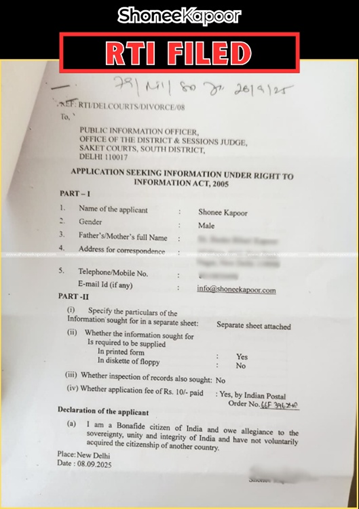
What Was Asked?
An RTI application sought aggregate, year-wise data (2021 onwards):
- Total divorce cases filed
- Mutual consent divorce petitions
- Contested divorce outcomes (allowed / dismissed / withdrawn)
- In decreed cases, how many involved alimony awards
No personal data.
No case files.
No confidential proceedings.
Only anonymized statistical information.
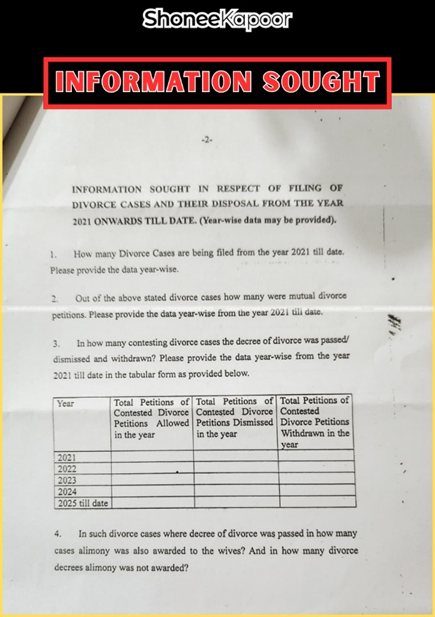
Section 6(2) RTI Act: No Reason Required
The rejection cited lack of “justification” for seeking information.
This is legally indefensible.
Section 6(2) of the RTI Act clearly states:
An applicant shall not be required to give any reason for requesting the information.
Public authorities cannot ask why a citizen seeks information.
This is black-letter law.
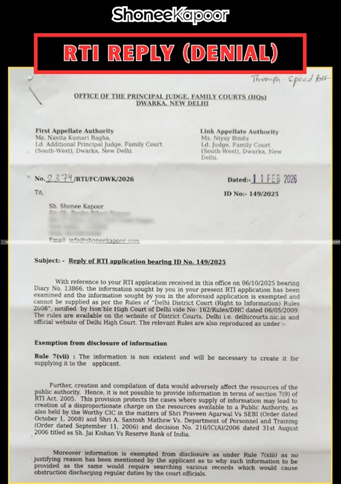
Section 7(9) RTI Act: Cannot Be Used to Deny Information
Authorities claimed “disproportionate diversion of resources.”
Section 7(9) does NOT allow refusal of information.
It only permits supplying information in a different form if the requested format is burdensome.
The Supreme Court in CBSE v. Aditya Bandopadhyay (2011) 8 SCC 497 held:
Information available in material form must be supplied unless exempt.
Statistical data maintained in electronic records is not “creation.”
Extraction is not compilation of fresh research.
If courts can upload pendency data to the National Judicial Data Grid (NJDG), they cannot claim statistical data does not exist.
Judiciary is a Public Authority Under RTI
In CPIO, Supreme Court of India v. Subhash Chandra Agarwal (2019) 16 SCC 1, a Constitution Bench held:
- The judiciary is a public authority under RTI.
- Transparency enhances accountability.
- Disclosure of non-sensitive information strengthens public trust.
Aggregate divorce statistics:
- Do not invade privacy
- Do not concern fiduciary relationships
- Do not attract Section 8 exemptions
Therefore, they are disclosable.
Section 4: Proactive Disclosure is Mandatory
The Supreme Court in Kishan Chand Jain v. Union of India (2023 SCC OnLine SC 915) emphasized:
- Public authorities must proactively disclose operational information.
- Section 4 compliance must be monitored.
- Transparency reduces the need for RTI applications.
Divorce filings and disposal statistics fall squarely within administrative functioning.
If pendency data is proactively disclosed, outcome statistics cannot be selectively withheld.
Selective transparency is not transparency.
Why Divorce Data Matters — Especially for Men
Public debate around matrimonial law is narrative-driven.
But data matters.
Questions that require empirical answers:
- What percentage of contested divorce petitions are dismissed?
- How many cases are withdrawn?
- What proportion of decrees involve alimony awards?
- What is the actual ratio of mutual consent vs contested divorces?
In India, men routinely face:
- Section 498A IPC (now Section 85, Bharatiya Nyaya Sanhita, 2023)
- Domestic Violence Act proceedings
- Maintenance under Section 125 CrPC (now Section 144 BNSS, 2023)
- Interim maintenance under Section 24 Hindu Marriage Act
- Permanent alimony under Section 25 Hindu Marriage Act
The Supreme Court in Rajnesh v. Neha (2020) 9 SCC 1 laid down structured maintenance guidelines because of widespread inconsistencies and misuse.
When laws carry serious financial and criminal consequences, transparency in outcomes becomes essential.
Without data:
- Public perception is shaped by anecdote.
- Policy debates lack evidence.
- Men facing litigation operate in informational darkness.
Transparency is not anti-women.
It is pro-rule of law.
“Information Non-Existent” — An Administrative Improbability
Family Courts operate on:
- Case Information System (CIS)
- Digitized filing categories
- Disposal classifications
- NJDG reporting
Cases are categorized at filing and at disposal.
To say aggregate data “does not exist” is administratively implausible.
The RTI Act does not require creation of new information.
But it absolutely mandates disclosure of information that exists in electronic or physical records.
The Larger Question
Why is it that:
- Judicial pendency statistics are proudly displayed,
- But outcome statistics in matrimonial litigation are resisted?
Transparency should not stop where uncomfortable questions begin.
If dismissal rates are high, the public has a right to know.
If alimony awards are rare, the public has a right to know.
If mutual consent dominates, the public has a right to know.
Democracy functions on informed debate — not selective disclosure.
The Legal Position is Clear
The rejection violates:
- Section 6(2), RTI Act, 2005
- Section 2(f), definition of information
- Section 7(9), improper invocation
- Section 4, proactive disclosure obligations
- Supreme Court rulings in:
- CBSE v. Aditya Bandopadhyay (2011)
- Subhash Chandra Agarwal (2019)
- Kishan Chand Jain (2023)
- Rajnesh v. Neha (2020)
This is not activism.
This is statutory enforcement.
What Happens Next
Appeals will follow.
If required, the matter will be escalated to ensure:
Judicial statistical data cannot be insulated from public scrutiny.
Men facing matrimonial litigation deserve transparency.
Citizens deserve transparency.
The RTI Act is not ornamental legislation.
It is enforceable law.
And transparency cannot be selective.
FAQ’s
No. Under Section 6(2) of the RTI Act, no reason is required to seek information, and Section 7(9) cannot be used to deny existing statistical data.
Yes. Section 2(f) defines information to include records and data held in any form, including aggregate judicial statistics.
Yes. In CPIO v. Subhash Chandra Agarwal (2019), the Supreme Court held that the judiciary is a public authority under the RTI Act.
Such data reveals trends in contested cases, dismissals, withdrawals, and maintenance awards, helping ensure informed debate and accountability in matrimonial law.
The applicant can file a First Appeal under Section 19(1) of the RTI Act and, if necessary, escalate to the Information Commission for enforcement.
Punjab & Haryana High Court
Bench: Hon’ble Justice Anoop Chitkara & Justice Sukhvinder Kaur
ABC Vs XYZ On Febuary 6, 2026
Case No.: CRM-49385-2025 in CRA-D-1489-2025
Judgement
The applicant/convict, incarcerated for the last six months in the above-mentioned case, and was a minor at the time of the commission of the alleged rape on a girl who was also a minor, has come up before this Court second time under Section 430 BNSS 2023, seeking suspension of sentence.
The Applicant’s counsel submits that the Applicant would have no objection whatsoever to any stringent conditions that this Court may impose, including that he shall stay away from the victim.
State’s Counsel opposes the suspension of sentence.
We have heard counsel for the parties and analyzed the application for suspension and the impugned judgment for the limited purpose of adjudicating the present application. It shall be relevant to cull out the following information:
The applicant was a child in conflict with law, being under 18 years of age however was tried as an adult before the Sessions court, Patiala, which convicted him for offence punishable under §§363, 366, 120B IPC as well as §4 of POCSO Act, along with another co-accused namely Sachin Sharma, who was convicted for conspiracy and was sentenced to 5 years, whereas the applicant was sentenced to imprisonment for 20 years under §4(2) of POCSO Act.
The primary reason for which the applicant seeks suspension is parity with coaccused Sachin Sharma, to whom a Coordinate Bench of this Court had granted suspension of sentence vide order dated Dec 04, 2025, passed in CRM-40518-2025. However, the perusal of the order shows that the maximum sentence awarded to Sachin Sharma was 05 years. In contrast, the sentence awarded to the present applicant-child in conflict with law under §4(2) of the POCSO Act is 20 years. Thus, on the face of it, the applicant is not entitled to suspension of sentence on the grounds of parity.
The applicant also seeks suspension on merits. It shall be appropriate to refer to paragraph 32 of the impugned judgment dated Aug 07, 2025, as per which, when PW4 Dr. Jaspreet Kaur had medically examined the victim, she noticed that the hymen was not intact, but no fresh bleeding, swelling, redness, or ooze was present. However, on oath, the victim, PW1, stated that the coitus had taken place in February 2023; as such, the medical examination is hardly of any consequence.
Section 29 of the POCSO Act raises the presumption for offences under §§ 3,5,7,9 of the POCSO Act, unless the contrary is proved. A reference to the Special Court’s judgment does not refer to a rebuttal of such presumption.
There are certain contradictions, issues with credibility, and also a delay in reporting; however, all aspects need a detailed analysis at the time of the final hearing of the appeal.
The question before this court is that when the coitus itself amounts to statutory rape under the POCSO Act, and the judgment primafacie does not totally discredit the prosecution, then why should this Court suspend the sentence?
Given the above, we are suspending the applicant’s sentence because of the following reasons:
First, the FIR in the present case is dated in the second half of March 2023, the alleged coitus was in February 2023. Though according to the victim, the coitus had taken place between them back in February 2023 but it was not reported by the victim at that time. She chose not to report until her maternal uncle noticed the victim going with the applicant and the co-accused. After that, they dropped off the victim near her house, and there are allegations of some ruckus. It means that if the victim’s uncle had not spotted her along with the applicant, then in all probabilities no complaint would have been made to the police. FIR was registered much later in March, after the accused and the girl were caught together by her Maternal Uncle.
Secondly, but primarily the accused was also a child1 being a minor for all purposes except for the definition §2(33)2’3 and §154 of the Juvenile Justice (Care and Protection of Children) Act, 2015
Thirdly, an analysis of the allegations indicates that the coitus, if any, was consensual; there is no allegation of him being cruel while doing the act, the absence of injuries on the victim, are circumstances which all need to be appreciated by analyzing the evidence in great detail. However, the fundamental legal obstacle for the boy is that the girl cannot consent to sexual intercourse unless she is aged eighteen, and even if she gives her consent to have sex, it shall amount to statutory rape as defined in §63 of BNS, 2023 and §§3 and/or 5 of POCSO Act, 2012. Probably, neither the boy nor the girl would be aware of the Sovereign’s restrictions before they could go intimate. Thus, when caught in the statutory juggernaut enacted by the elected representatives, the age gap between the boy and the girl becomes a significant factor that the legislature did not address. Thus, when the age gap between the boy and the girl is little, and all other tell-tale signs of coitus point towards consent, the gigantic scale of Justice would sway to strike a balance between the statutes and the ground realities.
Fourthly, the applicant is a first offender and has undertaken through Counsel not to cause any harm to the victim. Needless to say, the present offense is also heinous, but this Court cannot rule out and ignore the fact that the applicant has clean antecedents.
Fifthly, the applicant is a young boy and is in the formative years of skill development, and given the preceding factors, he should not be restricted from acquiring employable education.
On all these counts alone, the applicant is entitled to suspension of his sentence.
Moreover, as per the custody certificate dated Jan 14, 2026, the applicant’s total 1The Juvenile Justice (Care and Protection of Children) Act, 2015, §2(12) “child” means a person who has not completed eighteen years of age; 2POCSO, §2(d) “child” means any person below the age of eighteen years; 3§2(33) “heinous offences” includes the offences for which the minimum punishment under the Indian Penal Code (45 of 1860) or any other law for the time being in force is imprisonment for seven years or more; 4§15. Preliminary assessment into heinous offences by Board.—(1) In case of a heinous offence alleged to have been committed by a child, who has completed or is above the age of sixteen years, the Board shall conduct a preliminary assessment with regard to his mental and physical capacity to commit such offence, ability to understand the consequences of the offence and the circumstances in which he allegedly committed the offence, and may pass an order in accordance with the provisions of sub-section (3) of section 18: Provided that for such an assessment, the Board may take the assistance of experienced psychologists or psycho-social workers or other experts. Explanation.—For the purposes of this section, it is clarified that preliminary assessment is not a trial, but is to assess the capacity of such child to commit and understand the consequences of the alleged offence. 3 custody is for about 05 months & 25 days.
Furthermore, this court has around 18 to 19 death references pending for final hearing, which have to be given priority, and every murder reference will take more time than any other case; delay in decisions might be a ground for commutation. Additionally, there are a large number of appeals against conviction where more than one person was murdered, cases involving murder and dacoity are pending, and where some of the convicts are habitual offenders, this Court has to draw a priority list for the cases, and if such a list is made, the present case would certainly fall lower on the rung. Although this court has not used any algorithm-based tool to clearly point out how much time it would take for this present appeal to be finally heard, and also no artificial intelligence is being utilized to come to such a conclusion without referring to such scientific tools, in our raw assessment of the disposal of criminal appeals, the appeal is not likely to be taken up in the near future.
Given the above, without commenting on the case’s merits and in the peculiar facts and circumstances of the matter, the execution of the sentence of imprisonment is suspended till the pendency of the appeal, subject to the Applicant furnishing bail bonds of Rs. 25,000/- with one surety of the like amount to the satisfaction of the Chief Judicial Magistrate/ Judicial Magistrate/ Illaqa Magistrate, within 30 days from today.
If the bail bonds are not furnished within 30 days, then the Applicant’s Counsel is to inform this Court so that the bail bond conditions are diluted.
The sentence has been suspended subject to the convict abiding by the following conditions
The convict-applicant shall mention the permanent and present residential address along with the present mobile number, and if there is no mobile number, then the mobile number of the person who shall convey the information sent by any Court, the Prosecution, Police, etc, to the applicant. In case of a change of address or phone number, the SHO of the Police Station, where FIR was investigated, shall be informed through any means and the said change shall also be informed to the Court where bail bonds were furnished. The said change in information is also required to be updated on this Court’s web portal, as and when such a facility is made available.
Given the nature of the allegations and the other circumstances peculiar to this case, the applicant shall not enter the property, workplace, or residence of the victim and the victim’s family. This Court is imposing this condition to rule out any attempt by the accused to cause discomfort to the victim and her family. Reference be made to Vikram Singh v Central Bureau of Investigation, 2018 All SCR (Crl.) 458; and Aparna Bhatt v. The State of Madhya Pradesh, 2021-INSC-192, 2021 SCC Online SC 230.
Given the background of allegations against the applicant, it becomes paramount to protect the victim’s family members, as well as the members of society, and incapacitating the accused would be one of the primary options until the pendency of this appeal. Consequently, it would be appropriate to restrict the possession of firearms. [This restriction is being imposed based on the preponderance of evidence of probability and not of evidence of certainty, i.e., beyond a reasonable doubt; and as such, it is not to be construed as an intermediate sanction.] Given the nature of the allegations and the other circumstances peculiar to this case, the Applicant/Convict shall surrender all weapons, firearms, and ammunition, if any, along with the arms license to the concerned authority within fifteen days from release from prison and inform the Investigator about the compliance. However, subject to the Indian Arms Act, 1959, the Applicant shall be entitled to renew and reclaim it in case of acquittal in this instance, provided otherwise permissible under the relevant rules. Restricting firearms would instill confidence in the victim(s), their families, and society; it would also restrain the accused from influencing the witnesses and repeating the offense.
This suspension of sentence is conditional, with the foundational condition being that if the convict repeats the offense or commits any non-bailable offense which provides for a sentence of imprisonment for more than seven years, the State shall file an application for cancellation of the order of suspension of sentence.
The furnishing of the personal bonds shall be deemed acceptance of all stipulations, terms, and conditions of this bail order.
In Amit Rana v. State of Haryana, CRM-18469-2025 [Decided on 05.08.2025), in CRA-D-123-2020], a Division Bench of Punjab and Haryana High Court in paragraph 13, holds that “To ensure that every person in judicial custody who has been granted bail or whose sentence has been suspended gets back their liberty without any delay, it is appropriate that whenever the bail order or the orders of suspension of sentence are not immediately sent by the Registry, computer systems, or Public Prosecutor, then in such a situation, to facilitate the immediate restoration of the liberty granted by any Court, the downloaded copies of all such orders, subject to verification, must be accepted by the Court before whom the bail bonds are furnished.”
DISCLAIMER: The above judgment is posted for informational purposes ONLY. Printout/ Copy from this website are not admissible citation in the Court of Law. For a court admissible copy contact your advocate.
You may contact me for consultation or advice by visiting Contact Us
Rajasthan High Court
Bench: Hon’ble Justice Farjand Ali
Divik Ostwal vs Ambika Jain & Connected Petition On February 3, 2026
Neutral Citation: 2026:RJ-JD:5657
Case Numbers: S.B. Criminal Revision Petition No. 684/2025 & S.B. Criminal Revision Petition No. 845/2025 (Connected)
Judgement
By way of filing the instant revision petition, the petitionerhusband assails the judgment dated 06.05.2025 passed by the learned Additional Sessions Judge (Woman Atrocities Cases), Jodhpur Metropolitan, Jodhpur in Criminal Appeal No. 91/2024, whereby the appeal preferred by the petitioner–husband has been dismissed and the order dated 31.08.2024 passed by the learned Additional Chief Judicial Magistrate No. 02, Jodhpur Metropolitan in Criminal Misc. Case No. 16/2022 (CIS No. 191/2022) has been affirmed. By the said order dated 31.08.2024, the learned Magistrate allowed the application filed by the respondent–wife under Section 23 of the Protection of Women from Domestic Violence Act, 2005 and awarded maintenance of Rs. 40,000/- per month in favour of the respondent–wife from the date of application, i.e., 15.02.2022. The impugned appellate judgment, being illegal, arbitrary and contrary to the settled principles of law, has resulted in grave miscarriage of justice and, therefore, warrants interference by this Court in exercise of its revisional jurisdiction under Sections 438 read with 442 of the Bharatiya Nagarik Suraksha Sanhita, 2023.
By way of filing the instant revision petition, the petitionerwife assails the impugned order dated 06.05.2025 passed by the learned Additional Sessions Judge (Women Atrocities Cases), Jodhpur Metropolitan, Jodhpur in Criminal Appeal No. 103/2024, whereby the appeal preferred by the petitioner under Section 29 of the Protection of Women from Domestic Violence Act, 2005 seeking enhancement of interim maintenance was erroneously dismissed, affirming the order dated 31.08.2024 passed by the learned Additional Chief Judicial Magistrate No. 2, Jodhpur in Criminal Case No. 16/2022, which had granted an inadequate interim maintenance of ₹40,000/- per month in favour of the wife from the date of application, despite the sufficient means, status, and earning capacity of the respondent–husband, rendering the impugned orders illegal, arbitrary, and unsustainable in law.
Common Facts of the Case
That the marriage between the petitioner–husband and the respondent–wife was solemnized on 11.05.2011 as per Hindu rites and rituals. Out of the said wedlock, one daughter was born. After marriage, the parties initially resided together and later shifted to Mumbai. Owing to matrimonial discord, the parties started living separately in the year 2021, whereafter the respondent–wife came to reside at Jodhpur.
That the respondent–wife instituted proceedings under Section 12 of the Protection of Women from Domestic Violence Act, 2005, along with an application under Section 23 of the Act seeking interim maintenance, on 15.02.2022. During the pendency of the proceedings, both parties filed their respective replies and affidavits of income, assets and liabilities, as directed by the learned Trial Court.
That the learned Additional Chief Judicial Magistrate, after considering the pleadings and material available on record, partly allowed the application under Section 23 of the Act and granted interim maintenance of ₹40,000/- per month in favour of the respondent–wife from the date of application. Aggrieved by the said order, both parties preferred separate appeals, which came to be dismissed by the learned Appellate Court vide a common order, thereby affirming the order of interim maintenance passed by the learned Trial Court.
That being dissatisfied with the concurrent findings recorded by the courts below, the petitioner–husband has approached this Court assailing the grant of interim maintenance, whereas the respondent–wife has preferred the present revision petition seeking enhancement of the interim maintenance amount.
Submissions on behalf of the Petitioner–Husband
Learned counsel for the petitioner–husband contends that the learned Trial Court as well as the Appellate Court have failed to appreciate the material on record in its proper perspective while awarding interim maintenance. It is submitted that the respondent–wife left the matrimonial home of her own volition and without any justifiable cause, and therefore, is not entitled to claim maintenance.
It is further argued that the allegations of cruelty and dowry demand are false, exaggerated and have been levelled only with an ulterior motive to harass the petitioner–husband and his family members. Learned counsel submits that the petitioner–husband is already bearing the responsibility of maintaining the minor daughter, who is residing with him, and the grant of ₹40,000/- per month as interim maintenance imposes an unreasonable financial burden upon him.
It is also contended that the income attributed to the petitioner–husband is highly inflated and not borne out from the affidavits and documents on record. On these grounds, it is prayed that the impugned orders granting interim maintenance be set aside or suitably reduced.
Submissions on behalf of the Respondent–Wife
Per contra, learned counsel for the respondent–wife submits that the respondent–wife has been subjected to continuous physical, mental and economic cruelty on account of unlawful dowry demands and was ultimately abandoned by the petitionerhusband without any reasonable cause. It is contended that the respondent–wife has no independent source of income and is suffering from serious medical ailments, having undergone multiple surgeries, which renders her incapable of earning her livelihood.
It is further submitted that the petitioner–husband is a highly qualified and financially sound person, working on a senior position and earning substantial monthly income, which has been deliberately concealed by him by suppressing material financial documents, including complete income tax returns. Learned counsel asserts that the amount of ₹40,000/- per month awarded as interim maintenance is wholly inadequate considering the standard of living of the parties, the medical expenses of the respondent–wife and the actual earning capacity of the petitionerhusband.
It is thus argued that the learned courts below have erred in not enhancing the interim maintenance despite the material placed on record, and therefore, the respondent–wife is entitled to enhancement of interim maintenance to a just and reasonable amount.
Heard learned counsels present for the parties and gone through the materials available on record.
Observations of the Court
Before adverting to the rival submissions advanced on behalf of the parties, it would be apposite to delineate the settled legal position governing the grant of interim maintenance, whether under Section 23 of the Protection of Women from Domestic Violence Act, 2005 or under Section 144 of the BNSS, 2023 (corresponding to Section 125 of the Code of Criminal Procedure). The power to grant interim maintenance is essentially discretionary in nature, vested in the Court to be exercised pendente lite, and such discretion is neither arbitrary nor unfettered. It is a judicial discretion, required to be exercised on the basis of the pleadings of the parties, their affidavits of income, assets and liabilities, and a prima facie evaluation of the material placed on record at that stage. The very nature of interim maintenance presupposes that the Court is not expected to undertake a detailed roving inquiry or a meticulous adjudication on disputed questions of fact, which are otherwise within the exclusive domain of the final adjudication after evidence is led by the parties.
The grant of interim maintenance does not amount to a final or conclusive determination either on the entitlement of the wife to maintenance or on the quantum thereof. The discretion exercised at the interim stage is tentative, provisional and purely ad hoc, intended to operate only during the subsistence of the proceedings. It cannot be construed as a declaration that the wife has conclusively established her entitlement to maintenance, nor can it be treated as a binding determination of the exact amount that she may ultimately be entitled to receive. The purpose of interim maintenance is limited and specific: it is to ensure that the aggrieved spouse is not rendered destitute or subjected to undue financial hardship during the pendency of the litigation, which, by its very nature, may take considerable time to reach its logical conclusion.
It is equally well settled that an order granting interim maintenance does not partake the character of a determination of arrears, nor does it crystallize any vested right in favour of either party. The amount so awarded is merely a stop-gap arrangement, operative till the final adjudication of the application under Section 12 of the Domestic Violence Act. The Court, at this stage, does not decide what the wife actually deserves, whether she ultimately deserves maintenance at all, or what should be the precise quantum of maintenance after a full-fledged inquiry. These issues fall squarely within the scope of the trial, where evidence is to be adduced, tested by cross-examination, and subjected to critical judicial scrutiny by the learned Trial Court.
The underlying object of interim maintenance is to prevent immediate hardship and financial deprivation to the claimant during the pendency of the proceedings. It is not intended to confer any share in the income of the husband, nor does it create any partnership or proprietary interest in his earnings.
Maintenance, particularly interim maintenance, is a measure of social justice, designed to ensure subsistence and dignity, and not to equalize incomes or to punish one party by imposing an onerous financial liability. The quantum fixed at the interim stage is necessarily approximate, based on a broad and prima facie assessment of the status of the parties, the apparent earning capacity of the husband, the needs of the wife, and other relevant circumstances, including the fact that the custody of the minor child in the present case is with the husband.
In the instant matter, the learned Trial Court, upon consideration of the pleadings, affidavits and material available on record, exercised its discretion to award interim maintenance of ₹40,000/- per month. The said discretion was thereafter examined by the learned Appellate Court, which found no perversity, illegality or patent infirmity warranting interference, and consequently affirmed the order of the Trial Court. It is trite law that an appellate or revisional Court ought not to substitute its own discretion merely because another view is possible or because it might have arrived at a different figure had it been exercising original jurisdiction. Interference with an order of interim maintenance is justified only where the discretion exercised by the Court below is shown to be manifestly arbitrary, capricious, perverse, or vitiated by a palpable error of law or jurisdiction.
The revisional jurisdiction of this Court is even more circumscribed. This Court does not sit as a Court of first appeal to re-appreciate the material or to reassess the tentative conclusions drawn by the Courts below at the interim stage. Unless the discretion exercised suffers from a glaring legal infirmity or results in manifest injustice, the revisional Court would be loath to interfere. The Trial Court, which has the advantage of directly dealing with the parties, assessing their pleadings at close quarters, and monitoring the progress of the proceedings, is best placed to exercise such discretion at the interlocutory stage.
In the present case, the rival contentions as to whether the respondent–wife left the matrimonial home voluntarily or was subjected to cruelty, whether she is entitled to maintenance at all, and what should be the appropriate quantum considering the income of the husband and the needs of the wife, are all matters which require evidence and detailed adjudication. These questions cannot be conclusively answered at the stage of interim maintenance. The learned Trial Court has consciously exercised its discretion with the clear understanding that the grant of ₹40,000/per month is purely interim, tentative and without prejudice to the rights and contentions of either party at the final stage. The fact that interim maintenance has been granted, and the amount thereof, will have no bearing whatsoever on the final determination of entitlement or quantum after the conclusion of evidence.
This Court finds no palpable error, perversity or illegality in the concurrent orders passed by the Courts below so as to warrant interference in revisional jurisdiction, either at the instance of the husband seeking reduction/set aside of interim maintenance or at the instance of the wife seeking enhancement thereof. The discretion exercised is within the parameters of law, based on a prima facie assessment, and subserves the limited object for which interim maintenance is envisaged.
Consequently, both the revision petitions are devoid of merit and are hereby dismissed. However, considering that the proceedings under Section 12 of the Protection of Women from Domestic Violence Act have been pending for a considerable period, the learned Trial Court is directed to make all endeavours to conclude and finally dispose of the main application under Section 12 of the Act expeditiously, preferably within a period of six months from the date of receipt of a copy of this order, in accordance with law.
It is clarified that all observations made herein are confined to the adjudication of the present revision petitions and shall not prejudice the rights and contentions of either party at the stage of final adjudication before the learned Trial Court.
DISCLAIMER: The above judgement is posted for informational purpose ONLY. Printout/ Copy from this website are not admissible citation in the Court of Law. For a court admissible copy contact your advocate.
You may contact me for consultation or advice by visiting Contact Us
Ancestral property is not a husband’s personal asset, yet many men are dragged into claims they never legally owned. This confusion quietly turns family property into a pressure tool against men during marital disputes.
Can a Wife Claim Husband’s Ancestral Property in India?: A few years ago, a young professional from Delhi approached me in a state of complete panic. His marriage had broken down within three years. Along with allegations and maintenance claims, his wife demanded a “share” in his ancestral house — a house that legally belonged to his father and formed part of a joint Hindu family property.
The man did not even have ownership rights in that property during his father’s lifetime. Yet, police visits, legal notices, and settlement negotiations revolved around that ancestral home. His parents — senior citizens — were dragged into court corridors for property that was never in the husband’s name.
This is not an isolated story. It is becoming a pattern.
To understand why this demand had no direct legal basis — and why it still became a pressure point — we need to examine the law correctly.
What Is Ancestral Property Under Indian Law?
Under the Hindu Succession Act, 1956, ancestral property is property inherited up to four generations of male lineage from a common ancestor. It forms part of a Hindu Undivided Family (HUF) governed by Mitakshara law (in most parts of India).
Key legal principles:
- Ancestral property is different from self-acquired property.
- Coparceners acquire a birthright in ancestral property.
- After the 2005 amendment to Section 6 of the Hindu Succession Act, daughters are also coparceners by birth, equal to sons.
The Supreme Court in Vineeta Sharma v. Rakesh Sharma (2020) clarified that daughters have coparcenary rights by birth, irrespective of whether the father was alive on the date of the amendment.
However, a wife does not become a coparcener in her husband’s ancestral family merely by marriage.
Most importantly:
During the lifetime of the father or karta, a son does not have exclusive, transferable ownership over ancestral property. His interest is undivided and fluctuating. He cannot unilaterally sell or gift specific portions without partition.
This principle has long been recognised in Hindu law jurisprudence.
If the husband himself does not hold the exclusive title, no derivative ownership can flow through him.
Does a Wife Have a Direct Legal Right in Her Husband’s Ancestral Property?
The settled legal position is:
A wife has no direct ownership right in her husband’s ancestral property during his lifetime.
She cannot:
- Demand partition solely by virtue of marriage.
- Claim coparcenary status.
- Seek declaration of ownership in joint family property.
Her legal rights arise in different domains:
(a) Right to Maintenance
Under:
- Section 125 CrPC (now Section 144 BNSS)
- Sections 24 and 25 of the Hindu Marriage Act
- Section 18 of the Hindu Adoptions and Maintenance Act
Maintenance is a financial right—not a property ownership right.
(b) Right of Residence
Under Section 17 of the Protection of Women from Domestic Violence Act (PWDVA), a woman has the right to reside in a “shared household.”
However, this does not create ownership.
The Supreme Court in S.R. Batra v. Taruna Batra (2007) held that a wife has no right to reside in property exclusively owned by parents-in-law if it is not the husband’s property.
Later, in Satish Chander Ahuja v. Sneha Ahuja (2020), the Court broadened the interpretation of “shared household,” stating that residence rights may extend beyond property owned solely by the husband.
However, even in that judgment, the Court did not grant ownership rights—only a right of residence subject to judicial determination.
Residence ≠ Ownership.
When Can a Wife Have an Indirect Connection to Ancestral Property?
There are limited legally recognised scenarios:
- After Partition: If the husband receives a defined share in ancestral property through partition, that share becomes his separate property. That portion may then be considered in maintenance or matrimonial asset discussions.
- Upon Inheritance: If the husband inherits property after the death of a coparcener, it becomes his property (subject to the nature of succession). Only then can financial implications arise.
- Maintenance Assessment: Courts may consider actual income or assets available to the husband while determining maintenance. However, speculative or unrealised ancestral interests are not automatically treated as disposable assets.
Even here, the wife does not automatically become a co-owner.
Why Then Does Ancestral Property Enter Matrimonial Disputes?
Because practical litigation pressure operates differently from strict legal entitlement.
Ancestral property frequently becomes:
- A negotiation lever in divorce settlements
- A psychological pressure tactic
- A subject indirectly invoked in domestic violence proceedings
- A reason to array elderly parents as parties
Men routinely face indirect claims, litigation pressure, and emotional blackmail using property they do not legally control. The gap between law and ground reality explains why ancestral property becomes collateral damage in marital conflicts.
The pressure is procedural, not proprietary.
Criminal complaints, prolonged trials, and social stigma often compel families to settle—even when the legal claim over property is unsustainable.
Legal Status of Parents’ Property
If the property is:
- Exclusively owned by the father or mother
- Self-acquired property of parents
- Part of an HUF not yet partitioned
Then the husband has no transferable title. Consequently, no third party can compel transfer through him.
The Supreme Court has repeatedly upheld the principle that ownership cannot be created by implication where title does not exist.
The Real Legal Position
Under current Indian law:
- A wife is not a coparcener in her husband’s ancestral family.
- She has no birthright in ancestral property.
- She cannot demand partition solely due to marriage.
- She has maintenance rights and residence protection rights.
- Ownership rights arise only if and when the husband acquires a defined share.
There is no statutory provision granting an automatic share in ancestral property to a wife during the husband’s lifetime.
Why Awareness Matters
Many families confuse:
- Maintenance with ownership
- Residence with title
- Emotional settlement pressure with legal entitlement
That confusion allows ancestral homes—often built over generations—to become negotiation tools in marital disputes.
The law is clear. The litigation environment is often not.
Final Word
Under Indian law, a wife has no direct right over her husband’s ancestral property during his lifetime. Her rights are confined to maintenance and residence, not ownership.
Yet, as seen in the opening incident, property that a man neither owns nor controls often becomes the centre of marital pressure. Elderly parents are dragged into litigation, and ancestral homes turn into bargaining tools—not because the law allows it, but because procedure is misused.
This gap between statutory position and ground reality explains why families must understand the precise legal framework governing ancestral property. When men themselves lack absolute ownership, any demand for transfer or “share” stands on a weak legal footing. Yet without awareness, fear often replaces law in settlement discussions.
Clarity of law is not anti-women. It is pro-justice. And in matrimonial disputes, precision in understanding property rights is essential to prevent generational assets from being dragged into battles they were never legally meant to fight.
Key Takeaways
- A wife has no direct ownership right in her husband’s ancestral property during his lifetime; marriage does not create coparcenary status.
- Ancestral property belongs to the Hindu Undivided Family, and a son himself cannot unilaterally sell or transfer it without partition.
- Legal rights available to a wife are maintenance and residence, not automatic ownership of parental or HUF property.
- Despite clear law, ancestral homes are often used as pressure tools in matrimonial disputes, dragging elderly parents into unnecessary litigation.
- Men must understand the difference between ownership, inheritance, residence, and maintenance to prevent generational assets from becoming collateral damage in marital conflict.
No. She is not a coparcener in her husband’s HUF by marriage and cannot legally demand partition of ancestral property.
Not as ownership. If the house is ancestral or is owned exclusively by the parents-in-law, she cannot claim title to it.
No. It may provide residence protection in a shared household, but residence is not ownership.
Yes, once he receives a defined share, it may be considered for maintenance, but it does not automatically become the wife’s property.
Because litigation pressure and settlement tactics often target family assets, even when the husband himself has no legal control over them.
Supreme Court Of India
Bench: Hon’ble Justices B.V. Nagarathna & Ujjal Bhuyan
CaseTitle: Anamika Jain Versus Dr. Atul Jain. On January 28, 2026
Case Number: Civil Appeal of 2026 (Arising out of SLP (C) No. 5220 of 2024)
The present appeal has been filed by the appellant – wife, aggrieved by the judgment dated 29.08.2018 passed by the High Court of Judicature at Madhya Pradesh, Principal Seat at Jabalpur1, in First Appeal No. 156 of 2016, whereby the High Court dismissed the appeal filed by the appellant – wife against the judgment dated 30.11.2015 passed by the First Additional Principal Judge, Family Court, Bhopal2 in Civil Suit No. 985-A/2012 insofar as it related to the grant of permanent alimony of Rs.15,000/- per month.
The record of proceedings discloses that the matter was initially referred to the Mediation Centre attached to the Principal Bench of the Madhya Pradesh High Court at Jabalpur. However, the mediation ended in failure. Thereafter, the parties pursued their respective remedies before this Court.
We have heard the learned counsel appearing on behalf of the appellant wife as well as the learned counsel appearing on behalf of the respondent husband.
The undisputed facts are that the marriage between the parties was solemnized on 13.11.1994 according to Hindu rites and rituals. Out of the said wedlock, a male child was born on 22.11.1997. Owing to matrimonial disputes that arose between them, the parties started living separately since 2011. Subsequently, the respondent – husband filed an application under Section 13 of the Hindu Marriage Act, 1955, seeking dissolution of marriage by a decree of divorce. After considering the pleadings, oral and documentary evidence, the Family Court passed a decree of divorce and in addition thereto, awarded permanent alimony of Rs. 15,000/- per month along with a lump sum amount of Rs. 50,000/- to the appellant – wife. Being dissatisfied with the quantum of maintenance awarded, the appellant – wife preferred First Appeal No. 156 of 2016 before the High Court seeking enhancement. The High Court dismissed the appeal by the impugned judgment dated 29.08.2018. Aggrieved thereby, the appellant – wife is before this Court.
The learned counsel appearing for the appellant – wife submits that the respondent – husband is a doctor by profession and earns approximately Rs.1,60,000/- per month. It is further submitted that before the Family Court, the respondent had admitted that he was also engaged in private practice and was receiving rental income, which material aspects were not duly considered by the High Court. It is also urged that the respondent has remarried, is leading an affluent lifestyle, and is financially capable of paying enhanced maintenance. Consequently, the permanent alimony of Rs. 15,000/- per month is grossly inadequate and requires enhancement.
Per contra, the learned counsel appearing for the respondent – husband submits that the appellant – wife is a highly qualified woman and is capable of maintaining herself. It is contended that the respondent is bearing the educational expenses of their son and has been regular in paying maintenance of Rs.15,000/- per month to the appellant – wife. It is further submitted that the respondent’s second marriage has also broken down and that he is not financially in a position to pay more than Rs. 15,000/- per month. Therefore, according to the respondent, no case for enhancement is made out and the High Court was justified in dismissing the appeal.
In reply, the learned counsel for the appellant – wife denied the respondent’s claim that he has been maintaining the son or bearing his educational expenses. It is further submitted that during the mediation proceedings, the respondent – husband had agreed to pay Rs. 30,000/- per month towards permanent alimony, but subsequently resiled from the said stand in his counter affidavit by citing untenable reasons for denying enhancement.
We have considered the rival submissions and perused the materials placed on record, including the pay certificate of the respondent – husband.
Admittedly, the appellant – wife has not challenged the decree of divorce. The challenge before this Court is confined solely to the quantum of permanent alimony of Rs. 15,000/- per month awarded by the Family Court, as affirmed by the High Court, which, according to her, is inadequate.
Marriage, as an institution in our society, is founded on emotional bonding, companionship, and mutual support, which cannot be evaluated in purely monetary terms. A woman often enters matrimony with legitimate aspirations of a stable and dignified life. When such a marriage breaks down, the obligation of the husband to ensure that the wife is able to live with dignity does not come to an end merely on the ground that she is educated or has parental support. Post-divorce, the wife is entitled to live a life consistent with the standard of living she was accustomed to during the subsistence of the marriage.
In this context, reference may be made to the decision of this Court in Bhuwan Mohan Singh v. Meena and others3, wherein, while dealing with proceedings under Section 125 Cr.P.C, it was observed as under:
The concept of sustenance does not necessarily mean to lead the life of an animal, feel like an unperson to be thrown away from grace and roam for her basic maintenance somewhere else. She is entitled in law to lead a life in the similar manner as she would have lived in the house of her husband. That is where the status and strata come into play, and that is where the obligations of the husband, in case of a wife, become a prominent one. In a proceeding of this nature, the husband cannot take subterfuges to deprive her of the benefit of living with dignity. Regard being had to the solemn pledge at the time of marriage and also in consonance with the statutory law that governs the field, it is the obligation of the husband to see that the wife does not become a destitute, a beggar. A situation is not to be maladroitly created whereunder she is compelled to resign to her fate and think of life “dust unto dust”. It is totally impermissible. In fact, it is the sacrosanct duty to render the financial support even if the husband is required to earn money with physical labour, if he is able bodied. There is no escape route unless there is an order from the Court that the wife is not entitled to get maintenance from the husband on any legally permissible grounds.”
In Rajnesh v. Neha and another4, this Court comprehensively examined the principles governing maintenance of wife, children and parents, and framed authoritative guidelines under Article 142 of the Constitution. The following observations are apposite:
“77. The objective of granting interim / permanent alimony is to ensure that the dependant spouse is not reduced to destitution or vagrancy on account of the failure of the marriage, and not as a punishment to the other spouse. There is no straitjacket formula for fixing the quantum of maintenance to be awarded. 78. The factors which would weigh with the Court inter alia are the status of the parties; reasonable needs of the wife and dependent children; whether the applicant is educated and professionally qualified; whether the applicant has any independent source of income; whether the income is sufficient to enable her to maintain the same standard of living as she was accustomed to in her matrimonial home; whether the applicant was employed prior to her marriage; whether she was working during the subsistence of the marriage; whether the wife was required to sacrifice her employment opportunities for nurturing the family, child rearing, and looking after adult members of the family; reasonable costs of litigation for a non-working wife5. 79. In Manish Jain v. Akanksha Jain6, this Court held that the financial position of the parents of the applicant-wife, would not be material while determining the quantum of maintenance. An order of interim maintenance is conditional on the circumstance that the wife or husband who makes a claim has no independent income, sufficient for her or his support. It is no answer to a claim of maintenance that the wife is educated and could support herself. The court must take into consideration the status of the parties and the capacity of the spouse to pay for her or his support. Maintenance is dependent upon factual situations; the Court should mould the claim for maintenance based on various factors brought before it. 80. On the other hand, the financial capacity of the husband, his actual income, reasonable expenses for his own maintenance, and dependant family members whom he is obliged to maintain under the law, liabilities if any, would be required to be taken into consideration, to arrive at the appropriate quantum of maintenance to be paid. The Court must have due regard to the standard of living of the husband, as well as the spiralling inflation rates and high costs of living. The plea of the husband that he does not possess any source of income ipso facto does not absolve him of his moral duty to maintain his wife if he is able bodied and has educational qualifications.” “90. The Courts have held that if the wife is earning, it cannot operate as a bar from being awarded maintenance by the husband. The Courts have provided guidance on this issue in the following judgments: 90.1. In Shailji v. Khobbanna7, this Court held that merely because the wife is capable of earning, it would not be a sufficient ground to reduce the maintenance awarded by the Family Court. The Court has to determine whether the income of the wife is sufficient to enable her to maintain herself, in accordance with the lifestyle of her husband in the matrimonial home8. Sustenance does not mean, and cannot be allowed to mean mere survival9.”
In the present case, the material on record indicates that the respondent husband has sufficient earning capacity and financial means to pay more than Rs. 15,000/- per month towards permanent alimony. Considering the present cost of living, the impact of inflation over the past decade, and the overall circumstances of the parties, we are of the view that the amount awarded by the Family Court, as affirmed by the High Court, is inadequate and warrants enhancement.
During the course of proceedings, this Court directed the learned counsel appearing for the respective parties to get instructions with regard to enhancement of permanent alimony to Rs. 30,000/- per month and passed over the matter. Upon receiving instructions, the learned counsel for both sides have fairly agreed to such enhancement.
In view of the above, the permanent alimony payable to the appellant wife is enhanced from Rs. 15,000/- per month to Rs. 30,000/- per month, which shall be payable by the respondent – husband from the date of filing of the special leave petition before this Court, i.e., 02.07.2021
Accordingly, the judgment of the Family Court, as affirmed by the High Court, stands modified to the aforesaid extent. The respondent – husband is directed to pay the revised permanent alimony of Rs. 30,000/- per month by the 5th of every succeeding month, commencing from 05.02.2026. The arrears of enhanced maintenance for the period from July 2021 to January 2026, amounting to Rs. 8,10,000/- (Rs. 15000/- x 54 months), shall be paid either in one lump sum or in instalments over a period of four years. In the event of payment by instalments, not less than one-third of the arrears shall be paid through equated quarterly instalments.
With the aforesaid modification and directions, the appeal stands allowed. There shall be no order as to costs.
DISCLAIMER: The above judgment is posted for informational purposes ONLY. Printouts/Copies from this website are not admissible citations in the Court of Law. Or, for a court-admissible copy, contact your advocate.
You may contact me for consultation or advice by visiting Contact Us
Supreme Court Of India
Bench: Hon’ble Justices B.V. Nagarathna & Ujjal Bhuyan
PKN vs State of Chhattisgarh & Others, Supreme Court of India, on February 5, 2026
Case Number: Criminal Appeal of 2026 (Arising out of Special Leave Petition (Crl.) No. 4452 of 2025)
Neutral Citation: 2026 INSC 124
Judgement
This appeal arises out of order dated 03.03.2025 passed by the High Court for the State of Chhattisgarh at Bilaspur in WPCR No.117/2025 dismissing the Writ Petition filed under Article 226 of Constitution of India preferred by the accused-appellant herein and thereby refusing to quash the proceedings arising out of the Signature Not Verified Digitally signed by RADHA SHARMA Date: 2026.02.05 15:11:24 IST Reason: FIR No.213/2025 dated 06.02.2025 registered at Sarkanda Police Station, District Bilaspur under Section 376(2)(n) of the Indian Penal Code, 1860 (for short, “IPC”) that was registered by the complainant-respondent No.3.
Briefly stated, the facts of the case are that the complainant- respondent No.3, an Advocate by profession, solemnized marriage with one Mitendra Kumar Dhirde on 02.06.2011 and subsequently gave birth to a boy named Ojash on 12.04.2012. Thereafter, owing to matrimonial discord between the couple, the husband sought divorce by filing the divorce petition Civil Case No.F/232A/2018 against the complainant-respondent No.3 on 10.12.2018 under Section 13(1)(ia) of Hindu Marriage Act, 1955 before the Family Court, Raigarh, Chhattisgarh. The contentions and grievances of the parties in the said divorce petition are not germane to the facts of the present case and hence are not dealt with herein. Suffice it to say that the said divorce petition was dismissed by the Family Court on 27.11.2024 and an appeal No.FA(MAT)/11/2025 against the said order was preferred by the husband of the complainant- respondent No.3 on 10.01.2025 which is currently pending adjudication before the High Court of Chhattisgarh at Bilaspur. Therefore, at the time of disposal of the present petition, the complainant-respondent No.3 is married and has a son.
It is stated that on 18.09.2022, the complainant-respondent No.3 had come into contact with the accused-appellant who is also an Advocate by profession, at a social event wherein both developed a mutual liking and fondness for each other and thereafter stayed in contact with each other.
On 06.02.2025, the complainant-respondent No.3 lodged an FIR No.213/2025 dated 06.02.2025 at Police Station Sarkanda at District Bilaspur, Chhattisgarh under Section 376(2)(n) of the IPC against the accused-appellant alleging that he had raped her on a false promise of marriage. The allegations against the accusedappellant contained in the said FIR can be crystallized as hereunder:
The complainant-respondent No. 3 met the accused-appellant at a social event, where both developed a cordial relationship based on their similar professions. The accused-appellant there fter regularly picked up and dropped off the complainant-respondent No. 3 at her house. The accused-appellant was informed by the complainant-respondent No. 3 that proceedings were pending before the Family Court between her and her husband.
On 18.09.2022, while going to a Mahan Bada Jarhabhata meeting, the accused-appellant took the complainant-respondent No.3 to his friend’s house in Geetanjali Phase 02, Sarkanda, on the pretext of picking up some of his essential documents from the said location.
Thereafter, in the guise of seeking help from the complainant-respondent No.3, the accused-appellant raped her. Upon protest and threat of lodging a police complaint, the accused-appellant told the complainant-respondent No.3 that he likes her and wants to marry her. Thereafter, he applied vermilion to her head.
S bsequently, on different occasions, the accusedappellant indulged in physical relations with the complainant-respondent No.3 whilst he kept verbally assuring her that hewouldld marry her and meet and talk to her family about the same.
Thereafter, the complainant-respondent No.3 informed the accused-appellant that she was pregnant with his child. Upon hearing the said information, he became evasive about the topic of marriage. He said that he was neither ready for a social marriage no for a child, and constantly urged her to consume tablets for abortion.
On 27.01.2025, the complainant-respondent No.3 visited the residence of the accused-appellant to confront him and his family about the said situation and was received with hostility by the members of the family of the accused-appellant, who proceeded to assault and threaten the complainant-respondent No.3 with dire consequences and threw her out of the house.
Thereafter, alleging harassment and blackmail on behalf of the complainant-respondent No.3, the accused-appellant lodged a complaint before Superintendent of Police, District Bilaspur on 06.02.2025 wherein he alleged that the complainant-respondent No.3 had been harassing him and his family with demand of marriage whilst threatening to commit suicide if the said demands of marriage were not met. The accused-appellant in the said complaint has further alleged that he had never considered marrying he, but instead always saw her as a good friend and colleague with whom he shared workspace.
Apprehending arrest in connection with the FIR No.213/2025, the accused-appellant preferred an Anticipatory Bail Application under Section 482 of BNSS in MCRCA No.285/2025 before the High Court of Chhattisgarh at Bilaspur. The said Anticipatory Bail Application was allowed by the High ourt by its order dated 03.03.2025. While allowing the said Anticipatory Bail Application, the High Court observed that upon perusal of the statement made by the complainant-respondent No.3 under Section 183 of BNSS, it appeared that she was married and had a 10-11-year-old son and had indulged in a consensual relationship with the accusedappellant. Pursuant thereto, the accused-appellant was formally arrested o 28.03.2025 and thereafter released on bail.
On the same day, i.e., 03.03.2025, when the accused-appellant was granted anticipatory bail by the High Court of Chhattisgarh in MCRCA No. 285/2025, the WPCR No. 117/2025 filed by him seeking quashment of FIR No. 213/2025 and all consequential proceedings thereto was dismissed. While dismissing the said Writ Petition, the High Court observed that the complainant- espondent No.3 has made vivid allegations against the accused-appellant that on the pretext of marriage, she was induced into sexual intercourse after which, ultimately, he refused to marry her. On the point of quality of consent, it was observed that the misconception of fact or retext of marriage is a question of factthat requires investigation. Therefore, at the nascent stage of investigation, it cannot be said with certainty that the allegations levelled by the complainant-respondent No.3 are false. No prima facie offence has been made out Therefore, the High Cour..t, in its wisdom, found no ground to interfere with the proceedings arising ut of the said FIR.
In the interregnum, the Investigating Officer submitted Final Report No.269/2025 under Section 192 of Bharatiya Nagarik Suraksha Sanhita, 2023 (hereinafter ‘BNSS’ for short) on 02.04.2025 against the accused-appellant alleging commission of offence u/s 376(2)(n) of the IPC and in pursuance thereto, Sessions Case No.89/2025 has been instituted before the Court of District and Sessions Judge, Bilaspur to try the accused-appellant for the aforesaid offence.
We have heard the learned counsel for the accused-appellant, the learned counsel for respondent No.1-State, and the complainant-respondent No.3. We have perused the material on record.
Learned counsel for the accused-appellant submitted that the alleged victim is a thirty-three years old married lady and an advocate by profession with a son aged 10-11 years old and therefore has knowledge of her well-being and hence by any stretch of imagination, it cannot be said that she was duped on the pretext of marriage considering her marital status and her occupation. It was further submitted that she voluntarily developed a physical relationship with the accused-app llant, which continued up to January 2025, which in itself goes on to show that she was a consenting party with the accused-appellant. Hence, no offence of rape is made out even from the contents of the FIR itself. Further, it has been alleged that the accused-appellant himself was the victim of the act of the compla nant-respondent No.3, as she had been blackmailing him,, for which the he had filed a complaint to the Superintendent of Police on 06.02.2025 and therefore, in the absence of any prima facie ingredients to constitute the offence of rape, he cannot be prosecuted for the same. He further submitted that the accused-appellant had also applied for the grant of anticipatory bail, re istered as MCRCA No. 285/2025, before the High Court of Chhattisgarh, which was allowed vide order dated 03.03.2025. Therefore, in view of the facts and circumstances of the case, the petition may be allowed, and the impugned FIR may be q ashed.
Per contra, the learned counsel for the respondent No.1-State contended that the facts of the present case are not only forus but hethe appellant washe appfor the prosecutionty analso for theld beiltyw,owho was apprehendedle to be pube, it has also been contended that through the investigation, there has been a recovery of WhatsApp conversation xchanged between the accused-appellant and the complainant-respondent No.3 wherefrom it is apparent that the accused-appellant was aware that the complainant-respondent No.3 was having a matrimonial dispute with her husband and therefore in a pre-planned manner nduced her into a physical relationship for satisfying his lust under the false pretext of marriage and thereafter impregnated her without having any actual intention to honour his promise. Therefore, it was argued that any argument on the consent of the prosecutrix stands vitiated at the very threshold by fraud and misconception induced by the accused-appellant.
On the other hand, the learned counsel for the complainant- respondent No.3 has contended that the police officials,, after due investigation found that offence has been made out against the accused-appellant and consequently Chargesheet No.269/2025 has been filed on 02.04.2025 under section 376(2)(n) of the IPC and Sessions Case No.89/2025 has been instituted. It was further contended that the accused-appellant, being an advocate himself, knows the implications of law and has commi ted the sexual offence with intention and full knowledge. That apart, counsel contended that the accused-appellant is not appearing before the Sessions Judge and, therefore, is dela ing the trial; he has an alternative remedy of arguing the case before the Sessions Judge on the point of discharge, rather than pursuing the remedy of quashing the FIR before this Court. The learned counsel has pointed outl that only fourteen witnesses have been listed in the chargesheet for examination,, and hence there is no scope for delay of trial,, and the same may be concluded within six months, and therefore all the questions regarding the consent of the complainant-respondent No.3 and its quality can be decided at the stage of trial itself.
We have given our thorough consideration to the arguments advanced at the Bar and the material on record.
In the instant case, the allegations in the FIR are under Section 376(2)(n) of the IPC. An offence of rape, if established in terms of Section 375 of the IPC, is punishable under Section 376 of the IPC. In the resent case, the second description of Section 376 is relevant, which is set out below:
“376. Punishment for rape. — (1). Whoever, except in the cases provided for in sub-section (2), commits rape, shall be punished ith rigorous imprisonment o either description for a term which shall not be less than ten years, but which may extend to imprisonment for life, and shall also be liable to fine. 2. Whoever, – (n) xxx commits rape repeatedly on the same woman, shall be punished with rigorous imprisonment for a term w ic shall not be less than ten years, but which may extendto imprisonment for life, which shall mean imprisonment for the remainder of that person’s natural life, and shall also be liable to fine. Explanation.—For this sub-section,— (a) “armed forces” means the naval, military and air forces and includes any member of the Armed Forces constituted under any law for the time being in force, including the paramilitary forces and any auxiliary forces that are under the control of the Central Government or the State Government; (b) “hospital” means the precincts of the hospital and includes the precincts of any institution for the reception and treatment of persons during convalescence or of persons requiring medical attention or rehabilitation; (c) “police officer” shall have the same meaning as assigned to the expression “police” under the Police Act, 1861 (5 of 1861); (d) “women’s or children’s institution” means an institution, whether called an orphanage or a home for neglected women or children or a widow’s home or an institution called by any other name, which is established and maintained for the reception and care of women or children.”
Section 376(2)(n) of the IPC provides for enhanced punishment in cases where rape is committed repeatedly on the same woman. It mandates rigorous imprisonment for a term of not less than ten years, which may extend to life imprisonment for the re ainder of the person’s natural life. The object of this provision is to address aggravated instances of sexual assault where the offence is not a single incide t but has occurred repeatedly on the same victim. The expression “repeatedly” employed in the provision is of significance. It contemplates more than one act of sexual assa lt, committed at different points in time on the same victim. Courts have consistently interpreted this phrase to mean a series of separateacts,d not a continuation of a single transac ion. In genuine cases under Section 376(2)(n) of the IPC, the pattern is usually unmistakable; it is an initial act of sexual a sault, followed by multiple acts under fear, pressure, captivity, or continued deceit, often when the woman is rendered vulnerable and unable to escape the situation.
At the outset, we refer to the ratio in the case of Naim Ahamed vs. State (NCT of Delhi), (2023) 15 SCC 385, wherein this Court had decided a similar matter, wherein, allegedly, the prosecutrix had also given her consent for a sexual relationship with the accused-appellant therein, upon an assurance to marry. The prosecutrix, who was herself a married woman with three children, had continued to have such a relationship with the a cused-appellant for about five years, till she filed the complaint. In the conspectus of such facts and circumstances, this Court had observed as under:
The bone of contention raised on behalf of the respondents is that the prosecutrix had given her consent for sexual relationship under the misconception of fact, as the accused had given a false promise to marry her and subsequently he did not marry, and therefore such consent was no consent in the eye of the law and the case fell under Clause Secondly of Section 375 IPC. In this regard, it is pertinent to note that there is a difference between giving a false promise and committing breach of promise by the accused. In case of false promise, the accused right from the beginning would not have any intention to marry the prosecutrix and would have cheated or deceived the prosecutrix by giving a false promise to marry her only with a view to satisfy his lust, whereas in case of breach of promise, one cannot deny a possibility that the accused might have given a promise with all seriousness to marry her, and subsequently might have encountered certain circumstances unforeseen by him or the circumstances beyond his control, which prevented him to fulfil his promise. So, it would be a folly to treat each breach of promise to marry as a false promise and to prosecute a person for the offence under Section 376. As stated earlier, each case would depend upon its proved facts before the court.”
It has been time and again settled by this Court that the mere fact that the parties indulged in physical relations pursuant to a promise to marry will not amount to rape in every case. An offence under Section 375 of the IPC could only be made outif a promise of marriage was made by the accused solely with a view to obtaining consent for sexual relations without having any intent of fulfilling the promise from the very beginning that such false promise of marriage had a direct bearing on the prosecutrix giving her consent for sexual relations. The issue for consideration is whether, having regard to the facts and circumstances of the case and after examining the FIR, the High Court was correct in refusing to quash the ongoing criminal proceedings against the accused-appellant arising out of FIR No. 213/2025 dated 06.02.2025 and Chargesheet No. 269/2025.
Upon a careful consideration of the record in the present case, we are unable to discern any material that would warrant the invocation of Section 376(2)(n) of the IPC. The facts of the present case unmistakably indicate a classic case of a consensual relationship turning acrimonious. Upon perusal of the records of the case, it is evident that the complainant-respondent No.3 is a married lady with a ten-year-old child. The said marriage was solemnized on 02.06.2011 and although divorce proceedings are currently pending adjudication between her an her husband, by no stsolemnizedmagination can it be held that the complainantrespondent No.3 was eligible for being married with the accusedappellant on 18.09.2022, the date on which the first of the multiple tances of acts of rape on the false pretext of marriage has been committed by the accused-appellant are alleged. Therefore, even for the sake of argument, if the contention of the respondent No.1 – State and the complainant-respondent No.3 is a cepted that there indeed was a false promise of marriage based on which the accused-appellant indulged in sexual activities, such a promise would not be legally enforceable or even capable of being acted upon as the victim herself was not eligible for marriage, neither on the date of the first alleged act of offence i.e. 18.09.2022 nor on any subsequent dates wherein the parties indulged in the sexual activities, till the point of the date of registration of FIR i.e. 06.02.2025. The said embargo arises from sub-clause (i) of Section 5 of the Hindu Marriage Act, 1955, which categorically prohibits marriage be ween two individuals if either of them has a living spouse. The said position of law has been reiterated under subclause (i) of Section 4 of the Special Marriage Act, 1954.
In other words, th law prohibits bigamous unions and therefore disallows parties from entering into a second marriage during the subsistence of their first marriage. It is, therefore, difficult to accept the view that the complainant-respondent No.3, who herself is an advocate, was oblivious to t e said settled position of law and hence was duped and induced by the accusedappellant into having sexual relations with him on different occasions on the pretext of marriage especially when both the parties were cognizant of the marital status of the complainant- respondent No.3.
At this juncture, it is also pertinent to mention that the complainant-respondent No.3 is a thirty-three-year-old woman and an advocate by profession and not a naïve or gullible woman incapable of making decisions for herself. It would be remiss not to mention, at the cost of repetition, that the complainant- respondent No.3 is herself an advocate. Therefo e, she should have exercised her prudence and discretion before engaging the already burdened State machinery in a roving c iminal litigation.
The Courts have to be extremely careful and cautious in identifying the genuine cases filed under Section 376(2)(n) of the IPC by identifying the essential ingredients to constitute the said offence i.e. there should be a promise of marriage made by the accused solely with a view to obtain consent for sexual relations and without having any intent of fulfilling said promise from the ery beginning, and that such false promise of marriage had a direct bearing on the prosecutrix giving her consent for sexual relations. Such genuine cases that deserve prosecution of the accused must be clearly demarcated from the litigation that arises from the case of consensual relationships between consenting adults going acrimonious on account of dispute and disagreement, or a future change of mind. In view of the aforesaid settled position of law, the respondent No.1-State and the complainant-respondent No.3 has failed to place any material on record to show how the accused-appellant on the subsequent meetings managed to repeatedly coax and dupe the complainant-respondent No.3 into having physical relations with him on the false pretext of marriagbecauseat within initial meetings, both parties were aware about the marital status of the victim. Therefore, it cannot, by any stretch of imagination, be said that the consent of the complainant-respondent No. 3 has beobtained on account of fraud and misrepresentation committed by the accused-appellant.
At this stage, it is material to refer to the decision of this Court in Mahesh Damu Khare vs. State of Maharashtra, (2024) 11 SCC 398, wherein the following observations were made:
“29. It must also be clear that for a promise to be a false promise to amount to misconception of fact within the meaning of Section 90 IPC, it must have been made from the very beginning with an intention to deceive the woman to persuade her to have a physical relationship. Therefore, if it is established that such consent was given under a misconception of fact, the said consent is vitiated and not a valid consent. …”
On a perusal of the allegations made in the present case, it is an admitted fact that the complainant-respondent No.3, during the initial meetings, told the accused-appellant that she was a married woman with divorce proceedings pending before the Family Court. Therefore, in the same breath, she cannot be allowed to claim or allege that he also coaxed her into having a physical relationship with him on t e false pretext of marriage, as the two facts cannot stand together on the same plane; they are, in fact, antagonistic and antithetical to each other. In our opinion, the facts of the present case clearly indicate a consensual relationship gone sour. In contrast, both parties should have exercis d restraint and refrained from involving the State in their personal relationship, which turned sou .
At this juncture, it is important to place reliance upon the observations in Prashant vs. State of NCT of Delhi, (2025) 5 SCC 764, wherein this Court speaking through one of us (Nagarathna, J.) observed that a mere break-up of a relationship between a consenting couple cannot result in the initiation of criminal proceedings. What was a consensual relationship between the parties at the initial stages cannot be given a colour of criminality when the said relationship d es not fructify into a marriage. Furthermore, this Court, in Samadhan vs. State of Maharashtra, 2025 SCC OnLine SC 252,8, through one of us (Nagarathna, J.), observed that this C urt has, on numerous occasions, taken note of the disquieting tendency to give the colour of criminality to failed or broken relationships. The offence of rape, being of the gravest kind, must be invoked only in cases where there exists genuine sexual violence, coercion, or absence of free consent. To convert every sour relationship into an offence of rape not only trivialises the seriousness of the offence but also inflicts upon the accused an indelible stigma and grave injustice. Such instances transcend metrivializes discord. The misuse of the criminal justice machinery in this regard is a matter of profound concern for t e judiciary,,, already facing a heavy lo,a,d, a d calls for condemnation.
In this regard, it would be apposite to rely on the judgment in the case of State of Haryana vs. Bhajan Lal, 1992 Suppl (1) SCC 335 (“Bhajan Lal”) with particular reference to paragraph 102 therein, where this Court observed thus:
“102. In the backdrop of the interpretation of the various relevant provisions of the Code under Chapter XIV and of the principles of law enunciated by this Court in a series of decisions relating to the exercise of the extraordinary power Under Article 226 or the inherent powers under Section 482 of the Code which we have extracted and reproduced above, we have given the following categories of cases by way of illustration wherein such power could be exercised either to prevent abuse of the process of any court or otherwise to secure the ends of justice. However, it may not be possible to lay down any precise, clearly defined, sufficiently channelised, and inflexible guidelines or rigid formulae a d to give an exhaustive list of myriad kinds of cases wherein such power should be exerchannelizedWhere the allegations made in the first information report or the complaint, even if they are taken at their face value and accepted in their entirety, do not prima facie constitute any offence or make out a case against the Accused. xxx (3) Where the uncontroverted allegations made in the FIR or complaint and the evidence collected in support of the same do not disclose the c mmission of any offence and make out a case against the Accused. xxx (6) Where there is an express legal bar engrafted in any of the provisions of the Code or the concerned Act (under which a criminal proceedi is instituted) to the institution and continuance of the proceeding,,s and/or where there is a specific provision in the Code or the concerned Act, providing efficacious redress for the grievance of the aggrieved party. (7) Where a criminal proceeding is manifestly attended with mala fide and/or where the proceeding is maliciously instituted with an ulterior moti e for wreaking vengeance on the Accused and with a view to spite him due to a private and personal grudge.”
With reference to the aforementioned judicial dictum, we find that the offence alleged against the accused-appellant is not made outct, we find that the allegation of rape on false pretext of marriage, even when taken on its face value, does not amount to an offence of rape and hence is not liable for punishment under Section 376(2)(n) of the IPC in the instant case. Thereforthisthis thethatthatent of th is thisif Bhaja al s arely applies to the facts of these cases. Therefore, it is neither expedient nor in t e interest of justice to permit the present prosecution emanating from the FIR and consequent Sessions Ca e No.89/2025 to continue.
In view of the aforesaid discussion and keeping the judicial dicta laid down by this Court in mind we set aside the impugned order dated 03.03.2025 of the High Court and consequently, FIR No.213/2025 dated 06.02.2025 registered with Sarkanda Police Station at district Bilaspur and the Chargesheet No.269/2025, and the consequent proceedings arising out of the said proceedings in Sessions Case No.89/2025 are quashed.
DISCLAIMER: The above judgment is posted for informational purposes ONLY. Printouts/Copies from this website are not admissible citations in the Court of Law. Or a court-admissible copy, contact your advocate.
You may conta t me for consultation or advice by visiting Contact Us
Giving money to your wife every month is legal under tax law, but the same bank entries are increasingly being used by courts to fix long-term maintenance and alimony for husbands. What looks like support on paper quietly becomes a lifelong liability in practice.
NEW DELHI: A recent wave of headlines warns Indian husbands:
“If you give money to your wife every month, you may receive an Income Tax notice.”
That headline is technically true — but dangerously incomplete.
The real risk is not just an Income Tax notice.
The real danger lies in how Indian family courts weaponise those same bank transfers to impose permanent maintenance and inflated alimony liabilities on men, even when the wife is educated, capable, or earning.
This article explains the exact legal position, the judicial reality, and why voluntary financial support has become legal evidence against husbands in India.
What Income Tax Law Actually Says (No Myths, Only Statute)
Gifts Between Husband and Wife Are Legal
Under Section 56(2)(x) of the Income Tax Act, 1961, money gifted by a husband to his wife is fully exempt from tax, because a spouse qualifies as a “relative” under the Act.
There is no illegality in transferring money to one’s wife — whether once or multiple times — provided the transfer is genuine and routed through banking channels.
The Clubbing Provision Most Men Don’t Understand
The complication arises under Section 64(1)(iv) of the Income Tax Act.
If a wife earns income from money gifted by her husband, such as:
- interest on fixed deposits
- rent from the property
- capital gains from investments
That income is clubbed back to the husband’s taxable income, unless the wife can prove that the investment came from her independent source of income.
This position is settled law and consistently applied by tax authorities.
So far, this is a tax compliance issue — not a crime.
Where Tax Law Ends — and Family Court Damage Begins
What the Income Tax Department views as a pattern of financial transfers, Indian family courts treat as proof of permanent financial capacity.
This is where men are blindsided.
How Monthly Transfers Are Used in Maintenance Cases
In proceedings under:
- Section 125 CrPC
- Protection of Women from Domestic Violence Act
- Sections 24 & 25 of the Hindu Marriage Act
Courts routinely rely on:
- bank statements
- UPI records
- monthly transfer patterns
to decide:
- “Standard of living”
- “Habitual financial support”
- “Ability to pay maintenance”
Even if:
- The wife is educated
- The wife has work experience
- The wife is capable of earning
The court often reasons:
“He was paying earlier, so he can continue to pay.”
Voluntary support becomes judicial expectation.
Indian Courts Treat Past Payments as Permanent Capacity
A consistent judicial trend across family courts is this:
- Past conduct = present earning capacity
- Lifestyle once funded must be indefinitely sustained
Once monthly transfers are shown on record, husbands face enormous difficulty in:
- seeking a reduction in maintenance
- claiming unemployment or medical hardship
- arguing changed circumstances
This is not a theory. This is daily courtroom practice.
The Silent Double Punishment of Indian Husbands
Here is the contradiction no institution addresses:
- Tax law says income earned from gifted money is the husband’s income (clubbing).
- Family courts say the same transfers prove the wife’s dependency.
Result:
- Husband is taxed for income he may not control.
- Husband is ordered to continue paying maintenance based on those transfers.
One transaction. Two liabilities. Zero protection.
Maintenance vs Alimony — Courts Blur What Law Separates
Position in Income Tax Law
- Lump-sum alimony → Capital receipt → Not taxable
- Monthly maintenance → Revenue receipt → Taxable as income in wife’s hands
This distinction has long been recognised in Indian tax jurisprudence.
Ground Reality
- Maintenance received by wives is rarely declared as taxable income
- Enforcement against non-disclosure is virtually non-existent
- Scrutiny, notices, and compliance pressure fall disproportionately on husbands
The system assumes:
- Men must explain every rupee
- Women need explain nothing
Why “Helping Your Wife” Is No Longer Safe for Men
If you are:
- separated
- in a strained marriage
- facing or anticipating litigation
Regular monthly transfers are not kindness — they are self-generated evidence.
They are used to:
- Inflate maintenance claims
- Block future reduction applications
- Undermine unemployment defences
- Convert temporary support into lifelong liability
Courts do not examine intent.
They examine bank entries.
The Larger Legal Problem No One Wants to Admit
Indian law today:
- Encourages dependency
- Penalises voluntary support
- Presumes men’s perpetual earning ability
- Ignores women’s earning capacity
What begins as emotional responsibility ends as legal entrapment.
This is not social welfare.
This is one-sided financial extraction masked as protection.
Final Word
The headline says:
“Be careful, you may get an Income Tax notice.”
The truth is:
“Be careful, you are creating permanent evidence against yourself in family court.”
Until maintenance law becomes gender-neutral and evidence-based,
Indian husbands must understand one hard fact:
Every monthly transfer can outlive the marriage — but not the liability.
Men don’t lose cases because they are wrong.
They lose because they trusted a system that records generosity as guilt.
Key Takeaways
- Giving money to your wife is legal under income tax law, but regular monthly transfers are treated by courts as proof of permanent paying capacity.
- Voluntary financial support during marriage or separation is often converted into court-ordered maintenance against husbands.
- Family courts rely more on bank statements than on a wife’s earning ability or qualifications.
- The same money can create double liability — taxed under income-tax clubbing rules and used to justify maintenance orders.
- Once a payment pattern is on record, reducing or stopping maintenance becomes extremely difficult for men.
FAQs
No. Transferring money to your wife is legal under income tax law, but regular transfers can be used by family courts to assess maintenance liability.
Yes. Courts routinely rely on bank statements to determine a husband’s financial capacity and past support.
Yes. Under clubbing provisions, income generated from money given by the husband is taxed in his hands unless the wife proves an independent source.
In many cases, yes. Voluntary support is often treated as evidence of permanent ability to pay maintenance.
By understanding the legal consequences, keeping clear records, and taking informed legal advice before making regular financial transfers.
Rajasthan High Court
Bench: Hon’ble Justice Anil Kumar Upman
Aryan S/o Parshuram v. State of Rajasthan & Ors. On January 12, 2026
Case Number: S.B. Criminal Miscellaneous (Petition) No. 88/2026
Neutral Citation: 2026:RJ-JP:3628
Judgement
Instant Criminal Misc. Petition under Section 528 of BNSS has been filed on behalf of the petitioner for quashing of FIR No.169/2025, registered at Kaladera, Jaipur Rural for offence punishable under Section 137(2) of the Bharatiya Nyaya Sanhita, (in short ‘BNS’) 2023 and all consequential proceedings arising out of it including criminal proceedings in Session Case No.70/2025, pending before learned Special Judge, Protection of Children from Sexual Offences Act, 2012, Jaipur.
After registration of the aforesaid FIR, the police conducted a thorough investigation into the matter and subsequently, filed a charge-sheet before the competent Court for offences punishable under Sections 137(2), 87, and 64(1) of the BNS, 2023 as well as Section 3/4 of the POCSO Act, 2012. Upon consideration of the charge-sheet, the learned trial Court took cognizance of the offences against the petitioner. After hearing arguments on the point of charge, the learned trial Court framed charges against the petitioner for offences under Sections 137(2) and 96 of the BNS, 2023, and Section 5(l)/6 of the POCSO Act, 2012, alternatively under Section 64(2)(m) of the BNS, 2023. The petitioner denied the charges so framed and sought trial.
Learned counsel for the petitioner contends that there is no material on record to prima facie attract the offences punishable under Sections 137(2), 96 and 64(2)(m) of the BNS, 2023 or Section 5(l), punishable under Section 6 of the POCSO Act, 2012. It is submitted that there is no allegation against the petitioner of having sexual relations with the victim, whether forcible or consensual, even on a single occasion, much less repeatedly. It is further contended that the victim had voluntarily left her parental home to accompany the petitioner, who is stated to be of approximately the same age. Learned counsel submits that the essential ingredients of Sections 137(2) and 96 of the BNS are not made out, as there is no material to indicate either taking away or active inducement on the part of the petitioner. Counsel further submits that at no stage of the investigation or trial has the victim levelled any allegation against the petitioner and that, during the course of trial, she has been declared hostile.
The alleged victim and her brother, who happens to be the complainant/informant in the present case, are present in the Court along with their counsel. Under their instructions, counsel submits that victim and her brother are not intending to prosecute the petitioner and if this petition is accepted and proceedings are quashed against the petitioner, they have no objection. It is further submitted by learned counsel that at no stage of the proceedings has the victim levelled any allegation against the petitioner of any form of sexual abuse.
Learned State counsel submits that the present case involves peculiar facts and that this Court may pass an appropriate order in the interest of justice. He fairly concedes that neither of the statements made by the victim under Sections 180 or 183 of the BNSS contains any allegation of sexual activity or abuse against the petitioner.
To appreciate the contention advanced by all the parties, this Court would like to refer to the statements made by the victim at various stages of the proceedings under Sections 180 and 183 of the BNSS and during the course of trial. The statements under Sections 180 and 183 of BNSS and statements made during the course of trial are being reproduced here in that order
Perusal of the above-mentioned statements would show that at no stage of the proceedings has the victim levelled any allegation against the petitioner and it also appears that she left her parental home on her own and remained in company of the petitioner willingly and visited several places with the petitioner and during this period she did not make any complaint or hue and cry. It is also evident from the record that at the time of alleged incident, victim was aged about 17 years and petitioner was aged about 19 years and for some time they studied in the same school. It is also evident that victim of this case is pursuing B.Sc. and she is of the age where she can exercise discretion and at the verge of attaining majority and was fully competent to understand the consequences of her actions.
This Court is deeply perturbed by the procedural trajectory of this case. The first and most glaring anomaly lies in the inclusion of Section 5(l)/6 of the POCSO Act. Section 6 deals with punishment of the offence of “Aggravated Penetrative Sexual Assault,” a charge of the highest gravity carrying a minimum sentence of twenty years. For such a charge to be sustained at the stage of framing, there must be a “grave suspicion” supported by some semblance of material evidence. However, a perusal of the victim’s statements recorded under Sections 180 and 183 of the BNSS, however different they may be due to whatsoever reasons, clearly reveal a categorical and unwavering denial of any sexual atrocity. The victim has explicitly stated that no sexual intercourse, consensual or otherwise, took place between her and the petitioner. This Court also takes into account that the Rape Examination Report prima facie reveals that there was no evidence of sexual assault being committed upon the victim.
It is incomprehensible for this Court as to how the investigating agency, in the face of an uncorroborated medical report and a categorical denial by the victim herself, could arrive at a conclusion of filing a charge-sheet with the offence punishable under Section 3/4 of the POCSO Act. It is a matter of profound concern that the police chose to ignore the primary evidence and then filed a charge-sheet for such heinous offences for which there exists harsh penal provisions containing stringent imprisonment. It is important to note that the POCSO Act is a powerful, stringent piece of legislation with a high threshold for bail and contains severe mandatory minimum sentences. Thus, when the police invoke these sections mechanically against a young individual in such cases, the law is transformed from a shield for the vulnerable into a sword for prosecution purposes. The psychological and social trauma of being labelled an “aggravated sexual offender” is immense. To subject a nineteen-year-old to this ordeal, despite the victim’s categorical denial, suggests an intent to punish the petitioner for the act of elopement or sexual harassment rather than to prosecute him for a genuine crime.
This Court then looks at the charges framed, and recognises the failure of the learned trial Court to act as a judicial bulwark against such overreach. While considering the issue of charge, a learned Judge is not a mere spectator. The Court is required to apply its judicial mind to see if the ingredients of the offence are even prima facie made out. It is the duty of the Court to prevent any abuse of the process of law, particularly when it is noticed nation-wide that cases are severely increasing of misuse of the penal provisions, the Courts are required to be more vigilant and careful while considering the issue of framing charges against the accused. In the present case, the learned Special Judge appears to have acted as a mere post office for the prosecution, framing charges for a crime that has not been alleged or is supported by a single piece of evidence.
The Hon’ble Supreme Court has elaborately discussed the powers of criminal Courts at the stage of framing of charges in the case of Dilawar Balu Kurane v. State Of Maharashtra, reported in 2002 (2) SCC 135 and observed as under-: “12. Now the next question is whether a prima facie case has been made out against the appellant. In exercising powers under Section 227 of the Code of Criminal Procedure, the settled position of law is that the Judge while considering the question of framing the charges under the said section has the undoubted power to sift and weigh the evidence for the limited purpose of finding out whether or nor a prima facie case against the accused has been made out; where the materials placed before the court disclose grave suspicion against the accused which has not been property explained the court will by fully justified in framing a charge and proceeding with the trial; by and large if two views are equally possible and the Judge is satisfied that the evidence produced before him while giving rise to some suspicion but not grave suspicion against the accused, he will be fully justified to discharge the accused, and in exercising jurisdiction under Section 227 of the Code of Criminal Procedure, the Judge cannot act merely as a post office or a mouthpiece of the prosecution, but has to consider the broad probabilities of the case, the total effect of the evidence and the documents produced before the court but should not make a roving enquiry into the pros and cons of the matter and weigh the evidence as if he was conducting a trial [See Union of India versus Prafulla Kumar Samal & Another (1979 3 SCC 5)].”
Regarding the charge of kidnapping, the landmark decision in S. Varadarajan v. State of Madras (AIR 1965 SC 942) cannot be ignored. A Constitutional Bench of the Hon’ble Supreme Court in the said case made a vital distinction between “taking” a minor and a minor “accompanying” an accused. The Court held that if a minor, having the capacity to understand the import of her actions, voluntarily abandons the protection of her guardian to join the accused, it cannot be termed as “taking” under Section 361 of the IPC. In this case it was observed-: “It must, however, be borne in mind that there is a distinction between “taking” and allowing a minor to accompany a person. The two expressions are not synonymous though we would like to guard ourselves from laying down that in no conceivable circumstance can the two be regarded as meaning the same thing for the purposes of s.361 of the Indian Penal Code. We would limit ourselves to a case like the present where the minor alleged to have been taken by the accused person left her father’s protection knowing and having capacity to know the full import of what she was doing voluntarily joins the accused person. In such a case we do not think that the accused can be said to have taken her away from the keeping of her lawful guardian. Something more has to be shown in a case of this kind and that is some kind of inducement held out by the accused person or an active participation by him in the formation of the intention of the minor to leave the house of the guardian. It would, however, be sufficient if the prosecution establishes that though immediately prior to the minor leaving the father’s protection no active part was played by the accused, he had at some earlier stage solicited or persuaded the minor to do so. In our, opinion if evidence to establish one of those things is lacking it would not be legitimate to infer that the accused is guilty of taking the minor out of the keeping of the lawful guardian merely because after she has actually left her guardian’s house or a house where her guardian had kept her, joined the accused and the accused helped her in her design not to return to her guardian’s house by taking her along with him from place to place. No doubt, the part played by the accused could be regarded as facilitating the fulfillment of the intention of the girl. That part, in our opinion, falls short of an inducement to the minor to slip out of the keeping of her lawful guardian and is, therefore, not tantamount to “taking”.”
In the instant case, the victim was seventeen years of age, an age where she can clearly use her discretion. She was not a child of tender years who could be easily enticed. The record is devoid of any evidence of active inducement. Following the ratio in S. Varadarajan (supra), since the victim left her home on her own volition to be with the petitioner, the essential ingredient of “taking” is absent. The petitioner did not “take” her; he merely provided company to a young girl who had already decided to leave her home.
The POCSO Act was enacted to protect children from sexual predators and exploiters. It cannot be said that the legislative intent was to use this stringent law to persecute young adults involved in consensual, albeit socially unaccepted, relationships. When the “victim” herself pleads for the innocence of the accused and the medical report prima facie supports this, the Court cannot shut its eyes to how the proceedings have been conducted in the trial Court, not only in this case but also in other similar cases where the Special POCSO Courts are adopting a mechanical approach at the stage of framing of charge and while deciding the bail applications.
As recently observed by the Hon’ble Supreme Court in State of Uttar Pradesh Vs. Anurudh & Anr, Petition for Special Leave to Appeal (Crl.) No.10656/2025, decided on 09.01.2026, there is an urgent need to distinguish between exploitative conduct and age-proximate, consensual relationships. The rigid application of the POCSO Act in cases where a seventeen-year-old girl and a nineteen-year-old boy are involved in a voluntary relationship ignores the lived reality of adolescent autonomy and converts a protective statute into a punitive tool of social regulation. The Hon’ble Supreme Court in the aforementioned case observed and passed directions as under-: “19. As the conclusions drawn above indicate the impugned judgment and order of the High Court has to be set aside on grounds of transgression of the jurisdiction present and thereby lacking the appropriate directions. It is to be set aside also because it goes against the statutory prescription under the JJ Act. Be that as it may, this Court has not lost sight of the well-intentioned purport of this order. The POCSO Act is one of the most solemn articulations of justice aimed at protecting the children of today and the leaders of tomorrow. Yet, when an instrument of such noble and one may even say basic good intent is misused, misapplied and used as a tool for exacting revenge, the notion of justice itself teeters on the edge of inversion. Courts have in many cases sounded alarm regarding this situation. Misuse of the POCSO Act highlights a grim societal chasm – on the one end children are silenced by fear and their families are constrained by poverty or stigma, meaning thereby that justice remains distant and uncertain, and on the other hand, those equipped with privilege, literacy, social and monetary capital are able to manipulate the law to their advantage. The impugned judgment is one amongst many where Courts have spoken out. Not only are instances rife where the age of the victim is misrepresented to make the incident fall under the stringent provisions of this law but also there are numerous instances where this law is used by families in opposition to relationships between young people. In Satish alias Chand v. State of U.P., the High Court, noted that on few occasions concern had been expressed by the Court with respect to application of the Act on consenting adolescence when it comes to consensual relationships between teenagers, four factors have been highlighted which, is crucial for the Courts to consider: “A. Assess the Context: Each case should be evaluated on its individual facts and circumstances. The nature of the relationship and the intentions of both parties should be carefully examined. B. Consider Victim’s Statement: The statement of the alleged victim should be given due consideration. If the relationship is consensual and based on mutual affection, this should be factored into decisions regarding bail and prosecution. C. Avoid Perversity of Justice: Ignoring the consensual nature of a relationship can lead to unjust outcomes, such as wrongful imprisonment. The judicial system should aim to balance the protection of minors with the recognition of their autonomy in certain contexts. Here the age comes out to be an important factor. D. Judicial Discretion: Courts should use their discretion wisely, ensuring that the application of POCSO does not inadvertently harm the very individuals it is meant to protect.”
The Delhi High Court in Sahil v. the State NCT of Delhi the Court noted in para 11 of the order that POCSO cases filed at the behest of a girl’s family objecting to romantic involvement with a young boy have become common place and consequent thereto these young boys languish in jails. Therein, reference is also made to an order of the Gujarat High Court35, where the Court noted that considering the closeness in age of the prosecutrix and the accused as also the fact that she had left home of her own accord observed that the application deserved consideration. This chasm between access and abuse is also mirrored in the misuse of Section 498-A IPC and the Dowry Prohibition Act, 1961. Amongst numerous examples, we may only refer to Rajesh Chaddha v. State of U.P, where this Court lamented the use of these Sections without specific instances or relevant details, among other cases. It is also to be stated though that no amount of judicial vigilance against misuse can alone bridge this ever-widening gap. The first line of defence lies with the Bar i.e., the body that translates grievance into action and is the gatekeeper of justice at the point entry. When it comes to matters such as these, the responsibility of the advocate is profound to examine the allegations with detachment and necessary discretion and to counsel restraint when grievance masks vengeance and to refuse participation in litigation when it can be seen that an ulterior motive is sought to be agitated under the guise of seeking protection of the law. It is only when the Bar takes a principled, proactive role, that the legislation intended as a shield can be stopped from being twisted into a weapon. A lawyer who tempers aggression with calm, reason and rationality, protects not only the opposing party from unwarranted harm but also the client from the long-term consequences of frivolous or malicious litigation, including adverse orders, and judicial censure. By taking a principled stand, the Bar acts as a crucial filter, preventing the legal system from being overwhelmed by abuse masquerading as enforcement. Such self-regulation strengthens public faith in the profession, ensures that judicial time is reserved for genuine disputes, and reinforces the foundational idea that law is a means of justice, not a weapon of convenience. In this sense, the ethical vigilance of lawyers is not ancillary to justice, it is indispensable to it. When they do not do so, the chasm alluded to above widens. Society also must match institutional reform with moral awakening. The intent and object of these legislations must be at the forefront when a person wishes to lodge a complaint thereunder. The misuse of these laws is a mirror to the opportunistic and selfcentered view that pervades the application of law. It is only through discipline, integrity and courage that these problems can be remedied and rooted out. Any legislative amendment or judicial direction will remain lack-luster without this deeper change. We have referred to certain instances of the High Courts noting the misuse/misapplication of the POCSO Act, somewhat in line with the indices appended to the impugned judgment as also its progenitors. Considering the fact that repeated judicial notice has been taken of the misuse of these laws, let a copy of this judgment be circulated to the Secretary, Law, Government of India, to consider initiation of steps as may be possible to curb this menace inter alia, the introduction of a Romeo – Juliet clause exempting genuine adolescent relationships from the stronghold of this law; enacting a mechanism enabling the prosecution of those persons who, by the use of these laws seeks to settle scores etc.”
While making a note that the current case seems to be devoid of any sexual activity between the alleged victim and the accused, this Court would also like to take into account the recent growth of these “Romeo and Juliet” cases which emphasizes a growing concern that the current legal framework fails to distinguish between predatory sexual exploitation and consensual adolescent relationships. By maintaining a strict age of consent at eighteen without any provision for close-age proximity, the law inadvertently creates a category of “statutory victims” who do not perceive themselves as such. In elopement cases like the present one, the criminal justice system is often triggered by parental disapproval rather than a genuine need for child protection. This lack of a nuanced exception forces the judiciary to treat young adults as criminals, ignoring the reality that adolescents near the age of majority possess a degree of emotional and sexual autonomy that a rigid interpretation of the statute refuses to acknowledge.
Research and law commission reports suggest that a significant percentage of POCSO cases are essentially “nonpredatory” in nature, often involving couples who intend to marry or are already in a committed relationship. The mechanical application of the law in these scenarios does not serve the legislative intent of protecting children from abuse; instead, it results in the unnecessary incarceration of youth and the social stigmatization of both parties. When a girl of seventeen is treated as a person without agency, the law effectively denies her the right to her own narrative, prioritizing a protective legal fiction over her actual lived experience. This systemic failure to account for adolescent maturity leads to a situation where the legal machinery becomes a tool for familial control and State-sponsored harassment, rather than a shield against sexual violence.
This Court cannot ignore the alarming statistical reality that has emerged since the enactment of the POCSO Act and the subsequent Criminal Law Amendment Act of 2013. Judicial experience, supported by various legal and sociological studies, indicates that a significant percentage of cases involve situations where the minor, typically between the age of 16 to 18, testifies to a consensual relationship. What would not have been categorized as a crime prior to 2012 is now a punishable offense irrespective of the girl’s consent, often carrying a mandatory minimum sentence of ten years. This legislative shift has significantly curtailed judicial discretion, leaving maneuverability to deliver substantive justice in cases where there is a clear absence of predatory intent. To ignore the salience of this trend is to overlook a systemic problem where the law, in its quest for absolute protection, inadvertently criminalizes adolescent autonomy and subjects young adults to a punitive framework designed for heinous offenders.
In addition, a clear injustice occurs when the harshness of the punishment is completely out of proportion to the nature of the offence due to the ongoing reluctance to include a close-age exception in the legal framework. Charging a young man with aggravated penetrative sexual assault in the context of a consensual elopement shows how the law can be used as a weapon to uphold societal norms, particularly when the victim disputes that such acts really took place. The state’s interest in protecting children must be weighed against the constitutional rights to privacy and individual choice. Without this equilibrium, the legal system is stuck in a vicious loop of criminalizing teenage love, which not only clogs the Courts but also causes severe psychological harm to the very people the statute was intended to protect.
The human cost of such a mechanical prosecution cannot be overstated. The Petitioner, a mere youth of nineteen years, stands at the threshold of his life. To subject him to a trial for Aggravated Penetrative Sexual Assault, an offense carrying a minimum of twenty years of rigorous imprisonment, in the absence of even a shred of incriminating medical or ocular evidence, is to place his entire future at the altar of a rigid and unforgiving statutory interpretation. Such an approach fundamentally undermines the reformative essence of Indian jurisprudence. If a young man is incarcerated for the better part of his youth for an act that lacked predatory intent and was, in fact, an expression of adolescent choice, the justice system fails in its duty to rehabilitate. Rather than protecting society, such misplaced severity risks releasing a hardened and embittered individual back into the community after two decades, effectively destroying a life that could have been productive and law-abiding. The law must not be so blind in its pursuit of protection that it becomes an engine of destruction for the very youth it seeks to govern.
This Court is further reminded of a striking instance previously brought before this very Bench, which serves as a poignant illustration of the situations which can arise from a purely chronological interpretation of the law. In that matter, the victim was precisely, merely an hour away from attaining legal majority, when alleged act of sexual abuse was committed upon her and case was registered under the charges of POCSO Act. To suggest that the character of an act undergoes a seismic legal transformation from a consensual private matter to a heinous, aggravated offence within a span of sixty minutes is to ignore the physical and mental reality of human development. When the law is applied with such clinical rigidity, it ceases to be an instrument of justice and becomes a tool for misuse.
In light of these recurring judicial challenges, this Court finds it imperative to suggest that the Union Government and the relevant legislative bodies undertake a comprehensive review of the current statutory framework. There is a pressing need to bridge the gap between the protective intent of the POCSO Act and the sociological reality of adolescent autonomy. This Court urges the Government to consider the introduction of a clause which grants exemption in such cases where the supposed perpetrator and the victim are in close proximity of age. When a child turns 16, they experience hormonal changes and puberty which lead to many such adolescent relationships. When these cases involve people of ages from 16-19, these are often innocent relationships without any predatory intentions. An exemption clause in this regard or a clause granting judiciary the discretion to adjudicate these cases looking at the particular facts and circumstances would grant the Judiciary the necessary maneuverability to distinguish between predatory sexual abuse and consensual intimacy between adolescents. Such an amendment would be in high consonance with the observations of the Hon’ble Supreme Court in State of U.P. (Supra), where the Court highlighted the need for a more nuanced approach in cases involving adolescents near the age of majority. A legislative clause of this nature would provide the Court with the jurisdiction to exercise discretion in cases involving minor age gaps, thereby preventing the unnecessary criminalization of youth. Until the legislature provides such a balanced mechanism, the Courts will continue to be burdened with cases that do not serve the true spirit of the law, resulting in the wastage of judicial time and the destruction of young lives.
In wake of the discussion made hereinabove, this Court deems it a fit case for exercising powers under Section 528 of BNSS (Corresponding to Section 482 of Cr.P.C) for quashing the impugned FIR and all consequential proceedings arising out of it as continuance of further proceedings before the learned trial Court would amount to abuse of the process of law. Accordingly, the impugned FIR No.169/2025, registered at Kaladera, Jaipur Rural for offence punishable under Section 137(2) of BNS and all consequential proceedings arising out of it including criminal proceedings in Session Case No.70/2025, pending before learned Special Judge, Protection of Children from Sexual Offences Act, 2012, Jaipur are hereby quashed and set aside.
Accordingly, the Criminal Misc. Petition is allowed.
The stay application and pending application(s), if any, also stand disposed of.
DISCLAIMER: The above judgement is posted for informational purpose ONLY. Printout/ Copy from this website are not admissible citation in the Court of Law. For a court admissible copy contact your advocate.
You may contact me for consultation or advice by visiting Contact Us
Delhi High Court
Bench: Hon’ble Justice Vikas Mahajan
Varun Kumar Singh vs State (SHO Rajinder Nagar) On Febuary 3, 2026
Case Number: Bail Application No. 3015 of 2025
Neutral Citation: 2026:DHC:896
Judgement
The present petition has been filed on behalf of the petitioner under Section 482 of the Bharatiya Nagarik Suraksha Sanhita, 2023 (BNSS) seeking regular bail in connection with FIR No. 357/2023 dated 12.08.2023 registered under Sections 363/366A/376 of the Indian Penal Code, 1860 (IPC) and Section 4 of the POCSO Act, 2012.
The case of the prosecution, as borne out from the chargesheet dated 10.10.2023 and the status report dated 22.08.2025, is that on 12.08.2023, a PCR call vide DD No. 38 was received from the complainant. Thereafter, a case was registered upon the statement of the complainant, who alleged that his daughter (hereinafter, ‘the prosecutrix’), aged about 141/2 years, at around 11:00 AM went behind the Ganga Ram City Hospital to get tea, from where she was taken away by the petitioner, who also happens to be a friend of the prosecutrix.
During the course of investigation, the prosecutrix and the petitioner were traced to Hotel Taj King Residency, Agra, Uttar Pradesh on 18.08.2023. Subsequently, both the prosecutrix as well as the petitioner were brought back from Agra to PS Rajinder Nagar, Delhi.
During interrogation, the prosecutrix disclosed that she had gone with the petitioner to visit Agra, stayed there for 4-5 days and that the petitioner is her family friend. Afterwards, the prosecutrix along with her mother was taken to RML Hospital for medical examination. Further, counselling of the victim was also conducted through the counsellor of the DCW. The statement of the prosecutrix under Section 164 CrPC was recorded on 19.08.2023.
During further investigation on 20.08.2023, the petitioner was arrested from his residence and a potency test was conducted of the petitioner, the result of which came positive. Further, during investigation, efforts were made to collect the age proof of the prosecutrix, but as the prosecutrix never went to school, the same became difficult. Consequently, a Bone Ossification Test was conducted on 21.09.2023, the report of which was received on 06.10.2023, wherein the estimated age of the prosecutrix was mentioned to be more than 14 years but less than 17 years.
Mr. Neeraj Kumar Jha, learned counsel appearing on behalf of the petitioner, submits that admittedly the prosecutrix and the petitioner were in a love relationship. He contends that the same is borne out from prosecutrix’s statement under Section 164 CrPC, wherein she has stated that she loves the petitioner and the petitioner also loves her.
He submits that the prosecutrix, in her statement under Section 161 CrPC given to the police, has accepted that nothing wrong happened to her while she was with the petitioner and that she had voluntarily, on her own free will, accompanied the petitioner to Agra.
Furthermore, in her cross-examination, the prosecutrix admitted, that she went with the petitioner to Agra of her own will.
He further submits that the petitioner was arrested on 20.08.2023 and since then he is in judicial custody. All material prosecution witnesses have been examined, therefore, there is no apprehension that the petitioner will tamper with the evidence.
Per Contra, Mr. Tarang Srivastava the learned APP appearing on behalf of the state submits that the prosecutrix in her statement under section 164 CrPC has stated that the petitioner had taken the prosecutrix forcefully to Agra. In her examination-in-chief she has testified that petitioner had sexual relations with her.
Ms. Vrinda Bhandari, learned counsel appearing on behalf of the prosecutrix supports the contention of the learned APP for State. She has placed reliance on the decisions in X v. State of Rajasthan and Anr., (2024) SCC Online SC 353; Raju Yadav v. the State of NCT of Delhi [Crl.A.570/2020; dated 16.05.2023] and Prince Kumar Sharma and Anr. v. The State NCT of Delhi and Anr. [Crl. M.C. 7145/2025; dated 14.11.2025].
I have heard learned counsel for the petitioner, learned APP for State as well as learned counsel for the prosecutrix and have perused the material on record.
The case of the prosecution is that the prosecutrix was minor, when she was forcefully taken by the petitioner to Agra, where petitioner established physical relations with her.
The age of prosecutrix could not become available as she never went to School. Accordingly, a bone ossification test was conducted on 21.09.2023. The report of said test, which became available on 06.10.2023, mentions the age of the prosecutrix as more than 14 years but less than 17 years.
The Division Bench of our own High Court in the decision Court on its Own Motion v. State of NCT of Delhi; 2024 SCC Online Del 4484, has held that in case of sexual assault under the POCSO Act, wherever the Court is called upon to determine the age of victim based on ‘bone age ossification test’ the upper age given in ‘reference range’ be considered as age of the victim. Thus, going by the said dictum, the age of the prosecutrix will have to be taken as 17 years.
Though the probative value of the evidence and the credibility of the witness is not to be examined by this Court while considering the bail application of the petitioner/accused, but this Court has perused the FIR, statements of prosecutrix under Section 161 as well as 164 CrPC, and the cross-examination of the prosecutrix only for the limited purpose of deciding this bail application.
The FIR specifically mentions that the prosecutrix is friends with a boy named Varun Kumar (petitioner herein). Further, statements of prosecutrix under Section 161 as well as 164 CrPC, and the crossexamination of the prosecutrix suggests that she had liking for the petitioner and went with him to Agra out of her own free will. Thus, it appears to be a case of romantic relationship between the petitioner and the prosecutrix.
Undoubtedly, the prosecutrix was minor at the time of incident, therefore, her consent for sexual relations, if any, between them, will have no value in the eyes of law, but taking her age as 17 years, it prima facie appears that prosecutrix was of sufficient maturity and intellectual capacity, and her romantic involvement with the petitioner is one of the consideration which tilts the balance in favour of the petitioner for the purpose of granting bail.
Yet another Coordinate Bench of this Court in Dharmender Singh v. State, 2020 SCC OnLine Del 1267, while considering the effect of Section 29 of the POCSO Act, when an application for bail is to be considered after framing of charges, laid down as under: “74. As always, when faced with such dilemma, the court must apply the golden principle of balancing rights. In the opinion of this court therefore, at the stage of considering a bail plea after charges have been framed, the impact of section 29 would only be to raise the threshold of satisfaction required before a court grants bail. What this means is that the court would consider the evidence placed by the prosecution along with the charge-sheet, provided it is admissible in law, more favorably for the prosecution and evaluate, though without requiring proof of evidence, whether the evidence so placed is credible or whether it ex facie appears that the evidence will not sustain the weight of guilt.”
The Court further enumerated certain real life considerations, any one or more of which if exists in a particular case, are ought to be considered while deciding a bail plea at the post-charge stage, in addition to the nature and quality of the evidence before it. The relevant part of the decision in Dharmender (Supra) reads as under: “77. Though the heinousness of the offence alleged will beget the length of sentence after trial, in order to give due weightage to the intent and purpose of the Legislature in engrafting section 29 in this special statute to protect children from sexual offences, while deciding a bail plea at the post-charge stage, in addition to the nature and quality of the evidence before it, the court would also factor in certain real life considerations, illustrated below, which would tilt the balance against or in favour of the accused: a. the age of the minor victim : the younger the victim, the more heinous the offence alleged; b. the age of the accused : the older the accused, the more heinous the offence alleged; c. the comparative age of the victim and the accused : the more their age difference, the more the element of perversion in the offence alleged; d. the familial relationship, if any, between the victim and the accused : the closer such relationship, the more odious the offence alleged; e. whether the offence alleged involved threat, intimidation, violence and/or brutality; f. the conduct of the accused after the offence, as alleged; g. whether the offence was repeated against the victim; or whether the accused is a repeat offender under the POCSO Act or otherwise; h. whether the victim and the accused are so placed that the accused would have easy access to the victim, if enlarged on bail : the more the access, greater the reservation in granting bail; i. the comparative social standing of the victim and the accused : this would give insight into whether the accused is in a dominating position to subvert the trial; j. whether the offence alleged was perpetrated when the victim and the accused were at an age of innocence : an innocent, though unholy, physical alliance may be looked at with less severity; k. whether it appears there was tacit approval-in-fact, though not consent-in-law, for the offence alleged; l. whether the offence alleged was committed alone or along with other persons, acting in a group or otherwise; m. other similar real-life considerations. 78. The above factors are some cardinal considerations, though far from exhaustive, that would guide the court in assessing the egregiousness of the offence alleged; and in deciding which way the balance would tilt. At the end of the day however, considering the myriad facets and nuances of real-life situations, it is impossible to cast in stone all considerations for grant or refusal of bail in light of section 29. The grant or denial of bail will remain, as always, in the subjective satisfaction of a court; except that in view of section 29, when a bail plea is being considered after charges have been framed, the above additional factors should be considered.”
Likewise, in Riyaz v. State & Anr., 2024 SCC OnLine Del 5918, while dealing bail with application in the offences under Sections 363/376 IPC and Section 6 of the POCSO Act, having similar facts, observed as under: This Court is of the opinion that the present case is of love affair between the Prosecutrix and the Petitioner. Consensual sex between girls who are just below the age of 18 years and boys who are just above 20 years has been in legal grey area because the consent given by a minor girl cannot be said to be a valid consent in the eyes of law. 9. At this juncture, this Court is not going into the question as to whether the Petitioner has committed offences under Sections 363/376 IPC and Section 6 of the POCSO Act or not. This Court is only concerned with as to whether a youngster who is in jail for about three years now should be granted bail or not in view of the fact that all the public witnesses, including the Prosecutrix, have been examined. 10. This Court has been constantly seeing that POCSO cases are being filed at the behest of the girl’s family who object to her friendship and romantic involvement with a young boy and the law is being misapplied in such cases which results in young boys, who have genuinely fallen in love with young adolescent girls, languishing in jails.
The present is not a case where prosecutrix has been subjected to any violence or brutality, rather it is case in which the prosecutrix appears to be in romantic relationship with petitioner and willingly went with him to Agra. As noted above, even in the FIR it is alleged that prosecutrix and the petitioner were friends.
Further, the prosecutrix as well as the mother of the prosecutrix and other public witnesses have already been examined. Therefore, there is no question of petitioner exerting any influence on the said witness. 25. Furthermore, the petitioner is in custody since 23.08.2023 i.e. for about 2 years and 5 months. It is also not the case of the prosecution that the petitioner has any previous involvements. The presence of the petitioner during trial can otherwise, be ensured by putting appropriate conditions.
The reliance placed by the learned counsel for the prosecutrix on the decision in X v. State of Rajasthan (supra), is misplaced inasmuch as the said case was a case of gang rape whereas the present case prima facie appears to be a case of love affair between the prosecutrix and the petitioner. Further, in the said case, the victim as well as her mother, who was an eye witness had not been examined, whereas in the present case, the prosecutrix, the complainant as well as other public witnesses have already been examined. Furthermore, the Court also noticed in the said case that the victim and her mother as well as both the accused persons were residing in the same village, which is not the situation in the present case.
Likewise, the decision in Raju Yadav (supra) does not advance the case of the petitioner. The said case was an appeal against the judgement of conviction and order of sentence. Further, it was not a case of romantic relationship. The home guard (appellant no. 1 therein) had raped the victim with the help of maternal aunt of the prosecutrix (appellant no. 2) who bolted the room from inside preventing the victim from running away. That apart, it was a case of repeat offence, as the same incident was repeated again on the next day.
Similarly, reliance placed on the decision in Prince (supra) is also misplaced, as the said case was for quashing of FIR, which had been registered under section 6 of the POCSO Act and Section 9 and 10 of the Prohibition of child Marriage Act, 2006. The Court refused to quash the FIR observing that the Court cannot carve out an exception to the statute merely because the victim describes the relationship as consensual, whereas the present case is of granting of bail for which the considerations are different.
At this stage, reference may be had to decision of Hon’ble Supreme Court in Prasanta Kumar Sarkar vs. Ashis Chatterjee and Anr., (2010) 14 SCC 496, wherein the Court laid down the following parameters for granting bail. “9. ……It is well settled that, among other circumstances, the factors to be borne in mind while considering an application for bail are: (i) whether there is any prima facie or reasonable ground to believe that the accused had committed the offence; (ii) nature and gravity of the accusation; (iii) severity of the punishment in the event of conviction; (iv) danger of the accused absconding or fleeing, if released on bail; (v) character, behaviour, means, position and standing of the accused; (vi) likelihood of the offence being repeated; (vii) reasonable apprehension of the witnesses being influenced; and (viii) danger, of course, of justice being thwarted by grant of bail.”
Having regard to the aforesaid facts and circumstances, this Court is of the view that petitioner has made out a case for grant of regular bail. Accordingly, the petitioner is admitted to regular bail, subject to his furnishing a personal bond in sum of Rs.25,000/- with one surety of the like amount to the satisfaction of the learned Trial Court/JMFC/Duty JM, further subject to the following conditions: (a) The petitioner shall not leave city/NCR region without informing the local SHO; and (b) The petitioner shall provide his mobile number to the IO concerned which shall be kept in working condition at all times and he shall not change the mobile number without prior intimation to the Investigating Officer concerned.
It is clarified that the observations made hereinabove are only for the limited purpose of deciding the present bail application and the same shall not be construed as an expression of opinion on merits of the case.
DISCLAIMER: The above judgement is posted for informational purpose ONLY. Printout/ Copy from this website are not admissible citation in the Court of Law. For a court admissible copy contact your advocate.
You may contact me for consultation or advice by visiting Contact Us
Madhya Pradesh High Court
Bench: Hon’ble Justice Vivek Agarwal & Justice Ratnesh Chandra Singh Bisen
Ritu Khatri vs Navneet Khanna On January 20, 2026 On January 29, 2026
Case Number: Criminal Appeal No. 3221 of 2023
Neutral Citation: 2026:MPHC-JBP:8178
Judgement
This appeal under Section 372 of the Code of Criminal Procedure, 1973 (for short “Cr.P.C) is filed by the complainant being aggrieved of judgment dated 20.1.2023 passed by learned Additional Judge to the Court of Additional Sessions Judge-Bareli, District Raisen in Sessions Trial No.79/2020 acquitting the accused persons from the charges under Sections 498A and 304B/34 of the Indian Penal Code, 1860 (for short “I.P.C”). 2 The prosecution case in short is that on 7.4.2022, merg intimation was recorded by Shahrukh to the effect that three years back, his marriage was performed with Mumtaz of Village Chandon. Mumtaz was daughter of Mansoor Khan. They have a son from the marriage aged about 7 months. When Mumtaz was alone at home, he himself, his mother Jameela Bee, father Sakoor Khan and sister Rubina Bee were harvesting wheat crop in the fields at 6:00 AM. He returned back at home at 2:00 PM to have his lunch and after lunch he had gone back to his fields. At about 3:00 PM, he had received a call from a neighbourer that Mumtaz had put herself on fire. When he returned back, he saw Mumtaz, her son Shahan were already burnt.
The Merg No.21/2020 was registered at Arakshi Kendra-Bareli, District Raisen. The postmortem was carried out. The doctor states that the deceased Mumtaz died because of 95% burn injury. The allegation is that because of not giving dowry to Shahrukh and his family members, Mumtaz was tortured, as a result of which, she committed suicide. After recording the statements of the witnesses, Crime No.186/2020 was registered for the offence under Section 304B/34 of the I.P.C. The investigation was carried out. The spot map was prepared. The accused persons were arrested. Viscera of deceased Mumtaz was sent for forensic science laboratory report. The charge sheet was filed. The case was committed to the Court of Sessions. The trial was conducted. The accused persons abjured their guilt and pleaded complete innocence. The learned Trial Court has acquitted the accused persons from the charges under Sections 498A and 304B/34 of the I.P.C.
Learned counsel for the appellant submits that present is a case where death of Mumtaz took place within seven years of her marriage with Shahrukh, therefore, presumption is to be drawn against Shahrukh and other accused persons. The death had occurred under unnatural circumstances and the prosecution witnesses have proved demand of dowry and resultant harassment, which caused the death of Mumtaz, therefore, it is a fit case to record finding of reversal and convict all the accused persons.
We have heard learned counsel for the parties and gone through the record.
It has come on record that the FIR was lodged on 9.5.2020 i.e. after more than one month of the incident, which took place on 7.4.2020. The FIR is available on record as Exhibit P/9. Naksha Panchayatnama (Exhibit P/2) was prepared in presence of five witnesses out of which one Mansoor Khan (PW.1), father of deceased Mumtaz was present. In the Naksha Panchayatnama, it is not mentioned that there was any cruelty relating to demand of dowry, as a result of which, the deceased Mumtaz committed suicide. The dead body of deceased Mumtaz was handed over to Shahrukh and he had carried out last rites of Mumtaz and their 7 months’ old son Shahan.
Mansoor Khan (PW.1) is father of deceased Mumtaz. He states that the marriage of Mumtaz with Shahrukh was performed in a community gathering. He alleges that there was dispute with regard to demand of dowry. However, this witness in cross-examination states that he had not made any complaint to any police station during subsistence of the marriage. This witness admits that he had not informed the police while giving his statement as to what was the demand of the accused persons. This witness admits in Paragraph No.5 of his cross-examination after denying suggestion of the defence that Mumtaz was not interested in going to her in-laws’ house that he had refused to send Mumtaz to her matrimonial home. This witness admits that he had not enquired from the neighbourers of Mumtaz as to how Mumtaz caught fire. This witness admits that he had not enquired from anybody in the neighbourhood about the incident. This witness in Paragraph No.11 admits that Shahrukh never had any discussion with regard to demand of dowry with him. This witness admits that it was Mumtaz, who had informed him about the demand of dowry. He admits that delivery of Mumtaz was performed in her parental home. He states that he had refused to send Mumtaz to her matrimonial home and then states that the child was small.
Yunis Khan (PW.2) states that Mumtaz was his sister. After making allegation with regard to demand of dowry, this witness in Paragraph No.3 of his cross-examination states that Mumtaz stayed in her in-laws’ house only for one day and thereafter she was brought back to her parental home. She had stayed with him for 2-4 days and then had gone back to her matrimonial home. He admits that no documentation was carried out in the Panchayat though he states that Ramzan, Kayum Bhai and his family members were present in the Panchayat. This witness again states that he is narrating what was informed to him by Mumtaz. He admits that none of the accused persons had ever interacted with him with regard to demand of dowry.
Iqbal Khan (PW.3) states that Mumtaz was his sister. He alleges that Shahrukh and Afzal had killed Mumtaz. This witness was declared hostile. Leading questions were put to him. This witness in cross-examination admits that the marriage of Mumtaz and Shahrukh had taken place in a Sammelan i.e. a community gathering. The marriage was performed without exchange of any gifts or dowry. He admits that at earlier point of time, Mumtaz had complained about rude behavior of her sister-in-law Rubina Bee but when she came back again, no complaint was made. He admits contradictions in his case diary statement (Exhibit P/4). This witness in Paragraph No.10 admits that Mumtaz used to refuse to go to her matrimonial home, yet she was forcefully sent there. This witness admits that he had no conversation with Shahrukh or Afzal.
Fatima Bee (PW.4) states that Mumtaz was her daughter. After having stated about demand of dowry in Paragraph No.4 of her cross-examination, this witness admits that marriage of Mumtaz was performed with Shahrukh without any exchange of any gifts or dowry. This witness in Paragraph No.6 admits that she is narrating whatever has been informed to her by her husband or children. She admits that the incident took place during Lockdown. The family members of Shahrukh are working as agricultural labourers. At the time of the incident, harvesting of wheat crop was going on. They had not taken any information from Village Kamton. They had not informed anybody in their village or society about the incident. This witness admits that Mumtaz wanted to stay at Bankhedi but this was not accepted by Shahrukh. This witness in Paragraph No.8 states that few days prior to the date of incident, Mumtaz had informed her that she was residing happily.
Gayatri Bai (PW.6) admits that marraige of Mumtaz was performed in a Sammelan. The family members of Mumtaz are poor. She admits that Mumtaz was not interested in going to her matrimonial home and even her parents had refused to send her to her matrimonial home. No report was lodged that Mumtaz was forcefully taken to her matrimonial home.
Manzoor Khan (PW.7) states he had signed Panchnamas (Exhibits P/1 & P/2) at the instance of the police personnel and they had not read over the documents to him.
Narbada Prasad Sahu (PW.8) states that he stays on the rear side of the Shahrukh’s house. He had never seen any dispute between Shahrukh and Mumtaz. The police had obtained his signatures on blank papers and they had never read over to him.
Altaf Mansoori (PW.9), another witness of seizure, states that the police had obtained his signatures and those documents were never read over to him.
Naib Tahsildar Neelu Jain (PW.10) states that she had not visited the place of the incident on 7.4.2020. She states that she had prepared Naksha Panchayatnama on 8.4.2020, which contains her signatures. 16 Suman Bai (PW.11) states that she had not narrated what was stated before the Court in her case diary statement (Exhibit D/1). She admits that she has been tutored by the brother of Mumtaz and she was giving statement as per that tutoring.
Asgar (PW.12) states that he was a witness of Nikah of Shahrukh and Mumtaz. The marraige was performed in the year 2017-218 in a Sammelan without any exchange of dowry.
Dr.Sajan Jee Murgan (PW.13) states that he had conducted the postmortem on the body of deceased Mumtaz alongwith Dr.Sushma Adhikari. The deceased died because of cardio respiratory arrest due to shock and multi organ dysfunction due to the burning. The death was homicidal/accidental. The victim was carrying 95%-100% burns. There were no other marks except burning.
Sub Inspector Sahadat Ali (PW.14) states that merg intimation was received by him as was given by Shahrukh and he had registered the FIR. He admits that at the time of the incident, the family members and the accused Shahrukh had gone for harvesting wheat crop. He admits that some persons from the Colony had called Shahrukh on telephone to inform him that Mumtaz had put herself on fire. By the time, Shahrukh returned back, Mumtaz and her son Shahan had already burnt. He could not state as to what was the cause for Mumtaz to put herself on fire.
Retired S.D.O.P Ashok Ghanghoria (PW.16) states that he had carried out investigation and had prepared the spot map etc. This witness in Paragraph No.7 categorically admits that he had recorded the statements of Mansoor, Yunis, Iqbal & Fatima Bee on 11.5.2020. This witness in Paragraph No.8 admits that in the statements of Mansoor, Yunis, Iqbal and Fatima Bee, it is not mentioned that the accused persons had ever visited the Village Kamton or had met or discussed the aspect of the victim being tortured for demand of money either with Patel, Sarpanch, Chowkidar or any other resident of the village. He admits that he had not taken the statements of Patel, Sarpanch, Chowkidar or residents of Village Kamton. Accused Afzal is not a resident of Village Kamton. He resides in Udaipura. Sakoor Khan, aged about 90 years, was present at home. The arrest was made on 3.6.2020.
Lalchandra Kushwaha (DW.1) states that Shahrukh is his neighbourer. He states that Mumtaz was residing cordially in her matrimonial home. Mumtaz wanted to reside separately in a rented house. Shahrukh had refused to leave his parents when this witness had counselled both Shahrukh and Mumtaz. This witness admits that Shahrukh, his parents and sister had gone to harvest wheat crop when the incident took place.
When all these pieces of evidence are taken into consideration then it is evident that from none of the prosecution witnesses, any demand was made by the accused persons. All the prosecution witnesses have admitted that they were informed by Mumtaz that she was tortured for want of dowry. All the prosecution witnesses have also admitted that the marriage of Mumtaz was performed with Shahrukh in a Sammelan without exchange of any gift or dowry. It has come on record that the family members of Mumtaz are poor. It has also come on record that Shahrukh and his family members were working as agricultural labourers. Mumtaz wanted to reside separately and that was the cause of discord.
When all these facts are taken into consideration then non-fulfillment of the demand to live separately from the parental home may be a cause of anguish resulting in the unfortunate incident of a young woman setting herself and her infant child on fire but at the same time, if Section 113B of the Indian Evidence Act, 1872 is not proved then conviction of the accused persons for the offence under Section 304B of the I.P.C. cannot be recorded. 24 All the facts and evidence have been rightly appreciated by learned Trial Court and the learned Trial Court has recorded a finding of acquittal, which does not call for any interference especially when the judgment of the Apex Court in Mahabir and Others versus State of Haryana 2025 SCC Mahabir and Others versus State of Haryana 2025 SCC Online SC 184 Online SC 184 is taken into consideration whereby in Paragraph No.42, the Apex Court has observed as under:”42. This Court in Ganesha v. Sharanappa & Anr. reported in (2014) 1 Ganesha v. Sharanappa & Anr. reported in (2014) 1 SCC 87, SCC 87, in para 11, clarifies that :… Interference with the order of acquittal is called for only in exceptional cases – where there is manifest error of law of procedure resulting into miscarriage of justice, and, where the acquittal has been caused by shutting out evidence which otherwise ought to have been considered or where material evidence which clinches the issue has been overlooked. In such exceptional cases, the High Court can set aside an order of acquittal, but it cannot covert it into one of conviction. The only course left to the High Court in such exception cases, is to order retrial.”
When the law on the subject is taken into consideration then admittedly we find no illegality in the impugned judgment judgment dated 20.1.2023 passed by learned Additional Judge to the Court of Additional Sessions Judge-Bareli, District Raisen in Sessions Trial No.79/2020 acquitting the accused persons from the charges under Sections 498A and 304B/34 of the I.P.C.
Accordingly, this appeal fails and is dismissed.
Let record of the Trial Court be sent back forthwith.
Shri Dharmendra Kaurav, learned Amicus Curiae, is entitled to receive remuneration from the Madhya Pradesh State Legal Services Authority for the valuable assistance rendered to this Court in the adjudication of the present appeal.
DISCLAIMER: The above judgement is posted for informational purpose ONLY. Printout/ Copy from this website are not admissible citation in the Court of Law. For a court admissible copy contact your advocate.
You may contact me for consultation or advice by visiting Contact Us
Rajsthan High Court
Bench: Hon’ble Justice Farjand Ali
Ritu Khatri vs Navneet Khanna On January 20, 2026
Case Number: S.B. Criminal Revision Petition No. 1083/2024
Neutral Citation: 2026:RJ-JD:2380
Judgement
By way of filing the instant revision petition, the petitioner assails the impugned order dated 22.07.2024 passed by the learned Presiding Officer, Family Court No. 1, District Sriganganagar, in Misc. Criminal Case No. 07/2020, whereby the learned Court has partly allowed the application filed under Section 125 Cr.P.C. and awarded a meager sum of Rs. 8,000/- per month as maintenance from the date of application, which is grossly inadequate, unjust, and disproportionate to the needs of the petitioner and the income and status of the respondent, thereby necessitating the present petition seeking enhancement of maintenance.
Briefly stated, the facts of the case are that the petitioner complainant filed an application under Section 125 Cr.P.C. seeking maintenance, inter alia, pleading that her marriage with the non-applicant was solemnized on 02.10.2019 as per Hindu rites and rituals at Gurudwara Nanank Darbar, Ahmedabad, Gujarat, in the presence of parents and family members of both sides. The marriage was arranged through a matrimonial advertisement with the consent of both families. At the time of marriage, the parents and family members of the petitioner gave gifts, jewellery, and other articles, which were handed over to the non-applicant and his mother, and the dowry articles of the petitioner are still lying with the family of the non-applicant. It was represented that the non-applicant was in a Government job and was required to submit a declaration in his office that no dowry had been taken; believing the same in good faith, the petitioner executed a declaration on stamp paper stating that no dowry was demanded or given. It was further disclosed that the non-applicant was previously married and his first wife had expired about 5–6 years prior, while the petitioner’s first marriage had already been declared void under Section 12(1)(a) of the Hindu Marriage Act ,1955 by the Family Court, and all relevant documents were shown to the nonapplicant’s family prior to the marriage.
It is the case of the petitioner that soon after the marriage, the non-applicant and his mother started harassing her for additional dowry, taunting and comparing her with the dowry articles of the first marriage, and subjected her to physical and mental cruelty. Despite intervention by her parents in October 2019, the harassment continued unabated. Owing to constant harassment, the petitioner’s health deteriorated, and during this period her mother expired on 27.10.2019 at Sriganganagar. Even at the time of bereavement, the petitioner was harassed, and on 29.10.2019, upon reaching Sriganganagar, fresh demands were raised by the nonapplicant and his mother, including demands for facilities and a car. On 30.10.2019, despite intervention by the Panchayat, the non-applicant allegedly assaulted the petitioner in front of the Panchayat and deserted her at Sriganganagar. The petitioner thereafter lodged a complaint at Police Station Sriganganagar. A legal notice dated 30.11.2019 was issued by the non-applicant, to which a reply was submitted by the petitioner.
The petitioner asserted that she is highly qualified, being a graduate with B.Ed., M.Ed., and NET qualifications, but is presently unemployed and dependent upon her father, having no independent source of income. It was pleaded that the non-applicant is a Mechanical Engineer, educated up to M.I./Ph.D., presently working as Head of Department at the Institute of Infrastructure and Technology Research and Management, Ahmedabad, a Government Institute, earning more than Rs. 1.5 lakhs per month, enjoying government accommodation, other service benefits, and owning immovable property at Kurukshetra, Haryana. On the other hand, the respondent denied the allegations, claimed that the petitioner is earning sufficiently, and alleged cruelty on her part. After both parties led their evidence, the learned Family Court, by order dated 22.07.2024, partly allowed the application under Section 125 Cr.P.C. and awarded a sum of Rs. 8,000/- per month as maintenance. Being aggrieved by the said order, which is alleged to have been passed in a hurried and hyper-technical manner without proper appreciation of the material on record and settled legal principles, the petitioner has preferred the present petition seeking enhancement of maintenance.
Learned counsel for the petitioner submitted that the impugned order dated 22.07.2024 passed by the learned Family Court suffers from manifest perversity, gross illegality and patent error apparent on the face of record, inasmuch as the Court failed to properly appreciate the pleadings, evidence and settled principles governing grant of maintenance under Section 125 Cr.P.C., resulting in serious miscarriage of justice. It is contended that awarding a meager sum of ₹8,000/- per month as so-called “supportive maintenance” is wholly arbitrary, particularly when the respondent is an admittedly well-placed government employee, presently working as an Associate Professor and earning more than ₹1,80,000/- per month, which fact was deliberately avoided by him but duly pleaded and supported by material on record by the petitioner. The learned Family Court gravely erred in drawing an adverse inference against the petitioner merely on the ground of her educational qualifications, ignoring the settled law that mere capacity to earn does not disentitle a legally wedded wife from maintenance, especially when she is not actually employed and has specifically pleaded physical, mental and emotional breakdown due to dowry harassment, desertion and pendency of divorce proceedings initiated by the respondent himself.
It is further submitted that the Court failed to consider the petitioner’s dependent status, her lack of independent means, her right to live with dignity and parity with the standard of living of her husband, and the respondent’s statutory obligation to maintain her. The impugned order, being devoid of proper judicial reasoning and appreciation of material evidence, deserves to be interfered with and the maintenance amount enhanced as prayed.
The respondent submitted that the present revision petition has been filed by the petitioner with the sole intent to harass the respondent and his minor daughter, Soham, and to misuse the criminal justice system for monetary extortion. It is contended that the petitioner herself insisted that the minor child be sent away permanently to her maternal home or a hostel and declined to discharge her moral and constitutional duty as a mother under Article 51A(k) of the Constitution. Upon the respondent’s refusal, the petitioner allegedly lodged false criminal cases under Sections 498-A, 323 and 406 IPC and pursued proceedings under Section 125 Cr.P.C. It is further urged that presuming cruelty against the respondent in maintenance proceedings solely on the basis of a pending 498-A trial violates the fundamental right to presumption of innocence.
The respondent asserted that the petitioner approached the Court with unclean hands, as her allegations of physical and mental cruelty and forcible ouster from the matrimonial home stand unsupported by any medical, documentary, or independent evidence. On the contrary, during crossexamination (Exhibit-AW01), the petitioner admitted that she produced no medical reports, no affidavits of neighbors, and no video or other proof to substantiate her claims. Further admissions reveal that she never expressed willingness to resume cohabitation, never made efforts for restitution of conjugal rights under Section 9 of the Hindu Marriage Act, and has been voluntarily living separately without sufficient cause, thereby attracting the statutory bar under Section 125(4) Cr.P.C.
It is further submitted that the petitioner is not entitled to maintenance as she is highly educated, professionally qualified, able-bodied, and has sufficient independent means to maintain herself. She admittedly holds multiple postgraduate degrees, professional teaching qualifications, NET eligibility, and is pursuing a PhD with a monthly stipend. She has also admitted past gainful employment in reputed institutions, receipt of permanent alimony of ₹5,00,000/from her previous marriage, possession of substantial fixed deposits, gold ornaments, and bank savings, and absence of any liabilities. Her own testimony reveals that she voluntarily chose not to work to attend to her ailing father, which cannot be construed as inability to maintain herself. The marriage itself lasted only about 57 days, a relevant factor as recognized by the Supreme Court in Rajnesh v. Neha 2020 SCC online SC 903 .
Lastly, the respondent highlighted contradictions in the petitioner’s pleadings and evidence, deliberate concealment of her employment history, and non compliance with the mandatory income–asset–liability affidavit despite repeated directions, causing prolonged delay in adjudication.
In contrast, the respondent duly disclosed his financial details, cooperated with the proceedings, and even made voluntary supportive maintenance payments, which were never denied by the petitioner. The respondent, a single parent, is solely responsible for the upbringing, education, and future needs of his minor daughter, Soham, and has no immovable property of his own. Despite contesting the entitlement, he continues to comply with the impugned order by regularly depositing maintenance as directed, without prejudice to his rights and contentions.
Heard learned counsel present for the petitioner and respondent -Mr. Navneet Khanna (present in person through VC) as well as gone through the materials available on record. Observations of the Court
Having bestowed anxious consideration to the rival submissions advanced by learned counsel for the parties, having minutely perused the pleadings, evidence led by both sides, the impugned order dated 22.07.2024 passed by the learned Presiding Officer, Family Court No. 1, District Sriganganagar, and the material available on record, this Court proceeds to record its observations. It is made clear at the outset that the present exercise is confined to examining the correctness, legality and propriety of the impugned order within the limited revisional jurisdiction, and not to reappreciate the entire evidence as if sitting in appeal. It is a settled proposition of law that revisional powers are supervisory in nature and are to be exercised sparingly, only where there is manifest illegality, perversity, jurisdictional error or gross miscarriage of justice apparent on the face of the record.
At the core of the controversy lies the grievance of the petitioner with regard to the quantum of maintenance awarded under Section 125 Cr.P.C. The jurisprudence governing maintenance proceedings is well crystallized. Maintenance is neither a mode of punishment nor a measure of unjust enrichment. It is a social justice measure intended to prevent destitution and vagrancy, ensuring that a dependent spouse is not left to penury and indignity. At the same time, maintenance is not to be equated with partition of property, nor does it confer a right upon the wife to claim an equal share in the income or assets of the husband. The object of maintenance is to provide reasonable financial support commensurate with the needs of the claimant and the paying capacity, financial strength, social milieu and standard of living of the respondent. The oft-quoted maxim aurea mediocritas- the golden mean, aptly applies to determination of maintenance, requiring the Court to strike a judicious balance between competing considerations.
The learned Family Court, while exercising its discretion on the question of quantum, has demonstrably undertaken an assessment of the relevant factors, including the duration of the marriage, the educational qualifications and capacity of the petitioner, the income and liabilities of the respondent, and the overall factual matrix. This Court finds no substance in the contention that such discretion was exercised arbitrarily or capriciously. It is trite law that determination of maintenance involves a large element of judicial discretion, and unless such discretion is shown to be perverse, unreasonable or based on irrelevant considerations, interference in revision is wholly unwarranted.
A significant and undisputed circumstance, which cannot be glossed over or forgoed, is that the matrimonial relationship between the parties subsisted for an extremely short duration of about 57 days. While the length of marriage by itself is not determinative of entitlement under Section 125 Cr.P.C., it is nonetheless a relevant factor in assessing the nature of dependency, adjustment of lifestyle, and the extent to which parties had, in fact, shared a common standard of living. The learned Family Court has rightly taken note of this aspect.
Equally important is the conduct of the respondent post passing of the impugned order. It is not in dispute that instead of assailing the order or adopting dilatory tactics, the respondent has honoured the directions of the Family Court and has been regularly paying the maintenance amount as awarded. This conduct reflects his respect for the judicial process and compliance with the rule of law. Such conduct cannot be lightly brushed aside. It evidences bona fides, gentlemanship, and a responsible approach towards judicial orders, even while contesting entitlement on merits. Courts are not oblivious to conduct of parties, as equity and good conscience are integral to the dispensation of justice.
The contention of the petitioner that the maintenance amount of ₹8,000/- per month is “meager” merely because the respondent is earning a higher income, does not appeal to reason. Maintenance cannot be claimed on a straightjacketed formula that a fixed proportion of the husband’s income must invariably be awarded to the wife. The law does not envisage that because the husband earns more, the wife must necessarily receive half or a substantial fraction thereof. Such an approach would amount to converting maintenance proceedings into a de facto claim for sharing of income or property, which is impermissible. The learned Family Court has correctly appreciated that maintenance is to ensure reasonable support in accordance with the needs of the claimant and the surrounding circumstances, not to elevate the claimant to a position of unjust enrichment.
This Court also finds substance in the observation that the petitioner is a highly educated and professionally qualified individual. The record reflects that she holds multiple academic and professional qualifications and has admittedly worked in reputed and well-known schools in the past. It is common knowledge, and can be judicially noticed, that employment in reputed educational institutions is not easily forthcoming and ordinarily reflects merit, competence and capability. The mere assertion that she is presently unemployed does not ipso facto establish inability to maintain herself, particularly when the material on record suggests that she possesses the capacity, qualification and potential to earn. The settled legal position is that while mere capacity to earn does not disentitle a wife from maintenance, the Court is entitled to take into account the earning potential, qualifications and past employment while determining the quantum. The learned Family Court has not denied maintenance on this ground; rather, it has calibrated the quantum after due consideration, which cannot be said to be illegal or perverse.
The argument that adverse inference ought not to have been drawn against the petitioner on account of her qualifications is misconceived. The impugned order does not proceed on a presumption alone, but on cumulative assessment of her educational background, past employment in reputed institutions, absence of convincing proof of complete inability to work, and the overall circumstances. It is also relevant that even if certain documents of petitioner’s employment could not be produced by the respondent, the Court is not required to don blinkers and ignore reasonable inferences arising from admitted facts and surrounding circumstances.
As regards allegations of cruelty, desertion and dowry harassment, this Court is conscious that proceedings under Section 125 Cr.P.C. are summary in nature. At the same time, the learned Family Court has correctly noted that the petitioner failed to substantiate such allegations by cogent medical or independent evidence, and that certain admissions made during cross-examination dilute the force of her assertions. The respondent’s contention that presumption of cruelty cannot be drawn merely on the pendency of criminal proceedings is legally sound, being anchored in the fundamental principle of presumption of innocence.
The plea under Section 125(4) Cr.P.C., raised by the respondent, has also been considered by the learned Family Court in the backdrop of admissions regarding voluntary separation and absence of concrete steps for restitution. While the Family Court has still awarded supportive maintenance, it has evidently exercised restraint and balance, which reinforces the conclusion that the discretion has been exercised judiciously and not mechanically.
This Court also takes note of the respondent’s responsibility as a single parent towards his minor daughter. While such responsibility does not absolve him of his statutory obligation towards the petitioner, it remains a relevant factor in assessing his overall liabilities and financial commitments. The learned Family Court has not ignored this aspect, nor has it disproportionately weighed it to the detriment of the petitioner.
Viewed cumulatively, the impugned order reflects a reasoned exercise of judicial discretion, based on relevant considerations and settled principles of law. The observations and conclusions drawn therein do not suffer from perversity, illegality or patent error apparent on the face of the record.
Accordingly, this Court finds no ground to interfere with the impugned order dated 22.07.2024. The learned Family Court has properly assessed the quantum of maintenance, taking into account the short duration of marriage, the financial capacity and conduct of the respondent, the qualifications and potential of the petitioner, and the object of Section 125 Cr.P.C. The award of ₹8,000/- per month cannot be termed arbitrary or unjust in the facts and circumstances of the case. The revision petition, being devoid of merit, deserves to be dismissed.
DISCLAIMER: The above judgement is posted for informational purpose ONLY. Printout/ Copy from this website are not admissible citation in the Court of Law. For a court admissible copy contact your advocate.
You may contact me for consultation or advice by visiting Contact Us
Kerala High Court
Bench: Hon’ble Justice C. Pratheep Kumar
Umesh & Anr. v. State of Kerala & Ors. On January 14, 2026
Case Number – Crl.M.C. No. 6711 of 2021
Neutral Citation- 2026:KER:2897
Judgement
This is a petition filed under Section 482 Cr.P.C. by the petitioners are the accused in C.C.No.1414/2017 pending before the Judicial First Class Magistrate Court, Mattannur, arising out of Crime No.607/2017 of Iritty Police Station. The offences alleged against the petitioners are under Section 498A of IPC.
The prosecution case is that the 1st accused married the defacto complainant as per religious rights and ceremonies and while they were living together as husband and wife he along with the 2nd accused subjected her to cruelty both physically and mentally and also appropriated her 15 sovereigns of gold ornaments and thereby they are alleged to have committed the aforesaid offences.
According to the learned counsel for the petitioners, as per Annexure A2 judgment of the Family Court, Kannur, the marriage between the 1st petitioner and the defacto complainant was annulled and as such, the offence under Section 498A IPC will not lie against the petitioners. Therefore, she prayed for quashing all further proceedings against the petitioners.
The petition was strongly opposed by the learned Public Prosecutor.
From Annexure A2 judgment dated 20.02.2020, it is revealed that the Family Court, Kannur declared the marriage between the 1st accused and the defacto complainant as null and void. In the decision in Shivcharan Lal Verma & another Vs. State of M.P. [2002 2 Crimes (SC) 177] relied upon by the learned counsel for the petitioner, the apex court held that the offence under Section 498A IPC will not stand in case the marriage is null and void.
In the decision in Suprabha v. State of Kerala [2013 (3) KLT 514] in a similar instance, this Court also held that a valid marriage is essential to attract the offence under Section 498A IPC. In the decision in P.Sivakumar v. State [2023 SCC OnLine SC 1737], also a similar view was taken by the apex court. Since in this case, the marriage between the 1st accused and the defacto complainant was annulled by a competent court it is to be held that there was no valid marriage between the 1st accused and the defacto complainant and as such the offence under Section 498A IPC will not lie against the petitioners.
In the result, this Crl. M.C is allowed. All further proceedings against the petitioner in C.C.No.1414/2017 pending before the Judicial First Class Magistrate Court, Mattannur, arising out of Crime No.607/2017 of Iritty Police Station, stands quashed.
DISCLAIMER: The above judgement is posted for informational purpose ONLY. Printout/ Copy from this website are not admissible citation in the Court of Law. For a court admissible copy contact your advocate.
You may contact me for consultation or advice by visiting Contact Us
Central Information Commission
Naveen Manocha vs. PIO, Income Tax Officer, Ward 2(1), Chandigarh On December 26, 2025
File Number: CIC/CCITC/A/2024/623845
Judgement
The Appellant filed an RTI application dated 27.03.2024 (online) seeking the following information:
“Pls Provide the generic details of the net taxable income/gross income of My wife Priyanka D/o Atam Parkash Kataria, for the assessment year 2019-20, 2020-21, 2021-22, 2022-23 & 2023-24. Her PAN No: 0L. Aadhar no. **949.”
The CPIO furnished a reply to the Appellant on 23.04.2024 stating as under:
“1. Your RTI application was received in this office on 12.04.2024. On perusal of your application, it is submitted that it is not clear from the application what public interest will be served from the information sought by you. Furthermore, the information sought by you cannot be provided by this office as this information falls under section 8(1)(j) of the RTI Act, 2005. The extract of the section 8(1)(j) is reproduced as below: 8(1)(j) “information which relates to personal information the disclosure of which has no relationship to any public activity or interest, or which would cause unwarranted invasion of the privacy of the individual unless the Central Public Information Officer or the State Public Information Officer or the appellate authority, as the case may be, is satisfied that the larger public interest justifies the disclosure of such information.”
Therefore, your application is rejected u/s 8(1)(j) of the RTI Act, 2005”
Being dissatisfied, the Appellant filed a First Appeal dated 03.05.2024. The FAA vide its order dated 20.05.2024, upheld the reply of CPIO.
Feeling aggrieved and dissatisfied, Appellant approached the Commission with the instant Second Appeal.
Relevant Facts emerged during Hearing:
The following were present:
Appellant: Present through video conference. Respondent: Shri Rajiv Lochan, Income Tax Officer/PIO, appeared through video conference.
Proof of having served a copy of Complaint on Respondent while filing the same in CIC on 06.06.2024 is not available on record. The Respondent confirmed non-service.
The Appellant inter alia submitted that he is involved in matrimonial dispute, and a maintenance case is pending before the Family Court, Chandigarh. He stated that being a government employee, all particulars of his salary and income are already available with the authorities through Form-16 and official records. However, according to him, his wife is engaged in private business and claims to be filing Income Tax Returns, but her actual income is not being disclosed before the matrimonial court. He therefore seeks only basic/generic details of her gross or net taxable income for limited assessment years to place correct facts before the competent court.
The Respondent while defending their case inter alia reiterated the reply given by the PIO and denied the information under section 8 (1) (j) of the RTI Act.
Decision:
The Commission after adverting to the facts and circumstances of the case, hearing both the parties and perusal of the records, noted that the Appellant sought generic details of the net taxable income/gross income of his wife Priyanka for the assessment year 2019-20, 2020-21, 2021-22, 2022-23 & 2023-24. The appellant in his second appeal and during the hearing stated that his maintenance case was pending before the Family Court, Chandigarh and for the purpose of proper adjudication of maintenance case, above information was sought. The Respondent denied the information on the ground of thirdparty information and claimed exemption under section 8 (1) (j) of the RTI Act. However, in response to a query of the Commission, it was informed that the Appellant’s wife Mrs. Priyanka has been filing Income Tax Return with them.
The Commission referred to the judgment of the Hon’ble Supreme Court of India in Girish Ramchandra Deshpande vs. Central Information Commission & ors. SLP (C) No. 27734 of 2012 dated 03/10/2012 wherein it was held as under:
“The details disclosed by a person in his income tax returns are “personal information” which stand exempted from disclosure under clause (j) of Section 8(1) of the RTI Act, unless involves a larger public interest and the Central Public Information Officer or the State Public Information Officer or the Appellate Authority is satisfied that the larger public interest justifies the disclosure of such information.”
However, making a distinction with the said judgment, the Division Bench of the Hon’ble High Court of M.P. in the matter of Smt. Sunita Jain vs. Pawan Kumar Jain and others W.A. No. 168/2015 and Smt. Sunita Jain vs. Bharat Sanchar Nigam Limited and others W.A. No. 170/2015 dated 15.05.2018 had in a matter where the information seeker had sought the salary details of her husband from the employer held as under:
“While dealing with the Section 8(1)(j) of the Act, we cannot lose sight of the fact that the appellant and the respondent No.1 are husband and wife and as a wife she is entitled to know what remuneration the respondent No.1 is getting. Present case is distinguishable from the case of Girish Ramchandra Deshpande (supra) and therefore the law laid down by their Lordships in the case of Girish Ramchandra Deshpande (supra) are not applicable in the present case. In view of the foregoing discussion, we allow the appeal and set aside the order passed by the Writ Court in W.P. No.341/2008. Similarly, the W.A. No.170/2015 is also allowed and the impugned order passed in W.P. No.1647/2008 is set aside.”
Moreover, the Hon’ble High Court of Bombay (Nagpur Bench) in the matter of Rajesh Ramachandra Kidile vs. Maharashtra SIC and Ors in W.P. No. 1766 of 2016 dated 22.10.2018 held as under:
“8. Perusal of this application shows that the salary slips for the period mentioned in the application have been sought for by the Advocate. As rightly submitted by the learned counsel for the petitioner, the salary slips contain such details as deductions made from the salary, remittances made to the Bank by way of loan instalments, remittances made to the Income Tax Authority towards part payment of the Income Tax for the concerned month and other details relating to contributions made to Provident Fund, etc. It is here that the information contained in the salary slips as having the characteristic of personal nature. Any information which discloses, as for example, remittances made to the Income tax Department towards discharge of tax liability or to the Bank towards discharge of loan liability would constitute the personal information and would encroach upon the privacy of the person. Therefore as held by the Hon’ble Apex Court in the case of Girish Ramachandra Deshpande (supra) such an information could not be disclosed under the provisions of the RTI Act. This is all the more so when the information seeker is a person who is totally stranger in blood or marital relationship to the person whose information he wants to lay his hands on. It would have been a different matter, had the information been sought by the wife of the petitioner in order to support her contention in a litigation, which she filed against her husband. In a litigation, where the issue involved is of maintenance of wife, the information relating to the salary details no longer remain confined to the category of personal information concerning both husband and wife, which is available with the husband hence accessible by the wife. But in the present case, as stated earlier, the application has not been filed by the wife.
Then, by the application filed under the provisions of the RTI Act, information regarding mere gross salary of the petitioner has not been sought and what have been sought are the details if the salary such as amounts relating to gross salary, take home salary and also all the deductions from the gross salary. It is such nature of the information sought which takes the present case towards the category of exempted information.
All these aspects of the matter have not been considered by the authority below and, therefore, I find that its order is patently illegal, not sustainable in the eyes of law.”
In light of the above observations, the Respondent should ascertain that the Appellant is the legally wedded husband of Mrs. Priyanka and there is a maintenance case/matrimonial case pending before the Court. For said purpose, the Appellant is directed to submit complete relevant documents before the Respondent Public Authority, within a week from the date of receipt of this order. On receipt of the same and on being satisfied, the Respondent is directed to provide the “generic details of the net taxable income/gross income” of the estranged wife for the period as mentioned in the RTI application, free of cost, within three weeks from the date of receipt of the documents from the Appellant. The details/copy of income tax returns and other personal information of third party need not to be disclosed to the Appellant.
The FAA to ensure compliance of this order.
DISCLAIMER: The above judgement is posted for informational purpose ONLY. Printout/ Copy from this website are not admissible citation in the Court of Law. For a court admissible copy contact your advocate.
You may contact me for consultation or advice by visiting Contact Us
Delhi’s improved crime metrics followed sustained legal pressure through RTIs, police engagement, and strategic litigation questioning misuse of criminal laws. This shift highlights how data-driven men’s rights activism can trigger institutional accountability and course correction.
NEW DELHI: In a remarkable turn of events, the latest Delhi Crime Report 2025 — widely covered by leading news outlets — shows a significant decline in key crimes like rape, robbery, murder, and molestation compared to previous years.
But what many don’t realise is that our systematic legal interventions as Men’s Rights Advocates directly contributed to this transformation.
This article uncovers the untold story behind those numbers — the strategic legal efforts, RTIs, PILs, and relentless advocacy that helped expose flaws in prosecution, push for better policing, and ensure fairness for victims and the accused alike.
Delhi Crime Data 2025: The Numbers That Tell a Story
According to official Delhi Police crime data:
- Rape cases dropped from 2,076 in 2024 to 1,901 in 2025, while the solve rate remained over 97% — a sign of better law enforcement and case handling.
- Murder and robbery also saw downward trends, with murder cases dipping and robbery reductions continuing year-on-year.
- Extortion and snatching remained harder to resolve, with significantly lower solve rates (around 63–64%).
These facts do more than underscore better policing — they reveal gaps where justice is uneven, especially for crimes that carry high social stigma and serious personal consequences.
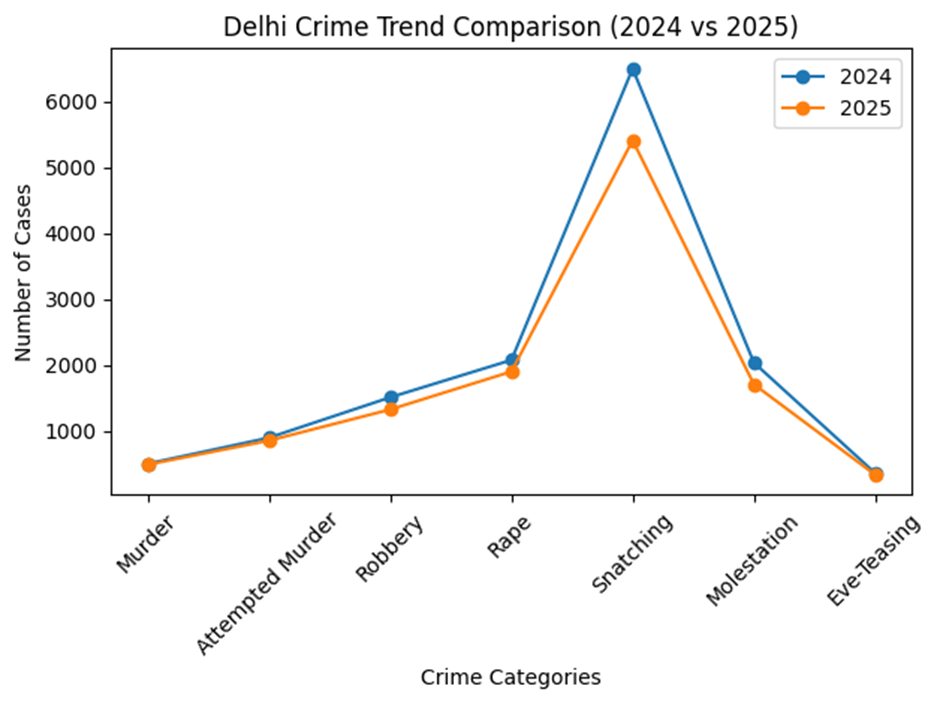
Why Rape Conviction Rates in India Demand Reform
Even as reported rape cases decline in cities like Delhi, the national conviction rate for rape remains stubbornly low. Data shows:
- National conviction rate for rape is around 22–28%, one of the lowest among serious crimes.
- This means most cases registered do not end in conviction, even after trials — a systemic challenge affecting justice for all involved.
This is exactly why we took action.
Our Strategic Legal Interventions: Turning Numbers Into Reform
RTI Inquiries That Exposed the Truth
Through multiple RTI (Right to Information) applications, we uncovered a startlingly low conviction rate of just 4.1% in rape cases — a number that shook public discourse and forced authorities to respond.
This wasn’t just data — it became a legal lever to demand accountability, transparency, and fair investigation.
Three Official Letters to All Delhi DCPs
We formally wrote to every Deputy Commissioner of Police (DCP) in Delhi three times over the year, highlighting:
- The need for standardised investigation protocols
- The urgent reform of policing strategies that disproportionately harm men facing false allegations
- Encouraging sensitivity training to handle complaints judiciously
These letters weren’t symbolic — they were part of a systematic pressure campaign to improve policing fairness.
Meetings With Police Leaders
Over the year, we met with 7–8 DCPs and senior police officers, briefing them on:
- The pattern of misuse in serious crime reporting
- The psychological and social impact of false cases on accused men
- Evidence-based recommendations for improving case assessment
This advocacy contributed to top-level administrative attention on extortion and snatching case backlogs.
Public Interest Litigation (PIL): Database of Repeat Offenders
We filed a PIL in the courts seeking the creation of a centralised database of repeat complainants, particularly those who file multiple rape cases.
Why this matters:
The absence of such a database allows repeat civil allegations and criminal complaints to remain untracked, enabling systemic misuse of powerful laws without institutional memory.
This PIL lays the groundwork for future judicial and administrative action to ensure justice is truly blind and balanced.
Real Results, Not Rhetoric
The crime report published recently — featuring headlines like *“Unresolved extortion cases a key challenge” — captures the impact of continued advocacy and pressure from responsible activists. You can see the downward trend in crime and improved resolution in court and police processes reflected right there in mainstream media.
This kind of coverage signals that data transparency, accountability, and legal advocacy actually move the needle.
Men’s Rights and Crime Justice Are Not Opposites — They Are Critical for Fair Law Enforcement
Some critics paint the discussion of false accusations and male rights as controversial. But the greater public interest lies in:
- Accurate reporting and fair investigations
- Balanced law enforcement that protects real victims
- Preventing misuse of legal provisions that destroy innocent lives
No justice system can be credible until it protects both the victim and the accused with equal Vigor.
Join the Movement for Holistic Justice
This isn’t about “supporting crime” — it’s about championing evidence-based reform in policing and legal processes, so justice is fair and effective for everyone.
If you believe:
- In transparent crime statistics
- In supporting systemic reform
- In legal fairness for all
Share this blog and help educate the nation about why balanced justice matters.
Conclusion: From Legal Advocacy to Real Social Impact
The latest crime trends in Delhi aren’t just numbers — they’re the result of coordinated legal activism, data transparency, and official responsiveness. They prove that:
- Strategic legal action can change institutional behaviour.
- Men’s rights activism grounded in facts builds credibility.
- Fair justice helps society as a whole.
Let’s keep pushing for a justice system that protects truth, not prejudice.
Key Takeaways
- Crime reform improves when data misuse is challenged, not when laws are blindly expanded.
- Low conviction rates expose investigative and prosecutorial failure, not automatic guilt.
- RTIs, institutional pressure, and PILs can force systemic correction without diluting genuine justice.
- Sensitising police leadership reduces mechanical arrests and restores procedural balance.
- Men’s rights advocacy grounded in law strengthens credibility and public safety outcomes.
FAQs
They reveal investigation quality, evidentiary gaps, and procedural misuse—critical for protecting both genuine victims and the falsely accused.
Yes. RTIs compel transparency, expose inefficiencies, and force administrative course correction when data contradicts narratives.
By demanding due process, reducing false escalation, and ensuring resources focus on real crimes rather than misuse-driven cases.
Institutional memory prevents serial misuse, protects the integrity of the justice system, and safeguards genuine complainants.
No. It strengthens them by ensuring credibility, focused enforcement, and higher trust in outcomes.
Non-payment of maintenance can trigger coercive court action, including warrants and civil jail, even when inability—not refusal—is the cause. When a husband genuinely lacks income, the law still moves faster to punish than to verify hardship. Indian law often punishes financial distress first and verifies hardship later, leaving genuine cases trapped in enforcement abuse.
New Delhi: In Indian matrimonial litigation, maintenance has slowly transformed from a survival safeguard into a coercive legal weapon. Interim maintenance orders are frequently passed without rigorous income verification, operating on assumptions that every husband has endless earning capacity, undisclosed assets, and permanent job security.
When a man genuinely struggles due to job loss, medical emergency, business failure, or crushing litigation costs, the system rarely pauses to evaluate reality. Instead, recovery machinery activates immediately — arrest threats, property attachment, bank freezes, and repetitive contempt proceedings. The human aspect disappears; only recovery statistics matter.
Maintenance Is Treated Like a Criminal Liability, Not a Civil Debt
Once maintenance is ordered, it functions almost like a penal liability rather than a civil obligation.
If payment is delayed or missed, the wife can initiate execution proceedings without any fresh adjudication. The husband is automatically branded a defaulter, not a financially distressed citizen.
Courts frequently place the entire burden on the husband to prove inability. Job loss, salary reduction, business shutdown, illness, or dependent responsibilities rarely soften enforcement.
In many cases, courts presume concealed income without concrete proof, making compliance practically impossible for genuinely distressed men.
Arrest and Jail Are Real Possibilities for Non-Payment
Under criminal maintenance enforcement provisions, non-payment can directly lead to arrest and imprisonment.
Warrants are routinely issued once arrears accumulate. Police can arrest the husband like a criminal accused. Jail is imposed not for committing an offence, but merely for failure to arrange funds.
A man can be sent to jail even when his appeal or modification application is pending.
This creates extreme coercion — pay or face incarceration — even if funds genuinely do not exist.
Imprisonment does not wipe out arrears. Dues continue to accumulate during custody, trapping men in perpetual financial liability.
Courts Rarely Audit the Wife’s Actual Income or Capability
One of the deepest structural biases lies in income verification.
Many wives conceal employment, consultancy income, rental earnings, business interests, or family wealth while declaring “no independent income.”
Maintenance often shifts from subsistence support into profit extraction.
Men must disclose every bank statement, tax return, asset record, and expenditure detail, while vague affidavits from the other side frequently pass without strict scrutiny.
This imbalance fuels inflated claims and systemic misuse.
Modification or Reduction Is Slow and Uncertain
Although law permits modification when circumstances change, practical relief is painfully slow.
Courts demand extensive documentation:
- Termination letters
- Medical certificates
- Business loss records
- Updated income affidavits
Even after filing, interim protection is rarely granted quickly. Arrears keep mounting during litigation.
By the time modification arrives, financial damage is often irreversible.
Children Become Leverage, Not Beneficiaries
In many cases, maintenance money does not translate into child welfare.
There is no accountability mechanism ensuring funds are spent on education, healthcare, or development.
Men pay blindly while emotional access to children remains restricted or manipulated.
The Harsh Ground Reality for Men
- Maintenance Is Fixed on Assumptions, Not Proof: Courts often calculate maintenance on lifestyle assumptions, social status, or past earnings — not on current cash flow. Many husbands are self-employed, contractual workers, startup founders, or facing layoffs. Income fluctuates, but court orders remain rigid.
A man earning nothing today is still expected to pay like yesterday.
- Jail Is Used as Pressure, Not as Justice: Under Section 125(3) CrPC and Domestic Violence Act enforcement provisions, imprisonment is frequently threatened if payment is delayed. The purpose was compliance, not punishment — but in practice, jail is used as a recovery tool.
A man sitting in jail cannot earn, cannot work, and cannot recover financially. Yet courts continue this cycle mechanically.
- Property and Bank Accounts Get Attached: When arrears accumulate, courts invoke attachment of movable and immovable property, salary garnishment, vehicle seizure, and bank freezing. Even jointly owned family property and aged parents’ assets sometimes get dragged into execution.
This destroys creditworthiness, business continuity, and family stability.
- No Automatic Relief for Genuine Financial Collapse: If a man loses his job or business, courts rarely suspend or reduce maintenance automatically. He must file modification applications, wait months or years for hearing, while arrears keep increasing.
Justice delayed here becomes economic death.
- False Criminal Cases Multiply Pressure: Many men already face 498A IPC, DV Act, child custody litigation, and multiple court jurisdictions simultaneously. Maintenance becomes another leverage point to force settlement, property surrender, or unjust alimony demands.
This is not family welfare — this is legalized extortion.
Psychological and Social Damage to Men
Maintenance litigation destroys:
- Mental health
- Professional reputation
- Career continuity
- Family relationships
- Social standing
Men suffer anxiety, depression, insomnia, and suicidal thoughts — yet there is no mental health safeguard in the legal framework for male litigants.
Silence is expected from men, resilience is assumed, and suffering is ignored.
The Unspoken Truth
A husband who genuinely cannot pay is treated worse than a criminal. There is no social safety net, no rehabilitation mechanism, no protection against abusive recovery. The law assumes default equals dishonesty, not hardship.
Men lose jobs. Businesses collapse. Health fails. Litigation drains savings. But the court ledger only sees unpaid numbers — not human survival.
This imbalance is pushing many men into depression, forced settlements, property sacrifice, and financial ruin.
Maintenance law was meant to protect dignity — not to become a recovery racket.
Final Words: A Wake-Up Call for Legal Reform
Maintenance law in its present form is driven more by presumption than proof. Courts often assume that the husband has unlimited earning capacity, hidden income, and automatic liability, without strict scrutiny of actual documents, real expenses, or the wife’s earning potential. This converts a welfare provision into a punitive recovery mechanism.
The genuine objective of preventing destitution gets diluted when economic vulnerability of men, job loss, medical liabilities, loans, and dependent parents are ignored, while financial dependency is conveniently projected to extract leverage in matrimonial litigation.
True justice cannot survive on gender bias. What we need is gender-neutral enforcement, mandatory disclosure and forensic verification of income, realistic assessment of lifestyle and liabilities on both sides, and proportional liability instead of arbitrary figures. No civil dispute should convert into coercive imprisonment merely because a man is temporarily unable to pay. Jail is not a recovery tool; it is an abuse of process when used to force settlements or silence legal resistance.
Until structural reform happens, men cannot afford complacency. Stay legally alert, maintain clean financial documentation, avoid cash transactions, challenge exaggerated claims through affidavits and cross-examination, and use procedural remedies aggressively.
Rights are not protected by silence; they are protected by preparation, precision, and persistence. This is not about avoiding responsibility, it is about restoring balance, fairness, and constitutional dignity in family law.
Key Legal Sections Governing Maintenance Enforcement
| Law / Section | Purpose | Purpose |
|---|---|---|
| Section 125 CrPC | Monthly maintenance for wife, child, parents | Non-payment can lead to recovery proceedings and imprisonment |
| Section 125(3) CrPC | Enforcement mechanism | Court can issue warrant and order imprisonment up to one month for each default |
| Section 127 CrPC | Modification / cancellation | Husband can seek reduction if financial circumstances change |
| Section 128 CrPC | Execution of maintenance order | Order enforceable anywhere in India |
| Protection of Women from Domestic Violence Act – Section 20 | Monetary relief | Separate maintenance order can run parallel to CrPC |
| DV Act – Section 23 | Interim orders | Quick interim maintenance often without deep inquiry |
| DV Act – Section 31 | Breach of protection order | Criminal consequences for violation |
| CPC Order XXI Rules 37–40 | Arrest and civil imprisonment | Used for recovery of money decrees |
| CPC Order XXI Rules 54, 64 | Property attachment and sale | Movable and immovable assets can be attached |
| Article 21 Constitution | Right to life and dignity | Jail for inability to pay raises constitutional concerns |
Important Case Laws Every Husband Must Know
| Case Name | Court | Key Principle |
| Shahada Khatoon v. Amjad Ali (1999) | Supreme Court | Imprisonment under Section 125(3) CrPC can only be up to one month for each breach and does not wipe out arrears |
| Kuldip Kaur v. Surinder Singh (1989) | Supreme Court | Court can use both attachment and imprisonment for recovery |
| Bhuwan Mohan Singh v. Meena (2014) | Supreme Court | Maintenance should be decided expeditiously but not mechanically |
| Rajnesh v. Neha (2020) | Supreme Court | Mandatory income disclosure affidavits; guidelines for fair maintenance fixation |
| Chaturbhuj v. Sita Bai (2008) | Supreme Court | Maintenance depends on ability to earn, not just actual income |
| Jaiminiben Hirenbhai Vyas v. Hirenbhai Rameshchandra Vyas (2015) | Supreme Court | Maintenance aims at preventing destitution, not enrichment |
| Shailja v. Khobbanna (2018) | Supreme Court | Capability to earn is relevant while fixing maintenance |
| Sudeep Chaudhary v. Radha Chaudhary (1999) | Supreme Court | Maintenance granted under one law can be adjusted against another |
KEY TAKEAWAYS
- Maintenance today is enforced like a criminal punishment, not social welfare, and inability to pay is treated as defiance, not distress.
- Jail for non-payment is a legal reality, even without proof of guilt or financial capacity, and imprisonment does not erase arrears.
- Property attachment is routinely used to break men financially, dragging family assets and lifetime savings into matrimonial disputes.
- Courts aggressively scrutinize a man’s income but rarely audit the wife’s earning capacity, creating a one-sided system.
- Maintenance operates as a pressure tool to force unfair settlements, not as a balanced mechanism for dignity or child welfare.
- Until laws become gender-neutral and evidence-based, maintenance litigation will continue to legally exhaust men rather than protect families.
FAQs
Yes. Courts can order arrest for non-payment, and inability to pay is often disbelieved unless proved with strong documents.
No. Arrears continue to accumulate even during imprisonment.
Yes. Bank accounts, salary, vehicles, and even property can be attached to recover dues.
In theory yes, in practice relief is slow and arrears keep piling up meanwhile.
Rarely. Men face detailed scrutiny, while many women escape full income disclosure.
Court: Bombay High Court
Bench: Hon’bles Bharati Dangre & Shyam C. Chandak, JJ.
Mrs. Amrik Singh Saini vs State of Maharashtra & Anr. WITH Amit Saini vs State of Maharashtra & Anr. On December 9, 2025
Neutral Citation: 2025:BHC-AS:55713-DB
Writ Petition Numbers: Writ Petition No. 4833 of 2024 & Writ Petition No. 724 of 2025
Judgement
The aforesaid Petitions mounted a challenge to the FIR No.533 of 2024 dated 29/09/2024, registered with Sinhgad Road police station, under Sections 85, 351(2), 115(2), 3(5) and 352 of Bharatiya Nyaya Sanhita, 2023 on the report of Respondent No.2 and seeking quashing and setting aside of the said FIR.
Heard Mr.Chatterjee, learned Counsel for the Petitioners, Ms.Kak learned A.P.P. for the Respondent-State and Ms. Mundada, learned Counsel for Respondent No.2.
The prosecution case is that Respondent No.2 got married with Rumit Saini on 20/06/2014. The Petitioner-Amrik Singh is father and Petitioner-Amit is brother of Rumit Saini. After the marriage, Respondent No.2 went to reside with her husband-Rumit Saini and the Petitioners. It is alleged that the Petitioners and her husband induced Respondent No. 2 to hand over her gold and silver ornaments speaking to her in a persuasive manner. Later, when Respondent No. 2 was preparing to travel to Hong Kong with her husband, she asked for her ornaments back.
Her husband, however, avoided returning them on the pretext that she could use them after they returned. It is further alleged that her father-in-law used to pollute her husband’s mind against her, causing the husband to abuse and physically assault her. When Respondent No. 2 came to know about her husband’s extramarital affair and questioned him, he abused and assaulted her.
She then approached the Petitioner-father-in-law with her grievance, but her father-in-law responded by alleging that she must be the one harassing her husband and abused her. Further, her father in law stated that no car and dowry was given in the marriage. The Petitioner in Writ Petition No.724 of 2025 who is brother-in-law of Respondent No.2 used to taunt Respondent No.2 by stating that she should tolerate the beating of her husband.
Thus, the husband of Respondent No.2, along with the Petitioners, subjected her to cruelty and misappropriated her ornaments. Therefore, she lodged the report, pursuant to which the police registered the impugned FIR. During the course of investigation, the police recorded the statements of witnesses and, upon completion of the investigation, submitted the charge-sheet.
The learned A.P.P. submitted that the FIR and witness statements disclose sufficiently show that the husband of Respondent No. 2 and the Petitioners subjected her to cruelty and misappropriated her jewellery. It is contended that whether the Petitioners have committed the alleged offences is a question of trial which cannot be adjudicated in the proceedings under Article 226 of the Constitution and under Section 482 of the Code of Criminal Procedure. Hence, there is no merit in the Petitions and deserves to be dismissed.
The learned Advocate Ms. Mundada appeared through V.C. and supported the submissions made by learned A.P.P.
We have considered these submissions and carefully examined the material on record. In so far as the Petitioners are concerned, only two allegations have been made against them. The first is that when Respondent No. 2 complained to them about her husband’s assault upon her questioning his alleged extramarital affair, the Petitioner–father-in-law responded by alleging that she must be harassing her husband and expressed displeasure about not receiving sufficient dowry or a car at the time of marriage.
As regards the Petitioner–brother-in-law, it is alleged that he taunted her to tolerate the beating. When these allegations are considered apposite Section 498A of the I.P.C., they do not constitute ‘cruelty’ as defined in the explanation appended to the provision.
In Kahkashan Kausar @ Sonam vs. The State of Bihar1, the Hon’ble Supreme Court observed that the Apex Court has at numerous instances expressed concern over the misuse of Section 498A of IPC and the increased tendency of implicating relatives of the husband in matrimonial disputes, without analyzing the long term ramifications of a trial on the complainant as well as the accused. False implication by way of general omnibus allegations made in the course of matrimonial dispute, if left unchecked would result in misuse of the process of law. Therefore, the Apex Court by way of its judgments has warned the courts from proceeding against the relatives and in-laws of the husband when no prima facie case is made out against them.
The Supreme Court in K. Subba Rao and Others vs. The State of Telangana and Ors.2 held that “the Courts should be careful in proceeding against the distant relatives in crimes pertaining to matrimonial disputes and dowry deaths. The relatives of the husband should not be roped in on the basis of omnibus allegations unless specific instances of their involvement in the crime are made out.’’
An unfounded criminal charges and long drawn criminal prosecution always have serious consequences. A person implicated in such litigation not only suffers mental trauma and humiliation but also suffers a financial loss. It is common experience that reckless imputations can result in serious repercussion on one’s career progression and future pursuits. Additionally, it stigmatizes reputation, bring disrepute and lower the image of a person amongst friends, family and colleagues. As such, in such cases, it is necessary to invoke the jurisdiction of the High Court under Section 528 of the Bharatiya Nagarik Suraksha Sanhita 2023 and Article 226 of the Constitution to protect the character and reputation of the relatives who have been unnecessarily implicated in the case of Section 498A I.P.C.
Considering the case in hand in the light of the observations in the reported cases referred above, it appears that, Respondent No.2 lodged the impugned FIR mainly on account of her personal dispute with her husband. However, the Petitioners being the relatives of the husband, she implicated them in the FIR with an ulterior motive. Therefore, continuation of the FIR and the consequent charge-sheet against the Petitioners would amount to an abuse of the process of law.
In view of the above discussion, we are inclined to allow the Petitions and pass the following order :-
Order
The proceedings arising out of the subject FIR No.533 of 2024 dated 29/09/2024 lodged at the instance of Sinhgad Road police station and the consequent chargesheet are quashed and set aside qua the Petitioners.
Writ Petitions are disposed of in the aforesaid terms.
DISCLAIMER: The above judgement is posted for informational purpose ONLY. Printout/ Copy from this website are not admissible citation in the Court of Law. For a court admissible copy contact your advocate.
You may contact me for consultation or advice by visiting Contact Us
The Supreme Court of India has openly acknowledged rampant misuse of the POCSO Act against consensual adolescent relationships. Calling for a Romeo–Juliet clause, the Court signalled urgent reform to stop criminalising young boys for normal teenage relationships.
NEW DELHI: The Supreme Court in State of Uttar Pradesh v Anurudh & Anr urged the Centre to consider a “Romeo Juliet clause” in POCSO to protect genuine adolescent relationships and condemned misuse of the law to settle scores.
What the Supreme Court actually held (and why it matters)
In a reportable judgment dated 9 January 2026, a Bench of Justice Sanjay Karol and Justice N. Kotiswar Singh decided Criminal Appeal @ SLP (Crl) 10656 of 2025, reported as 2026 INSC 47.
The Court did two big things in one stroke:
- Set aside the Allahabad High Court’s sweeping directions that effectively tried to create a mandatory “medical age determination protocol” in all POCSO cases at the bail stage.
- Formally urged the Union Government to consider steps to curb misuse of such laws—explicitly including a “Romeo–Juliet clause” to exempt “genuine adolescent relationships” and a mechanism to prosecute those who weaponise these laws to settle scores.
This isn’t “dilution” of child protection. This is the Supreme Court admitting a hard truth: a zero-context strict liability framework is producing perverse outcomes, where consensual teen relationships are being pushed into the same bucket as predatory sexual offences.
The case background in simple words
The State of Uttar Pradesh challenged the Allahabad High Court’s order dated 29 May 2024 in CRMBA No. 4880 of 2024. The FIR (No. 622/2022, PS Kotwali, Orai, District Jalaun) involved allegations under IPC Sections 363/366 and POCSO Sections 7/8.
While granting bail, the High Court went further and issued broad directions—essentially telling police and courts that medical age determination should be ensured and produced at bail stage across POCSO investigations, and that medical age could prevail over other age documents in bail proceedings.
The Supreme Court made it crystal clear: this kind of “policy-making” cannot be done inside Section 439 bail jurisdiction.
Why the Allahabad HC approach was struck down: “Mini-trials” and jurisdictional overreach
The Supreme Court’s core legal finding is straightforward:
- Section 439 CrPC bail jurisdiction is not a legislative workshop.
- A bail court cannot run “mini-trials”, cannot issue mandatory investigative protocols contradicting the statutory scheme, and cannot exceed what the law permits under the bail framework.
This matters for men (and especially young boys) because bail-stage overreach has real-world consequences:
- Arrest first, label forever.
- Bail hearings becoming quasi-trials, where “age disputes” and “document credibility” get prematurely litigated without full evidence.
The Supreme Court restored balance: trial is the forum for conclusive age determination and evidentiary appreciation, not the bail court.
The Court’s legal roadmap on “age determination” (and why medical tests cannot be automatic)
The judgment walks through the relevant statutory framework:
- Section 27 POCSO (medical examination of a child to be in accordance with Section 164A CrPC)
- Section 94 JJ Act, 2015 (hierarchy of age proof; medical/ossification only in absence of primary documents)
- Section 29 POCSO (presumption)
And then the crucial doctrinal anchor: Jarnail Singh v State of Haryana (2013) 7 SCC 263, where the Supreme Court held that the age determination method (then Rule 12 JJ Rules) can guide age determination even for a child victim.
But here is what activists, lawyers, and parents must understand: The Supreme Court did not say medical evidence is useless. It said the High Court cannot mandate medical age determination “as a matter of course” at bail stage, and that mechanical reliance on radiology is not conclusive.
That protects due process—because medical age estimation has margins of error, and “mandatory medical tests in every case” can become another tool of coercion and fishing inquiries.
The most important paragraph for India: POCSO being used to “settle scores”
Now to the part that should shake the conscience of the system.
The Supreme Court acknowledges that misuse/misapplication of POCSO exists, including misrepresenting the age of the victim to invoke stringent provisions, and using the law as a weapon to target relationships.
It also notes the uncomfortable class reality: on one side are real child victims denied justice due to fear/poverty/stigma; on the other side are people with privilege and resources who can manipulate the law to their advantage.
This is precisely why men’s rights groups have been demanding reform: Because in the “teen relationship” category, the accused is disproportionately a boy, and the complaint is often driven by family opposition, breakup retaliation, or social pressure—not child protection.
What is a “Romeo–Juliet clause” and why India needs it inside POCSO
A “Romeo–Juliet clause” is a close-in-age exception to statutory rape laws, designed to prevent harsh criminalisation of consensual relationships where both parties are adolescents or near in age.
The Supreme Court explicitly asked the Law Secretary (GoI) to consider steps including introduction of such a clause to protect “genuine adolescent relationships.”
This is not theoretical. Indian academic work has also discussed the need and design of Romeo–Juliet style safeguards in India.
My position is clear: If India truly wants to protect children, it must stop treating adolescent sexuality as a crime by default. Protection must target exploitation and coercion—not mutual teenage relationships.
What the Supreme Court ordered (operational outcome)
The Court’s operative directions include:
- Appeal allowed; HC directions set aside.
- The effect of setting aside extends to related Allahabad HC decisions referred to (including Aman and Monish) insofar as connected directions were concerned.
- Bail already granted was left undisturbed (subject to judicial review if any), and the Court clarified prospective effect so past bails obtained following the impugned approach are not negatively impacted.
- Copy of judgment to be sent for follow-up action within the Allahabad HC system, and circulated to the Law Secretary for reform consideration.
This “prospective” protection is important—because it prevents chaos and retaliatory cancellations in already-decided matters.
What went wrong earlier: the human cost men have been paying
Let’s speak plainly.
Before this judgment, the ground reality in many teen-relationship disputes has been:
- POCSO slapped as a relationship-ending weapon after family disapproval.
- Immediate arrest and social death, even before facts are tested.
- Bail hearings turning into age-document battles, with inconsistent approaches.
- “Consent” becoming irrelevant even when the relationship is clearly mutual, because POCSO is structured around age, not intent.
When the accused is a teenage boy, the system often treats him as disposable collateral. The Supreme Court’s call for a Romeo–Juliet clause is, therefore, not just legal reform—it is damage control for an entire generation.
What should Parliament do now (a reform blueprint that can actually work)
If the Government is serious, the Romeo–Juliet reform must be:
- Close-in-age window (example: 2–3 years) with safeguards.
- Clear consent indicators and strict action where coercion/force/grooming exists.
- No benefit if the accused is in a position of trust/authority (teacher/guardian/employer).
- Fast preliminary scrutiny to filter malicious complaints early.
- Penalty mechanism for malicious invocation, as the Supreme Court itself suggested.
Without penalties for abuse, any law becomes a marketplace weapon.
Conclusion: This is a pro-child, pro-justice decision—and men should pay attention
The Supreme Court has done something rare: it protected the purpose of POCSO while also acknowledging its misuse and calling for a legislative safety valve.
A Romeo–Juliet clause is not “anti-women” or “anti-child.” It is anti-misuse.
It draws a line between:
- Predation, and
- Peer adolescent relationships.
India cannot keep pretending these are the same. This judgment is the strongest mainstream judicial push yet towards rational reform.
If you want real child safety, support reforms that target exploiters—and stop sacrificing young men to satisfy moral policing and revenge litigation.
Click Here To Read Detailed Supreme Court Ruling On This Case
Explanatory Table: Laws & Sections Involved In The Case
| Law / Provision | What It Deals With | How It Was Misused / Clarified by SC |
| POCSO Act, 2012 | Protection of children from sexual offences | Used mechanically to criminalise consensual teen relationships |
| Section 7 & 8, POCSO | Sexual assault & punishment | Invoked even in peer, consensual adolescent cases |
| Section 29, POCSO | Presumption of guilt | Places heavy burden on accused boys even before trial |
| Section 27, POCSO | Medical examination of child | SC clarified it cannot be forced as a routine at bail stage |
| Section 164A, CrPC | Medical examination procedure | Must follow statutory safeguards, not blanket directions |
| Section 439, CrPC | Bail jurisdiction of High Courts | Cannot be used to issue policy-level or legislative directions |
| Section 94, Juvenile Justice Act, 2015 | Age determination hierarchy | Medical tests only when documents are unavailable |
| IPC 363 / 366 | Kidnapping / abduction | Frequently added to pressure accused in relationship cases |
Key Takeaways
- The Supreme Court has formally acknowledged that POCSO is being misused to criminalise consensual adolescent relationships, largely harming young men.
- Courts cannot turn bail hearings into mini-trials or issue blanket directions like mandatory medical age tests under POCSO.
- Treating teenage boys as sexual offenders for peer relationships is legal overreach, not child protection.
- The call for a Romeo–Juliet clause is an admission that strict liability without context has destroyed young lives.
- Real child safety requires punishing misuse of POCSO, not protecting those who weaponise it to settle personal scores.
FAQs
The Court acknowledged that POCSO is often misused to target consensual adolescent relationships.
A legal safeguard protecting close-in-age, consensual teenage relationships from harsh criminal prosecution.
No. It reaffirmed child protection while calling out misuse and demanding balance.
No. The Supreme Court held such directions exceed bail jurisdiction.
Because teenage boys are disproportionately arrested, jailed, and stigmatised under POCSO for consensual relationships.
Disclaimer
This content is for general legal awareness and public-interest commentary only. It does not constitute legal advice, does not intend to prejudice any individual case, and relies on publicly available judicial records and news reports. Readers should consult a qualified legal professional for case-specific advice.
From a celebrity wedding to IPC 498A allegations, a Supreme Court-linked divorce settlement, and now a Delhi High Court inheritance battle after death, the Karisma Kapoor – Sunjay Kapur case shows a harsh truth. In India, divorce rarely means closure for men. Legal battles often survive marriage, settlement, and even death.
NEW DELHI: The story of Karisma Kapoor and Sunjay Kapur is no longer just a celebrity divorce story.
It has evolved into a multi-decade legal saga involving marriage, criminal complaints, settlement, death, inheritance, and a high-stakes property dispute before the Delhi High Court.
For Indian men, this case is a mirror of matrimonial reality:
- divorce does not end litigation
- settlement does not mean closure
- death does not stop disputes
This article documents what actually happened, step by step.
Marriage: A Bollywood–Business Alliance (2003)
Karisma Kapoor married Delhi-based industrialist Sunjay Kapur on 29 September 2003.
The marriage united a leading Bollywood family with one of India’s prominent business houses.
- Two children were born from the marriage:
- Daughter: Samaira
- Son: Kiaan
For several years, the marriage appeared stable in public.
Breakdown of Marriage & Separation (2014)
By 2014, serious marital discord surfaced and divorce proceedings were initiated.
What followed was not an amicable separation, but intense legal confrontation involving:
- Allegations of cruelty
- Financial disputes
- Custody and visitation issues
This phase marked the entry of criminal and civil law into the relationship.
Criminal Complaint: IPC 498A & Dowry Allegations (2016)
In February 2016, Karisma Kapoor filed a criminal complaint alleging:
- Cruelty
- Dowry harassment
Sections reportedly invoked included IPC 498A.
- Important legal clarity:
- Filing of a complaint is a fact
- Guilt or innocence is never presumed
- Allegations remain allegations unless proven by trial or final court finding
This distinction is often ignored in public discourse — but matters greatly in law.
Supreme Court–Backed Settlement & Divorce Decree (2016)
In June 2016, the marriage was legally dissolved.
- Key points widely reported as part of the settlement:
- Divorce by mutual consent
- Custody of both children with the mother
- Financial arrangements for children’s future, including reported high-value bonds
- Visitation rights for the father
Several reports state that criminal proceedings were quashed as part of the settlement, following consent terms.
This is crucial: The dispute was legally closed at that stage.
At least on paper.
Death That Changed Everything: Sunjay Kapur (2025)
On 12 June 2025, Sunjay Kapur collapsed during a polo match in the UK and passed away.
- Age: 53
- Location: Windsor, United Kingdom
- Funeral rites were later performed in Delhi
Different reports mentioned different medical narratives; therefore, it is legally safe to say: Sunjay Kapur died suddenly during a sporting event.
His death reopened legal questions that divorce had supposedly settled.
The Real Turning Point: Estate, Will & Inheritance Dispute
After Sunjay Kapur’s death, disputes emerged regarding:
- His will
- Control over assets
- Rights of his legal heirs
This dispute reached the Delhi High Court in 2025.
Delhi High Court Proceedings: What Is the Case About?
The litigation before the Delhi High Court is not a divorce case.
It is an estate and inheritance dispute.
- What has been reported:
- The children of Sunjay Kapur, represented through their legal guardian, approached the court
- Allegations were raised that:
- A will was forged or fabricated
- Legitimate heirs were being excluded
- The dispute involves Indian and foreign assets
- The court examined:
- Asset disclosures
- Jurisdiction over foreign properties
- Confidentiality of estate details
- Legal precision:
- The court has not declared any will forged
- These are issues under adjudication
- Final determination is still awaited
Why This Case Matters for Indian Men
This case exposes hard truths about Indian matrimonial and inheritance law:
- Divorce is not the end: Even after settlement, litigation can restart years later.
- Financial exposure never truly closes: Assets, properties, and estates remain vulnerable.
- Children become legal instruments: Inheritance disputes often reopen past marital battles.
- Men’s liability survives marriage — and sometimes even death: Few cases illustrate this more starkly.
From Marriage to Courtroom: A Clear Timeline
- 2003 – Marriage
- 2014 – Separation
- 2016 – IPC 498A complaint + Supreme Court-linked settlement + Divorce
- 2025 (June) – Death of Sunjay Kapur
- 2025 onward – Delhi High Court estate and property dispute
This is not chaos.
This is a pattern.
Final Words
The Karisma Kapoor–Sunjay Kapur case is not gossip.
It is a legal warning.
In India, marriage can end,
divorce can be granted,
settlements can be signed,
but a man’s legal vulnerability rarely ends.
Until matrimonial and inheritance laws become balanced and finality-driven,
Indian men — celebrity or common — will continue fighting battles long after relationships die.
Laws & Sections Involved — Explanation And Application
| Law / Section | What the Law Provides | How It Appears in This Case |
| IPC Section 498A | Criminal offence relating to cruelty by husband or his relatives against a married woman | A criminal complaint alleging cruelty/dowry harassment was reported to have been filed during matrimonial disputes prior to divorce. Filing is reported; outcome was linked to settlement |
| Dowry Prohibition Act, 1961 | Prohibits giving or taking of dowry and related harassment | Referenced in media reports as part of matrimonial allegations during separation phase |
| Code of Criminal Procedure, 1973 – Section 482 | Inherent powers of High Court to quash criminal proceedings to prevent abuse of process | Reportedly invoked for quashing of matrimonial FIRs as part of settlement/consent terms |
| Hindu Marriage Act, 1955 – Section 13B | Divorce by mutual consent | Divorce between parties was granted by mutual consent in 2016 |
| Guardians and Wards Act, 1890 | Governs custody and guardianship of minors | Custody of children granted to mother; father given visitation as per settlement |
| Indian Succession Act, 1925 | Governs wills, testamentary succession, probate | Central statute governing the current dispute relating to alleged will and inheritance |
| Code of Civil Procedure, 1908 | Governs civil suits, injunctions, jurisdiction | Applied in estate/property litigation and interim relief proceedings |
| Constitution of India – Article 226 | High Court’s writ jurisdiction | Invoked procedurally in Delhi High Court estate-related proceedings |
| Private International Law Principles | Jurisdiction over foreign assets and estates | Raised in arguments relating to overseas properties/assets of deceased |
| Sealed Cover / Confidentiality Jurisprudence | Court-controlled disclosure of sensitive material | Delhi High Court considered confidentiality of estate disclosures |
Death & Estate Context
| Particular | Details |
| Name of Deceased | Sunjay Kapur |
| Date of Death | 12 June 2025 |
| Place of Death | United Kingdom |
| Legal Significance | Triggered inheritance and estate disputes |
| Applicable Law | Indian Succession Act, 1925; Private International Law |
| Heirs Involved | Children from marriage with Karisma Kapoor and other legal heirs |
| Estate Nature | Indian and foreign assets |
Consolidated Timeline
| Year | Event |
| 2003 | Marriage |
| 2014 | Separation and initiation of disputes |
| 2016 | Criminal complaint; mutual consent divorce; settlement |
| 2025 (June) | Death of Sunjay Kapur |
| 2025 onwards | Delhi High Court estate and inheritance litigation |
FAQs
Yes, the divorce was granted by mutual consent after settlement, but later events show that settlement does not always bring legal finality for men.
A criminal complaint alleging cruelty/dowry harassment was reported during the matrimonial dispute; filing is a fact, guilt is a matter of law and evidence.
His death in 2025 triggered inheritance and estate issues, leading to fresh litigation regarding will and assets.
It is not a divorce case; it concerns inheritance, validity of a will, and control over Indian and foreign assets.
Because it shows that even after divorce, settlement, and death, men’s families can remain trapped in long legal battles.
Disclaimer
This article is based on publicly reported court proceedings and media reports. It is intended for informational and educational purposes only. All references to allegations are stated as allegations, not findings of guilt. The author does not claim personal knowledge of facts beyond what is available in the public domain, and the content should not be construed as legal advice or a statement on the merits of any pending or concluded case.
Court: Delhi High Court
Bench: Hon’ble Justice Amit Mahajan, J
Mrs. D J vs Mr. S J On December 23, 2025
Neutral Citation: 2025:DHC:11985
Case Number: CRL.REV.P. 768/2023
Judgement
The present revision petitions have been filed assailing the Order dated 18.05.2023 (hereinafter ‘impugned order’), passed by the learned Family Court in MT No. 330/2022 vide which Mrs. Devika Jain/Wife was awarded interim maintenance in the sum of Rs. 50,000/- per month, directed to be paid by Mr. Sidharth Jain/Husband.
Further, the Husband/Mr. Sidharth has also challenged the Order dated 21.03.2024, vide which the application filed by the Husband/Mr. Sidharth seeking re-call of the impugned order was dismissed by the learned Family Court.
The Petition bearing CRL.REV.P. 768/2023 has been filed by the Wife/Mrs. Devika Jain, seeking enhancement of the maintenance amount on the following grounds: –
- Husband/ Mr. Sidharth is working as Software Engineer, SDE-II, on the payroll of Amazon. Com Services LLC which has it’s registered office at 202 Estlake Ave N Seattle WA 98109. He was earning $150300 per annum as on October 2021 and his current salary is $232000 i.e. Rs. 1,76,32,000/- p.a. which means that he is earning about Rs. 14,61,000/- per month.
- She has no source of income and is not gainfully employed, since she left her job around December 2021. Further, the husband does not have any other dependants apart from his wife.
Per contra, the Petition bearing CRL.REV.P.(MAT.) 169/2025 has been filed by the Husband/Mr. Sidharth Jain, seeking reduction of the amount of maintenance granted on the following grounds: –
- Wife/Mrs. Devika Jain is a highly qualified lady and has completed her BE (IT) from DTU Delhi, and has the capacity to earn handsomely. She was employed with Bank of America and was drawing income of Rs. 9,00,000/-, but has deliberately left her job and has chosen to remain unemployed.
Submissions heard and the material placed on record perused.
As per record, Crl. M.A.11305/2025, seeking condonation of delay of 679 days in filing CRL.REV.P.(MAT.) 169/2025, had been filed by the Husband/Mr. Sidharth Jain. The delay in filling is attributed to the erstwhile counsel and the fact that the Petitioner is residing in USA. Though this Court had noted it’s dissatisfaction with the above reasons in its Order dated 18.09.2025, however, in view of the nature of the proceedings, deems it appropriate to advert to the merits of the present case.
At the outset, it is apposite to reiterate that the object of granting maintenance is to prevent vagrancy by compelling those who can provide support to those who are unable to support themselves and who have a moral claim to support.
Further, in Bhagwan Dutt v. Kamla Devi : (1975) 2 SCC 386, it has been observed that the wife should be in a position to maintain a standard of living which is neither luxurious nor penurious but what is consistent with status of a family. The expression “unable to maintain herself” does not mean that the wife must be absolutely destitute before seeking maintenance.
It is also trite law that a husband cannot shirk his sacrosanct duty to financially support his wife [Ref: Shamima Farooqui v. Shahid Khan : (2015) 5 SCC 705].
In the present case, it has been recorded in the impugned order that the Husband/Mr. Sidharth has failed to file his Written Statement and had not even furnished his detailed Income Affidavit, in view of which his defence was struck off.
The learned Family Court, therefore, proceeded to make a prima facie assessment of the interim maintenance, on the basis of the material placed on record by the Wife and the admitted position regarding the employment of the parties.
It stands admitted that the Husband is gainfully employed with Amazon. Com Services LLC as Software Engineer, SDE-II and he has also not denied that he is residing in the United States of America. It also stands admitted that the Wife is unemployed and the Wife had specifically asserted that her Husband has been earning approximately Rs. 1,76,00,000/- per annum.
It stands admitted that the Husband is gainfully employed with Amazon. Com Services LLC as Software Engineer, SDE-II and he has also not denied that he is residing in the United States of America. It also stands admitted that the Wife is unemployed and the Wife had specifically asserted that her Husband has been earning approximately Rs. 1,76,00,000/- per annum: –
| S. No. | Particulars | Amount in USD | Conversion Rate as on 18.05.2023 | Amount in INR per month |
|---|---|---|---|---|
| 1. | Gross Pay as per statement dated 30.07.2021 | $12,525 (p.m.) | 82.4783 | Rs. 10,33,040/- |
| 2. | Base Pay as per Certificate dated 06.10.2021 | $1,50,300 (p.a.) | 82.4783 | Rs. 10,33,040/- |
| 3. | IRS Tax Return- Total Income (year ending 31.12.2021) | $2,94,191 | 82.4783 | Rs. 20,22,031/- |
Additionally, the Wife has also placed on record the Affidavit of Income, Assets and Liabilities, dated 17.05.2024, filed the Husband/Mr. Sidharth in proceedings under the Protection of Women against Domestic Violence Act, 2005, which discloses his monthly income as $10,000 after taxes. 15. Hence, considering the totality of the circumstances and the admitted positions, it emerges that the interim maintenance of Rs. 50,000/- per month awarded by the learned Family Court, does not appear to be commensurate with the Husband’s earning capacity or the status of the parties.
At this juncture, this Court finds it apposite to mention that the determination of interim maintenance is not an exercise capable of mathematical precision. More often than not, particularly in cases where one of the spouses is employed abroad and has failed to place complete and candid disclosure of income before the Court, the assessment necessarily involves a degree of estimation and informed guesswork. This Court is not expected to embark upon a roving or final inquiry at the interim stage, and is rather is required to arrive at a reasonable figure on the basis of available material, surrounding circumstances, lifestyle indicators and the admitted earning capacity of the earning spouse.
This Court in K.N. v. R.G. : 2019 SCC OnLine Del 7704 when deciding the question of grant of interim maintenance to the wife whose husband was employed at a very senior position in a company at Singapore and was earning in foreign currency which after conversion were about ₹13 lakhs per month, observed as under:
appellant that merely because the respondent is earning in ‘dollars’ she is entitled to the maintenance claimed by converting his salary in dollars into Indian rupees. We agree with the respondent that his expenditure being in dollars, the salary being in dollars is a fact which cannot be overemphasized. We are supported in our view by a judgment of this court in Bindu Chaudhary v. Deepak Suga reported at (2016) 234 DLT 108 (DB), where this court has held that if a person is employed in Dubai and earns in currency of that country, then he also spends in that currency. So, it is not open to the wife to convert his income in Indian currency and seek enhancement. The relevant para of the said judgment is extracted herein:
“9. If a person is working in Dubai, he earns in the currency of that country and spends also in that currency. So it is not open to the wife to just convert his income in Indian currency and then seek enhancement. The Court has to consider the cost of living as per the living standards in country where he is employed.”
The respondent is thus justified in his submission that the courts will have to consider the cost of living as per the living standard in the country where he is employed and mere earning ‘dollars’ cannot be the sole criteria to award exorbitant maintenance in favour of other spouse. Thus, this contention of the appellant does not appeal to this court and is hereby rejected. ”
In the present case, it is undisputed that the husband is earning in foreign currency and is residing in the United States of America. Consequently, he is also required to incur expenses in foreign currency, and the standard as well as the cost of living in the USA cannot be equated with that prevailing in Delhi. While this Court is conscious of the sacrosanct duty of a husband to maintain his wife, such obligation cannot be construed to mean that the entirety of the husband’s income is liable to be equalised or proportionately mirrored in the amount of maintenance payable to the wife. Mere earning in foreign currency does not, by itself, entitle the wife to claim maintenance by mechanically converting the husband’s foreign income into Indian currency and applying the formulae evolved by Indian courts without due regard to the attendant circumstances.
Accordingly, having regard to the totality of the facts and circumstances of the case, and considering that the wife is admittedly not gainfully employed, this Court deems it appropriate to enhance the interim maintenance from Rs. 50,000/- per month to Rs. 1,00,000/- per month, based on a broad, reasonable, and rounded-off assessment. The enhanced interim maintenance shall be payable from the date of filing of the application for interim maintenance, subject to adjustment of any amount already paid.
Insofar as the contention regarding the Wife’s educational qualifications and previous employment is concerned, it is well settled that mere capacity to earn cannot be equated with actual earnings. When it is admitted that the wife is not gainfully employed, the question whether she deliberately remained unemployed to extract maintenance, can only be ascertained after evidence is led by both the parties.
At the stage of interim maintenance, the Court is required to consider the present financial position of the parties and not indulge in conjectures as to possible income prospects of the wife. Even otherwise, the burden of proving financial independence lies with the husband, and such contentions are a subject matter of trial.
It is not disputed that the impugned order is only an order of interim maintenance. The other defences raised by the parties along with the allegations and counter allegations, would be the subject matter of trial, and would have to be decided after the parties have led their evidence.
The learned Trial Court is directed to pass the final order uninfluenced by the observations made in this order.
The enhanced amount of interim maintenance of Rs. 1,00,000/- per month, shall be payable by the Husband/Mr. Sidharth from the date of filing of the application for interim maintenance, subject to adjustment of amount already paid.
The arrears, if any, shall be cleared by the Husband/Mr. Sidharth within 12 weeks from date.
The amount deposited by the Husband/Mr. Sidharth Jain before this Court as arrears of maintenance, be released in favour of the Wife/Mrs. Devika Jain.
In view of the above, the Petition filed by the Wife/ Mrs. Devika Jain bearing CRL.REV.P. 768/2023 is allowed and the Petition filed by the Husband/Mr. Sidharth Jain bearing CRL.REV.P.(MAT.) 169/2025 is dismissed.
The pending application(s), if any also stand disposed of.
A copy of this order be placed in both the matters.
DISCLAIMER: The above judgement is posted for informational purpose ONLY. Printout/ Copy from this website are not admissible citation in the Court of Law. For a court admissible copy contact your advocate.
You may contact me for consultation or advice by visiting Contact Us
Court: Bombay High Court
Bench: Hon’ble Manjusha Deshpande, J
MMM vs AAA
Case Number: Writ Petition No. 3828 of 2024
Neutral Citation: 2025:BHC-AS:54818
Law Point:
Judgement
Rule. Rule made returnable forthwith and heard finally with the consent of the parties.
The Petitioner challenges the judgment and order dated 22.08.2023, passed by the Judge, Family Court No.7, Bandra, Mumbai, below Exhibit 10A, in Petition No. A 1899 of 2020, a prayer is made to set aside the said order and enhance the interim maintenance to Rs. 3,50,000/- p.m. or such other and higher amount as this Court deems fit, just and proper, from the date of the application filed by the Petitioner
The undisputed facts of the case are that, the petitioner and the Respondent were married on 11.04.2014. There are two minor children (1) Sana Amit Khajanchi born on 31.12.2008 and (2) Yana Amit Khajanchi born on 27.01.2014. The Petitioner has completed her education up to 12th Class and is a home-maker, while the Respondent is a graduate in Commerce. He works along with his father, and is managing the family business, namely, ‘Khajanchi Exports’.
The Respondent filed Petition for Divorce on 10.09.2020, in the Family Court at Bandra, which is numbered as MJ Petition No. A-1899 of 2020. The Petitioner also filed maintenance Petition No. C-2 of 2021 on 04.12.2020 for maintenance under Hindu Adoption and Maintenance Act, 1956. During the pendency of maintenance Petition filed by the Petitioner, she had also filed an interim maintenance application under Section 24 of the Hindu Marriage Act, 1955 (“HMA”) in the Divorce Petition filed by the Respondent.
During the pendency of the interim maintenance application, interim Consent Terms were entered into between the parties on 12.02.2021, thereby agreeing for an amount of Rs. 20,000/- p.m. to be paid by the Respondent, towards daily expenses of the Petitioner and her two daughters.
The arrangement as per the Consent Terms continued till the decision in the Interim Application for maintenance which was decided vide order dated 22.08.2023, partly allowing the application, by directing the Respondent-Husband to pay interim maintenance of Rs. 50,000/- p.m., each to the Respondent-Wife and their two daughters, from the date of passing of the order. It is this order passed by the Judge, Family Court, Mumbai, passed below Exhibit 10-A, dated 22.08.2023, impugned in this Writ Petition.
The learned Advocate Mr. Samarth Moray, appearing for the Petitioner submits that, it needs to be appreciated that, the Petitioner is educated only up to 12th Standard, and she is not trained to do any work. She is a home-maker, with no special skills necessary for being employed. She does not have any independent source of income to maintain herself and their two daughters.
Therefore, she has claimed interim maintenance of Rs. 3,50,000/for maintenance of herself and her two daughters from the Respondent. On the contrary, the Respondent is coming from a wealthy background, enjoying sound financial position. In the affidavit of assets and liabilities filed by the Respondent, the monthly income disclosed by the Respondent is Rs. 3,98,870/p.m. In his affidavit of Assets and Liabilities he has disclosed that, he owns a two BHK Flat at Lodha Amara and has inherited residential property at Bhagya Apartments, Prabhadevi, Dadar, Mumbai where he is presently residing. He has 1/3 share in the family business ‘M/s. Khajanchi Exports’, which deals in export of food items where he is a partner.
On this background, the Petitioner had claimed Rs. 3,50,000/- towards maintenance of herself and her two daughters which is proportionate to the income of the Respondent, and commensurates with the life-style enjoyed by the Petitioner and her two daughters.
It is submitted that, in the Affidavit of Assets and Liabilities, the Respondent has suppressed the complete details of his other sources of income from the properties, viz., rental income from Saba Palace, Khar West, Mumbai, and Bhagya Apartments, Dadar, Mumbai, where he is residing since December 2020.
It is further submitted that, the ‘Family Trust’, of which the Petitioner was also one of the beneficiary, has been dissolved on 30.11.2018. The mother of the Respondent and his two sister have executed necessary documents in his favour, hence, he is the sole beneficiary of that Trust, which is not disclosed by him. The lifestyle enjoyed by the Respondent can be gathered from the standard of car driven by him, which is a BMW Gran Turismo (GT) series, the price of which ranges between 40 to 50 lakhs.
Although it is claimed that, the Petitioner was filing ITRs and her share is of 35 lakhs, the Petitioner had no knowledge about her share holding and even the ITRs that were filed in her name by the Respondent. She has merely put her signatures on the necessary documents as and when asked by the Respondent.
The Petitioner, being a home-maker, has no knowledge about the finances of the Respondent and the transactions that have been made in her name. Considering the income of the Respondent, and the life-style which the Petitioner and her daughters have enjoyed till their separation, the petitioner has claimed the maintenance of Rs. 3,50,000/-. On this background, the order passed by the Judge, Family Court Room No.7, Bandra, Mumbai, dated 22.08.2023, is totally insufficient and falls much short of the needs of the Petitioner.
The learned Advocate, submits that, though the affidavit of Assets and Liabilities filed by the Respondent and his financial status reflects the affluent background of the Respondent, the Court has committed error by granting maintenance to a much lower side than her entitlement.
This is presumably on account of the income disclosed in her name from the ITRs for the years 2017 to 2021. Relying on the ITRs and the income disclosed in the respective years, the Court has come to the conclusion that, the Petitioner appears to have some source of income. In this regard, the learned Advocate relies on the judgment of the Hon’ble Supreme Court in the case of Kiran Tomar & Ors. V/s. State of UP & Anr..1, to submit that, ITRs do not necessarily furnish accurate guide about the income of an individual particularly, when the parties are engaged in matrimonial conflict. Therefore, the Family Court has to take a holistic view of the matter and pass appropriate order.
It is further submitted that, even while passing the order, there is no clarity regarding the amount of maintenance awarded to each of the daughter. In the operative order, it is held that, ‘the husband is directed to pay interim maintenance of Rs. 50,000/p.m. each to the Respondent wife and their two daughters from the date of passing of this order’.
The word ‘each’ is to be be interpreted to mean Rs.50,000/- for the two daughters individually. On the contrary, the interpretation given to the said order by the Respondent is ‘Rs.50,000/- p.m. is awarded together for the two daughters’. If the income of the Respondent is taken into consideration, along with the standard of living enjoyed by the two daughters, it will have to be interpreted as ‘Rs. 50,000/- each, to the two daughters individually’.
It is further submitted that, the impugned order is also vulnerable for the reason that, though it is settled position of law that, the maintenance is to be granted from the date of application, the Judge, Family Court, has awarded maintenance from the date of passing of the order. This order awarding maintenance from the date of order is not supported by any reason.
According to the learned Advocate, it seems that the Judge, Family Court, has relied on the Consent Terms entered between the parties on 12.02.2021, as an interim arrangement. However, that cannot be a ground to deny maintenance to the Petitioner from the date of her application. He relies on Paragraph No.113 of the Judgment of Rajnesh V/s. Neha & Another2, where directions are issued to bring uniformity and consistency in the orders passed by all Courts while granting maintenance. It is held that, maintenance is required to be awarded from the date of application. It is, therefore, submitted that, the impugned order, is ambiguous with no clarity and passed against the mandate contained in the Rajnesh (supra), needs to be set aside by granting maintenance amount of Rs. 3,50,000/- p.m. for the Petitioner and her two daughters.
Per Contra, the learned Advocate Mr. Vikramditya Deshmukh, for the Respondent, submits that, the Petitioner has filed interim maintenance application on 14.12.2020 when the COVID-19 pandemic was at its peak. Therefore, an interim arrangement was worked out between the parties, by entering into interim Consent Terms on 12.02.2021, which is a part of the record. As such, the Respondent has been paying Rs. 20,000/- p.m. to the Petitioner and their two daughters from 12.02.2021 onwards. After passing of the orders by the Family Court, he has not challenged the order passed by the Family Court, Bandra, and is making payment of Rs. 50,000/- p.m. to the wife and Rs.50,000/- p.m. to the two minor daughters.
Apart from making payment of maintenance as directed by the Family Court, Bandra, he is taking care of all the household expenses of the Petitioner like educational expenses, tuition fees, school fees, electricity bills, phone bills, maintenance bills, etc. He relies on the two statements annexed to his reply, which shows that he has spent an amount of Rs. 19,080/- towards the expenses of their daughter Yana in month of September 2023.
Similar statements showing her expenses of each month up to May 2025, have been placed on record. He also relies on the fee receipts of Bombay Scottish School. Similar chart showing expenses of his daughter Sana is also placed on record to indicate that, though he is paying monthly maintenance for their expenses, over and above that amount, he is also taking care of other expenses of his children, being a responsible and loving father. Hence, according to him, the order passed by the Judge, Family Court, has been issued/rendered after taking into consideration all the documents placed on record.
It is submitted that, considering the fact that he was already paying Rs. 20,000/- p.m., during the pendency of the interim application filed by the Petitioner, the Judge, Family Court, has rightly passed an order, granting maintenance from the date of order. Thus, no fault can be found with it.
He also submits that, the income disclosed by him in his affidavit of assets and liabilities is an undisputed figure, therefore, the amount of maintenance is required to be quantified on the basis of his income that is Rs. 3,98,870/-. Since he is already taking care of other expenses like school fees and other necessities of the children as well as the maintenance of his house, the amount of maintenance awarded by the Family Court is just and sufficient. There is no ambiguity in the order passed by the Judge, Family Court, as claimed by the Petitioner.
Referring to the observation made in operative part of the order he would submit that, it is observed by the Judge, Family Court that, it would be appropriate to grant Rs.50,000/- p.m. each to the Respondent as well as both the daughters. The word ‘both the daughters’ is used to mean the maintenance of Rs. 50,000/- is collectively awarded to the two daughters.
The sentence ‘as well as both of the daughter’ is to be read conjunctively. Therefore, there is no doubt when the operative order says Rs.50,000/- each to the Respondent Wife and their two daughters, it would mean Rs. 50,000/- it is collectively awarded for the two daughters. The claim of the Petitioner is an inflated claim, which is more than his income. Thus, the prayer made by the Petitioner does not deserve any consideration and the Writ Petition deserves to be dismissed.
I have heard the respective the parties and perused the documents placed on record.
The challenge raised by the Petitioner basically rests on three grounds (1) On the quantum of maintenance awarded; (2) Whether the amount of maintenance granted to the daughters has to be read as Rs. 50,000/- p.m. to each daughter or Rs. 50,000/- to both the daughters collectively? and (3) Whether the order granting maintenance is to be passed, from the date of the order or from the date of application?
The amount of income disclosed by the Respondent is not disputed by the Petitioner. Assuming without admitting, even if the amount of income disclosed by the Respondent is more than his actual income, it does not mean that a proportionate part of his income is to be awarded to the wife and children. The maintenance has to be in proportion with the needs of the children.
The Respondent has already placed on record the receipts of the School fees and other activities which is taken care by him and apart from that, he is already paying Rs. 25,000/- p.m. for each of the child. Though the Petitioner has claimed general monthly expenses incurred by her to be Rs. 3,87,333/-, she has not given any details or break-up of the expenses needed for each month. Thus, claim of the Petitioner has to be appreciated on the background of the admitted income of the Respondent, i.e., Rs. 3,98,870/-.
Apart from the admitted income from the business, the other sources of income are available with the Respondent, which is not denied by him. He himself has placed on record certain documents, demonstrating the expenses borne by him for his two daughters, list of various expenses itself discloses the standard of life being enjoyed by the Petitioner and her two daughters.
All these factors would weigh while quantifying the maintenance admissible to the wife and dependent children. After determining the relevant factors about the financial status and income of the Respondent, comparing standard of living and the reasonable needs of the Petitioner and their two daughters, the amount admissible towards maintenance, can be fixed.
Admittedly, the Petitioner, being the primary caregiver, needs to take care of the two daughters of growing age, who are accustomed to particular life-style. But, her claim of Rs. 1 lakh for the two daughters appears to be inflated and not supported by any documents. As against that, the Respondent has placed on record the expenses of school fees, transport, extracurricular activities, taken care of by him by making payments. He has also placed on record various other receipts of medicine and bills of credit cards, showing purchases made and bills paid by him for the children.
On this background, the claim of Rs. 1 lakh each for the two daughters though appears to be exorbitant. Though the Respondent is claiming to be taking care of it, those expenses, which appear to be necessary, it cannot be left to the discretion or mercy of the Respondent.
The affidavit of assets and liabilities of the respective parties reflect their standard of life and the income of the parties. The approximate income disclosed by the Respondent is Rs.3,98,870/-, from which only a meager amount of Rs.50,000 and Rs.25,000, respectively is being paid to the Petitioner and her daughters by interpreting the order passed by the Judge, Family Court. After deducting Rs. 60,000/- for his personal expenses as claimed by the Respondent, it leaves more than Rs. 3 lakhs at his disposal. Considering the list of necessary expenses given by the Respondent, Rs. 50,000/- p.m. collectively to the two daughters also appear to be insufficient.
The Family Court while passing the order has observed that the monthly income of the Respondent is Rs.3,98,870/- as disclosed by the Respondent, the amount of Rs. 50,000/- p.m. is a meager amount for the two daughters of growing age and it is inadequate and very less. On this background, the words ‘each’ used in the order assumes importance. At the beginning of the operative order itself, the amount of Rs. 50,000/- has been mentioned and it is followed by the word ‘each’ to the RespondentWife and their two daughters. It will have to be interpreted as Rs.50,000/- to the Wife and each of the daughters individually.
The word ‘each’ will have to be read as each of the two daughters individually. As such, the order passed by the Judge, Family Court, will have to be read as the interim maintenance payable by the Respondent to the Petitioner-Wife and the daughters is, Rs. 50,000/- each p.m individually.
As regards the issue of order awarding maintenance from the date of order is concerned, all the ambiguity and confusion has already been set to rest by the Hon’ble Supreme Court in the judgment of Rajnesh (supra), which clearly mandates that the maintenance has to be paid from the date of application.
On the question of the date of awarding maintenance, the Hon’ble Supreme Court held in Rajnesh (supra) that ‘maintenance will be awarded from the date of the application.’ This principle has been reaffirmed by the Hon’ble Supreme Court Supreme Court in Parvin Kumar Jain v. Anju Jain3 where the Court observed that ‘relief under Section 24 can only be granted from the date of filing of the application.’ The Family Court’s omission to follow this mandate without assigning reasons constitutes an error apparent on the face of record.
The Nagpur Bench of this Court in the case of Sau. Pradnya @ Anjali w/o. Ajay Kukde & Anr. V/s. Ajay s/o. Bakaramji Kukde4, has also held that maintenance should ordinarily be granted from the date of the application, and that deviation from this rule must be supported by reasons. The Respondent’s reliance on the interim Consent Terms to resist retrospective maintenance is, therefore, misplaced.
In light of the above, it is evident that the Judge, Family Court, has not undertaken the comprehensive evaluative exercise required by law. The Petitioner’s financial vulnerability, her role as sole caregiver and the Respondent’s earning capacity, were not assessed in their proper perspective. The Judge, Family Court, also failed to apply the mandatory rule regarding date of awarding maintenance. These omissions constitute errors warranting correction in the supervisory jurisdiction of this Court.
The Consent Terms entered between the parties did not create any bar for the Court to grant maintenance from the date of application particularly on the background of the fact that, the date on which the Consent Terms were entered, it was the peak time of COVID-19. Therefore, the Petitioner had agreed to that amount, without prejudice to her right to receive the amount of maintenance quantified by the Court.
The Writ Petition is partly allowed for the reasons recorded herein. The Judge, Family Court, has not applied the governing legal principles in their correct perspective, and the impugned order is liable to be modified to that extent.
At the same time, it also needs to be appreciated that, the above directions of the Hon’ble Supreme Court apply in the case where no maintenance is paid during the pendency of Interim Application. However, in the present case, by way of interim arrangement between the parties, as a result of the Consent Terms, the Petitioner was receiving an amount of Rs. 20,000/- p.m. from 12.02.2021. Hence, this amount is needed to be considered while granting the maintenance quantified by the Court, while deciding the Interim Application.
While calculating the arrears admissible to the Petitioner, the amount(s) of Rs. 20,000/- p.m. already paid by the Respondent shall be deducted and balance of the amount will have to be paid to the Petitioner.
As a result, the impugned order passed by the Family Court dated 22.08.2023 is modified, and the rule is made absolute in the following terms :
- The Petitioner and the two daughters are individually entitled for maintenance of Rs. 50,000/- p.m. from the date of application.
- The amount(s) of Rs. 20,000/- p.m. already paid by the Respondent during the pendency of the Interim Application, shall be adjusted while making the payment of arrears of maintenance admissible to the Petitioner.
DISCLAIMER: The above judgement is posted for informational purpose ONLY. Printout/ Copy from this website are not admissible citation in the Court of Law. For a court admissible copy contact your advocate.
You may contact me for consultation or advice by visiting Contact Us
झूठे चाइल्ड एलियनेशन के मामले एक ऐसी गंभीर मानसिक प्रताड़ना को उजागर करते हैं, जिसमें बच्चे को झूठ और सुनियोजित षड्यंत्रों के ज़रिये उसके ही पिता से दूर कर दिया जाता है। भारतीय कानून इसे रोक सकता है — लेकिन यह तभी संभव है, जब पिता शुरुआत से ही समझदारी से कदम उठाएँ, हर तथ्य का ठोस सबूत रखें और भावनाओं में बहने के बजाय कानून के अनुसार लड़ें।
NEW DELHI: बच्चे को जानबूझकर पिता से दूर करना, जिसे अक्सर झूठा चाइल्ड एलियनेशन के रूप में भी अंजाम दिया जाता है, बच्चों और पिताओं — दोनों पर होने वाला सबसे क्रूर और सबसे अदृश्य अत्याचार है। इसमें न कोई शारीरिक चोट दिखती है, न कोई FIR होती है, न ही कोई मेडिकल रिपोर्ट सामने आती है — लेकिन इससे बच्चे और उसके पिता के रिश्ते में स्थायी दरार पड़ जाती है।
भारत में झूठे चाइल्ड एलियनेशन के मामले प्रायः तलाक, कस्टडी, मेंटेनेंस या अन्य वैवाहिक विवादों के दौरान सामने आते हैं, जब एक माँ इसे हथियार की तरह इस्तेमाल करती है। बच्चे के मन में पिता के खिलाफ ज़हर भरा जाता है — झूठ, डर और भावनात्मक शोषण को कानूनी प्रक्रिया की आड़ में अत्यंत योजनाबद्ध तरीके से अंजाम दिया जाता है, और बच्चे के मन में जीवन भर के लिए एक निर्दोष पिता की क्रूर छवि बैठा दी जाती है।
यह कोई “फैमिली मैटर” नहीं है।
यह बच्चे पर मानसिक प्रताड़ना और पिता का कानूनी रूप से शोषण है।
भले ही भारतीय अदालतें “पैरेंटल एलियनेशन सिंड्रोम” शब्द का औपचारिक उपयोग न करें, लेकिन यह आचरण वास्तविक है, जानबूझकर किया जाता है और यदि सही ढंग से लड़ा जाए, तो यह पूरी तरह कानूनी कार्यवाही के योग्य है।
झूठा चाइल्ड एलियनेशन क्या होता है?
बच्चे को पिता से अलग करने की यह मनगढ़ंत प्रक्रिया तब होती है, जब एक अभिभावक — जो अक्सर माँ होती है — जानबूझकर बच्चे को पिता से नफरत करने के लिए उकसाती है, उसके मन में पिता को लेकर डर पैदा करती है और उसे पिता के हर संपर्क या प्रयास को अस्वीकार करने के लिए तैयार करती है, जबकि पिता की ओर से कोई वास्तविक उत्पीड़न या लापरवाही मौजूद नहीं होती।
इसमें शामिल है:
- बच्चे को पिता के खिलाफ मनगढ़ंत और झूठी कहानियाँ सुनाना
- पिता को बच्चे से बातचीत या मिलने-जुलने से रोकना
- बच्चे को यह विश्वास दिलाना कि पिता बुरे, खतरनाक या अयोग्य हैं
- मेंटेनेंस या बदले की भावना से पिता को अदालत में घसीटने के लिए बच्चे को हथियार बनाना
एलियनेशन बच्चे की रक्षा नहीं करता — यह बच्चे और पिता, दोनों के खिलाफ किया गया मानसिक उत्पीड़न है।
माताओं द्वारा एलियनेशन के लिए अपनाए जाने वाले सामान्य हथकंडे, जो भारतीय कस्टडी मामलों में बार-बार सामने आते हैं:
- बच्चे को कोचिंग देना: माँ द्वारा बच्चे को अदालत, पुलिस या काउंसलर के सामने रटी-रटाई बातें बोलना सिखाया जाता है, जिनमें ऐसी कानूनी भाषा होती है जो केवल एक वयस्क व्यक्ति ही इस्तेमाल कर सकता है।
- बेबुनियाद उत्पीड़न के आरोप: बिना किसी ठोस सबूत के शारीरिक, मानसिक या भावनात्मक हिंसा के आरोप लगाए जाते हैं, ताकि पिता को बच्चे से दूर किया जा सके।
- मिलने-जुलने से रोकना: अदालत की अनुमति होने के बावजूद पिता को बच्चे से मिलने नहीं दिया जाता और बीमारी, परीक्षा, डर, मानसिक तनाव या अचानक आपातकाल जैसे बहाने बनाए जाते हैं।
- इमोशनल ब्लैकमेल: बच्चे को यह महसूस कराया जाता है कि यदि उसने पिता से प्यार किया, तो माँ टूट जाएगी।
- पुराने सच को मिटा देना: पिता द्वारा बच्चे के लिए किए गए त्याग और देखभाल की भूमिका को पूरी तरह नकार दिया जाता है और माँ स्वयं को अकेली “त्याग करने वाली” अभिभावक के रूप में प्रस्तुत करती है।
भारत में पिता का हारना सामान्य क्यों है — और इसका बदलना क्यों ज़रूरी है?
भारतीय पारिवारिक मामलों में पिता अक्सर इसलिए पीछे रह जाते हैं, क्योंकि वे रणनीति के बजाय भावनाओं को अपना हथियार बना लेते हैं।
गुस्से, हताशा या टूटे हुए मन से भेजा गया हर मैसेज, कॉल या भावनात्मक प्रतिक्रिया अदालत में “अस्थिर व्यवहार” (Unstable Behaviour) के रूप में पेश कर दी जाती है — और यहीं से पिता का मामला कमज़ोर होने लगता है।
पिता को पहले दिन से ही पीड़ित नहीं, बल्कि वादी (Litigant) की तरह व्यवहार करना होगा।
इसका अर्थ है:
- बच्चे से हमेशा शांत, स्नेहपूर्ण और सम्मानजनक भाषा में बात करना
- किसी भी उकसावे के बावजूद माँ को गाली, धमकी या अपशब्द न कहना
- व्हाट्सएप, ई-मेल या कॉल पर भावनात्मक भड़ास बिल्कुल न निकालना
अधिकांश मामलों में पिता इसलिए नहीं हारते क्योंकि वे गलत होते हैं, बल्कि इसलिए हारते हैं क्योंकि वे तैयार नहीं होते।
झूठे चाइल्ड एलियनेशन के मामलों में व्यवस्थित कानूनी रणनीति
हर बात का दस्तावेज़ तैयार करें (मामले यहीं से जीते जाते हैं)
- स्वयं को पीड़ित नहीं, बल्कि वादी के रूप में देखें
- जिन तारीखों पर मिलने नहीं दिया गया, उनका दिन, समय और बहाना लिखें
- कॉल या वीडियो एक्सेस से इनकार का प्रमाण सुरक्षित रखें
- शत्रुतापूर्ण संदेश, धमकियाँ और दबाव बनाने की रणनीतियों के सबूत संभालें
- डर, अपराध-बोध और भ्रम पैदा करने वाले हर व्यवहार को नोट करें
- बच्चे की भाषा में अचानक आए वयस्क या आरोपात्मक शब्द दर्ज करें
- स्कूल, डॉक्टर और काउंसलर जैसे निष्पक्ष रिकॉर्ड जुटाएँ
- सभी दस्तावेज़ दिनांक-वार और क्रमबद्ध रखें
अदालतें भावनाओं पर नहीं, बल्कि व्यवहार के पैटर्न पर भरोसा करती हैं।
मुलाकात आदेशों (Visitation Orders) को सख्ती से लागू कराएँ
- एनफोर्समेंट के बिना कोई भी मुलाकात आदेश निरर्थक है
- उल्लंघन पर तुरंत एग्जीक्यूशन या कंटेम्प्ट की कार्यवाही करें
- “स्थिति अपने-आप सुधर जाएगी” सोचकर प्रतीक्षा न करें
- अधिकारों से बार-बार समझौता न करें — अदालत इसे मौन सहमति मान सकती है
- देरी को अक्सर स्वीकृति समझ लिया जाता है
बच्चे से संवाद और काउंसलर रिपोर्ट की माँग करें
- निष्पक्ष काउंसलर के साथ मुलाकात की रिपोर्ट हेतु आवेदन करें
- न्यायाधीश के समक्ष इन-कैमरा इंटरैक्शन की माँग रखें
- चाइल्ड साइकोलॉजिस्ट इवैल्यूएशन के लिए आवेदन दें
रेड फ्लैग्स दिखाएँ:
- बिना कारण तीव्र शत्रुता
- वयस्कों जैसी भाषा
- बिना अनुभव के भय
- कठोर अस्वीकृति, बिना भावनात्मक द्वंद्व के
जब मानसिक नियंत्रण हटता है, तब बच्चे का वास्तविक भाव सामने आता है।
क्रॉस-एग्ज़ामिनेशन से झूठे आरोप उजागर करें
- बयानों में बदलाव पकड़ें
- मेडिकल या पुलिस रिकॉर्ड की अनुपस्थिति दिखाएँ
- मुकदमे के बाद लगाए गए देरी-युक्त आरोप उजागर करें
- कस्टडी या भरण-पोषण से जुड़ा मकसद (Motive) स्थापित करें
- समयरेखा-आधारित, व्यवस्थित प्रश्न पूछें
झूठे आरोप दबाव पड़ते ही टूटने लगते हैं।
एलियनेशन सिद्ध होने पर कस्टडी में बदलाव की माँग करें
- कस्टडी कोई स्थायी अधिकार नहीं, बल्कि शर्तों पर आधारित व्यवस्था है
- बार-बार मुलाकात रोकना अत्यंत महत्वपूर्ण सबूत है
- जॉइंट कस्टडी की माँग करें
- पैरलल पैरेंटिंग के लिए आवेदन करें
- गंभीर मामलों में कस्टडी ट्रांसफर भी माँगा जा सकता है
अदालतें स्पष्ट कर चुकी हैं कि जो अभिभावक बच्चे को दूसरे माता-पिता से दूर करता है, वह विशेष कस्टडी के योग्य नहीं होता।
स्कूल और अन्य थर्ड-पार्टी रिकॉर्ड का सही उपयोग करें
- स्कूल निष्पक्ष गवाह होते हैं
- PTM और स्कूल संवाद से बाहर किए जाने का प्रमाण दें
- शिक्षा पर एकतरफा नियंत्रण दिखाएँ
निष्पक्ष रिकॉर्ड का प्रमाणिक मूल्य अत्यंत अधिक होता है।
वे मनोवैज्ञानिक सत्य जिन्हें अदालतें अब स्वीकार कर रही हैं
बच्चे बिना कारण अपने माता-पिता को अस्वीकार नहीं करते।
एलियनेशन के संकेत:
- अचानक शत्रुता
- वयस्क भाषा का उपयोग
- बिना पुराने अनुभव के भय
- कठोर अस्वीकृति, बिना भावनात्मक संघर्ष
पैरेंटल एलियनेशन बच्चे की पसंद नहीं होती।
यह मनोवैज्ञानिक कंडीशनिंग है, जिसके दुष्परिणाम आजीवन होते हैं।
पिता को तुरंत किन गलतियों से बचना चाहिए
- अधिकार लागू कराने के बजाय गिड़गिड़ाना
- “अस्थायी” या सीमित मुलाकात स्वीकार करना
- पैसे से व्यवहार बदलने की उम्मीद करना
- “उचित” दिखने के लिए चुप रह जाना
मौन शांति नहीं लाता — मौन उत्पीड़न को बढ़ावा देता है।
निष्कर्ष: एलियनेशन उत्पीड़न है — और इसे वैसे ही लड़ना होगा
झूठा चाइल्ड एलियनेशन न भावनाओं का मुद्दा है, न लिंग का।
यह एक सुनियोजित मनोवैज्ञानिक उत्पीड़न है, जिसमें बच्चे को हथियार बनाया जाता है।
- प्यार से मुकदमे नहीं जीते जाते
- अदालतें प्रमाण, आचरण और निरंतरता को महत्व देती हैं
- बच्चों को पिता चाहिए — प्रचार नहीं
- प्रारंभिक कानूनी कार्रवाई विकल्प नहीं, आवश्यकता है
यदि एलियनेशन को शुरुआत में चुनौती नहीं दी गई,
तो नुकसान केवल कस्टडी का नहीं होता — नुकसान बच्चे की सोच, भरोसे और भावनात्मक भविष्य का होता है।
व्याख्यात्मक तालिका: झूठे चाइल्ड एलियनेशन मामलों में लागू कानून
| कानून / धारा | क्या कहती है | पिता के लिए इसका मतलब |
| Guardians and Wards Act, 1890 – Sec. 7 | कस्टडी बदलने की शक्ति | एलियनेशन साबित होने पर कस्टडी बदली जा सकती है |
| Guardians and Wards Act, 1890 – Sec. 17 | बच्चे का कल्याण सर्वोपरि | मानसिक ब्रेनवॉश child welfare के खिलाफ है |
| Hindu Minority and Guardianship Act, 1956 – Sec. 13 | बच्चे का हित सर्वोच्च | बच्चे को भड़काने वाला अभिभावक कस्टडी के योग्य नहीं |
| Hindu Minority and Guardianship Act, 1956 – Sec. 6 | प्राकृतिक अभिभावक | एलियनेशन से पिता का दर्जा खत्म नहीं होता |
| CPC – Order XXI | आदेश का निष्पादन | विज़िटेशन ऑर्डर ज़बरदस्ती लागू कराए जा सकते हैं |
| CPC – O.39 R.2A | आदेश उल्लंघन पर सज़ा | मिलने से रोकना दंडनीय हो सकता है |
| Contempt of Courts Act | अवमानना | बार-बार इनकार सिविल कंटेम्प्ट है |
| Juvenile Justice Act, 2015 – Sec. 2(9) | संरक्षण की ज़रूरत वाला बच्चा | मानसिक शोषण JJ Act में आता है |
| Juvenile Justice Act, 2015 – Sec. 75 | बच्चे के प्रति क्रूरता | भावनात्मक क्रूरता अपराध है |
| Evidence Act – Sec. 114(g) | प्रतिकूल अनुमान | सबूत छुपाने पर अदालत खिलाफ़ अनुमान लगाएगी |
| Evidence Act – Sec. 155 | विश्वसनीयता पर हमला | कोच किए गए बयान कमजोर माने जाते हैं |
| IPC – Sec. 191/193 | झूठी गवाही | झूठ बोलना आपराधिक अपराध है |
| Family Courts Act – Sec. 12 | काउंसलर सहायता | ब्रेनवॉश और हेरफेर पकड़ा जाता है |
| Article 21 | गरिमा का अधिकार | पिता-बच्चे का रिश्ता मौलिक अधिकार है |
| Article 39(f) | बच्चों का संरक्षण | भावनात्मक उपेक्षा असंवैधानिक है |
FAQs
यह एक सुनियोजित मानसिक शोषण है, जिसमें बच्चे को झूठ, डर और ब्रेनवॉश के ज़रिये पिता के खिलाफ किया जाता है।
हाँ, भारतीय अदालतें इसे बच्चे के कल्याण के विरुद्ध गंभीर और हानिकारक आचरण मानती हैं।
सबसे पहले बच्चे को, और उसके बाद उस पिता को जिसे जानबूझकर बच्चे से काट दिया जाता है।
मुलाकात से इनकार के रिकॉर्ड, कॉल लॉग, काउंसलर रिपोर्ट और एक जैसे व्यवहार का लगातार पैटर्न सबसे मज़बूत सबूत होते हैं।
हाँ, अदालत साझा हिरासत, पैरलल पैरेंटिंग या गंभीर मामलों में कस्टडी ट्रांसफर का आदेश दे सकती है।
Court: Allahabad High Court
Bench: Hon’ble Madan Pal Singh, J.
Madhu Alias Aruna Bhajpai vs. State of U.P. On December 8, 2025
Law Point:
Judgement
Heard Sri Prabhankar Srivastava, learned counsel holding brief of Sri Rajeev Sawhney, learned counsel for the revisionist, Ms. Sasmita Srivastava, learned counsel for opposite party no. 2, learned A.G.A. for the State, and perused the record.
This criminal revision has been filed by the revisionist with a prayer to set aside the judgment and order dated 12-02-2024 passed by the learned Additional Principal Judge, Family Court, Court No.2, Kanpur Nagar in Maintenance Execution Case No. 1104 of 2020 (Smt. Madhu @ Aruna Bajpai vs. Shiv Prakash Bajpai), whereby the Trial Court has rejected the application under Section 125 Cr.P.C. filed by the revisionist.
Learned counsel for the revisionist submits that the revisionist was earlier married to one Shri Ram Chandra Tiwari on 29.04.1992 according to Hindu rites and two children were born out of the said wedlock. Subsequently, due to matrimonial discord, both parties started residing separately and a suit under Section 9 of the Hindu Marriage Act, being Case No. 237 of 2005, was filed by the husband and was decreed ex-parte on 02.04.2009. During this period, the revisionist came in contact with opposite party no. 2, who is an advocate practicing at District Court, Unnao. He advised her that the prior marriage could be dissolved through a family settlement and notarized agreement. The opposite party no. 2 also represented that he himself had dissolved his earlier marriage by a similar settlement and even provided a copy of the said notarized settlement dated 24.08.2005 executed with his former wife, Ram Kumari. Believing his representations, the revisionist and opposite party no. 2 allegedly solemnized marriage on 30.06.2009 and cohabited as husband and wife for nearly a decade.
Learned counsel further contends that the revisionist’s name is recorded as wife of opposite party no. 2 in her official documents including Aadhaar Card and Passport, and she has been socially acknowledged as his spouse. It is submitted that later on the opposite party no. 2, along with his sons, subjected the revisionist to cruelty and harassment, leading to lodging of Case Crime No. 898 of 2017 under Sections 394, 342, 328, 323 & 506 I.P.C. wherein the investigation and statements of witnesses also recognized the revisionist as wife/stepmother. Despite a long marital relationship, the opposite party no. 2 deserted her and denied entry to the matrimonial home in March 2018, compelling her to file an application under Section 125 Cr.P.C. seeking maintenance. The trial court, however, rejected her claim only on the ground of maintainability, ignoring that the law under Section 125 Cr.P.C. recognises even relationships akin to marriage where parties have lived together as husband and wife for a considerable period, as held by the Hon’ble Supreme Court in Badshah vs. Urmila Badshah Godse & Anr., (2014) 1 SCC 188.
On the other hand, learned counsel for opposite party no. 2 submitted that the revisionist has not obtained a final decree of divorce from her earlier husband, yet in the present case she seeks maintenance from opposite party no. 2, who has no marital relationship with her and is, in fact, residing with his legally wedded wife, Smt. Ram Kumari, along with their two children. During the course of arguments, learned counsel fairly admitted that opposite party no. 2 had earlier married Smt. Ram Kumari, and despite this marriage still being in existence, he allegedly entered into a relationship with the revisionist. It was further submitted that opposite party no. 2 shares only a distant familial acquaintance with the revisionist, as she is the daughter of his distant aunt. In such circumstances, the claim for maintenance against opposite party no. 2 is untenable and liable to be dismissed.
Upon consideration of the facts and circumstances, submissions advanced by learned counsel for the parties, and upon perusal of the material on record as well as the impugned order, it stands established that the revisionist, Madhu @ Aruna, was earlier married to Ram Chandra Tiwari @ Raju on 29.04.1992 and the said marriage has never been legally dissolved. The divorce petition instituted by her against the said husband under Section 13 of the Hindu Marriage Act was dismissed in default. Thus, the first marriage of the revisionist continues to subsist in law.
From the arguments and material on record, it is further evident that opposite party no. 2 was also previously married, yet he too entered into a second marital relationship without dissolution of his earlier marriage. Hence, both individuals stand married in law at the time of their alleged second marriage. In terms of Section 11 of the Hindu Marriage Act, a marriage contracted during the lifetime of a spouse is void ab initio, and such a union cannot create the legal status of husband and wife.
The contention of the revisionist that she believed the opposite party no.2 upon being shown a notarized deed of mutual divorce and thereafter solemnized marriage with him, and that in various proceedings the opposite party had acknowledged her as his wife, cannot be accepted. The reason clearly is that under Section 125 Cr.P.C., the revisionist does not fall within the definition of a legally wedded wife. The Hon’ble Supreme Court in Savitaben Somabhai Bhatiya vs. State of Gujarat, AIR 2005 SC 1809, has held that the expression wife cannot be expanded so widely as to include a woman who is not legally married. Though the revisionist has relied upon Badshah vs. Urmila Badshah Godse & Anr., (2014) 1 SCC 188, the ratio therein is distinguishable inasmuch as maintenance was granted only because the second wife was unaware of the first marriage of the husband and her own earlier marriage already stood dissolved. In the present case, the revisionist admits her subsisting marriage with Ram Chandra Tiwari and there is no decree of divorce. Her plea that she acted on the basis of mutual settlement and notarized deed cannot confer her legal status, particularly when she herself initiated divorce proceedings which later stood dismissed. Therefore, the plea of ignorance regarding the dissolution of first marriage cannot be accepted.
This Court is of the view that although the revisionist resided with the opposite party for nearly ten years and the relationship may appear akin to marriage, yet such cohabitation does not confer the legal status of a wife under Section 125 Cr.P.C. In law, even assuming a marriage ceremony was performed, the same would be void as the applicant’s earlier marital tie continued to subsist. Thus, she cannot claim maintenance under Section 125 Cr.P.C. based on a long standing relationship.
If such a practice is permitted in society, where a woman continues to remain legally married to one man, yet resides with another without obtaining dissolution of the first marriage, and thereafter seeks maintenance from the latter, the very object and sanctity of Section 125 Cr.P.C. would stand diluted and the institution of marriage would lose its legal and social integrity. Such a proposition neither aligns with the legislative intent nor with the ethical and cultural foundation of Hindu family law.
Accordingly, this Court holds that the revisionist does not fall within the ambit of a legally wedded wife for the purpose of Section 125 Cr.P.C. and therefore, her maintenance application was rightly rejected. The impugned judgment warrants no interference.
Accordingly, the present criminal revision is dismissed.
DISCLAIMER: The above judgement is posted for informational purpose ONLY. Printout/ Copy from this website are not admissible citation in the Court of Law. For a court admissible copy contact your advocate.
You may contact me for consultation or advice by visiting Contact Us
Court: Delhi High Court
Bench: Hon’ble Dr. Justice Swarana Kanta Sharma
Sahiba Sodhi vs. The State (NCT of Delhi) & Anr. On 09 December 2025
Law Point:
Judgement
The present criminal revision petition has been preferred by the petitioner-wife against the order dated 05.04.2024 [hereafter „impugned order‟], passed by the learned Additional Sessions Judge, SFTC (West)-01, Tis Hazari Courts, Delhi [hereafter „Sessions Court‟] in Criminal Appeal Nos. 96/2022 and 190/2022, wherein both the parties had assailed the order dated 08.04.2022, passed by the learned MM (Mahila Court-05), West, Tis Hazari Courts, Delhi [hereafter „Trial Court‟] in MC No. 300/2020 titled „Sahiba Sodhi vs. Bikram Jeet Singh‟, filed under Section 12 of the Protection of Women from Domestic Violence Act, 2012 [hereafter „PWDV Act‟].
The brief facts necessary for adjudication of the present petition are that the parties herein were married on 19.02.2012 according to Sikh rites and ceremonies. A male child was born from the wedlock on 21.01.2013, who is presently in the custody of the petitioner-wife. In September 2020, the petitioner instituted a complaint under Section 12 of the PWDV Act, alleging that she had been subjected to continuous harassment on account of dowry demands and verbal as well as emotional abuse by the respondent no. 2-husband. It was stated that since 22.07.2020, she had been residing separately along with her minor son in a rented accommodation.
The learned Trial Court, after directing both parties to file their affidavits of income and assets, and upon hearing them, was pleased to grant ad-interim maintenance of ₹30,000/- per month to the petitioner-wife for herself and the minor son, vide order dated 09.11.2020, based on the admitted net income of the respondent no.2husband of ₹67,000/- per month.
Thereafter, the learned Trial Court, vide order dated 08.04.2022, disposed of three applications: (i) the petitioner-wife‟s application seeking interim maintenance, (ii) the respondent no. 2husband‟s application seeking reduction of the ad-interim maintenance, and (iii) the petitioner-wife‟s application seeking restoration of the earlier ad-interim maintenance order (which had been stayed on 10.03.2022 on the ground that the wife was delaying the proceedings).
Vide order dated 08.04.2022, the learned Trial Court was pleased to grant interim maintenance of ₹15,000/- per month each to the petitioner-wife and the minor son, from the date of filing of the petition till its final disposal.
Aggrieved thereby, both the parties preferred appeals under Section 29 of the PWDV Act before the learned Sessions Court. The petitioner-wife contended that the quantum of interim maintenance was inadequate and based on an erroneously assessed income of the respondent-husband. The respondent no. 2-husband, on the other hand, contended that the wife was disentitled to any maintenance as she had concealed her true income.
The learned Sessions Court, vide common order dated 05.04.2024, dismissed the appeal filed by the petitioner-wife and allowed the appeal filed by the respondent no. 2-husband. While upholding the direction to pay interim maintenance of ₹15,000/- per month to the minor son, the learned Sessions Court set aside the direction granting interim maintenance to the petitioner-wife.
Aggrieved by the impugned order dated 05.04.2024, the petitioner-wife has preferred the present revision petition.
The learned counsel appearing for the petitioner submits that the learned Sessions Court erred in concluding that the petitioner, being a dual MBA, was capable of earning and had been earning a substantial income.
It is argued that the petitioner had only been employed for a brief period of three months, but owing to the ongoing litigations and having to frequently remain absent from work, her services were terminated. Thereafter, as she had the sole responsibility of caring for her minor child, who was then about two years old, and in the absence of parental support due to the demise of both her parents, she could not seek fresh employment and presently has no independent source of income.
It is further contended that the order dated 08.04.2022 granting interim maintenance included the petitioner‟s essential expenses towards food, clothing, and rent. It is argued that the respondent no. 2 had taken a rented accommodation for the family and later abandoned the petitioner without paying rent, resulting in the property being vacated through Court orders. Consequently, the petitioner was compelled to take shelter at her brother‟s residence, where she presently resides out of his goodwill. After the impugned order dated 05.04.2024, she has not been receiving any amount towards rent or residence. The learned Sessions thus failed to consider her entitlement to residential rights under the PWDV Act. Further, the petitioner denies the allegation that she was imparting private tuitions or earning from the same. It is submitted that due to lack of stable and independent accommodation, she is not in a position to take tuitions, assuming she ever did. It is further contended that the finding that she concealed her income is erroneous. According to the petitioner, she had three bank accounts – two in Bank of Baroda (one individual, one joint with respondent no. 2) and one in Punjab National Bank – and all transactions in two of these accounts were carried out by the respondent no. 2, who still retains physical possession of the passbooks. It is argued that her salary for the first month was deposited by respondent no. 2 in her Bank of Baroda account, and the next two months‟ salary was transferred into her PNB account at his request. Statements of all accounts were eventually filed on record; therefore, there was no intention to conceal.
It is also argued that the learned Sessions Court has wrongly presumed continued employment merely because she did not initially produce the termination letter, which was later placed on record. The Court also erred in relying upon her ITRs, which were prepared and filed by the respondent no. 2 showing „Nil‟ income, and no income tax was ever paid by her. It is contended that the alleged voice recordings and documents relating to “S.S. Study,” were created by the respondent no. 2 and pertain to a period prior to 2020. Further, the coaching centres remained closed during the pandemic, and thus, allegations of earning income from tuition are baseless. It is argued that the Sessions Court also failed to appreciate that the substantial credits in her bank account comprised maturity amounts from LIC policies and recurring deposits left behind by her deceased parents, which she reinvested for the future of her minor child and which do not constitute income.
The absence of withdrawal entries has been explained by the fact that after moving into her brother‟s house, her basic expenses were borne by him until the Trial Court‟s ad-interim maintenance order of 09.11.2020. It is further contended that the respondent no. 2 has no dependents, as both his parents are retired government employees with substantial pensionary benefits, and his married sister resides in her matrimonial home. Therefore, he is solely responsible for maintaining the petitioner and the child. Moreover, any delay or omission in filing documents occurred due to inadvertence of counsel and was not a deliberate concealment. It is therefore prayed that the impugned order dated 05.04.2024 be set aside and the matter be remanded to the learned Trial Court for fresh adjudication under Section 23 of the PWDV Act, after directing both parties to file fresh income and expenditure affidavits.
Conversely, the learned counsel appearing for respondent no. 2 contends that the learned Sessions Court has rightly set aside the interim maintenance of ₹15,000/- per month granted to the petitioner while upholding the maintenance awarded to the minor child. It is argued that the petitioner is a well-qualified, able-bodied woman with dual MBA degrees, who had been employed before and during marriage and was also taking private tuitions under the name “S.S. Study Circle.” It is submitted that she had worked in several organisations, drawing a salary of ₹20,000/- per month with performance incentives, and her total monthly income was around ₹35,000/-. These facts were suppressed initially but later admitted during arguments.
It is further argued that the petitioner had deliberately concealed her income, including earnings of ₹17,000/- per month reflected in her self-filed ITR for the Assessment Year 2025–2026. It is argued that she has intentionally stopped working to claim maintenance. The petitioner‟s financial records, including fixed deposits of ₹25,000/- in Bank of Baroda and ₹3,00,000/- in Punjab National Bank, are cited as proof of independent financial resources.
It is contended that the petitioner had withheld complete bank statements in her November 2020 affidavit, and only after the respondent filed an application under Section 340 of Cr.P.C. were the full statements produced. It is argued that there are no digital transfers or bank entries corroborating the claim of having borrowed money from relatives, including NRIs. Thus, it is prayed that the present petition be dismissed.
This Court has heard arguments addressed on behalf of the petitioner as well as the respondent no. 2, and has perused the material available on record.
At the outset, the operative portion of the impugned order dated 05.04.2024, passed by the learned Sessions Court, is set out below:
“…6. This Court has given thoughtful consideration to the pleadings made and contentions by / on behalf of the parties and perused the entire record including Ld. Trial Court record carefully. The application under Section 12 of the Protection of Women from Domestic Violence Act, 2005 was taken up by the Ld. Trial Court firstly being received on 04.09.2020. Wife filed her income affidavit in that Court on 09.11.2020 and on the same date, husband filed his income affidavit but Ld. Counsel for the wife objected this affidavit being not accompanied with salary slip, credit card, statements and ITR for past three years and on the very next date on 11.12.2020 additional affidavit of income together with documents running into 105 pages was filed along with an application under Section 340 Cr.P.C simultaneously objecting and contending that wife be directed to file her account statement from April 2020 to November 2020. But it seems that it was not filed expeditiously and Ld. Trial Court also has to impose the cost and stay the interim order vide its order dated10.03.2022. Vide impugned order, discussing various records filed by the wife, Ld. Trial Court observed the following:- ….. her latest bank account statement also reflect major credit entries which have remained unexplained Undoubtedly, petitioner has concealed her job as a teacher in the year 2020 in her income affidavit filed on oath and it is only after filing of income affidavit by respondent no. I alleging that she has been working in Clevora Global Outsourcing Services LLP that an admission has been made during the course of arguments by Ld. Counsel for petition that she was working for three months only and earning Rs.18,000/- pm. Also, the salary of Rs. 18,000/- pm is not reflected in her bank account statements, nor has she filed her termination letter. Thus, it is deemed that petitioner does have a source of income which she has tried to conceal from the court in her latest income affidavit. With respect to the allegation that petitioner has been giving private tuitions, respondent no. 1 has placed on record a website document of SS study point which mentions the address as that of petitioner. He has also placed on record whatsapp conversation with the petitioner wherein she has stated that her class is going on, on 20.11.2019. Some conversation with respect to receipt of amount through paytm in the said conversation of petitioner along with the document reflecting SS Study Point at the address where petitioner is residing, accompanied with the entries in her bank accounts and her constant investments prima facie reflects that petitioner has other source of income which she has tried to conceal. “
Upon reading the appeal filed by the wife, it is found that it is dominantly assailing the observations made by Ld. Trial Court regarding her concealment of her source of income. But going through the Trial Court Record and her income affidavit and the various documents placed there by the wife herself and consideration made by Ld. Trial Court in above para, this Court finds no error in appreciation made by Ld. Trial Court and final observation made that wife had been concealing her source of income. So this Court is in agreement that the wife did not approach to the Court with clean hands at the first instance and produced the various records only when same was indicated by the husband or his Counsel that too not before the striet orders were required to be passed by Ld. Trial Court, The various grounds on which the observations made by Ld. Trial Court is being assailed, seems the continuous attempt of the wife to assign reasons and justifications for not owning the income reflected in her documents. But mere oral explanations and reasons cannot be accepted to ignore the documents at the stage of deciding the application for interim maintenance since the documents could be proved otherwise than what the same is reflecting, only during trial where evidence has to be produced by the parties.
Now, proceeding further, so far as challenge on point of quantum fixed for maintenance is concerned, it is noted that during the course of the arguments Ld. Counsel for the husband categorically submits that impugned order is not being assailed qua the maintenance fixed for the child though if the incomes of husband and wife are considered in totality, the quantum of share of the husband towards maintenance child as per impugned order is more than what he should share. It is the contention of the husband that it is not only the quantum fixed but also entitlement of wife for maintenance is incorrectly held in impugned order. So, appeal by the husband is a challenge to the very entitlement of the wife for any maintenance while appeal of wife is to seek enhanced quantum requiring appreciation of income of husband. But this Court is of the view that before assessing the income of the husband, it is necessary to appreciate if is entitled for maintenance and for this, prima facie it should made out from the record that wife is unable to maintain herself and to live in the status equal to what she was enjoying at her matrimonial home in the company of her husband. Reference in this regard may be made to Rajnish Vs. Neha (2021) 2SCC, 324 also relied upon by the Counsel for wife wherein it is held by Hon’ble Apex Court that “an order of interim maintenance is conditional on the circumstance that the wife or husband who makes a claim has no independent income, sufficient to her or his support.” But in case in hand as observed by Ld. Trial Court, wife has a source of income but she has concealed the same. Further, admittedly wife is MBA and record is showing that she is working and earning interest given by the bank despite negative entries shown in the bank statement of the wife. There is also no withdrawal from the accounts. This all suggests that wife has sufficient income from other sources to meet out her expenses and to maintain herself. Omission on the part of wife to make true disclosure of the income also makes the Court unable to appreciate the status that she has been living; in her matrimonial home. So once it has come on record that wife had been concealing her source of income, Court can neither draw that wife who is otherwise working and earning, is unable to maintain herself nor can draw that she is living in a status lower than what she had been used to at her matrimonial home and consequently, husband cannot be directed to give the maintenance to the wife to make her to maintain a particular standard of living. Making reference to Mamta Jaiswal Vs. Rajesh Jaiswal 2000 (3) MPLJ 100, Double Bench of Hon’ble High Court of Delhi in Matrimonial Application (FC) 248/2019 decided on 12.09.2023, observed that “law does not expect persons engaged in the legal battles to remain idle solely with the objective of squeezing out money from the opposite party. Section 24 of HMA is not meant to create an Army of Idle people waiting for a dole to be awarded by the other spouse”. In this case finally holding that wife is not only highly qualified and has an earning caring capacity but also has been earning though has not been inclined to truthfully disclose her true income, Hon’ble High Court held the wife not entitled to maintenance. This decision is squarely applicable to the facts and circumstances involved in case in appeals in hand. Therefore, this Court is of the view that wife is not entitled for maintenance for omission in disclosure of true particulars on her part and an income earned by her, therefore further assessment of income of the husband is not required. In such scenario, the judgments relied upon on behalf of the wife are also not applicable. Hence, the impugned order dated 08.04.2022 passed by Ld. Trial Court to the extent of entitlement of wife for the maintenance and grant of maintenance to her, is held not sustainable and accordingly, set aside to that extent only.
Consequently, in view of the above discussion, the appeal filed by the husband stands allowed whereas the appeal filed by the wife is dismissed.”
Upon perusal of the Trial Court and Sessions Court records, as well as the documents placed before this Court, certain material aspects emerge regarding the petitioner‟s disclosure of her income and her entitlement to interim maintenance.
From the affidavit of income, assets and liabilities filed by the petitioner-wife before the learned Trial Court in November 2020, it is evident that she did not disclose the income earned during her period of employment between April 2020 and July 2020. In the said affidavit, she asserted that she had worked only for ten months during the entire eight years of marriage. However, she later admitted having worked for a few months in 2020 also, only after the learned Trial Court specifically directed her to file her bank account statements for the period April 2020 to November 2020 – statements which she had not annexed with her affidavit despite filing it in November 2020.
It is further noted that although an updated income affidavit was filed by the petitioner in April 2021 in compliance with the directions of the Hon‟ble Supreme Court in Rajnish v. Neha: (2021) 2 SCC 324, she still did not file her income tax returns for the preceding three years, claiming that the husband had been filing them on her behalf. The learned Trial Court observed that ITRs could nevertheless be accessed using her PAN details and granted her a final opportunity to file them, while imposing costs of ₹1,000/-. The relevant bank statements were eventually filed in July 2021, but legible copies were not furnished to the respondent-husband. In view of the petitioner‟s repeated non-compliance and withholding of material documents, the learned Trial Court was constrained to stay the operation of the ad-interim maintenance order. When bank statements were eventually produced, the salary of about ₹18,000/- per month, admittedly earned by the petitioner during those three months as stated by the learned counsel for the petitioner before the Court, was not reflected in the bank account statements, nor was any termination letter filed contemporaneously. These omissions led the learned Trial Court to conclude that the petitioner did have a source of income, which she attempted to suppress.
The learned Trial Court also took note of the petitioner‟s earlier ITRs which showed that, contrary to her claim of having no source of income, she had declared substantial earnings in the years immediately preceding the filing of the complaint. Her ITR for the FY 2017–2018 reflected a gross income exceeding ₹3,00,000/-, comprising rental income and income from other sources. Similarly, her ITR for the FY 2018–2019 showed a gross income of more than ₹3,50,000/-, again arising from rent and deposits. These disclosures were inconsistent with her submission that she was unemployed and that whatever she earned was taken away by her husband. Her bank account statements also reflected electronic transfers, credit entries and investments, none of which were satisfactorily explained by her. These circumstances, at the interim stage, provided sufficient basis for the learned Trial Court to draw a prima facie inference that the petitioner had additional sources of income which she had not disclosed in her income affidavit, and thus, suppressed material facts relating to her financial capacity.
The learned Sessions Court, after independently examining the Trial Court record, affirmed these findings and held that the petitioner had not approached the Court with clean hands. It noted that the petitioner had produced the relevant records only when confronted with the documents filed by the respondent-husband and only after specific and repeated directions were passed by the learned Trial Court. The learned Sessions Court also observed that her explanations for the credit entries in her bank accounts were merely oral and unsupported by documents.
The record further reflects that the petitioner had received substantial amounts towards maturity of LIC policies and recurring deposits upon the demise of both her parents. Her own explanation is that these amounts were reinvested for the benefit of herself and the child. However, the fact remains that such reinvestments would reasonably generate returns in the form of interest, which constitute a source of income that was never disclosed. The respondent-husband has also placed on record the ITR Acknowledgement for AY 20252026, of the petitioner-wife, showing an income of ₹2,04,730/-.
This Court therefore finds no error or perversity in the concurrent finding of both courts that the petitioner had concealed material facts and suppressed her true income.
The learned Sessions Court has set aside the interim maintenance awarded to the petitioner on the ground that she had independent income and earning capacity but had not disclosed true facts. In this regard, it is a matter of fact that the petitioner holds an MBA degree, has prior work experience, and she has been found to possess financial resources that were not disclosed by her. It is trite that a party who suppresses material information regarding his or her income cannot claim maintenance on the premise that he or she is unable to maintain herself.
However, this Court finds merit in the submission of the petitioner regarding her right to secure adequate residence. It is undisputed that after the parties vacated the rented premises, the petitioner and the minor child have been residing at her brother‟s house. The petitioner is not paying any rent and is residing there purely out of goodwill.
Section 19(1)(f) of the PWDV Act empowers the Court to direct the respondent to secure for the aggrieved woman the same level of alternate accommodation as enjoyed by her in the shared household, or to pay rent for the same. The husband also owes a statutory duty to provide residence for his minor child, who resides with the petitioner. The fact that the petitioner may not be entitled to monetary maintenance due to concealment of income does not, ipso facto, in the interregnum, disentitle her to a residence order under Section 19 of the PWDV Act.
Accordingly, this Court is of the view that the petitioner-wife is entitled to a sum of Rs. 10,000/- per month, as expenses towards securing a rented accommodation for herself and the minor child, which shall be paid by the respondent herein. The directions qua payment of interim maintenance of Rs. 15,000/- per month to the minor child, as directed by the learned Trial Court and upheld by the Sessions Court, have not been challenged before this Court, and the same are accordingly not interfered with.
The impugned order is accordingly modified in above terms.
However, given the fact that the complaint in this case pertains to the year 2020 and the ad-interim maintenance was granted in the year 2020, interim maintenance in the year 2022 and the impugned order was passed in the year 2024, it is directed that the learned Trial Court shall expedite the trial in the present case by granting shorter dates and ensuring that evidence of both parties is concluded without unnecessary delay.
DISCLAIMER: The above judgement is posted for informational purpose ONLY. Printout/ Copy from this website are not admissible citation in the Court of Law. For a court admissible copy contact your advocate.
You may contact me for consultation or advice by visiting Contact Us
False child alienation is a silent form of psychological abuse where children are turned against loving fathers using lies and legal manipulation. Indian law can stop it—but only if fathers act early, document ruthlessly, and enforce their rights without emotion.
NEW DELHI: False child alienation is one of the cruellest and most invisible forms of abuse inflicted on fathers. It leaves no bruises, no FIRs, no medical reports—yet it destroys a child’s bond with a loving father permanently.
In India, false child alienation is routinely weaponised during divorce, custody battles, maintenance litigation, and matrimonial disputes. A child is systematically poisoned against the father through lies, fear-building, emotional manipulation, and legal intimidation, often with full procedural cover.
This is not a “family issue.”
This is psychological abuse of a child and legal harassment of a father.
Indian courts may avoid using the term Parental Alienation Syndrome, but the conduct is real, deliberate, and legally actionable—if fought correctly.
What Is False Child Alienation?
False child alienation occurs when one parent—most commonly the custodial mother—deliberately programs the child to hate, fear, or reject the father, without any genuine abuse or neglect.
This includes:
- Teaching the child false narratives about the father
- Blocking communication and physical access
- Making the child believe the father is dangerous, immoral, or uncaring
- Using the child as a weapon for maintenance pressure or revenge litigation
Alienation is not protection.
It is psychological violence against both the child and the father.
Common Tactics Used by Mothers to Alienate the Child
Indian custody litigation reveals repeating, predictable patterns of alienation:
- Coaching the Child: Children are trained to deliver scripted statements before courts, counsellors, and police—often using adult or legal language.
- False Abuse Allegations: Baseless claims of physical, emotional, or sexual abuse are planted to justify denial of access.
- Denial of Visitation: Court-ordered visitation is sabotaged using excuses like illness, exams, fear, emotional breakdowns, or sudden emergencies.
- Emotional Blackmail: The child is made to believe that loving the father will emotionally destroy the mother.
- Rewriting History: The father’s past caregiving role is erased, while the mother projects herself as the sole, self-sacrificing parent.
Why Indian Fathers Lose Early—And Why That Must Change
The biggest mistake fathers make is reacting emotionally instead of litigating strategically.
Every angry message, desperate call, or emotional outburst is later labelled as “unstable behaviour.”
You must behave like a litigant—not a victim—from Day One.
This means:
- Communicate with the child only in calm, loving, respectful language
- Never abuse or threaten the mother, even when provoked
- Never vent on WhatsApp, email, or calls
Alienation cases are lost not because fathers are wrong, but because they are unprepared and reactive.
Step-by-Step Legal Strategy to Fight False Child Alienation
Document Everything (This Wins Cases)
- Start behaving like a litigant, not a victim
- Record missed visitations with dates, times, and excuses
- Save proof of denied calls and video access
- Preserve hostile messages, threats, or pressure tactics
- Track manipulation, fear-building, and guilt induction
- Identify coaching patterns in the child’s language
- Collect neutral third-party records (school, doctors, counsellors)
- Maintain strict chronological documentation
Courts trust patterns, not emotions.
Enforce Visitation Orders Ruthlessly
- A visitation order has zero value unless enforced
- File execution or contempt immediately for violations
- Never wait for “things to improve”
- Avoid repeated compromises—courts treat them as consent
Delay is interpreted as acceptance.
Demand Child Interaction & Counsellor Reports
- Seek neutral counsellor interaction reports
- Request in-camera interaction with the judge
- Apply for child psychologist evaluation
- Highlight red flags: adult language, irrational fear, rigid hostility
Children reveal truth when manipulation is removed.
Expose False Allegations Through Cross-Examination
- Attack inconsistencies across statements
- Highlight absence of medical or police records
- Expose delayed or post-litigation allegations
- Establish motive linked to custody or maintenance
- Use structured, timeline-based questioning
False allegations collapse under pressure.
Seek Custody Modification Where Alienation Is Proven
- Custody is conditional, not absolute
- Repeated visitation violations matter
- Seek shared custody to reduce control
- Apply for parallel parenting
- In extreme cases, seek transfer of custody
Courts have consistently held that an alienating parent is unfit for exclusive custody.
Use School & Third-Party Records Strategically
- Schools are neutral observers
- Document exclusion from PTMs and school communication
- Show one-sided control over the child’s education
- Neutral records carry high evidentiary value
Psychological Truth Courts Are Slowly Accepting
Children do not reject loving parents without cause.
- Key indicators of alienation:
- Sudden hostility without history
- Use of borrowed or adult language
- Fear without lived experience
- Rigid rejection without emotional conflict
- Anxiety, guilt, and emotional instability
- Long-term damage to trust and relationships
Parental alienation is not a child’s choice.
It is psychological conditioning with lifelong consequences.
Mistakes Fathers Must Stop Making Immediately
- Begging instead of enforcing rights
- Accepting “temporary” reduced visitation
- Paying money hoping behaviour will change
- Staying silent to appear reasonable
Silence does not create peace.
Silence empowers abuse.
Final Word: Alienation Is Abuse—Fight It Like One
False child alienation is not about emotions or gender.
It is a calculated form of psychological abuse, where a child is weaponised against a parent.
- Love alone does not win cases
- Law rewards evidence, conduct, and consistency
- Children need fathers—not propaganda
- Early legal action is non-negotiable
If alienation is not challenged early, the loss is not just custody.
It is the child’s perception, trust, and emotional future.
Fight smart.
Fight legally.
Fight relentlessly.
Explanatory Table: Laws & Legal Provisions Applicable in False Child Alienation Cases
| Law / Section | Purpose | How It Applies to False Child Alienation |
| Guardians and Wards Act, 1890 – Section 7 | Court’s power to appoint or modify guardianship | Enables custody modification when the custodial parent harms the child’s welfare through alienation |
| Guardians and Wards Act, 1890 – Section 17 | Paramount consideration of child’s welfare | Alienation directly violates the child’s emotional and psychological welfare |
| Hindu Minority and Guardianship Act, 1956 – Section 13 | Welfare of minor is supreme | Custody cannot continue if one parent poisons the child against the other |
| Hindu Minority and Guardianship Act, 1956 – Section 6 | Natural guardianship | Father remains a natural guardian; alienation does not extinguish this right |
| Code of Civil Procedure – Order XXI (Execution) | Enforcement of court orders | Used to enforce visitation orders repeatedly violated by the mother |
| Code of Civil Procedure – Order XXXIX Rule 2A | Consequences of disobedience of injunctions | Applicable where visitation or access orders are deliberately disobeyed |
| Contempt of Courts Act, 1971 | Punishment for wilful disobedience | Repeated denial of visitation despite orders amounts to civil contempt |
| Juvenile Justice Act, 2015 – Section 2(9) | Definition of “child in need of care and protection” | Psychological abuse through alienation can bring the child under this category |
| Juvenile Justice Act, 2015 – Section 75 | Punishment for cruelty to child | Emotional manipulation and fear-building qualify as mental cruelty |
| Indian Evidence Act, 1872 – Section 114(g) | Adverse inference | Courts may draw adverse inference when evidence or access is deliberately withheld |
| Indian Evidence Act, 1872 – Section 155 | Impeaching credibility | Used to attack coached statements and inconsistent allegations |
| Indian Penal Code – Section 191/193 | False evidence & perjury | Applicable where false allegations are made under oath to alienate the child |
| Family Courts Act, 1984 – Section 12 | Counsellor and welfare expert assistance | Court can seek neutral counselling to detect manipulation and coaching |
| Article 21 of the Constitution of India | Right to life and dignity | Includes the child’s right to emotional security and a father’s right to parenthood |
| Article 39(f) of the Constitution | Protection of childhood | State must protect children from emotional and moral abandonment |
FAQs
It is psychological abuse where a child is trained to hate or fear a loving father through lies and manipulation.
Yes, courts treat it as harmful conduct affecting the child’s welfare, even if the term is not expressly used in law.
No. Lack of evidence, delays, and emotional reactions hurt fathers more than allegations themselves.
Documented visitation denial, call logs, counsellor reports, school records, and consistent patterns.
Yes. Proven alienation can lead to shared custody, parallel parenting, or custody transfer.
भारतीय अदालतें मानती हैं कि शिक्षित और सक्षम पत्नी काम कर सकती है, फिर भी व्यवहार में भरण-पोषण का बोझ पति पर ही डाला जाता है। कानून में मान्यता और ज़मीनी हकीकत के बीच यही अंतर पुरुषों की सबसे बड़ी कानूनी पीड़ा बन चुका है।
नई दिल्ली: भारत में मेंटेनेंस के कानूनों का उद्देश्य वैवाहिक विवाद या अलग होने के बाद आर्थिक तंगी को रोकना और मानवीय गरिमा की रक्षा करना है। इन कानूनों को कभी भी आजीवन आर्थिक गारंटी या वैवाहिक मुकदमों में रणनीतिक हथियार के रूप में इस्तेमाल करने के लिए नहीं बनाया गया था। भारतीय अदालतें बार-बार स्पष्ट कर चुकी हैं कि मेंटेनेंस का मकसद वास्तविक आर्थिक आवश्यकता को पूरा करना है, न कि किसी सक्षम व्यक्ति को जानबूझकर आर्थिक निर्भरता में बनाए रखना।
समय के साथ, मेंटेनेंस से जुड़े मुकदमों ने सुरक्षा और जवाबदेही के बीच एक गंभीर कानूनी टकराव को उजागर किया है । जिससे यह स्पष्ट हुआ है कि कई पति, पत्नी की कमाने की स्पष्ट क्षमता होने के बावजूद, आर्थिक और मानसिक दबाव झेलने के लिए विवश हैं।
क्या केवल शिक्षा के आधार पर भरण-पोषण से इनकार किया जा सकता है?
अगर बात केवल शिक्षा के आधार पर मेंटेनेंस निर्धारित करने की है तो इसका जवाब है नहीं, परन्तु मेंटेनेंस निर्धारित करते समय इसे एक महत्त्वपूर्ण आधार माना जाता है ।
सिर्फ किसी महिला के पास डिग्री होना उसे भरण-पोषण से स्वतः वंचित नहीं करता। लेकिन जब शिक्षा के साथ रोजगार-योग्यता, पेशेवर योग्यता, व्यावहारिक कौशल या एक्सपीरियंस जुड़ा हो, तो अदालतें यह सवाल उठाती हैं कि वह काम क्यों नहीं कर रही है।
भारतीय अदालतों का दृष्टिकोण स्पष्ट है—जानबूझकर बेरोजगारी को प्रोत्साहित नहीं किया जा सकता।
यहाँ शिक्षा तब कानूनी रूप से प्रासंगिक बनती है जब वह कमाने की क्षमता दर्शाती है, न कि केवल शैक्षणिक उपलब्धि।
मेंटेनेंस का उद्देश्य आर्थिक विवशता से बचाना है ना कि आलस को बढ़ावा देना । इसलिए असली सवाल यह नहीं है कि “क्या वह शिक्षित है?”, बल्कि यह है:
- क्या वह शारीरिक और मानसिक रूप से सक्षम है?
- क्या उसके पास योग्यता या कौशल है?
- क्या उसमें कमाने की वास्तविक क्षमता है?
- क्या वह जानबूझकर काम न करने का निर्णय ले रही है?
मेंटेनेंस कानून व्यवहारिक और वास्तविक परिस्थितियों के आधार पर मूल्यांकन करता है, न कि प्रतीकात्मक या केवल सहानुभूति को आधार बना कर।
अदालतें इन सभी पहलुओं को मिलाकर यह तय करती हैं कि मेंटेनेंस वास्तव में आर्थिक कठिनाई रोकने में सहायक होगा, या फिर यह जानबूझकर निर्भरता को बढ़ावा देगा।
अदालतें कैसे संतुलन स्थापित करती हैं ?
अदालतों के पास ऐसा कोई वैज्ञानिक फार्मूला नहीं है जिससे वे इन सभी कारकों के आधार पर मेंटेनेंस तय कर सकें, असल में ये चारों कारकों में एक संतुलन बनाती हैं जिससे वास्तविक कठिनाई से बचा जा सके और निष्क्रियता को बढ़ावा ना मिले।
जहाँ वास्तविक आवश्यकता होती है, वहाँ भरण-पोषण दिया जाता है।
जहाँ क्षमता तो होती है लेकिन प्रयास नहीं, वहाँ अदालतें संतुलन बनाने की कोशिश करती हैं, और मेंटेनेंस की रकम कम कर दी जाती है ।
मेंटेनेंस कानूनों में पत्नी की कमाने की क्षमता का आकलन
मेंटेनेंस से जुड़े प्रमुख प्रावधानों, जैसे- धारा 125 CrPC, हिंदू विवाह अधिनियम (HMA) की धारा 24 और 25, तथा घरेलू हिंसा अधिनियम (DV ACT) इत्यादि, सभी कानूनों के अंतर्गत जो समान सिद्धांत अपनाया जाता है, वह है : आर्थिक आवश्यकताओं का मूल्यांकन कमाने की क्षमता के साथ किया जाना चाहिए।
- धारा 125 CrPC: इसके अंतर्गत डिग्री के अलावा यह भी देखा जाता है कि, मेंटेनेंस की मांग करने वाली पत्नी, स्वयं कितनी सक्षम है, वह स्वस्थ एवं शिक्षित है या नहीं, नौकरी का अनुभव इत्यादि, अगर वह सारी सक्षमताओं के बाद भी बेरोज़गारी का निर्णय लेती है तो मेंटेनेंस निर्धारित करते समय इसे ध्यान में रखा जाता है ।
- हिंदू विवाह अधिनियम (HMA): धारा 24 के अंतर्गत अंतरिम मेंटेनेंस को निर्धारित करते समय तात्कालिक जरूरतों को ध्यान में रखा जाता है और धारा 25 के तहत परमानेंट एलिमनी में योग्यता, पूर्व रोजगार अनुभव और आत्मनिर्भरता की वास्तविक संभावना देखी जाती है। शिक्षित और रोजगार-योग्य पत्नी के मामलों में अदालतें परमानेंट एलिमनी को लेकर अधिक सतर्क रहती हैं, और इसे घटाया या नकारा जा सकता है।
- घरेलू हिंसा अधिनियम (DV Act): इसमें भी मेंटेनेंस स्वतः नहीं मिलता। शिक्षा, रोजगार-योग्यता और आत्मनिर्भर बनने के वास्तविक प्रयासों की जाँच की जाती है और उसकी के आधार पर मेंटेनेंस निर्धारित किया जाता है।
- न्यायिक प्रचलन (समर्थन और उत्तरदायित्व का संतुलन): हाल के न्यायिक फ़ैसले, सुरक्षा और जवाबदेही के बीच संतुलन बनाने के सचेत प्रयासों को दर्शाते हैं। हालांकि वास्तविक रूप से कमजोर लोगों को समर्थन मिलता रहता है, लेकिन वर्तमान बेरोजगारी के बजाय संभावित आय क्षमता निर्णायक कारक बनती जा रही है।
वे परिस्थितियाँ जहाँ मेंटेनेंस के दावे पर गंभीर सवाल उठते हैं
जब पत्नी अच्छी तरह शिक्षित, पेशेवर रूप से योग्य या पहले से कार्य-अनुभव रखने वाली होती है, लेकिन फिर भी काम नहीं करती, तो ऐसे मामलों में अदालतें दावे की कड़ी जाँच करती हैं।
अनेक पति उस समय तीव्र आर्थिक और मानसिक दबाव झेलते हैं जब पत्नी की कमाने की क्षमता के बावजूद भरण-पोषण माँगा जाता है। अदालतें विशेष रूप से उन मामलों पर ध्यान देती हैं जहाँ पत्नी ने:
- अपनी इच्छा से नौकरी छोड़ी हो
- काम ढूंढने का कोई ईमानदार प्रयास न किया हो
- आय या संपत्ति को शपथपत्र में छिपाया हो
इन परिस्थितियों में भरण-पोषण सहायता के बजाय आर्थिक दबाव का साधन बन सकता है—विशेषकर तब, जब पति पहले से मुकदमे का खर्च, आवासीय व्यय और सामाजिक कलंक झेल रहा हो।
फिर भी असलियत में, इन कारणों के होते हुए भी मेंटेनेंस को पूर्णतः बहुत कम इंकार किया जाता है । अक्सर पुरुषों को कम राशि पर ही सही, भुगतान जारी रखने का आदेश दिया जाता है—जिससे पुरुषों की आर्थिक स्थिति और अधिक कमजोर हो जाती है।
शिक्षित पत्नियों के भरण-पोषण पर न्यायिक व्याख्या
Chaturbhuj v. Sita Bai (2008), SC:सर्वोच्च न्यायालय ने स्पष्ट किया कि मूल्यांकन इस बात का होना चाहिए कि क्या पत्नी अपना भरण-पोषण करने में समर्थ है या नहीं, न कि पति के भुगतान कर सकने की सक्षमता को। इस फैसले ने सहानुभूति के बजाय आय क्षमता के मूल्यांकन की नींव रखी।।
Shamima Farooqui v. Shahid Khan (2015), SC: मेंटेनेंस के अधिकार की पुष्टि करते हुए, न्यायालय ने इस बात पर जोर दिया कि इसका उद्देश्य बेबसी को रोकना है, न कि निर्भरता पैदा करना – जिसका हवाला अक्सर पुरुष द्वारा अपने खिलाफ बढ़ा-चढ़ाकर किए गए दावों में बचाव के लिए दिया जाता है।
Manish Jain v. Akanksha Jain (2017), SC: न्यायालय ने माना कि मेंटेनेंस उचित और तर्कसंगत होना चाहिए, जिसमें पत्नी की योग्यता और पति की क्षमता को ध्यान में रखा जाए, और चेतावनी दी की मेंटेनेंस को मूल रूप से महिलाओं के लिए आर्थिक पुरस्कार ना समझा जाये।
Mamta v. Rajesh (2018), Delhi High Court: पत्नी के योग्य, सक्षम एवं जानबूझ कर बेरोजगार होने के कारण, मेंटेनेंस से इंकार कर दिया गया, जिससे इस बात की पुष्टि होती है कि अगर सही तथ्य दिए जाएँ तो अदालतें आय का अनुमान लगाकर मेंटेनेंस से इंकार भी करती हैं।
Rajnesh v. Neha (2020), SC: दोनों पक्षों से आय संबंधी शपथ-पत्र अनिवार्य करके, न्यायालय ने अप्रत्यक्ष रूप से पुरुषों को आय के दमन और झूठे आश्रितता दावों को उजागर करने के लिए सशक्त बनाया।
न्यायिक सोच में विकास : सिर्फ मान्यता, पूर्ण राहत नहीं
मेंटेनेंस कानून में बदलाव आ रहा है, और अदालतें अब खुले तौर पर यह भी स्वीकार करती हैं कि शिक्षा और कमाने की क्षमता मायने रखती है। हालांकि, यह मान्यता अभी तक पूरी तरह से राहत देने में विफल रही है।
अदालतें यह तो स्वीकार कर सकती हैं कि पत्नी कमाने में सक्षम है, फिर भी इस आधार पर मेंटेनेंस का आदेश दे सकती हैं, इस तर्क के साथ कि वह वर्तमान में कार्यरत नहीं है या उसे आत्मनिर्भर होने के लिए समय चाहिए। परिणामस्वरूप, रिकॉर्ड में अनुकूल प्रावधान होने के बावजूद, पुरुष लंबे समय तक चलने वाले मुकदमों के दौरान वित्तीय जिम्मेदारी निभाते रहते हैं।
कानूनी सिद्धांत और व्यावहारिक परिणाम के बीच यह अंतर इस बात को उजागर करता है कि प्रगतिशील रूप से तर्कसंगत कानूनी ढांचे के भीतर भी पुरुष आर्थिक रूप से कितने असुरक्षित बने रहते हैं।
निष्कर्ष: पुरुषों के लिए मेंटेनेंस कानून की कठोर सच्चाई
ववर्तमान कानूनी स्थिति एक कड़वी सच्चाई को दर्शाती है। एक शिक्षित पत्नी स्वतः ही मेंटेनेंस के अपने अधिकार से वंचित नहीं हो जाती, और कई मामलों में, आय क्षमता के संबंध में वैध तर्कों के बावजूद भी पति को भरण-पोषण का भुगतान करने का निर्देश दिया जाता है।
भरण-पोषण का मामला तथ्यों पर आधारित होता है, लेकिन वर्तमान में वित्तीय बोझ लगभग हमेशा पति पर ही पड़ता है। पुरुषों के लिए, इसका अर्थ है एक ऐसी व्यवस्था से निपटना जो सैद्धांतिक रूप से दुरुपयोग को स्वीकार करती है, लेकिन असलियत में हमेशा वित्तीय दायित्व को बनाये रखती है—जिससे मेंटेनेंस संबंधी केस न केवल एक कानूनी लड़ाई बन जाती है, बल्कि आर्थिक और भावनात्मक सहनशक्ति की एक लंबी परीक्षा भी बन जाती है।
विधायी प्रावधान (Statutory Provisions)
| कानून / धारा | संबंधित अधिनियम | किसके लिए लागू | कानूनी उद्देश्य | कमाने की क्षमता पर न्यायिक दृष्टिकोण |
| Section 125 | दंड प्रक्रिया संहिता (CrPC) | पत्नी, बच्चे, माता-पिता | आर्थिक बदहाली रोकना | केवल डिग्री नहीं, बल्कि स्वास्थ्य, योग्यता, अनुभव और स्वैच्छिक बेरोज़गारी पर विचार किया जाता है |
| Section 24 | हिंदू विवाह अधिनियम (HMA) | पति / पत्नी | मुकदमे के दौरान अंतरिम भरण-पोषण | तात्कालिक ज़रूरतें देखी जाती हैं, पर शिक्षित पत्नी की क्षमता को नज़रअंदाज़ नहीं किया जा सकता |
| Section 25 | हिंदू विवाह अधिनियम (HMA) | पति / पत्नी | स्थायी गुज़ारा भत्ता (Permanent Alimony) | योग्यता, पूर्व रोजगार और आत्मनिर्भरता की संभावना निर्णायक कारक |
| Section 20 | घरेलू हिंसा अधिनियम (DV Act) | पत्नी | आर्थिक राहत व मेंटेनेंस | मेंटेनेंस स्वतः नहीं—कमाने की क्षमता और प्रयासों की जाँच अनिवार्य |
प्रमुख न्यायिक निर्णय (Case Laws Interpretation)
| केस नाम | न्यायालय / वर्ष | मुख्य कानूनी सिद्धांत | शिक्षित / सक्षम पत्नी पर प्रभाव |
| Chaturbhuj v. Sita Bai | सुप्रीम कोर्ट, 2008 | पत्नी आत्मनिर्भर है या नहीं—यह निर्णायक प्रश्न | सहानुभूति नहीं, आय क्षमता का मूल्यांकन आवश्यक |
| Shamima Farooqui v. Shahid Khan | सुप्रीम कोर्ट, 2015 | मेंटेनेंस का उद्देश्य बेबसी रोकना है | निर्भरता को बढ़ावा देना कानून का उद्देश्य नहीं |
| Manish Jain v. Akanksha Jain | सुप्रीम कोर्ट, 2017 | मेंटेनेंस उचित और तर्कसंगत होना चाहिए | इसे महिलाओं के लिए “आर्थिक पुरस्कार” नहीं माना जा सकता |
| Mamta v. Rajesh | दिल्ली हाईकोर्ट, 2018 | जानबूझकर बेरोज़गारी अस्वीकार्य | सक्षम पत्नी को मेंटेनेंस से इंकार किया गया |
| Rajnesh v. Neha | सुप्रीम कोर्ट, 2020 | आय-शपथपत्र अनिवार्य | झूठी निर्भरता और आय छिपाने पर रोक |
सिस्टम की व्यावहारिक वास्तविकता (Ground Reality Table)
| कानूनी सिद्धांत | सैद्धांतिक स्थिति | ज़मीनी हकीकत |
| कमाने की क्षमता | मान्य | अक्सर केवल राशि घटती है, समाप्त नहीं होती |
| स्वैच्छिक बेरोज़गारी | अस्वीकार्य | फिर भी अंतरिम मेंटेनेंस जारी |
| अंतरिम भरण-पोषण | अस्थायी राहत | वर्षों तक स्थायी बोझ बन जाता है |
| लैंगिक निष्पक्षता | कागज़ पर मौजूद | आर्थिक भार लगभग हमेशा पुरुष पर |
मुख्य निष्कर्ष (Key Takeaways)
- भारतीय कानून कमाने की क्षमता को मानता है, लेकिन व्यवहार में मेंटेनेंस का बोझ लगभग हमेशा पति पर ही डाला जाता है।
- शिक्षित और सक्षम पत्नी की स्वैच्छिक बेरोज़गारी अक्सर केवल राशि घटाती है, जिम्मेदारी समाप्त नहीं करती।
- अंतरिम मेंटेनेंस “अस्थायी राहत” नहीं रह गया, बल्कि वर्षों तक चलने वाला आर्थिक दंड बन चुका है।
- कानून दुरुपयोग को सैद्धांतिक रूप से स्वीकार करता है, पर पुरुषों को व्यावहारिक राहत देने में विफल रहता है।
- मेंटेनेंस सिस्टम आज भी इस धारणा पर चलता है कि पति हमेशा भुगतान करने में सक्षम होता है।
FAQs
हाँ। केवल शिक्षा भरण-पोषण से वंचित नहीं करती, इसी कारण पुरुष असुरक्षित रहते हैं।
सिद्धांत के अनुसार हाँ, लेकिन व्यवहार में केवल रकम कम होती है।
बहुत कम मामलों में ऐसा होता है। अंतरिम मेंटेनेंस आमतौर पर जारी रहता है।
क्योंकि अदालतें सावधानी के नाम पर पहले भुगतान और बाद में विवाद का रास्ता अपनाती हैं—जो वर्षों चल सकता है।
कागज़ पर हाँ, ज़मीनी स्तर पर आर्थिक बोझ अब भी पुरुषों पर ही रहता है।
Indian courts recognise education and earning capacity, yet husbands are still routinely ordered to pay maintenance.
Interim orders, delays, and cautious judicial approaches continue to place the financial burden squarely on men.
Educated Wife & Maintenance: Maintenance laws in India were enacted to prevent financial destitution and preserve basic human dignity after marital breakdown. They were never designed to function as a lifetime financial guarantee or a tactical weapon in matrimonial litigation. Indian courts have repeatedly clarified that maintenance is meant to address real economic need, not to subsidise a capable adult who consciously chooses financial dependence.
Over time, however, maintenance litigation has increasingly exposed a legal tension—between protection and accountability—leaving many husbands financially and emotionally strained despite clear indicators of the wife’s earning capacity.
Can Education Alone Be a Ground to Refuse Maintenance?
The answer is clear: No—but it is a legally significant factor.
Merely holding an academic degree does not automatically disqualify a wife from claiming maintenance. However, when education is accompanied by employability, professional qualifications, marketable skills, or prior work experience, courts begin to question why the wife is not earning.
Indian courts have consistently held that intentional unemployment is not rewarded. Education becomes legally relevant when it reflects the capacity to earn, not merely academic achievement.
Maintenance is meant to prevent destitution—not to institutionalise idleness. Therefore, the real legal test is not “Is she educated?” but:
- Is she able-bodied?
- Is she qualified?
- Does she have the capacity to earn?
- Is she choosing not to work?
Maintenance law applies a practical, reality-based assessment, not a symbolic or sympathy-driven one.
Courts examine these factors collectively to determine whether maintenance is genuinely required to prevent hardship or whether granting it would encourage deliberate financial dependence.
First, if the wife is able-bodied, meaning physically and mentally fit with no proven medical incapacity, the law presumes she can undertake suitable employment.
Second, if she is qualified, her education, professional training, or vocational skills are examined to assess employability—even if she is not currently earning.
Third, courts evaluate her capacity to earn, considering prior employment, age, experience, and realistic job opportunities. In appropriate cases, courts may even impute income based on this capacity.
Fourth—and most critical—courts assess voluntary unemployment. Refusal to seek work, resigning without justification, or remaining inactive despite capability can weigh heavily against maintenance claims.
Together, these factors ensure that maintenance serves its true purpose: preventing hardship, not manufacturing dependency.
How Do Courts Balance These Factors?
Courts do not apply a mechanical or formulaic approach. Instead, they balance all four factors to decide whether maintenance is necessary to prevent genuine hardship or whether it would merely reward inactivity.
Where real need exists, courts grant maintenance. Where capability exists but effort is absent, courts are increasingly stepping in to restore balance—though often cautiously.
How Different Maintenance Laws Examine a Wife’s Earning Capacity
Across all major maintenance provisions—Section 125 CrPC, Sections 24 and 25 of the Hindu Marriage Act, and the Domestic Violence Act—Indian courts follow a common principle: financial need must be assessed alongside earning capacity.
Under Section 125 CrPC, the focus is not on degrees, but on whether the wife is capable of maintaining herself.
Under the Hindu Marriage Act, both interim maintenance during litigation and permanent alimony after adjudication are examined through the lens of qualifications, past employment, and realistic prospects of self-support. Courts exercise greater caution when long-term maintenance is sought by educated and employable wives.
Even under the Domestic Violence Act, maintenance is not automatic. Courts continue to assess education, employability, and genuine efforts toward self-reliance—ensuring the law remains a shield against hardship, not a tool for unjust enrichment.
Applicability of Indian Laws to Decide Maintenance
Section 125 CrPC (Focus on Earning Capacity): Courts look beyond certificates. If the wife is educated, healthy, and has prior work experience, her decision to remain unemployed is questioned. Where intentional unemployment is evident, maintenance may be reduced or denied, as the provision is not meant to encourage dependency.
Hindu Marriage Act (Interim and Permanent Maintenance): Under Section 24, interim maintenance depends on immediate financial need during litigation, assessed against qualifications and earning potential.
Under Section 25, dealing with permanent alimony, courts adopt a stricter approach. Where self-sufficiency is achievable, long-term maintenance may be limited or declined.
Domestic Violence Act and Maintenance Claims: Even under the DV Act, courts scrutinise education and earning capacity. The Act does not eliminate fairness or convert maintenance into an automatic entitlement following marital discord.
Judicial Trend (Balancing Support and Responsibility): Recent judicial trends show a conscious effort to balance protection with accountability. While genuine vulnerability continues to receive support, potential earning capacity—rather than present unemployment—is becoming a decisive factor.
Situations Where Maintenance Claims Are Commonly Questioned
Maintenance claims face heightened scrutiny where the wife is well-educated, professionally qualified, or has a proven employment history yet chooses not to work.
Many husbands experience intense financial and psychological pressure when maintenance is sought despite the wife’s earning ability. Courts now seriously examine cases where the wife has:
- Voluntarily resigned from employment
- Made no sincere effort to seek work
- Suppressed income or assets in affidavits
In such cases, maintenance risks transforming from support into economic coercion, particularly when the husband is already burdened with litigation costs, housing expenses, and social stigma.
However, in practice, these factors rarely lead to outright denial. More often, men are directed to continue paying—sometimes at a reduced rate—while courts attempt to “balance equities.”
This leaves husbands carrying a continuing financial burden even when the wife has clear potential for self-reliance, exposing the fragile position men occupy in maintenance litigation.
How Courts Have Interpreted Maintenance Claims Filed by Educated Wives
Chaturbhuj v. Sita Bai (2008) SC: The Supreme Court clarified that the test is whether the wife is unable to maintain herself—not whether the husband can pay. This judgment laid the foundation for evaluating earning capacity over sympathy.
Shamima Farooqui v. Shahid Khan (2015) SC: While affirming the right to maintenance, the Court stressed that it exists to prevent destitution, not to create dependency—frequently cited by men against inflated claims.
Manish Jain v. Akanksha Jain (2017) SC: The Court held that maintenance must be reasonable and realistic, factoring in the wife’s qualifications and the husband’s capacity, cautioning against mechanically high awards.
Mamta v. Rajesh (2018) – Delhi High Court: Maintenance was denied where the wife was qualified, capable, and intentionally unemployed, reinforcing that courts may impute income where facts justify it.
Rajnesh v. Neha (2020) SC
By mandating income affidavits from both parties, the Court indirectly empowered men to expose suppression of income and false dependency claims.
These judgments show judicial recognition of men’s arguments. Yet, despite strong precedents, men are frequently directed to pay—especially interim maintenance—making these rulings crucial tools for reduction and long-term relief rather than immediate exemption.
Evolving Jurisprudence: Recognition Without Full Relief
Maintenance law is evolving, and courts now openly acknowledge that education and earning capacity matter. However, this recognition often stops short of full relief.
Courts may accept that a wife is capable of earning yet still award maintenance on the ground that she is not presently employed or needs time to become independent. Consequently, men continue bearing financial responsibility throughout prolonged litigation—sometimes for years—despite favourable observations on record.
This disconnect between legal principle and practical outcome highlights how men remain economically vulnerable even within a progressively reasoned legal framework.
Conclusion: A Legal Reality Men Must Navigate
The present legal position reflects a hard truth. An educated wife does not automatically lose her right to maintenance, and in many cases, husbands are still directed to pay despite valid arguments regarding earning capacity.
Maintenance remains fact-specific, but the immediate financial burden almost always falls on the husband. For men, this means navigating a system that acknowledges misuse in theory but often sustains financial liability in practice—turning maintenance litigation into not just a legal battle, but a prolonged test of economic and emotional endurance.
Explanatory Table – Laws & Sections Involved
| Law / Section | Belongs To | Core Purpose |
| Section 125 | Code of Criminal Procedure (CrPC) | Prevents destitution of wife, children, and parents |
| Section 24 | Hindu Marriage Act (HMA) | Interim maintenance during pending litigation |
| Section 25 | Hindu Marriage Act (HMA) | Permanent alimony after disposal |
| Section 20 | Domestic Violence Act | Monetary relief including maintenance |
Key Takeaways
- Courts may acknowledge a wife’s earning capacity, yet husbands are still often ordered to pay maintenance.
- Interim maintenance frequently becomes a long-term financial burden due to delayed trials.
- Earning capacity is noted but rarely treated as a substitute for actual income.
- Voluntary unemployment usually leads to reduction, not denial, keeping men financially liable.
- Litigation costs and household expenses faced by men are often ignored.
- Procedural delays effectively punish husbands by extending maintenance indefinitely.
- The presumption that men can always pay continues to mask male financial distress.
FAQs
Yes. Education alone does not bar maintenance, which is precisely why many men remain vulnerable despite the wife’s earning capacity.
In theory, yes. In practice, courts usually treat capacity as a ground for reduction, not rejection.
Rarely. Even unjustified resignation often does not stop interim maintenance.
Because courts prioritise caution at the interim stage—making men pay first and contest later, sometimes for years.
On paper, increasingly so. On the ground, men continue to shoulder the financial burden by default.
धारा 498A के नाम पर बिना जांच गिरफ्तारी ने हजारों निर्दोष पुरुषों और परिवारों की जिंदगी तबाह की है। सुप्रीम कोर्ट ने साफ कर दिया है कि 498A गिरफ्तारी का कानून नहीं है और व्यक्तिगत स्वतंत्रता सर्वोपरि है।
नई दिल्ली : भारतीय दंड संहिता की धारा 498A को लागू करने का उद्देश्य विवाहित महिलाओं को क्रूरता एवं दहेज उत्पीड़न से बचाना था ताकि उन्हें किसी अनहोनी का सामना ना करना पड़े, पर सवाल यह है कि:
- क्या यह कानून अपने उद्देश्य में सफल हो पाया?
- क्या वे महिलाएं, जो सचमुच उत्पीड़न की शिकार हैं, वे इस कानून का लाभ उठा पति हैं?
- या कहीं ऐसा तो नहीं कि समाज के एक पक्ष को सुरक्षा देने के उद्देश्य से उनको एक शक्तिशाली हथियार पकड़ाकर, उसी समाज के दूसरे पक्ष को असुरक्षित बना दिया गया है ?
जिसके कारण वे अपने जीने की स्वतंत्रता के अधिकार (भारतीय संविधान का अनुच्छेद 21) के लिए भी गिड़गिड़ाने को मजबूर हो गए हैं।
इसमें कोई संदेह नहीं कि, इस कानून क व्यापक दुरूपयोग हुआ है, गिरफ्तारियां बड़े पैमाने पर हुई हैं, कई परिवार बिखर गए, इसमें पुरुषों को दोषी पहले मान लिया गया और सुनवाई बाद में हुई ।
आपराधिक कानून के इस दुरुपयोग को देखते हुए, भारत के सर्वोच्च न्यायालय ने निर्दोष पतियों, वृद्ध माता-पिता, बहनों और यहां तक कि नाबालिग रिश्तेदारों को झूठे और बदले की नियत से किये गए मुकदमों से बचाने के लिए संवैधानिक सीमाएं निर्धारित करने के उद्देश्य से बार-बार निर्देश दिए हैं ।
धारा 498A (IPC) की पृष्ठभूमि
धारा 498A को Criminal Law (Second Amendment) Act, 1983 के माध्यम से लागू किया गया था और यह 25 दिसंबर 1983 से प्रभाव में आया। इसके तहत पति या उसके रिश्तेदारों द्वारा की गई क्रूरता को अपराध की श्रेणी में रखा गया, जिससे यह अपराध संज्ञेय और गैर-जमानती बन गया, जिसके लिए तीन साल तक के कारावास और जुर्माने का प्रावधान है।
इसका उद्देश्य स्पष्ट था, दहेज हत्याओं और विवाहित महिलाओं के प्रति क्रूरता पर अंकुश लगाना।
हालांकि, इसका परिणाम यह हुआ कि पीड़ितों का एक नया वर्ग बन गया—पुरुष और उनका परिवार—जो प्रतिशोध, दबाव या वित्तीय शोषण के लिए दायर किए गए झूठे मुकदमों में फंस गए।
जैसे-जैसे इसका दुरुपयोग बढ़ता गया, संवैधानिक न्यायालयों को हस्तक्षेप करने के लिए विवश होना पड़ा।
सुप्रीम कोर्ट के वे ऐतिहासिक फैसले जो धारा 498A के दुरुपयोग पर अंकुश लगाने में सफल रहे
Arnesh Kumar v. State of Bihar
धारा 498A के तहत गिरफ्तारी पर यह सबसे निर्णायक फैसला है। सुप्रीम कोर्ट ने खुले तौर पर स्वीकार किया कि यह प्रावधान “ढाल के बजाय हथियार” बन गया था और इसके दुरुपयोग को कानूनी आतंकवाद बताया गया।
मुख्य दिशा-निर्देश :
- धारा 498A सहित 7 वर्ष तक की सजा वाले सभी अपराधों में बिना जाँच प्रक्रिया के गिरफ्तारी नहीं होगी।
- पुलिस को CrPC की धारा 41 और 41A का पालन करना होगा।
- गिरफ्तारी केवल तभी की जाएगी जब:
- खतरा निश्चित हो।
- आरोपी सबूतों के साथ छेड़छाड़ कर सकता हो।
- आरोपी फरार हो सकता हो।
- मजिस्ट्रेट द्वारा आरोपी को हिरासत भेजने से पहले कारण दर्ज करने होंगे।
Rajesh Sharma v. State of Uttar Pradesh
न्यायालय ने इस बात को स्वीकार किया कि धारा 498A के तहत झूठे मामले व्यक्तिगत प्रतिशोध की भावना से दर्ज किए जाते हैं, जिससे पूरे परिवार को आपराधिक मुकदमेबाजी में घसीटा जाता है।
मुख्य दिशा-निर्देश :
- अनावश्यक गिरफ्तारियों को रोकने पर जोर
- समझौता और सुलह पर ध्यान केंद्रित करना
- व्यापक दुरुपयोग को न्यायिक पहचान (हालांकि कुछ दिशा-निर्देशों में बाद में संशोधन किया गया)
Social Action Forum for Manav Adhikar v. Union of India
न्यायालय ने इस बात की पुष्टि की कि धारा 498A का दुरुपयोग एक गंभीर चिंता का विषय है और अर्नेश कुमार मामले में निर्धारित संवैधानिक सुरक्षा उपायों को बरकरार रखा।
मुख्य दिशा-निर्देश:
- महिलाओं की सुरक्षा और पुरुषों की स्वतंत्रता के बीच संतुलन बनाए रखना
- अनुच्छेद 21 के अंतर्गत संवैधानिक सुरक्षा उपायों को कमजोर नहीं करना
Preeti Gupta v. State of Jharkhand
कोर्ट ने रिश्तेदारों, विशेषतः अलग रह रहे बुजुर्ग माता-पिता और विवाहित बहनों को लापरवाहीपूर्वक और षड्यंत्र के ज़रिये दोषी ठहराने की निंदा की।
मुख्य दिशा-निर्देश :
- अस्पष्ट और व्यापक आरोप मुकदमे को रद्द करने का आधार है।
- अलग रह रहे रिश्तेदारों को सशक्त न्यायिक संरक्षण प्राप्त होना चाहिए।
Sushil Kumar Sharma v. Union of India
यह उन शुरुआती मामलों में से एक है जिनमें सुप्रीम कोर्ट ने चेतावनी दी थी कि धारा 498A का दुरुपयोग कानूनी आतंकवाद के समान है।
मुख्य दिशा-निर्देश:
- कानून को ढाल के रूप में कार्य करना चाहिए, ना कि हथियार के रूप में।
- न्यायालयों को वास्तविक क्रूरता और प्रक्रिया के दुरुपयोग के बीच अंतर करना चाहिए।
- निर्दोष व्यक्तियों को झूठी शिकायतों के कारण गिरफ्तारी और कारावास का सामना नहीं करना चाहिए।
गिरफ्तारी अनिवार्य नहीं – स्वतंत्रता मौलिक अधिकार है
सुप्रीम कोर्ट ने अपने निर्णयों में लगातार यह माना है कि गिरफ्तारी अपवाद है, नियम नहीं, विशेषकर वैवाहिक विवादों में। विवाह संवैधानिक अधिकारों को निलंबित नहीं करता। केवल आरोपों के आधार पर कैद उचित नहीं ठहराया जा सकता।
न्यायालय ने यह भी चेतावनी दी है कि गिरफ्तारी संबंधी दिशानिर्देशों का उल्लंघन करने वाले पुलिस अधिकारी बाध्यकारी कानून का प्रत्यक्ष उल्लंघन करते हैं और उनके खिलाफ विभागीय कार्रवाई और अवमानना की कार्यवाही की जा सकती है।
धारा 498A के झूठे केस में फंसाये जाने पर वो महत्त्वपूर्ण कदम जो पुरुषों के लिए ज़रूरी हैं
धारा 498A का दुरुपयोग होने पर पुरुषों के लिए जो सबसे बड़ी समस्या है, घबरा का उनका हार मान लेना। ऐसे में सुप्रीम कोर्ट ने आपको पहले ही सुरक्षा उपाय उपलब्ध करा दिए हैं—बशर्ते आप उनका उपयोग करना जानते हों।
धारा 41A CrPC के तहत नोटिस की मांग करें
पुलिस स्वतः गिरफ्तार नहीं कर सकती। उन्हें उपस्थिति का नोटिस जारी करना होगा।
किसी भी उल्लंघन को मजिस्ट्रेट या उच्च न्यायालय के समक्ष चुनौती दी जा सकती है।
अग्रिम जमानत के लिए आवेदन करें (धारा 438 CrPC)
Arnesh Kumar का हवाला दें। न्यायालय उचित दिशा-निर्देशों का पालन करने पर नियमित रूप से अंतरिम सुरक्षा और गिरफ्तारी निषेध निर्देश प्रदान करते हैं।
धारा 482 CrPC के तहत मामला रद्द करने की मांग करें
उच्च न्यायालय FIR को निम्नलिखित स्थितियों में रद्द कर सकते हैं:
- आरोप अस्पष्ट या व्यापक हों
- किसी विशेष भूमिका का उल्लेख न हो
- मामला दुर्भावनापूर्ण इरादे से दर्ज किया गया हो
आपराधिक कानून अनुमानों पर आधारित नहीं हो सकता।
धारा 498A के तहत झूठे मामलों की कठोर सच्चाई
498A के झूठे मामले महज़ एक “घरेलू विवाद” नहीं हैं। इसमें मुक़दमे का फैसला बाद में आता है पर सजा पहले ही सुनाई जाती है।
- करियर बर्बाद: पुरुषों को केस से बरी होने में सालों लग जाते हैं; नौकरी तक चली जाती है और गई हुई प्रतिष्ठा कभी वापस नहीं लौटती।
- पुरुषों को आत्महत्या के लिए मजबूर कर दिया जाता है : गिरफ्तारी की धमकियाँ, सार्वजनिक अपमान और आर्थिक बर्बादी पुरुषों को मानसिक रूप से तोड़ देती हैं।
- माता-पिता रातोंरात अपराधी बन जाते हैं: बुजुर्ग माता-पिता और दूर के रिश्तेदारों को सालों तक अदालतों में घसीटा जाता है।
- विवाह का दुरुपयोग: आपराधिक कानून का इस्तेमाल धन, संपत्ति और समझौतों के लिए दबाव बनाने के रूप में किया जाता है।
- झूठी शिकायतकर्ताओं के लिए जुर्माने या सज़ा का कोई प्रावधान नहीं : झूठी गवाही या गलत उद्देश्य से किये गए मुक़दमे के लिए कोई वास्तविक प्रावधान नहीं।
एकतरफा जवाबदेही से न्याय कायम नहीं रह सकता।
निष्कर्ष
सर्वोच्च न्यायालय ने संवैधानिक सीमाएँ निर्धारित करके अपना कर्तव्य पूरा कर दिया है। लेकिन सिर्फ सुप्रीम कोर्ट के फैसलों से सुधार नहीं लाया जा सकता। जब तक झूठे शिकायतकर्ताओं को कानूनी रूप से जवाबदेह नहीं ठहराया जाता, तब तक निर्दोष लोगों के लिए सुप्रीम कोर्ट के फैसले ही एकमात्र ढाल बने रहेंगे, न कि स्वयं कानून। न्याय सबके लिए बराबर होने चाहिए ना कि सिर्फ उनके लिए जो इसका चयन करते हैं। स्वतंत्रता को लिंग के आधार पर विभाजित नहीं किया जा सकता।
498A के तहत झूठे मामलों में लागू कानून व विधिक धाराएँ
| धारा (Section) | अधिनियम (Act) | 498A के झूठे मामलों में भूमिका |
| Section 498A | भारतीय दंड संहिता (IPC) | पति या उसके परिजनों द्वारा की गई क्रूरता को अपराध घोषित करती है; असल में इसका दुरुपयोग होता है और बिना जाँच प्रक्रिया के तत्काल गिरफ्तारी हो जाती है |
| Article 21 | भारत का संविधान (COI) | जीवन और व्यक्तिगत स्वतंत्रता का मौलिक अधिकार; झूठे मामलों में मनमानी गिरफ्तारी से इस अधिकार का उल्लंघन होता है |
| Section 41 | दंड प्रक्रिया संहिता (CrPC) | गिरफ्तारी की शर्तें निर्धारित की जाती है; पुलिस को गिरफ्तारी से पहले इसकी आवश्यकता को लिखित रूप में उचित ठहराना जरूरी |
| Section 41A | दंड प्रक्रिया संहिता (CrPC) | पुलिस के समक्ष उपस्थिति का नोटिस देना अनिवार्य; 498A के दुरुपयोग पर सुप्रीम कोर्ट द्वारा दिया गया प्रमुख सुरक्षा उपाय |
| Section 438 | दंड प्रक्रिया संहिता (CrPC) | गिरफ्तारी से बचने के लिए अग्रिम जमानत का प्रावधान; झूठे व दुर्भावनापूर्ण मामलों में महत्वपूर्ण राहत |
| Section 482 | दंड प्रक्रिया संहिता (CrPC) | हाई कोर्ट की अंतर्निहित शक्तियाँ; झूठे और प्रतिशोध की भावना से या कानून के दुरुपयोग वाले मामलों को रद्द करने का अधिकार |
मुख्य बातें (Key Takeaways)
- धारा 498A कोई गिरफ्तारी कानून नहीं है: गिरफ़्तारी का कारण रिकॉर्ड ना करना, संविधान का उल्लंघनहै
- अनुच्छेद 21 पुरुषों को भी समान संरक्षण देता है: विवाह के बाद भी व्यक्ति की स्वतंत्रता समाप्त नहीं हो जाती
- अस्पष्ट व सामूहिक आरोपों का कोई कानूनी मूल्य नहीं: ओम्निबस FIRs (सामान्य व बिना विवरण के आरोप) रद्द किए जाने योग्य हैं
- सिर्फ रिश्ते के आधार पर परिजनों को फँसाया नहीं जा सकता: रिश्तेदारी अपराध का प्रमाण नहीं है
- आपराधिक कानून दबाव या वसूली का औज़ार नहीं हो सकता: धारा 498A का उपयोग ब्लैकमेलिंग या एक्सटॉर्शन के लिए करना कानून का दुरुपयोग है
- FIR में अनावश्यक देरी मामला कमज़ोर करती है: बिना स्पष्टीकरण की देरी गंभीर संदेह उत्पन्न करती है
- दुरुपयोग से वास्तविक पीड़िताओं को भी नुकसान होता है: झूठे केस असली पीड़िताओं की सुरक्षा को कमजोर करते हैं
- न्याय लैंगिक रूप से तटस्थ होना चाहिए: कानून के समक्ष समानता पर कोई समझौता नहीं होना चाहिए
FAQs
क्या धारा 498A में पुलिस तुरंत पति को गिरफ्तार कर सकती है?
नहीं। सुप्रीम कोर्ट ने स्पष्ट किया है कि गिरफ्तारी स्वतः नहीं होती। पुलिस को गिरफ्तारी से पहले धारा 41 और 41A CrPC का पालन करना अनिवार्य है।
सुप्रीम कोर्ट का कौन-सा निर्णय 498A के झूठे मुक़दमे में पुरुषों को गिरफ़्तारी से बचाता है?
Arnesh Kumar V. State of Bihar का निर्णय। इस फैसले में अवैध गिरफ्तारी को दंडनीय बताया गया और हिरासत सौंपने से पहले कारण दर्ज करना अनिवार्य किया गया।
क्या 498A की झूठी FIR को हाई कोर्ट रद्द कर सकता है?
हाँ। यदि FIR में आरोप अस्पष्ट, सामूहिक या दुर्भावनापूर्ण हों, तो धारा482 CrPC के तहत FIR रद्द की जा सकती है।
क्या बिना सबूत माता-पिता व रिश्तेदारों को 498A में गिरफ्तार किया जा सकता है?
नहीं। सुप्रीम कोर्ट के अनुसार बिना विशिष्ट भूमिका और ठोस प्रमाण के परिजनों को आरोपी नहीं बनाया जा सकता।
क्या सुप्रीम कोर्ट ने माना है कि धारा 498A का दुरुपयोग होता है?
हाँ। सुप्रीम कोर्ट ने कई फैसलों में इसके बड़े पैमाने पर दुरुपयोग को स्वीकार किया है और 498A को कानूनी रूप से वसूली का हथियार ना बनाने की हिदायत दी है ।
The Supreme Court has ruled that arrest under Section 498A is not automatic and personal liberty under Article 21 applies equally to men. These judgments protect husbands and their families from false cases, illegal arrests, and misuse of matrimonial laws.
NEW DELHI: Section 498A of the Indian Penal Code was enacted with a noble intent—to protect married women from cruelty and dowry harassment. But intent and impact are two very different things. On the ground, Section 498A has not remained a shield for the vulnerable; it has often turned into a weapon of coercion, exposing men and their families to arrest, humiliation, and legal extortion.
The result has been devastating: mass arrests, broken families, ruined careers, and men treated as guilty first and heard later—a direct assault on the Right to Life and Personal Liberty under Article 21 of the Constitution.
Recognising this constitutional crisis, the Supreme Court of India has repeatedly stepped in to draw red lines—to protect innocent husbands, elderly parents, sisters, and even minor relatives from false and vindictive prosecutions under Section 498A.
Background of Section 498A IPC
Section 498A was introduced through the Criminal Law (Second Amendment) Act, 1983 and came into force on 25 December 1983. It criminalised cruelty by a husband or his relatives, making the offence cognizable and non-bailable, punishable with up to three years’ imprisonment and fine.
The purpose was clear: curb dowry deaths and domestic cruelty.
The consequence, however, has been the creation of a new class of victims—men and their families—trapped in false cases filed as tools of revenge, pressure, or financial extraction.
As misuse became rampant, constitutional courts were compelled to intervene.
Landmark Supreme Court Judgments That Curb 498A Misuse
Arnesh Kumar v. State of Bihar
This is the most decisive judgment on arrests under Section 498A. The Supreme Court openly acknowledged that the provision had become “a weapon rather than a shield”, describing its misuse as legal terrorism.
Key Guidelines:
- No automatic arrest in offences punishable up to 7 years, including 498A
- Police must follow Sections 41 & 41A CrPC
- Arrest only if:
- There is a credible threat
- The accused may tamper with evidence
- The accused may abscond
- Magistrates must record reasons before authorising custody
Rajesh Sharma v. State of Uttar Pradesh
The Court acknowledged that false 498A cases are often filed to settle personal scores, dragging entire families into criminal litigation.
Key Guidelines:
- Emphasis on preventing unnecessary arrests
- Focus on settlement and reconciliation
- Judicial recognition of widespread misuse (even though some directions were later modified)
Social Action Forum for Manav Adhikar v. Union of India
The Court reaffirmed that misuse of Section 498A is a serious concern and upheld the constitutional safeguards laid down in Arnesh Kumar.
Key Guidelines:
- Balance women’s protection with men’s liberty
- No dilution of constitutional safeguards under Article 21
Preeti Gupta v. State of Jharkhand
The Court condemned the casual and mechanical implication of relatives, especially elderly parents and married sisters living separately.
Key Guidelines:
- Vague and omnibus allegations are grounds for quashing
- Relatives living separately deserve strong judicial protection
Sushil Kumar Sharma v. Union of India
One of the earliest cases where the Supreme Court warned that misuse of Section 498A results in legal terrorism.
Key Guidelines:
- Law must function as a shield, not a weapon
- Courts must distinguish between genuine cruelty and abuse of process
- Innocent persons should not suffer arrest and incarceration due to false complaints
Arrest Is Not Mandatory – Liberty Is Fundamental
Across judgments, the Supreme Court has consistently held that arrest is an exception, not the rule, especially in matrimonial disputes. Marriage does not suspend constitutional rights. Allegations alone cannot justify incarceration.
The Court has also warned that police officers violating arrest guidelines act in direct defiance of binding law and may face departmental action and contempt proceedings.
What Men Must Do If Trapped in a False 498A Case
When Section 498A is misused, panic is your worst enemy. The Supreme Court has already armed you with safeguards—if you know how to invoke them.
Demand Notice Under Section 41A CrPC
Police cannot arrest automatically. They must issue a Notice of Appearance.
Any violation can be challenged before the Magistrate or High Court.
Apply for Anticipatory Bail (Section 438 CrPC)
Cite Arnesh Kumar. Courts routinely grant interim protection and no-arrest directions when guidelines are properly invoked.
Seek Quashing Under Section 482 CrPC
High Courts can quash FIRs where:
- Allegations are vague or omnibus
- No specific role is attributed
- Case is filed with mala fide intent
Criminal law cannot proceed on assumptions.
The Harsh Reality of False 498A Cases
False 498A cases are not “mere disputes.” They impose punishment without trial.
- Careers Destroyed: Acquittal comes years later; reputations never recover
- Men Pushed to Suicide: Arrest threats, public humiliation, and financial ruin break men psychologically
- Parents Criminalised Overnight: Elderly parents and distant relatives are dragged into courts for years
- Marriage Weaponised: Criminal law is used as leverage for money, property, and settlements
- Zero Accountability for False Complainants: No real consequences for perjury or malicious prosecution
Justice cannot survive one-sided accountability.
Final Word
The Supreme Court has done its duty by drawing constitutional boundaries. But judgments are not reforms. Until false complainants are held legally accountable, Supreme Court rulings remain the only shield for innocent men—not the law itself.
Justice cannot be selective. Liberty cannot be gendered.
Explanatory Table: Laws & Legal Sections Involved in False 498A Cases
| Law / Section | Belongs To | Core Purpose |
| Section 498A | Indian Penal Code (IPC) | Criminal offence of cruelty by husband or his relatives |
| Article 21 | Constitution of India | Right to life and personal liberty |
| Section 41 | Code of Criminal Procedure (CrPC) | Conditions under which police can arrest |
| Section 41A | Code of Criminal Procedure (CrPC) | Mandatory notice of appearance instead of arrest |
| Section 438 | Code of Criminal Procedure (CrPC) | Anticipatory bail against arrest |
| Section 482 | Code of Criminal Procedure (CrPC) | High Court’s power to quash false cases |
| Criminal Law (Second Amendment) Act, 1983 | Parliamentary Amendment | Introduced Section 498A into IPC |
| Cognizable Offence | Criminal Procedure | Police can register FIR without court approval |
| Non-Bailable Offence | Criminal Procedure | Bail not automatic; court discretion |
| Magistrate’s Duty to Record Reasons | Judicial Safeguard | Prevents mechanical remand and illegal custody |
Key Takeaways
- 498A Is Not an Arrest Law: Arrest without reasons violates the Constitution
- Article 21 Protects Men Equally: Marriage does not dilute liberty
- Vague Allegations Have No Value: Omnibus FIRs are liable to be quashed
- Relatives Cannot Be Roped in Casually: Relationship alone is not guilt
- Criminal Law Cannot Be a Pressure Tool: Using 498A for extortion is abuse
- Delay in FIR Weakens the Case: Unexplained delays raise serious doubts
- Quashing Is a Constitutional Duty: Courts must stop malicious prosecutions
- Misuse Harms Genuine Victims: False cases weaken real women’s protection
- Justice Must Be Gender Neutral: Equality before law is non-negotiable
FAQs
Can police arrest a husband immediately in a Section 498A case?
No. The Supreme Court has ruled that arrest is not automatic and police must follow Sections 41 and 41A CrPC before arresting.
Which Supreme Court judgment protects men from false 498A arrests?
The Arnesh Kumar v. State of Bihar judgment makes illegal arrests punishable and mandates reasons before custody.
Can false 498A FIRs be quashed by the High Court?
Yes. FIRs with vague, omnibus, or malicious allegations can be quashed under Section 482 CrPC.
Can parents and relatives be arrested in a 498A case without evidence?
No. The Supreme Court has held that relatives cannot be implicated casually without specific roles and proof.
Is Section 498A often misused according to the Supreme Court?
Yes. The Supreme Court has repeatedly acknowledged large-scale misuse and warned against using 498A as a tool for legal extortion.
भारतीय कानून कस्टडी में माँ-पिता को बराबर मानता है, लेकिन कोर्ट के फैसलों में सामाजिक धारणाएँ हावी रहती हैं। सही कानूनी रणनीति और जानकारी के अभाव में अधिकांश पिता कस्टडी की लड़ाई हार जाते हैं।
नई दिल्ली: भारतीय कानून के अनुसार, चाइल्ड कस्टडी प्राप्त करना इस बात पर निर्भर नहीं करता कि कस्टडी पाने वाला व्यक्ति उस बच्चे की माँ है या उसका पिता, बल्कि यह इस बात से तय किया जाता है कि बच्चे का सर्वोत्तम हित किसके साथ है।
इसी विषय में यदि सामाजिक मान्यताओं पर दृष्टि डालें तो ये पता चलता है कि, पिता की तुलना में बच्चे की माँ अधिक योग्य है, उसका पालन-पोषण करने के लिए, क्योंकि एक बच्चे का शारीरिक एवं भावनात्मक जुड़ाव माँ के साथ अधिक होता है, अब सवाल यह है की इस विषय पर भारतीय न्यायपालिका का क्या दृष्टिकोण है?
न्यायालय किन बातों को ध्यान में रखकर “चाइल्ड कस्टडी” मामलों में फैसले सुनाती है?
क्या न्यायालयों का फैसला निर्धारित कानून के अनुसार होता है या उन फैसलों पर सामाजिक मान्यताओं का भी प्रभाव होता है?
और कैसे एक पिता सही जानकारी एवं रणनीति के अभाव में कानूनी पक्षपात का शिकार हो जाता है?
इन सवालों पर नज़र डालने से पहले इस इस बात की जानकारी होना आवश्यक है, की चाइल्ड कस्टडी है क्या, और कब इसकी नौबत आती है?
चाइल्ड कस्टडी क्या है और कब पड़ती है इसकी ज़रूरत?
चाइल्ड कस्टडी उस अवस्था अथवा व्यवस्था को कहा जाता है, जब बच्चे को साथ रखने, देखभाल एवं पालन-पोषण करने, उसकी शिक्षा एवं स्वास्थ्य से जुड़े फैसले लेने का अधिकार और बच्चे के प्रति सभी उत्तरदायित्व कोर्ट किसी एक अभिभावक, माता या पिता को सौंपती है।
यदि भारतीय कानूनी व्यवस्था पर नज़र डालें तो ये पता चलता है कि बच्चे का सर्वोत्तम हित यानि “वेलफेयर ऑफ़ चाइल्ड” को ध्यान में रखकर ये फैसला किया जाता है कि बच्चे की कस्टडी किसको दी जाएगी।
अतः बच्चे की कस्टडी ना तो माता के अधिकार पर निर्भर करती है, ना ही पिता के अधिकार पर, बल्कि इसके लिए महत्त्वपूर्ण एवं निर्णायक बिंदु है “बच्चे का अधिकार” क्योंकि एक बच्चे की सही वर्तमान परवरिश ही उसका उज्जवल भविष्य तय करती है, अतः न्यायालयों के लिए बच्चे की कस्टडी का फैसला करते समय उसके सर्वोत्तम हितों को ध्यान में रखना ज़रूरी हो जाता है।
अब सवाल उठता है, कि चाइल्ड कस्टडी की नौबत क्यों और कब आती है? सामान्यतः ऐसे मुश्किल फैसले की की नौबत तभी आती है जब बच्चे के माता-पिता कानूनी रूप से एक दुसरे से अलग हो रहे होते हैं अथवा तलाक़ लेते हैं, और बच्चे की परवरिश को लेकर आपसी सहमति नहीं बना पाते।
‘चाइल्ड कस्टडी’ के मुद्दे पर न्यायिक दृष्टिकोण
यदि बात की जाये भारत में बने कानून और उनके संशोधन की, तो इस बात से इस इंकार नहीं किया जा सकता की ये अधिकतर महिलाओं के पक्ष में हैं, लेकिन जब बात चाइल्ड कस्टडी की आती है तो कानून महिलाओं एवं पुरुषों को बराबर का हक देता है ताकि ये सुनिश्चित किया जा सके कि बच्चे का सर्वोत्तम हित किसके साथ रहने में है, अतः ये माना जा सकता है कि जब मुद्दा बच्चे की परवरिश और उसके भविष्य का हो, तो हमारी न्याय व्यवस्था स्त्री एवं पुरुष में भेदभाव नहीं करती, परन्तु इसी विषय पर न्यायालयों द्वारा निर्णीत मामलों को देखा जाए तो सच्चाई विपरीत नज़र आती है।
90 फीसदी से अधिक मामलों में न्यायालयों ने माँ को ही बच्चे की कस्टडी के लिए अधिक योग्य माना है, परिणामतः बच्चे की कस्टडी पाने में विफल पिता अक्सर पक्षपात का दवा करता हुआ, भारत की न्याय व्यवस्था को कोसता हुआ नज़र आता है।
पर क्या ऐसे मामलों में सिर्फ कानूनी व्यवस्था को दोषी ठहराया जा सकता है? हालाँकि भारतीय न्याय व्यवस्था को लिंग के आधार पर पूर्णतया तटस्थ भी नहीं माना जा सकता, लेकिन संभावित यह भी है कि पिता द्वारा बच्चे की कस्टडी मांग करने में कोई चूँक हुई हो और इसका लाभ बच्चे की माँ को मिला हो।
सफल चाइल्ड कस्टडी प्राप्त करने के लिए एक पिता को किन बातों की जानकारी होनी चाहिए
अपने बच्चे की कस्टडी पाने के लिए एक पिता को इस बात की जानकारी होना बहुत ज़रूरी है कि किस तरह की कस्टडी चाहिए, क्योंकि सिर्फ कस्टडी की माँग करना कोर्ट को गुमराह करना है और ऐसे में पिता कभी भी सफल परिणाम नहीं पा सकता, इसलिए यह ज़रूरी है कि एक पिता को कस्टडी के प्रकार की जानकारी हो।
भारत में चाइल्ड कस्टडी के विकल्प जो एक पिता को प्राप्त है
शारीरिक कस्टडी : यदि कोई पिता न्यायालय से ‘शारीरिक कस्टडी’ की मांग करता है, तो इसका अर्थ है कि बच्चा उसके साथ रहेगा और उसे कस्टोडियन अभिभावक माना जाएगा। माँ को बच्चे से मिलने का अधिकार दिया जा सकता है। बच्चे की शारीरिक कस्टडी प्राप्त करने के लिए, पिता को न्यायालय में यह सुनिश्चित करना होगा कि की उसके द्वारा बच्चे को स्थिर, शांतिपूर्ण व घरेलू वातावरण दिया जायेगा और यह भी आश्वासन देना होगा कि बच्चे का सर्वोच्च हित उसके साथ रहने में ही है।
कानूनी कस्टडी : जिस भी अभिभवाक को कानूनी कस्टडी मिलती है उसे बच्चे से जुड़े महत्त्वपूर्ण फैसले लेने का अधिकार मिल जाता है, जैसे- बच्चे के स्वास्थ, शिक्षा, सुरक्षा इत्यादि से जुड़े बुनियादी फैसले कानूनी कस्टडी पाने वाला अभिभावक ले सकता है। यदि पिता को बच्चे कानूनी कस्टडी मिलती है, तो इसका अर्थ यह है कि शारीरिक कस्टडी माँ के पास होने पर भी उसे बच्चे से संबंधित महत्वपूर्ण निर्णय लेने का अधिकार होगा।
संयुक्त/साझा कस्टडी : संयुक्त अथवा साझाकस्टडी के अंतर्गत, बच्चे के माता व पिता दोनों को बच्चे के प्रति अपनी जिम्मेदारियों को साझा करने का अवसर मिलता है, जिसमें बच्चा बारी-बारी से अपना निवास स्थान बदल भी सकता है। संयुक्त कस्टडी प्रदान करके, न्यायालय सुव्यवस्थित तरीके से बच्चे का माता एवं पिता दोनों के साथ पालन-पोषण सुनिश्चित करता है, ताकि बच्चे की परवरिश में दोनों का योगदान हो और उसे किसी नकारात्मक परिस्थिति का सामना ना करना पड़े।
मिलने का अधिकार : यदि एक पिता अपने बच्चे की उपरोक्त में से कोई भी कस्टडी प्राप्त करने में असमर्थ रहता है, तो मिलने का अधिकार पाकर भी वह बच्चे की अच्छी परवरिश में महत्त्वपूर्ण भूमिका निभा सकता है। इस अधिकार के अंतर्गत, यदि एक अभिभावक को बच्चे की कस्टडी न मिली हो तो भी उसे बच्चे से मिलने का, उसके साथ समय बिताने का, उससे एक बेहतर संबंध बनाये रखने का अधिकार मिल जाता है।
अदालतें मामले के दौरान अंतरिम कस्टडी या मुलाक़ात का अधिकार प्रदान कर सकती हैं और बाद में अंतिम कस्टडी भी प्रदान कर सकती हैं। हिंदू विवाह अधिनियम, 1955 की धारा 26 के तहत, वैवाहिक कार्यवाही में नाबालिग बच्चे की कस्टडी/भरण-पोषण/शिक्षा के संबंध में अंतरिम/अंतिम आदेश देने का विशेष अधिकार कानून के अंतर्गत आता है।
विभिन्न परिस्थितियाँ जिनमें एक पिता अपने बच्चे की कस्टडी का दावा कर सकता है
भारत में बच्चे की कस्टडी प्राप्त करने के लिए, एक पिता द्वारा न्यायालय को यह आश्वासन दिया जाना आवश्यक है कि वह “बच्चे का सर्वोत्तम हित और कल्याण” के लिए हमेशा तत्पर होगा और इसके लिए वह पूर्णतया सक्षम है, क्योंकि भारतीय कानून के अंतर्गत यह सर्वोपरि शर्त है, एवं न्यायलय तथ्यों और परिस्थितियों को ध्यान में रखकर ही कस्टडी का निर्णय लेती है।
वे परिस्थितियाँ जिनके अंतर्गत एक पिता अपने बच्चे की अभिरक्षा का दावा कर सकता है:
- बच्चे का कल्याण – बच्चे की कस्टडी तय करने में इसकी भूमिका सबसे महत्वपूर्ण है। इसमें बच्चे का शारीरिक, नैतिक, शैक्षिक एवं भावनात्मक कल्याण, घर के वातावरण की स्थिरता और देखभाल, मार्गदर्शन और सुरक्षा प्रदान करने की क्षमता शामिल है। यदि पिता यह साबित कर देता है कि वह बच्चे का बेहतर एवं समग्र कल्याण करने में सक्षम है , तो कस्टडी उसे दी जा सकती है।
- माता की अयोग्यता अथवा अक्षमता: यदि एक पिता बच्चे की माता की निम्नलिखित में से किसी भी अक्षमता को साबित कर देता है, तो बच्चे की कस्टडी प्राप्त करना उसके लिए आसान हो सकता है:
- वह किसी गंभीर मानसिक बीमारी से पीड़ित है
- वह शारीरिक रूप से बच्चे की देखभाल करने में असमर्थ है
- वह मादक पदार्थों के सेवन करती है या आपराधिक गतिविधि में शामिल है
- वह बच्चे के प्रति उपेक्षा, क्रूरता या अनैतिक आचरण प्रदर्शित करती है जिससे बच्चा प्रभावित होता है
- उसने बच्चे को त्याग दिया है
माता की ये अक्षमताएँ उसके केस को कमजोर बनाती हैं और ऐसी स्थितियों में, पिता को बच्चे की कस्टडी प्राप्त करने के लिए अधिक योग्य अभिभावक माना जाता है।
Case Ref.- (Gaurav Nagpal V. Sumedha Nagpal (2009))
- बच्चे की उम्र और लिंग: यदि बच्चा 5 वर्ष से कम आयु का है, तो कस्टडी आमतौर पर माँ को ही दी जाती है, हालांकि पिता कस्टडी प्राप्त कर सकता है यदि वह यह साबित कर दे कि माँ बच्चे की बेहतर देखभाल करने में असमर्थ है या उसके साथ बच्चे का कल्याण खतरे में है। यदि बच्चा बड़ा है, तो न्यायालय शिक्षा की निरंतरता और उसका पिता के साथ भावनात्मक जुड़ाव पर विचार करता है। न्यायाधीश बच्चे से निजी तौर पर बातचीत करके उसकी पसंद जान सकते हैं, और उसी के अनुसार कस्टडी प्रदान कर सकते हैं।
- पिता की आर्थिक स्थिति: यदि पिता यह साबित कर दे कि वह बच्चे को निम्नलिखित चीज़ें प्रदान करने में सक्षम है, जैसे-
- बेहतर शिक्षा
- स्थिर एवं शांत घरेलू वातावरण
- चिकित्सा देखभाल
- बच्चे को समग्र शारीरिक और भावनात्मक सुरक्षा, तो न्यायालय कस्टडी का अधिकार उसके पक्ष में दे सकता है, हालांकि केवल आर्थिक स्थिति ही पर्याप्त नहीं है, उसे अन्य आवश्यकताओं को भी पूरा करना चाहिए।
भारत में कस्टडी पाने के लिए कानूनी ढांचा
भारतीय कानूनों के तहत, ऐसा कोई विशिष्ट प्रावधान नहीं है जो स्वतः ही बच्चे की कस्टडी पिता या माता को प्रदान करता हो। हालांकि, कुछ अधिनियम और विशिष्ट धाराएं स्पष्ट रूप से पिता को कस्टडी का दावा करने का अधिकार प्रदान करती हैं।
Hindu Minority and Guardianship Act 1956 की धारा 6 (a) के तहत एक पिता कानूनी रूप से बच्चे का अभिभावक होता है, हालाँकि बच्चे की 5 वर्ष की आयु तक आमतौर पर कस्टडी उसकी माता को ही मिलती है और ऐसे में भी पिता पूर्ण रूप से उसके अभिभावक की भूमिका निभा सकता है।
Hindu Minority and Guardianship Act 1956 की धारा 13 के अंतर्गत माता या पिता जो भी न्यायालय में यह साबित कर दे कि बच्चे के कल्याण के लिए वह अधिक सक्षम यो योग्य अभिभावक है तो बच्चे की कस्टडी उसे प्राप्त हो सकती है।
Guardians and Wards Act, 1890 की धारा 17 के अनुसार न्यायालय बच्चे के कल्याण पर विचार करते हैं, जिसमें बच्चे की आयु, लिंग, धर्म और चरित्र, और प्रस्तावित अभिभावक की बच्चे से निकटता इत्यादि शामिल है। अतः इन मापदंडो में यदि एक पिता स्वयं को सक्षम साबित कर पाता है तो बच्चे की कस्टडी उसे प्राप्त हो सकती है।
भारतीय नागरिक सुरक्षा संहिता, 2023 (BNSS) की धारा 144 के अनुसार न्यायालय भरण-पोषण संबंधी कार्यवाही पर निर्णय लेते समय नाबालिग बच्चे की अंतरिम कस्टडी का आदेश दे सकती है, जिसमें पिता को कस्टडी सौंपना भी शामिल है।
मुख्य निष्कर्ष
- भारतीय कानून कस्टडी में माँ–पिता को समान मानता है, लेकिन व्यवहार में पिता को स्वतः अयोग्य मान लिया जाता है।
- चाइल्ड कस्टडी माँ का विशेषाधिकार नहीं, बच्चे का अधिकार है—फिर भी कोर्ट अक्सर सामाजिक धारणाओं से प्रभावित रहती है।
- अधिकतर पिता सही कानूनी रणनीति और कस्टडी के प्रकार की समझ के अभाव में अपना ही केस कमजोर कर देते हैं।
- “वेलफेयर ऑफ चाइल्ड” के नाम पर पिता को हाशिये पर डालना न्याय नहीं, यह संरचनात्मक पक्षपात है।
- एक जागरूक, तैयार और तथ्य-आधारित पिता ही इस सिस्टम में चाइल्ड कस्टडी की वास्तविक लड़ाई लड़ सकता है।
FAQs
- क्या भारत में पिता अपने बच्चे की कस्टडी पा सकता है?
हाँ, कानून पिता को भी माँ के बराबर अधिकार देता है, लेकिन कस्टडी तभी मिलती है जब वह साबित करे कि बच्चे का सर्वोत्तम हित उसके साथ है। - कोर्ट ज़्यादातर मामलों में माँ को ही कस्टडी क्यों देती है?
कानून तटस्थ है, लेकिन न्यायिक फैसलों में सामाजिक धारणा और यह मान्यता हावी रहती है कि माँ ही बेहतर देखभाल कर सकती है। - पिता की सबसे बड़ी कानूनी गलती क्या होती है कस्टडी केस में?
बिना कस्टडी के प्रकार समझे केवल “कस्टडी चाहिए” कहना, बिना ठोस सबूत और रणनीति के केस फाइल करना। - क्या पिता को जॉइंट या लीगल कस्टडी मिलने की संभावना ज़्यादा होती है?
हाँ, यदि शारीरिक कस्टडी कठिन हो तो लीगल या संयुक्त कस्टडी एक मजबूत और व्यावहारिक विकल्प बन सकती है। - क्या चाइल्ड कस्टडी माँ का अधिकार है या बच्चे का?
कानून के अनुसार कस्टडी माँ या पिता का नहीं, बच्चे का अधिकार है—लेकिन व्यवहार में इसका पालन कम और दुरुपयोग ज़्यादा होता है।
Indian law does not give automatic custody to the mother. A father can legally get child custody if he proves the “Welfare of Child” is safest with him.
NEW DELHI: In India, child custody is not decided just because someone is a father or a mother. The only rule followed by Indian courts is the principle of “Welfare of Child” or “best interest of the child”. This is the highest and final test. Society may assume that mothers always get custody, but Indian law never gives automatic preference to any gender.
A father has equal legal rights and can get custody if he proves that the child’s safety, growth, education, emotional health, and overall future are better protected with him.
This article explains how a father can legally get child custody, what courts actually see, and how fathers should plan their case in a lawful and child-centric manner.
Child custody issues mainly arise during divorce proceedings, and courts decide the matter based on best interest of the child. According to the principle “Welfare of Child”, if a father asks custody of his child, then he must demonstrate his ability to provide a stable, peaceful and nurturing environment to the child, and for this a father must understand the types of custody, related legal terminologies and effective strategies so that he can better position himself in custody battle.
Meaning and types of Child Custody
Child custody means the legal right and responsibility of a parent or guardian to take care of a minor child, the parent or guardian who gets the custody of minor child, have right to take decisions related to minor child’s upbringing, education, health, welfare etc.
As per Indian laws, the custody matters of the child are decided primarily on the principle of “Welfare of Child”, rights of the parents, whether mother or father is secondary, welfare of Child or Best interest of Child is Paramount.
Types of Child Custody in India:
To secure the child’s custody successfully, a father must ask for specific kind of custody from court, if he mentions simply ‘Custody’ in his petition, there’s an obvious chance that the petition would get rejected, as it sounds vouge. Hence, it’s important to keep the petition precise while seeking custody of the child.
There are types of Custody option available to a Father:
- Physical Custody: If a father seeks ‘Physical Custody’ from court that means, child will stay with him and he will be considered as custodial parent, mother might be grated visitation rights. To get Physical Custody of the child, father must assure stability, peaceful homely environment and wellbeing of child to the court.
- Legal Custody: By getting ‘Legal Custody’ parents get right to make important decisions related to education, travel, medical treatment etc. If a father gets Legal Custody, that means he would have the right make important decisions relate to the child even if the Physical Custody stays with mother.
- Joint/Shared Custody: Under joint custody, both the parents share their responsibilities for the child, which might include alternate residence of the child. By granting Joint Custody, court ensures structured co-parenting, so that both the parents be involved in raising their child.
- Visitation Rights: It can be considered as the last option for a father to stay connected with his child if he fails to get any of the above custody. Visitation Rights provides Legal Right to a Non-Custodial parent to meet, spend time with and maintain relationship with their child. It might include weekend visits, Holiday or vacation meeting and phone/video calls.
Courts can grant interim custody or visitation rights during the case and final custody later. Under section 26 of the Hindu Marriage Act, 1955, law specifically empowers interim/final orders regarding custody/maintenance/education of minor child in matrimonial proceedings.
Various Conditions under which a father can claim the Child Custody
To get the child’s custody in India a father is required to assure the court that he is able to fulfil “best interest and welfare of the child”, which is Paramount Condition under the laws of India, and Courts decide the custody based on facts and circumstances.
The conditions and situations under which a father can claim custody of his child:
- Welfare of the Child- This is the most important factor to decide the child’s custody. It includes physical, moral, educational, and emotional well-being, stability of home environment and ability to provide care, guidance and safety. If father proves that he would be able to provide better overall welfare, custody may be granted to him.
- Mother is Unfit of Incapable: If father proves any of the incapabilities of mother mentioned below, it becomes easier to get child’s custody for him:
- She is suffering from a serious mental illness
- She is Physically incapable of taking care of the child
- She is involved in substance abuse or criminal activity
- She displays neglect, cruelty, or immoral conduct affecting the child
- She has abandoned the child
These incapabilities of the mother make her case weaker and, in such situations, father is considered more fit parent to get custody of the child.
Case Ref.- (Gaurav Nagpal V. Sumedha Nagpal (2009))
- Child’s Age and Gender: In case the child is below 5 years, the custody usually granted to mother, however father can get the custody if he proves that the mother is unfit to provide better care or the child’s welfare is at risk with her.
If the child is older, then the courts consider educational continuity and emotional bonding with the father. Judge may interact privately with the child to know his/her preference and grants custody accordingly.
- Father has Better Financial Stability: If father proves that, he is capable to provide:
- Better Education
- Stable home environment
- Medical care
- Overall physical and emotional security, to the child, the court can order the custody rights in his favor, though the financial strength alone is not sufficient, it should meet other requirements as well.
- Mother got Remarried: The remarriage of the mother is not sufficient ground itself to grant Custody to a father, but the custody may shift to the father if:
- Child is uncomfortable or unsafe in new environment
- Step-father mistreats the child, or
- The new environment affects the emotional well-being of the child.
- Mother is Living an Immoral or Unsafe Life: A father can claim custody of the child if the mother is involved in:
- Some Criminal Activities which creates negative impact on child
- A Live-in Relationship which disturbs the child
- Exposure of unsafe individuals, where child feels unsafe.
- Mother doesn’t have a Stable Residence: If Mother relocates frequently due to transfer of her job or unstable residence, the education and routine of the child suffer, in that case also court may grant custody to the father as the stability is the key to get custody of the child.
Governing Legal Framework
Under Indian Laws, there’s no such specific provision which provides the Child custody to Father or to Mother only by default. However certain Acts and specific sections expressly provide father the right to claim Custody or Guardianship.
| Law/Statute | Section | Purpose |
| Hindu Minority and Guardianship Act 1956 | Section 6(a) | It declares the father as the Natural Guardian of a Hindu Minor Legitimate Child, if child is below 5 years, then mother gets the custody of child usually, but guardianship remains with father only |
| Hindu Minority and Guardianship Act 1956 | Section 13 | It mainly focuses on welfare of the child, under this section, any person is eligible to get the custody, if he/she proves that the child’s welfare is with him/her only |
| Guardians and Wards Act, 1890 | Section 7 | Court may appoint any person as a guardian of minor’s person or property under this section, which declares the removal of earlier guardian |
| Guardians and Wards Act, 1890 | Section 17 | Courts consider welfare of the child, including child’s age, sex, religion and character, capacity nearness of proposed guardian to the child |
| Guardians and Wards Act, 1890 | Section 25 | Under this section court returns the child’s custody to its guardian if the child is removed from the guardian’s custody. Father can apply for custody if child is removed from his lawful guardianship |
| Muslim Personal Law | Applied through courts | Father is the natural guardian (Wali) of minor children Custody (Hizanat) may shift to father after prescribed age (Boy- after the age of 7 years and Girls- after reaching the age of puberty) |
| Bhartiya Nagarik Suraksha Sanhita, 2023 (BNSS) | Section 144 | Court may pass interim custody orders of minor child while deciding maintenance proceedings, which includes custody to father |
Case Laws to Encourage a Father to Claim for his Child’s Custody
Custody of a child is not about the right of Father or Mother, it is mainly focused on the right of a child, whose welfare is paramount, and its father’s responsibility to prove that the child’s welfare is with him only, here’s few case laws which every father must know if he is fighting for his child’s custody:
- Nil Rathan Kundu V. Abhijit Kundu (2008): In this case the term ‘welfare of Child’ was explained, it includes moral welfare, emotional welfare, educational welfare and psychological well-being, only financial capacity is not considerable, healthy environment is important and courts can deny custody if environment is unhealthy. It focused on child-centric justice and not on straightjacket formula.
- Gaurav Nagpal V. Sumedha Nagpal (2009): According to this judgment, even if the mother got custody of the child earlier, father can reclaim the custody later, as the custody orders are not final, it can be modified as per the demand of welfare, and child’s wish gets more importance with the age.
- Athar Hussain V. Syed Siraj Ahmed (2010): This is the most powerful case against parental alienation, torturing, and false fear created against father. In this case Supreme Court held that, a parent who alienate the child from other parent in unfit for custody, as poisoning the child’s mind is against the welfare.
- Roxann Sharma V. Arun Sharma (2015): In this case SC opposed to solely evaluating the parental rights of mother or father, as mother is not an automatic custodian, father and mother, both have equal rights and welfare of child overrides the tender age
It’s general perception that, if child is below 5 years, then the custody is granted to mother only, but this case broke that perception as the welfare of the child is paramount even in its tender age. - Vivek Singh V. Romani Singh (2017): This important judgement of Supreme Court promotes ‘Joint Custody’, as child needs love of both the parents, hence courts must promote shared parenting because denial of father’s access harms the child.
Common Mistakes a Father Should avoid while claiming child’s custody
Indian family courts do not decide custody on sympathy, anger, or gender narratives. They decide on conduct, consistency, and child-centric intent. A father should avoid making following mistakes, as it destroys the custody case silently:
- Asking Visitation Rights Only: If a father seeks visitation rights only, the courts presume it as, he is not ready to take his child’s responsibility neither considers himself a natural guardian, just wants to meet occasionally without showing any responsibility.
It leaves bad impression on court and court might limit the father’s role permanently and it becomes difficult to reclaim child’s custody in future. - Not Attending Court’s Hearing: It creates damaging impression on father and he loses the moral credibility, if he skips court’s hearing even once, Courts generally see it as a non-serious behavior of father towards his child and make assumption that child is not his priority, he is filing case to harass the mother only. It might result into adverse observation in order and court may reduce or deny the access to father and can reject interim custody as well.
- Badmouthing the Mother Excessively: It is common perception that badmouthing the other parent would strengthen their case, but it creates negative impact and there’s a high chance that he/she would poison the child’s mind. A father should not put excessive allegations on child’s mother as the child is biologically and emotionally linked to its mother and courts see it as personal revenge and hostility, not concern. It weakens the suitability of a father as custodian.
- Emotional Outburst in Court: Courts don’t see an emotional father as a fit custodian, crying uncontrollably, shouting or emotional speeches are considered as unnecessary drama, courts see it as emotional instability and lack of self-control and find it risky parenting environment. Being calm is the key because a calm father looks safer than an emotional one.
- No Child-Centric Planning: This is the common mistake most of the fathers make while claiming their child’s custody, they would talk about- how they have suffered the false cases, how they got harassed, how they got robbed by their wives, they would count all the injustice happened to them, but no vulnerability is going to help here as the case is about child’s custody and the welfare of child is the only thing needs to be discussed here hence, make your discussion focused on residence, schooling, medical care, daily routine and emotional well being of the child.
Conclusion
Fathers often lose custody due to avoidable mistakes. Asking only visitation rights sends a message that the father does not want responsibility. Skipping court hearings damages credibility and seriousness. Excessive bad-mouthing of the mother appears as revenge, not concern.
Emotional outbursts in court reflect instability. Most importantly, talking only about false cases, harassment, or personal suffering instead of focusing on the child’s routine, education, health, and emotional needs destroys the case quietly.
In India, child custody is never decided on gender or tradition. It is decided on conduct, capacity, and genuine care. A father who approaches the court with calmness, consistency, clear planning, and true concern for his child stands on strong legal ground.
Indian law does not see fathers as secondary parents. It recognises both parents equally and entrusts custody to the one who truly serves the child’s present and future welfare.
Many men trapped in false cases look for sympathy, not solutions. They seek validation for their helplessness.
Real justice comes only when men stop complaining and start acting.
-By Shonee Kapoor
Men’s Rights Truth: Sympathy Destroys Innocent Men Trapped: Over the years of working closely with thousands of men who are stuck in false criminal and matrimonial cases, one reality has become very clear to me. Most men who approach men’s rights platforms do not actually want advice. They say they want help, but deep inside, what they really want is sympathy.
When a man comes to me crying that his wife has filed a 498A case, a false rape allegation, or a domestic violence complaint, the natural reaction is to help him. I start explaining how to prepare a legal defence, how to collect documents, how to preserve evidence, and how to remain mentally strong during the legal battle. But the moment practical steps are explained, many of them lose interest.
The reason is simple. Taking action needs courage. And courage comes only when a person accepts the truth that no one is coming to rescue him. Not the police, not the courts, and not society.
Most men are mentally conditioned to believe that someone else will come and “fix” everything. They want to cry, complain, and feel light for a short time. But the moment they are told, “Now get up and file that counter,” they disappear.
I have seen this repeatedly in men’s rights meetings. A hall full of men sharing painful stories: wives taking away children, police harassment, public humiliation, and even abandonment by their own families. But when simple questions are asked like-
“Have you filed for child visitation? Have you written a letter to DCP? Have you applied for discharge?”
-there is complete silence.
That silence explains everything.
The truth is harsh but necessary to accept. You cannot save someone who does not want to be saved. You can only guide and empower those who are ready to take responsibility and act.
A strong example is the case of Sarabjeet Singh, who was once labelled by the media as “Delhi ka Darinda” after a false molestation allegation. Before any trial, he was declared guilty by public opinion. But instead of sitting and crying about media bias, he chose to fight. He collected CCTV footage, gathered eyewitness statements, and continued the legal fight until the truth came out. He did not wait for sympathy. He demanded justice.
Now compare this with hundreds of messages I receive every day saying:
“Sir, I’m ruined. My life is over.”
I provide them with clear legal steps — collect the FIR copy, file RTI applications, move petitions for quashing — and after weeks, they return without doing anything. Only new complaints about how unfair life is.
The difference is not the legal system. The difference is the mindset.
Yes, the legal system can be biased. But life itself is biased. Men who rise after false cases do not waste time discussing how unfair everything is. They focus on learning how to survive and move forward.
Men’s rights is not meant to be emotional counselling or a therapy session. It is not a place for sympathy gatherings. It is a movement based on legal awareness, mental strength, and smart action.
- We are not here to pat heads and say, “Bechara aadmi.”
- We are here to say, “Get up and fight smart.”
- Because sympathy does not win cases. Strategy does.
This reality is seen clearly in false POCSO, rape, and workplace harassment or POSH cases, where men are often accused without evidence. The Rohtak sisters case is a clear example. Two girls accused random men on a bus of molestation, and the media instantly portrayed them as heroes. Later, CCTV footage exposed the truth. But by that time, the accused men had already lost their dignity, jobs, and reputation.
If those men had just sat and cried about “what the system did,” their lives would never recover. Instead, they fought back. They gathered evidence, exposed lies, and cleared their names.
That is what real empowerment looks like.
I often advise young activists not to waste energy on people who only want to complain. The moment you realise someone is not willing to act, step back. Helplessness spreads quickly. It drains motivation and makes even strong people lose hope.
Focus instead on the few men who come prepared. The ones who take notes. The ones who arrive with documents. The ones who ask, “What’s next?” instead of “Why me?”
Those men deserve guidance. They are the real future of the men’s rights movement.
In men’s rights, the biggest change is not legal, but mental. It is the shift from “Why did this happen to me?” to “Now that it has, how do I fight back?”
The system may not always support you, but self-pity has never won any battle.
Men must stop waiting for sympathy — from society, from organisations, or even from activists like me. Sympathy makes people weak. Strategy makes people strong.
- The truth is very simple.
- You can’t help a man who only wants to talk.
- You can only help the one who wants to act.
The day men understand this, the men’s rights movement will not need rescuers anymore. It will create warriors.
Every Men Needs To Understand This
- Sympathy gives temporary comfort, but only legal action saves men from false cases.
- Men lose cases not because laws exist, but because they delay evidence, paperwork, and strategy.
- Courts respond to documents and timelines, not emotional suffering or social media outrage.
- False allegations cause damage the moment a man stops acting and starts only complaining.
- The men’s rights movement is about fighting smart, not seeking validation for helplessness.
FAQs
Innocent men lose mainly due to delay, fear, and inaction. Courts decide cases based on evidence and procedure, not emotions. Men who wait for sympathy weaken their own defence.
No. Sympathy has no legal value. It may give emotional comfort, but it does not stop arrest, trial, or conviction. Only timely legal action works.
He must collect FIR copies, preserve digital evidence, file RTIs, consult a competent lawyer, and initiate legal remedies without delay. Time lost cannot be recovered.
The laws are gender-biased, but not undefeatable. Men who understand procedure, evidence, and timelines still succeed in courts despite the bias.
The biggest mistake is talking endlessly about injustice instead of filing applications, petitions, and counter actions. Silence and delay destroy more lives than false allegations.
This detailed legal article explains step-by-step how an innocent husband can defend himself against a false Section 498A case in India, including bail, evidence, and counter-complaints. It also highlights judicial concerns and Supreme Court positions on misuse of the law.
NEW DELHI: Section 498A of the Indian Penal Code was introduced in 1983 to protect married women from cruelty and harassment related to dowry, but in recent years courts including the Supreme Court have recognised that the provision is widely misused against men and their families.
When a man or his relatives are wrongly accused under Section 498A, the situation becomes stressful, emotionally draining and legally complex, especially because 498A is a cognizable and non-bailable offence.
The very first step for anyone facing a false 498A accusation is to stay calm and act strategically. Panicking or confronting the complainant can harm your legal defence.
A crucial early move is to apply for anticipatory bail under Section 438 of the Criminal Procedure Code before arrest. Anticipatory bail protects you and any family members named in the FIR from immediate arrest, giving you time to prepare your defence with a lawyer.
Alongside bail, it is vital to gather strong evidence to prove your innocence. This includes preserving all relevant communications such as messages, call logs, emails, financial records showing no dowry transfers, proof of separate residence, or any other material that shows the allegations are false.
Once evidence is in hand, one of the most effective legal moves is to file a petition to quash the FIR in the High Court under Section 482 of the Code of Criminal Procedure if the complaint lacks specific details or seems fabricated. Courts have quashed numerous 498A cases where allegations were vague, general, or unsupported by credible evidence.
While defending the case, you should work with your advocate to challenge police proceedings where needed. Police must issue a notice under Section 41A CrPC rather than arresting you without cause, and Supreme Court guidance (from Arnesh Kumar vs State of Bihar) emphasises that arrests should not be automatic in 498A cases.
If the case moves forward, a thorough defence at trial is required, which includes cross-examining prosecution witnesses, exposing contradictions in the complainant’s story, and presenting strong defence witnesses and documentary evidence.
Another important aspect of fighting a false 498A case is considering counter-complaints against the complainant when evidence shows malicious intent. You can file cases under:
- Section 182 IPC for giving false information to a public servant
- Section 211 IPC for false charge of offence
- Section 499/500 IPC for defamation if your reputation has been damaged
- Section 506 IPC for criminal intimidation if threats were used to coerce you into accepting the false complaint
All court dates must be attended diligently; missing them can weaken your defence and expose you to further legal risk.
The Supreme Court and High Courts have repeatedly expressed concern over misuse of Section 498A, noting that vague, omnibus allegations cannot sustain such criminal cases and urging courts to scrutinise complaints carefully.
In summary, the legal strategy to fight a 498A case requires:
- Early anticipatory bail.
- Strong evidence collection.
- Timely petitions for quashing, and, where applicable, counter-charges against wrongful accusations.
- Acting promptly with an experienced advocate and following judicial guidance can significantly improve your chances of justice in a complex matrimonial legal battle.
Supreme Court on Misuse of Section 498a
| Case Name | Key Observation by Supreme Court | Relief / Direction Granted |
| Arnesh Kumar vs State of Bihar | Arrest in 498A cases is not automatic; police must apply mind before arrest | Mandatory compliance of Sections 41 & 41A CrPC; notice of appearance instead of arrest |
| Preeti Gupta vs State of Jharkhand | Many 498A complaints are exaggerated and filed in anger | Courts must scrutinise cases carefully, especially against relatives |
| Rajesh Sharma vs State of Uttar Pradesh | Section 498A is being used as a weapon rather than a shield | Safeguards issued to prevent unnecessary arrests and harassment |
| Social Action Forum for Manav Adhikar vs Union of India | Misuse of 498A acknowledged; arrest should be last resort | Police and courts directed to follow due process strictly |
| Kahkashan Kausar vs State of Bihar | General and omnibus allegations cannot sustain 498A prosecution | FIR and criminal proceedings quashed against relatives |
FAQs
An innocent husband should immediately apply for anticipatory bail, collect evidence, comply with police notices, and seek FIR quashing from the High Court.
No. As per Supreme Court guidelines, police must follow Section 41A CrPC and arrest cannot be automatic in 498A cases.
Yes. If the complaint is proven false, the husband can file cases under Sections 182, 211, 499/500, and 506 IPC.
Yes. The High Court can quash a 498A FIR under Section 482 CrPC if allegations are vague, malicious, or unsupported by evidence.
Call records, chats, emails, bank statements, proof of separate residence, and witness statements strongly help in defence.
False cases don’t start with guilt — they start with blind trust. In India, believing “it won’t happen to me” is how innocent men lose everything.
False 498A Cases & PoSH Misuse in India: Every man begins with a lie he tells himself:
“It won’t happen to me.”
He watches other men dragged into false 498A cases, hears of fabricated rape or molestation complaints, or sees careers destroyed under PoSH — and comforts himself with the thought:
“I respect women. I’ll never face this.”
That blind faith is exactly what the system feeds on.
The “It Can’t Be Me” Illusion
In India today, your innocence doesn’t matter — your gender does.
- One accusation.
- One viral clip.
- One emotional story.
And you are finished before a trial even begins.
- The law presumes guilt.
- The media amplifies it.
- Society enjoys the spectacle.
Justice becomes secondary.
The Rohtak Sisters Case — Trial by Media
Remember the Rohtak Sisters case?
A viral video showed two girls thrashing men on a bus, claiming molestation. Overnight, the country crowned them heroes. The accused boys were instantly branded predators — suspended from the army, shamed on national television, and socially ostracized.
- Later, CCTV footage and witness testimonies exposed the truth — there was no molestation.
- Did the girls face consequences?
No. - Did the boys get their dignity back?
Never. - This is what happens when emotion replaces evidence.
Sarabjeet Singh — The “Delhi ka Darinda” Who Wasn’t
- Then came Sarabjeet Singh.
- After a woman accused him of molestation in public, news channels instantly labelled him “Delhi ka Darinda.” Within hours, he was beaten, arrested, and paraded by the media as a symbol of “women’s safety.”
- Days later, CCTV footage revealed the truth — the allegation was fabricated.
- His name was cleared.
- His life was not.
- No channel apologized.
- No headline was corrected.
- That is the real cost of a false allegation: Instant fame for the accuser. Permanent damage for the accused.
Molestation Laws — Guilty Until Proven Male
- Section 354 IPC can be triggered without evidence, without witnesses, sometimes even without your presence.
- A single statement — “He touched me” — and the machinery activates.
- The man must prove a negative, while the world celebrates the “survivor.”
- Justice has become a performance.
- And men are the props.
PoSH — When Protection Turns Into a Weapon
- The PoSH Act was created to ensure safe workplaces.
- Today, it is often misused to settle scores, block promotions, or punish rejection.
- One anonymous complaint can end a man’s career.
- Even when cleared, the damage remains — whispers, rumours, and permanent suspicion.
- PoSH was meant to protect women from fear.
- It has now made men live in it.
False Rape Cases — The Ultimate Betrayal
- Across India, courts quietly acquit men after years of false rape litigation.
- Cases where relationships turn sour.
- Where consent is retroactively labelled “rape.”
- Where families misuse the law for revenge or extortion.
- These acquittals never make prime time.
- Because truth doesn’t sell.
- Pain doesn’t trend.
- And an innocent man is no longer “newsworthy.”
The Collateral Damage No One Talks About
- Behind every false case is a family destroyed.
- Elderly parents humiliated.
- Sisters traumatised.
- Children alienated.
- Their suffering doesn’t count — because society only acknowledges one version of pain.
- And when men finally break down, the same system calls them weak.
Knowledge Is the New Masculinity
- Real strength today isn’t physical.
- It’s awareness.
- Know the laws: 498A, 354, 376, DV Act, PoSH, maintenance laws.
- Document interactions.
- Communicate in writing.
- Maintain dignity — but keep records.
- Don’t let politeness become vulnerability.
- You insure your car.
- You insure your house.
- You insure your phone.
- So why not your freedom?
Wake Up — Before It’s You
- Every man who once said, “My partner would never do this,” eventually calls me with a trembling voice and says: “Sir, I can’t believe this happened.”
- Believe it.
- Because it is happening every single day.
- The only men who survive are the ones who prepared — legally, emotionally, and mentally.
- So remember:
- It’s not paranoia if it’s the truth.
- Stop saying “It won’t happen to me.”
- Because that’s what every man says — until it does.
Explanatory Table: Laws & Sections Referenced
| Law / Section | Full Name | Purpose of the Law | Ground Reality / Misuse Highlighted |
| IPC Section 498A | Cruelty by Husband or Relatives | To protect married women from dowry harassment and cruelty | Frequently misused to implicate entire families without investigation; arrests happen before verification |
| IPC Section 354 | Assault or Criminal Force to Woman with Intent to Outrage Modesty | To penalize molestation and protect women’s dignity | Can be invoked solely on verbal allegation; often treated as guilty-until-proven-innocent for men |
| IPC Section 376 | Rape | To punish sexual assault | Misused in failed relationships by converting consensual acts into rape allegations |
| Domestic Violence Act, 2005 | Protection of Women from Domestic Violence Act | To provide civil remedies for domestic abuse | Used as a pressure tactic for maintenance, residence orders, and coercive settlements |
| PoSH Act, 2013 | Sexual Harassment of Women at Workplace (Prevention, Prohibition & Redressal) Act | To ensure safe workplaces for women | Anonymous or unverified complaints ruin careers; reputational damage remains even after acquittal |
| Maintenance Laws (CrPC 125 / HMA) | Maintenance to Wife | To prevent destitution of spouse | Often enforced without considering false cases or wife’s earning capacity |
Alimony and maintenance are not the same, but Indian courts often blur the line, creating lifelong financial pressure on men. This detailed legal news article explains the difference in simple Indian English and exposes how misuse happens in real life.
NEW DELHI: In India, divorce is no longer just an emotional breakdown of a marriage. For many men, it becomes a long financial punishment that continues for years, sometimes for life.
Words like “alimony” and “maintenance” are used daily in courts, media debates, and social media arguments, but very few people actually understand the legal difference between them. This confusion is one of the biggest reasons why men suffer silently in matrimonial disputes.
In 2025, the debate over alimony and maintenance in Indian family courts has reached a boiling point. As headlines flash massive monthly payouts and balancing acts in courtrooms across the country, ordinary men are left grappling with the real impact of these laws — often tilted against them despite constitutional ideals of equal treatment.
What Is Maintenance — The Ongoing Burden
Maintenance in India refers to periodic financial support ordered by courts. It can be awarded:
- During the marriage, if a spouse cannot support themselves.
- During separation & litigation (interim maintenance).
- Even after divorce, under some statutes.
Legal frameworks like Section 125 of the CrPC and provisions under personal laws allow spouses — usually wives — to demand monthly payments to sustain their living and legal costs. Courts regularly emphasize dignified life and standard of living as benchmarks for maintenance awards.
Recent Groundbreaking Maintenance Facts (2025)
- In Bombay High Court, maintenance orders were raised as high as ₹3.5 lakh per month after the husband was found to have suppressed income.
- In Delhi courts, even employed wives earning over ₹1.2 lakh per month were granted enhanced maintenance approaching ₹1.5 lakh to match marital standard of living.
- Bengaluru courts have insisted husbands must pay maintenance even when the wife earns a significant salary, emphasizing maintenance is a legal duty, not charity.
What Is Alimony — The Long-Term Pay-Out
Alimony is generally post-divorce financial support, often structured as:
- A lump sum payout, or
- Permanent periodic payments designed to secure long-term financial stability after the marriage legally ends.
Unlike maintenance, alimony under laws like Section 25 of the Hindu Marriage Act typically arises once the divorce decree is passed. It is aimed at ensuring both former spouses can rebuild financial independence.
2025 Supreme Court Shake-Up on Alimony
A landmark ruling in May 2025 set new norms:
- Permanent alimony was raised to ₹50,000/month, with automatic 5% increases every two years.
- Courts emphasized standard of living during marriage, inflation, and future security as deciding factors.
- In some cases, courts ordered transfer of the husband’s home to secure alimony rights.
These procedural changes have increased public scrutiny, as critics argue the laws now demand more from men than ever — with limited consideration for their financial obligations outside the marital dispute.
Key Legal Precedents Shaping the Debate
Rajnesh vs Neha (2020/2021) — A Supreme Court milestone on maintenance.
This judgment provided structured guidelines on:
- How interim maintenance is calculated,
- Basis for disclosure of assets,
- Timelines for family courts to decide,
- Who qualifies for maintenance based on actual need and ability to pay.
While hailed as clarity in law, in practice lower courts still routinely grant interim maintenance without rigorous financial audits or equal scrutiny of the claiming spouse’s income. Critics say this often results in one-sided financial orders hurting men’s ability to sustain businesses, support elderly parents, or meet children’s needs from previous relationships.
Another crucial case, M.V. Leelavathi v. C.R. Swamy, affirmed that when granting permanent alimony, courts must balance the payer’s capacity with the recipient’s security — a fairness principle often lost in litigation.
How Courts Are Applying These Laws — The Real Story
Maintenance has become a default weapon, not a carefully calibrated legal remedy:
- Men facing allegations — often without independent evidence — are ordered massive monthly payments even at interim stages.
- Courts give enormous weight to standard of living during marriage, often ignoring changes in that standard over time or the husband’s new family responsibilities.
- Women with independent income are still granted maintenance if their income doesn’t match the husband’s lifestyle, a criterion rarely extended to men in reverse scenarios.
Meanwhile, alimony orders can dwarf maintenance, especially after lengthy litigation — a warning signal for men entering divorce proceedings without expert legal strategy.
Is the Law Being Misused? Voices from the Ground
There’s growing concern among legal activists, especially men-rights advocates, that:
- Maintenance laws are often weaponised in contested divorces rather than used as genuine protection.
- Interim awards are granted on minimal pretext, putting men under enormous financial stress long before substantive hearings.
- Courts sometimes fail to enforce full financial disclosure, tilting decisions toward the claimant by default.
- The pressure of monthly orders effectively sidelines men’s recovery, business continuity, and mental wellbeing.
These concerns focus less on denying genuine support and more on ensuring due process, transparency, and parity of scrutiny — the cornerstone of any fair legal system.
Conclusion — The Legal Divide Between the Terms
In simple terms:
Maintenance = Periodic support, can be awarded before, during, or after divorce.
Alimony = Post-divorce long-term support, often higher and harder to overturn.
Both are rooted in law, but current application trends reveal a disproportionate burden on men, magnified by procedural gaps and judicial interpretation practices. Advocates and legal reformers call for clearer standards, balanced application, and gender-neutral enforcement so that justice serves all, not just one side.
As alimony and maintenance debates rage across courtrooms and social media, one truth stands out: laws meant to protect can be misused if human biases go unchecked — and Indian family law in 2025 is a battleground testing that truth.
Misuse Patterns Identified
Misuse #1 — Interim Awards Without Financial Evidence
Women often file for interim maintenance immediately after filing suits — and courts grant monthly payments without verifying income/lifestyle parity.
Result: Men’s finances are frozen, bank accounts garnisheed, even when final verdict later reduces or denies maintenance.
Misuse #2 — DV Act Exploitation
Protective laws like the DV Act allow maintenance irrespective of civil status — courts sometimes overlap maintenance with protection claims, turning routine spousal support into punitive orders.
Misuse #3 — Presumption of Dependency
Despite Rajnesh vs Neha insisting on actual inability, lower benches often presume dependency, making men default payers.
Explanatory Table: Laws & Sections Governing Maintenance and Alimony in India
| Law / Statute | Section | What It Provides | Practical Impact on Men |
| Code of Criminal Procedure, 1973 (now BNSS) | Section 125 CrPC / Section 144 BNSS | Monthly maintenance to wife, children, and parents if they cannot maintain themselves | Summary proceedings, often interim orders passed quickly without full income scrutiny |
| Hindu Marriage Act, 1955 | Section 24 | Interim maintenance and litigation expenses during pendency of matrimonial proceedings | Used to secure immediate monthly payments even before evidence is tested |
| Hindu Marriage Act, 1955 | Section 25 | Permanent alimony after divorce (lump sum or periodic) | Long-term or lifelong financial obligation, difficult to modify later |
| Protection of Women from Domestic Violence Act, 2005 | Section 20 | Monetary relief including maintenance, medical expenses, and losses | Parallel proceedings increase financial pressure on husbands |
| Hindu Adoption and Maintenance Act, 1956 | Section 18 | Wife’s right to maintenance during subsistence of marriage | Overlaps with other laws, leading to multiple claims |
| Muslim Women (Protection of Rights on Divorce) Act, 1986 | Section 3 | Reasonable and fair provision and maintenance | Often litigated alongside Section 125 claims |
| Civil Procedure Code, 1908 | Order XXI | Enforcement of maintenance and alimony orders | Leads to attachment, arrest, and coercive recovery |
Key Takeaways
- Maintenance and alimony were meant to prevent destitution, not to become lifelong financial punishment for men, yet courts often apply them mechanically.
- Interim maintenance is frequently granted without strict income verification, forcing men to pay first and prove their innocence later.
- Even educated and earning wives continue to receive maintenance on the vague excuse of “standard of living,” while men’s liabilities are ignored.
- Supreme Court has clearly said maintenance is “not meant to punish the husband,” but lower courts rarely follow this principle in practice.
- True justice demands gender-neutral scrutiny, mandatory financial disclosure from both sides, and an end to the assumption that only men must provide.
What The Law Should do
- Family law must be gender-neutral.
- Alimony and maintenance must be based on verified financial standings, not assumptions.
- Courts must refuse to grant interim awards without detailed income disclosure.
- Both spouses should be treated equally when it comes to dependency.
An RTI-based investigation uncovering the numbers, patterns, and judicial realities behind Delhi’s 4.3% rape conviction rate and what it means for justice in India.
Behind the Headlines: What My Rti Revealed About Delhi’s Justice System
My goal was to unearth the truth hidden beneath the rhetoric when I started submitting a number of RTI applications to Delhi’s district courts, not to make headlines. Delhi has been referred to as the “Rape Capital” of India for many years; this term is frequently used in news articles, NGOs’ reports, and political speeches. However, the information presented by the data paints a much more complicated and alarming picture.
3,097 rape Complaints cases were tried in Delhi’s district courts between 2021 and 2024. Only 133 of these led to conviction, which is a conviction rate of only 4.3%. A trail of failed cases, uncooperative witnesses, fabricated complaints, and lives; both male and female ripped apart by a justice system collapsing under the weight of abuse can be found behind this figure.
The information I gathered does not include cases under the POCSO Act, but it does cover the five main district courts: Patiala House, Saket, Tis Hazari, Rohini, and Karkardooma.
However, what comes out is a picture of systemic decay, where the courtroom has evolved from a place of justice to one of accusations, retractions, and destruction. This is a mirror held up to the conscience of the country, not just a statistic. It forces us to consider whether justice can endure when truth itself becomes antagonistic.
Why I Filed the RTI?
“Delhi; the rape capital” has become a catchphrase that is used without question over the last ten years. However, there was a troubling lack of actual data behind this label. What percentage of cases resulted in conviction? How many fell apart due to the withdrawal of witnesses or the inability of the accusations to withstand legal scrutiny? Because of these concerns, I filed numerous RTI applications in Delhi’s district courts, demanding the truth in numbers rather than raising concerns about women’s safety.
What I discovered highlights the profound harm that occurs to our justice system when accountability and the law diverge. What began as a search for numbers has now become a call for accountability and a demand that justice be measured, not assumed.
Key Figures from RTI Data (2021–2024):
| CATEGORY | DATA |
|---|---|
| Total rape cases tried | 3,097 |
| Convictions | 133 |
| Conviction rate | 4.3% |
| Complainants turned hostile (Saket & Rohini) | 194 (25% of the cases tried in these two courts; other courts don’t maintain the data of complainants turning hostile) |
| Compensation disbursed | ₹88.26 crore |
| Recovery from false cases | ₹6 lakh |
| Courts covered | Patiala House, Saket, Tis Hazari, Rohini, Karkardooma (Dwarka court refused to provided information) |
The Silence Around Hostile Witnesses
Not only the low conviction rate was the most concerning finding from the RTI data, but the reason why so many cases end in silence was even more concerning. There is a troubling trend in Delhi’s district courts: sometimes within months of bringing a case, complainants become antagonistic, retract, or contradict their own statements.
Saket and Rohini were the only two courts that kept track of these cases. A startling 194 women became hostile during 792 rape trials in these courts, leading to the accused’s acquittal. In their RTI responses, the other courts; Patiala House, Tis Hazari, and Karkardooma acknowledged that they “do not maintain such data.” This selective blindness hides the true scale of the problem.
For the accused man, the woman who might have been coerced or enticed, and the system that permitted the truth to slip through the cracks, each hostile witness signifies not only a failed prosecution but also a betrayed faith in justice.
The Growing Menace of False Rape Cases
The systemic abuse of rape laws, which were first intended to shield women from actual violence, is the root cause of every case that fails.
What started out as a legal protection following the Nirbhaya scandal in 2013 has been weaponised far too frequently over time. This unsettling reality is revealed by the data I was able to obtain through my RTI. The number of “serial complainants”; people who file numerous rape FIRs against various men over years, frequently out of personal animosity or financial gain in Delhi’s courts is on the rise.
One woman filed seven rape complaints and eight more at different capital police stations between 2014 and 2022. There is no denying the pattern, which is ruining lives.
One such case, in which a 64-year-old retired Army officer was falsely accused by a woman who had previously filed eight identical cases, required the Supreme Court to step in in February 2025. In addition to dismissing the FIR, the bench of Justices Sudhanshu Dhulia and K. Vinod Chandran publicly expressed their disbelief that the system could allow such persistent abuse to continue. “What is most concerning before this Court is that the same respondent filed nearly identical cases against eight other individuals,” they said, echoing a judicial fatigue that has long been simmering beneath the surface.
Each of these fabricated cases is an act of legal terrorism, not just a misuse of the legal system. It pushes innocent men into years of financial and emotional ruin, degrades families, and ruins reputations overnight. Tragically, real victims of sexual assault must contend with stigma and public incredulity while fraudulent complainants take advantage of the system. The credibility of those who genuinely need justice is eroded by each false FIR.
This is not a matter of men versus women. This is about justice versus opportunism, truth versus manipulation, and the unseen price society pays when laws lose their moral foundation.
Why This Matters?
Although statistics can make us numb, every acquittal is a tale of someone’s devastation. Filing a false rape case destroys lives, reputations, and trust in addition to clogging the legal system.
There is more to the RTI data than just percentages. It is about families losing everything, men spending years proving their innocence, and a justice system wasting its meagre resources chasing shadows rather than the truth. Every false complaint wastes public funds, investigative time, and court resources that could have been used to protect actual victims.
Data from the Delhi State Legal Services Authority (DSLSA) shows that victim compensation payments totalled almost ₹88.26 crore between 2021 and April 2025.
This sum was taken out of the taxpayer’s wallet with the intention of rehabilitating actual survivors. However, only ₹6 lakh has been recovered from those who were found to have filed false cases, despite hundreds of acquittals. As a result, millions of public funds that could have been used to create safer streets, quicker courts, or more robust rehabilitation programmes for real victims are instead being diverted into cases in which no crime has been proven.
However, the price is not only monetary. It has moral, psychological, and emotional components. Long before the initial hearing, innocent men are labelled “rapists.”
Even if they are found not guilty, their families still face permanent stigma, career ruin, and social exclusion. Additionally, for every fictitious case that garners media attention, there is a real survivor out there whose voice will be questioned, her truth called into question, and her suffering trivialised. Everyone loses when justice is misused, including women, men, and the foundation of trust that keeps society together. It doesn’t matter if we support men or women. Do we still believe in the truth? That is the true question.
Accountability Must Work Both Ways
With good reason, India called for stricter rape laws following the Nirbhaya incident in 2013. The justice system had to react after society’s conscience was rattled.
However, in our haste to defend women, we enacted a law that could imprison men without charge or trial. The moral bounds of that law are being exceeded today. Justice was the goal of the 2013 amendment. However, the result is a society in which men are seen as predators, accusations are taken as proof of guilt, and acquittal is interpreted as privilege rather than innocence. Therefore, accountability cannot be unilateral.
The system must have the moral fortitude to punish a woman who makes a false accusation if it can punish a man based only on an allegation. When justice defends dishonesty under the pretence of empowerment, it loses credibility. Action against false complainants is infrequent, despite the fact that hundreds of cases are dropped annually, according to RTI data. Only five cases were brought before Delhi courts in four years, a figure that belittles the concept of equality before the law.
“There should be the strongest punishment for filing false rape cases. Each fake FIR wastes precious judicial time, public money, and the moral authority of our courts.” — Shonee Kapoor
The struggle for justice is a struggle between truth and manipulation, not between sexes. We must demand justice for men if we want to protect women. If not, our legal system will continue to be what it has subtly devolved into: a courtroom where the rule of law, not the truth, is used to gain power.
Needed: Reforms and Real Data Transparency
If justice is to mean anything, it must first be measurable. And right now, our criminal justice system operates in darkness; without accountability, without clarity, and without the courage to admit its flaws. The RTI data I obtained is not just a collection of numbers. It is evidence of how opaque and unbalanced our system has become. Courts and investigating agencies must stop treating false complaints as mere procedural lapses and start seeing them for what they are a betrayal of justice. Reform must begin at the foundation with transparency and deterrence:
- Mandatory Data Disclosure: Every district court should be required to maintain and publish records of complainants who turn hostile, cases dismissed as false, and compensation recovered.
- Automatic Perjury Proceedings: When a case is proven false or fabricated, perjury and compensation recovery must be initiated automatically, not left to judicial discretion.
- FIR-Stage Scrutiny: Police must distinguish between genuine sexual assault and relationship disputes disguised as rape allegations before arrest, not after acquittal.
- Restoration of the Presumption of Innocence: Media trials must end. An accusation should never be treated as conviction.
- Balanced Victim Compensation Scheme: Interim compensation should be linked not only to the accusation but to verifiable evidence — and recovery must be swift where the case is proven false.
A decade ago, the Nirbhaya case redefined India’s outrage. Today, we need another moment of awakening one that redefines our commitment to fairness. Delhi’s 4.3% conviction rate is not just a statistic; it’s a warning bell. It tells us that when the law becomes a weapon, society itself becomes the victim. The path forward is clear; restore honesty to the system, restore accountability to the process, and restore faith in the idea that justice belongs to everyone.
Voices From the System
The crisis of credibility in rape prosecutions isn’t just reflected in numbers it is echoed by those inside the system itself. Judges, activists, and lawyers admit that the growing gap between accusation and proof is widening the cracks in justice.
“Trial in rape cases is a complex process. There are also fake cases which then demand rigorous investigation and trial. Our system is not 100% foolproof yet.” — Woman Judge, Delhi Fast-Track Court
“Misuse of rape laws is now more prevalent than misuse of dowry laws. We’re not denying genuine victims, but every false case erodes faith in the law.” — Deepika Narayan Bhardwaj, Documentary Filmmaker and Men’s Rights Activist
“A majority of the cases today stem from failed relationships that are later repackaged as rape. It’s not surprising when the complainant turns hostile — the FIR itself was often born out of regret, not crime.” — Manish Bhandari, Supreme Court Advocate
Conclusion
Every false case is a wound to the very fabric of justice, not just an injustice. A man who lost years of his life, a family that was split up, and a reputation that might never be repaired are all behind every acquittal. It is the process, not guilt, that is punishing innocent men by condemning them first and then acquitting them later. This isn’t empowerment. This is an imbalance that is being passed off as defence. Delhi’s 4.3% conviction rate is more than just a figure; it’s a critique of a justice system that is becoming less equitable. What the courts have been whispering for years, that abuse is real and reform is urgent that is screamed by the data. India needs to have the guts to say what few are willing to acknowledge: that laws that harm the defenceless can never shield the weak, and that truth is genderless. The information has spoken. The courts have issued a warning. Now society needs to pay attention.
From landmark Supreme Court rulings to ground-level misuse, this article unpacks how Section 498A defines ‘husband’ and ‘relative’, protecting the “girlfriend” of the husband.
Introduction: The Status of the Husband’s Girlfriend
Like all love stories, it starts with two people, a promise, and a future. But that promise falters somewhere in the middle of “I do” and “I’m done.” And what ought to have been a private conclusion turns into a public conflict.
In India, silence isn’t always the end of heartbreak. Section 498A is sometimes the last part. Over the years, a law intended to shield women from abuse has become a weapon in the wrong hands; one that is cruel, emotional, and unforgiving. When a marriage breaks down, 498A frequently turns into the last battleground where everyone is treated fairly, including the husband, in-laws, and even the woman who joined his life later—the so-called “girlfriend.” She turns into the antagonist of someone else’s tale, named in false police report she never saw coming, and charged with a crime she didn’t commit falling in love with the wrong man at the wrong time.
However, the law has limits, just like feelings. The Supreme Court once observed this and posed a straightforward query: “Can love, by itself, be cruelty? Can a girlfriend, by law, be called a relative?” The answer changed everything.
What Section 498a Really Covers?
One of the most talked-about and occasionally the most contested partition of Indian criminal law is Section 498A of the Indian Penal Code, 1860. It was first implemented during a period when society was dealing with the grim realities of dowry deaths and domestic abuse. The goal was admirable: to give women who were voiceless inside marriage a legal weapon. However, its reach has frequently brought up challenging issues, as is the case with any effective tool. It has walked a tightrope between justice and abuse, between protection and persecution, over the years. Section 498A was not intended to criminalize extramarital relationships; rather, it was intended to address actual cruelty rather than emotional disappointment.
Section 498A clearly states that: “Whoever, being the husband or the relative of the husband of a woman, subjects such woman to cruelty shall be punished with imprisonment for a term which may extend to three years and shall also be liable to a fine.”
In this single line, the entire legislative philosophy rests on two crucial expressions:
- Husband or relative of the husband, and
- Subjects such a woman to cruelty.
This clause was never intended to apply to everyone connected to the husband; rather, it was intended to target those who can exert control or influence in the matrimonial home and have a recognized legal or blood connection.
The Origin of This Section
Prior to 1983, cruelty committed by a husband or his family was not specifically covered by the law. Newlywed women’s suicides, bride burnings, and dowry deaths have all increased because of the social pressure of dowry demands. In response to mounting indignation, the legislature passed Section 498A, which recognized cruelty as a public offence that required government action in addition to being a private wrong. But as time went on, the courts noticed an unsettling trend: complaints in which it was difficult to distinguish between genuine cruelty and personal grudges. In the name of matrimonial cruelty, extended families, distant relatives, and even unrelated people have occasionally been included in FIRs. Thus began the judicial endeavor to bring a law that was in danger of losing its moral core back into balance.
“Cruelty” Has Two Faces
The explanation to Section 498A defines cruelty in two ways:
- Physical or Mental Cruelty: Any willful conduct likely to drive the woman to commit suicide or cause grave injury or danger to her life, limb, or health (mental or physical). This captures serious, life-threatening behavior, not routine domestic disagreements.
- Dowry-related Harassment: Harassment with a view to coercing the woman or her relatives to meet unlawful demands for property or valuable security. These targets economic exploitation masked as marriage tradition.
The Legal Character of the Offence
Section 498A is a cognizable (police can arrest and investigate without a warrant), non-bailable (Bail is not automatic), and non-compoundable offence (once filed, the case cannot be privately withdrawn without court approval). These strict procedural features were meant to ensure seriousness, not to encourage weaponization. Over time, the judiciary has repeatedly reminded us that greater power demands greater responsibility — both in invoking the section and in investigating it.
The Legal Question: Can a Girlfriend Be Considered a “relative”?
The question of whether a woman who has no legal or biological ties to her husband can be considered his “relative” just because they have an intimate or affectionate relationship is at the center of innumerable matrimonial prosecutions. This question has put to the test not only the limits of Section 498A IPC but also the fundamental tenet of criminal law: should it punish only legally defined wrongs, or should it also protect feelings?
FIRs that named not only the husband and his immediate family but also anyone else who was emotionally connected to him, such as friends, coworkers, business partners, and more frequently, the woman who was allegedly his girlfriend or companion, became frequent in the years after Section 498A was introduced. The wife’s suffering was real in many of these complaints, but her solution was inappropriate. What started out as an effort to penalize cruelty turned into a means of turning psychological distress into legal harm. Such FIRs were filed by police, frequently without legal review, which resulted in arrests and social stigma before the courts even investigated whether the law permitted such inclusion. The judiciary was forced to intervene and establish the precise definition of a “relative” under Section 498A due to the unchecked growth of the accused list.
Statutory Interpretation of the Word “Relative”
Although the word “relative” may seem commonplace, its meaning is precise in the legal context. A statute’s structure and intent must be considered when reading it. Family members who have a shared influence within the marriage and can control the wife socially or domestically are covered by Section 498A. Consequently, courts had to decide:
- Does a girlfriend share such a position of authority or proximity?
- Can emotional intimacy be equated with a legal relationship?
The answer, as later judgements confirmed, is no. In law, a “relative” is someone connected by blood, marriage, or adoption.
Judicial Recognition of this Problem
Courts throughout India started to notice a trend: years of litigation for individuals who had no legal connection to the marriage, arrests made on speculative charges, and FIRs naming unrelated women. This tendency compelled the courts to state what Parliament had not explicitly stated: that criminal liability under Section 498A can only result from legal and familial proximity, not from moral or emotional factors.
When Firs Become Family Traps: The Collateral Damage of Section 498A
Too often, what started out as a shield for suffering wives has turned into a web that ensnares whole families. The husband, parents, married sisters who live far away, and even family members who were not involved in the marriage can all be listed in a single Section 498A FIR. The distinction between the accused and those involved becomes hazy in this haste to punish, and suddenly, entire households are viewed as criminal enterprises.
This misuse has been repeatedly brought to the attention of Indian courts. The Supreme Court cautioned in Preeti Gupta v. State of Jharkhand (2010) that “many complaints reflect exaggerated versions of small incidents.” The Court had to issue arrest-control orders in Arnesh Kumar v. State of Bihar (2014) because police actions were frequently automated FIR first, inquiry later. This means emotional destruction for men and their families before they can get legal help. Interrogations are conducted on elderly parents, and suspicion damages professional reputations.
Even a girlfriend, who is not legally related but is emotionally connected, is dragged into the tangle of this dragnet and is blamed for her proximity rather than her behavior. The purpose of Section 498A was to safeguard cruelty victims, not to invent new ones.
The Other Woman, the Forgotten Victim: When the Law Punishes Love
The other woman is a silent victim caught in the crossfire of failing marriages and criminal accusations. Her name shows up in police complaints as if affection were a crime, even though she is neither a wife nor a relative. For her, a relationship becomes a criminal record; love becomes litigation. Most of these women are bystanders to a relationship that ended long before they entered it; they are not conspirators. Their social humiliation, however, happens quickly and cruelly. She is labelled a “home-breaker” by society and a “co-accused” by the system. She is questioned, humiliated, and occasionally arrested; not for her actions, but for the people she cared about.
The Supreme Court clarified in U. Suvetha v. State of Tamil Nadu (2009) that a girlfriend is not considered a “relative of the husband” for the purposes of Section 498A. To bring charges against her would be to punish feelings rather than facts. However, many police stations still include these women in FIRs despite this historic clarification, frequently at the request of a vengeful spouse or as an act of emotional retaliation.
The darker side of abuse is revealed by this weaponization of heartbreak, which harms innocent women who are accused of being “the other woman” in addition to men and their families. Despite having no legal connection to the complainant, they lose their peace, dignity, and reputation.
Judicial Interpretation: The Position of the Supreme Court
Courts faced a recurring issue when Section 498A abuses began to surface nationally: where does the law end and emotion begin? It was one thing for a wife to accuse her husband or in-laws of cruelty, but it was another to accuse someone who had no relationship to her and was not a member of the marital household. However, the “other woman” the alleged girlfriend began to appear as an accused in countless FIRs. She was charged with cruelty under Section 498A. This raised a constitutional question about fairness and statutory interpretation: Can the criminal justice system punish someone who isn’t legally related to the husband simply for participating in the marital emotional conflict?
Landmark Case: U. Suvetha V. State of Tamil Nadu (2009) 6 SCC 757
The judicial scope of Section 498A was established by this case. The wife in this case filed a complaint against her husband and his family, as well as the woman he was allegedly seeing. Accused of “mental cruelty,” the girlfriend contested her inclusion, claiming that she was not legally considered a “relative of the husband.” The Supreme Court agreed. “The term ‘relative’”, the Court observed, “must be understood in its plain, legal sense someone related by blood, marriage, or adoption. A girlfriend or concubine cannot be included within this term.” The Bench emphasized that personal vengeance cannot be satisfied by extending the criminal law. It stated that unless Parliament itself chooses to do so, the law cannot turn moral wrongs into crimes. The first distinct line was drawn by this historic ruling: 498A is limited to relationships that are recognized by the law, not by sentiment.
Reasoning Behind the Ruling
Two guiding principles served as the foundation for the Court’s reasoning: Literal Interpretation of Penal Law:
- Strict interpretation is required of penal statutes. The courts are unable to create new categories of people when the legislature specifies “husband or relative.”
- Incorporating a girlfriend would require judicial legislation, which the Court adamantly declined to do.
The Court recognized that although a husband’s extramarital affair may cause great suffering, morality by itself does not establish criminal responsibility. “Law does not punish immorality unless it becomes illegality,” the judiciary reminded us. The Court maintained the spirit of legislative intent behind Section 498A as well as the integrity of criminal jurisprudence by restating these boundaries.
Reema Agarwal v. Anupam (2004) 3 SCC 199
Prior to U. Suvetha, the Supreme Court had made it clear in Reema Agarwal v. Anupam that criminal laws such as Section 498A must only apply to those who have a valid legal connection. It held that: “A person who is not legally wedded cannot be treated as ‘husband’, nor can his companion be treated as ‘relative’.”
This early observation laid the foundation for the later and more explicit ruling in U. Suvetha. Following U. Suvetha, several High Courts echoed the same reasoning.
Exceptions: When Can a Girlfriend Still Face Charges?
In U. Suvetha v. State of Tamil Nadu, the Supreme Court established a clear line: a girlfriend cannot be charged under Section 498A IPC since she is not a “relative of the husband.” However, the Court also left open a narrow but important avenue: the girlfriend may still be held accountable under other provisions of the Indian Penal Code, rather than 498A, if she actively engages in cruel acts or aids and abets the husband in committing them. This distinction is crucial because it guarantees that real wrongdoers are held accountable while shielding innocent people from emotional abuse. They can she accountable under the following provisions:
Abetment under Section 109 IPC
Defined as motivating, provoking, or assisting someone in committing a crime, is covered under Section 109 IPC. “Whoever abets any offence shall, if the act abetted is committed in consequence of the abetment, be punished with the punishment provided for the offence.” So, if the girlfriend was proven to have:
- Actively participated in pressuring the wife for dowry,
- Encouraged or advised the husband to mentally or physically harm his wife, or
- Conspired to humiliate or drive the wife out of the marriage
Then, she becomes liable as an abettor rather than a “relative.”
Common Intention under Section 34 IPC
Section 34 of the IPC covers actions taken by several people in support of a common objective. As if they were the only ones who performed the entire act, each participant is held responsible. For instance, if evidence shows that:
- The husband and the girlfriend jointly plotted to harass or threaten the wife, or
- The girlfriend took direct part in acts that constituted cruelty
Then she could be charged under Section 498A read with Section 34 IPC. The prosecution must prove both participation and intention, which is a very high standard of proof in this case. Courts have emphasized that a romantic association alone does not imply common intention.
Judicial Warnings Against Loose Allegations
The judiciary has been firm in rejecting vague or vindictive allegations:
In Anita v. State of Maharashtra (2016), the Bombay High Court observed that “a mere allegation that the husband was in a relationship does not make the other woman a criminal.”
The Delhi High Court (2021) further clarified that ‘co-accused by convenience’ persons added only to exert emotional pressure must be struck out during the investigation itself.
The Delhi High Court in Rajeev v. State (2019) reiterated: “The mere existence of another relationship, however distasteful to the spouse, cannot be treated as an act of cruelty under Section 498A IPC.” In other words, the law does not punish heartbreak – it punishes harm.
Your Legal Survival Guide: Steps to Take When Love Turns Into Litigation
Panic is the initial response when relationships fall apart and accusations start, but the law encourages preparation rather than panic. Every man facing emotional litigation or falsely accused under Section 498A needs to understand that the first defense is knowledge. A useful road map for safeguarding your freedom, honor, and legal status when love becomes a formal complaint is provided below.
| Stage | What to do? | Relevant Provision | Purpose |
| Before FIR | Collect all messages, calls, and threats showing coercion or misuse. Keep digital and written records. | Section 482 CrPC | Helps in future quashing petitions before the High Court. |
| After FIR registration | Apply immediately for anticipatory bail in the Sessions Court or High Court. Avoid surrender unless advised by counsel. | Section 438 CrPC | Protects from arrest; preserves liberty during investigation |
| During Investigation | Cooperate with police, but insist on written notices and lawful summons under Arnesh Kumar guidelines | Arnesh Kumar v. State of Bihar (2014) | Prevents illegal or mechanical arrests. |
| During the trial | Maintain detailed evidence of false statements, contradictions, and misuse. | Section 340 CrPC | Enables filing for perjury (false evidence) later. |
| After Acquittal | File for malicious prosecution or defamation to reclaim dignity and compensation | Civil suit / Section 500 IPC | Holds false complainants accountable; sets deterrence. |
Analysis: Misuse, Men’s Rights & Legal Boundaries
Men’s Rights Perspective: A Fight for Fairness, Not Superiority
Making sure that justice is upheld is the problem here, not denying women justice. For every instance of true cruelty, there are others in which unsubstantiated accusations have led to years of legal action, humiliation, and arrest of innocent men and their families. The “girlfriend” being mentioned in these grievances represents something more profound: the breakdown of reason in highly emotional court cases. The distinction between morality and legality vanishes when a personal betrayal is transformed into a criminal charge, and the law turns into a tool of emotional revenge. Therefore, both must be protected for there to be true gender justice: The female victim of actual cruelty, and the man who is falsely accused.
In Sushil Kumar Sharma v. Union of India (2005), the Supreme Court ruled: “The provision’s goal is to prevent cruelty to women, not to punish innocent people.” The provision’s misuse is equally abhorrent.
Landmark Rulings That Saved Innocent Men
In the long judicial journey of Section 498A, certain verdicts became turning points, not just for men, but for the very idea of fairness in matrimonial law. Each of these rulings reaffirmed that justice must protect the innocent as firmly as it punishes the guilty.
- U. Suvetha v. State of Tamil Nadu (2009) – The Supreme Court drew a historic line, holding that a girlfriend or concubine is not a “relative of the husband.” Love may hurt, but it cannot be punished.
- Arnesh Kumar v. State of Bihar (2014) – The Court curbed mechanical arrests under 498A, reminding police that liberty cannot be lost on mere allegations.
- Sushil Kumar Sharma v. Union of India (2005) – Clarified that the object of 498A is protection, not persecution; misuse of law is itself an injustice.
- Rajeev v. State (Delhi HC 2019) – Held that infidelity or an affair, however painful, is not “cruelty” unless accompanied by deliberate harassment.
Conclusion: Drawing the Line Between Emotion and Law
Every law begins with compassion and Section 498A was no different. It was born to protect women from cruelty, not to criminalize human relationships. But as emotions began to spill into FIRs, and heartbreaks were translated into criminal allegations, the courts were compelled to step in and ask a timeless question: “Where does the law end, and where does emotion begin?” The answer, delivered through judgements like U. Suvetha v. State of Tamil Nadu, restored that crucial balance; law cannot punish love, and justice cannot avenge emotion.
The judiciary’s restraint in expanding the meaning of “relative” under Section 498A is not a failure of empathy; it is a triumph of legality. By refusing to equate a girlfriend with a “relative”, the Supreme Court reaffirmed the foundational principle of criminal jurisprudence no one shall be punished except by clear law. Because in a society where emotions easily become accusations, and accusations easily become arrests, boundaries are not limitations they are safeguards. The line that separates emotion from law is the very line that separates justice from revenge.
The Two Sides of Justice
For decades, Indian courts have walked a difficult path: to protect women genuinely suffering cruelty while also preventing innocent men and unrelated individuals from being destroyed by false or exaggerated claims. Every time a false case is filed, it doesn’t just hurt a man; it weakens the credibility of real victims who need this law the most. True justice demands that compassion be matched by caution and rights be balanced with responsibilities. Gender shouldn’t determine innocence. And just because a relationship didn’t work out doesn’t mean guilt. “Justice must not only be done but must also be seen to be done,” the Supreme Court has frequently stated. Men’s rights aim for that visibility of justice, not privilege, but equality.
The Broader Lesson: Let Law Be Law
Often, when love fails, it leaves behind sadness, anger, and betrayal. But rather than serving as a platform for emotions, the courtroom must remain a sanctuary for the evidence. In criminal law, sentiments are not facts, and morality is not mens rea. The Supreme Court’s steadfast stance has served as a reminder to the country that the goal of the law is to regulate behavior, not to alleviate emotional suffering. This line upholds the objectivity of justice and human dignity for both men and women.
Section 498A protects women from cruelty, not from heartbreak. A girlfriend is not a “relative”, and emotion is not an offence. The misuse of protective laws endangers their moral authority. True justice lies not in gendered sympathy but in equal legality.
Justice is ultimately about maintaining the balance, not picking sides. The innocent must be protected by the same law that protects the oppressed. And the Supreme Court has reminded us that the core of civilized law is that balance. Because no one not even justice itself remains innocent when the law begins to exact revenge on love.
For over 30 years, hard evidence has shown gender symmetry in partner violence. Still, governments fund shelters only for women, media frames every abuser as male, and policies silence male victims. Dr. Murray Straus’s research didn’t just challenge ideology; it exposed how “equality” ends when men need protection.
Introduction: Equal Blows, Unequal Blame
The story of domestic violence has been straightforward for decades: women suffer and men make them suffer. It became a social truth that was reiterated in courtrooms, classrooms, and campaigns until it was considered taboo to question it. Beneath that reassuring simplicity, however, is a truth so disturbing that even academics attempted to conceal it. Few people want to face the fact that men and women commit partner violence at nearly equal rates, according to more than 200 independent studies and thirty years of worldwide research led by sociologist Dr. Murray A. Straus. The difference lies not in who hits, but in who gets believed.
However, domestic violence is still treated as a “male-only crime” in every policy, news article, and court ruling. Male victims are not visible. The excuse for female offenders is reframed as “reacting in self-defence.” Researchers like Straus himself who dared to disagree were ridiculed, silenced, and even threatened.
This is about a system based on selective empathy, not just numbers. The silence is deafening when men are victims. The narrative vanishes when women are the ones who commit the crimes. Over time, what started out as a movement for justice has turned into a one-sided crusade that rejects the truth, defends ideology, and punishes men. Therefore, the question remains: If equality entails treating everyone fairly, why does it disappear the instant men bleed?
The Evidence They Tried to Bury: Men and Women Hit Equally
It is a myth that only men commit acts of aggression. The data contradicts this. The story was upended in 1975 by the U.S. National Family Violence Survey, one of the biggest and most reputable studies ever carried out. It was discovered that 11.6% of women and 12% of men had abused their partners. Almost the same. Even more shocking? Severe assaults, such as kicking, punching, choking, or hitting with objects, were reported by 4.6% of women and 3.8% of men. There was no statistically significant difference. Simply put, the likelihood of women using severe physical violence was equal to that of men.
However, rather than being discussed, this ground-breaking evidence which was published by reputable researchers Gelles, Straus, and Steinmetz was denied. The academic and activist worlds buried the narrative rather than changing it. While the matching numbers for “husband-beating” subtly vanished, the emphasis remained on “wife-beating.” Decades later, more than 200 studies conducted on different continents have confirmed the same pattern: Domestic violence is a mutual, human, and tragically common phenomenon that is not gendered. However, the question remains more pressing than ever: why are only men held accountable when women strike just as frequently?
Behind Closed Doors: The Truth They Couldn’t Face
The seminal study Behind Closed Doors: Violence in the American Family, written by Dr. Murray Straus and his associates in 1975, subtly altered the course of history. Within its pages lay a revelation that no one wanted to confront: the rates of partner violence are almost equal for men and women. The twist is that Straus himself initially failed to see the full ramifications. Like the majority of academics at the time, he viewed domestic violence through a feminist lens, viewing it as the result of female victimisation and male dominance.
His previous work, Sexual Inequality, Cultural Norms, and Wife-Beating” (1976), did not address partner violence, but rather “wife-beating.” Even the scientist who discovered gender symmetry was unable to recognise it at this time because the presumption was so ingrained.
Dr. Suzanne Steinmetz, Straus’s colleague, faced ridicule, harassment, and professional isolation when she dared to publish her 1977 paper, The Battered Husband Syndrome.
She was accused of fraud by her coworkers. At her daughter’s wedding, there were demonstrations, hate mail, and even a bomb threat. The message was unmistakable: some facts were too risky to be made public. However, the numbers continued to rise. The same pattern had already been confirmed by 23 separate studies by the mid-1980s, including two national surveys: Women hit their partners just as frequently as men do. And yet, public policy, academia, and media all continued to act as if the problem was one-directional.
The Turning Point
Straus went deeper rather than back away. In his subsequent writings, he pinpointed the psychological and social causes of partner violence, which are traits that both men and women share: jealousy, anger, control, power struggles, and learnt aggression. He realised what few were willing to acknowledge: Partner violence has many causes, and male dominance is just one of them. More than 200 studies demonstrating gender symmetry across nations, cultures, and age groups were later documented by meta-analyses conducted by Archer (2000) and Fiebert (2004). Still, most academics chose silence over confrontation, afraid that even acknowledging the data would make them targets.
Straus’s initial hesitancy demonstrates the strength of ideology, even when it triumphs over science. Decades, hundreds of studies, and individual bravery were required to publicly state what the data had been indicating since the 1970s: Violence in relationships is a human problem, not a problem specific to men or women.
Cumulative Number of Studies Showing Gender Symmetry (1970–2005)
Ten Major Studies Demonstrating Gender Symmetry in Partner Violence
| Study / Source | Men Perpetrators (%) | Women Perpetrators (%) | Key Finding |
|---|---|---|---|
| Brinkerhoff & Lupri (1988) – Canadian National Survey | 17.8 / 10.1 | 23.3 / 12.9 | Women slightly higher across all categories |
| Mihorean (2005) – Canadian General Social Survey | 7.0 | 8.0 | Gender parity |
| Mirrlees-Black (1999) – British Crime Survey | 4.2 | 4.1 | Near-perfect symmetry |
| Kessler et al. (2001) National Co-morbidity Study | 17.4 | 17.7 | Virtually equal perpetration |
| Straus (1995) – National Alcohol and Family Violence Survey | 6.5 / 9.1 / 6.2 | 9.5 / — / 9.5 | Women again higher in minor violence |
| Moffitt & Caspi (1999) – Dunedin Health Study (NZ) | 1.9 / 27.0 | 4.5 / 34.0 | Both sexes show high reciprocity |
| Tjaden & Thoennes (2000) – U.S. National Violence Against Women `Survey | 1.3 | 0.9 | Small gender gap; violence is mutual |
| Eaton et al. (2007) – Youth Risk Behavior Survey | 8.8 | 8.9 | Symmetry begins in adolescence |
| Woffordt et al. (1994) – National Youth Survey | 20.2 / 5.7 | 34.1 / 3.8 | Equal but reciprocal patterns |
| Ernst et al. (1997) – Emergency Room Visits | 19.0 | 20.0 | One-third of injured patients are men |
The Part of Domestic Violence No One Talks About: One-third of victims are men, none of the sympathy is
The results aren’t always the same, even when men and women strike at the same rates. The consequences aren’t symmetrical, even though the violence is. While both sexes engage in comparable levels of physical aggression, research indicates that women are more likely to sustain injuries, experience fear, and die as a result. There is no denying that men tend to cause more physical harm than women because they are generally stronger. Custodial duties and economic vulnerability also affect women, which can keep them in abusive relationships for longer. However, nobody discusses this part: Men continue to account for almost one-third of all partner violence fatalities and injuries. Despite the fact that men make up one in three victims of severe domestic abuse, there are hardly any campaigns, shelters, or compassion for them.
Even more concerning, research indicates that having both violent partners increases the risk of harm and escalation. Aggression is reciprocal in at least half of violent couples, creating a vicious cycle that harms both partners. Yes, women frequently experience more obvious harm. However, harm and blame are not the same thing.
Politicians and activists overlook the agonising reality that men also suffer, albeit more subtly, when they concentrate solely on the suffering of women. Perhaps the true asymmetry lies not in the violence per se, but rather in how the world responds to it. The system reacts when a woman sobs. The system laughs when a man cries.
The Myth of Self-Defence: What Really Drives Women to Violence
“She only hit him in self-defence” is a claim that has protected women from accountability in domestic violence cases for decades. Although it seems honourable, even natural, the science reveals otherwise. Women’s violence “is more likely to be in self-defence,” according to a statement made by the World Health Organisation itself. However, the truth was turned upside down when researchers looked back at the exact studies that the WHO had cited.
In Saunders (1986), 70% of minor and 60% of severe assaults by women were not in self-defence. DeKeseredy et al. (1997) found that 37% of minor and 43% of severe attacks were initiated by women. Across all major studies, only around 7% of women’s assaults could truly be called self-defence.
The catch is that, in the one study with high rates of self-defence, men were actually more likely to be defending themselves than women (56% vs. 42%) (Harned, 2001).
What, then, motivates women to use violence? The same feelings that motivate men: control, frustration, jealousy, and rage. 90% of women who hit their partners acknowledged that they did so out of anger or punishment rather than fear in Pearson’s (1997) study. The same pattern is seen in homicide research as well: 60% of female killers had a prior criminal record, 60% had initiated force, and Only 1 in 10 acted in true self-defence (Felson & Messner, 1998).
Violence is not solely a “male impulse,” as the evidence makes abundantly evident. This is a human response. However, women’s aggression is accepted while men’s aggression is denounced. The term “self-defence” has evolved into a social shield that conceals responsibility behind compassion. The reasons why women hit are the same as those of men, but only one gender is given an excuse.
Power Has No Gender: The Truth About Dominance and Violence
Feminist theory has been repeating the same idea for decades: Men use violence to control women. Indeed, that is often the case. However, this theory denies that dominance is genderless in and of itself. Women can and frequently do use violence to exert control, discipline, or authority over their partners.
According to a seminal study by Medeiros & Straus (2006), which involved 854 students from two American universities, any kind of dominance, whether it be female or male, raised the risk of partner violence. Aggression ensues when someone, whoever that person is, tries to dominate the relationship. This outcome wasn’t unique.
The same universal truth was confirmed when the International Dating Violence Study (Straus, 2008) replicated the findings across more than 14,000 students in 32 countries: Violence increases when equality is replaced by control, not when men replace women.
At least five other significant studies came to the same conclusion: violence is not bred by masculinity (Coleman & Straus, 1986; Kim & Emery, 2003; Straus et al., 2006; Sugihara & Warner, 2002; Tang, 1999).
Regardless of who is in charge, there is an imbalance of power. Given that the data indicates that it is human dominance, why do we still refer to it as “male dominance”? Because facing a mirror is more difficult than facing an adversary. The desire for control is the root cause of violence, not being a man or a woman.
How Academia Buried the Truth About Domestic Violence?
The world ought to have stopped and paid attention when the statistics started to reveal that women commit domestic violence at the same rate as men. Rather, it silenced the messengers, closed its journals, and closed its eyes. Not only did Dr. Murray Straus reveal gender symmetry, but he also revealed a system that was actively trying to conceal it. This is how it took place:
- Concealing the proof: When studies revealed equal violence by both sexes, researchers simply deleted the female data before publishing. In a Kentucky Commission on Women survey (1979), both men and women reported equal assault rates but the final report showed only men’s violence. A Canadian study (Kennedy & Dutton, 1989) originally displayed male-to-female and female-to-male violence. In the published version? The female data vanished. Even the World Health Organization’s school survey once included a question about boys being slapped by girlfriends; that question was quietly removed in later reports. Hundreds of researchers later admitted they never submitted such findings because they feared rejection, outrage, or career suicide.
- Avoided Collecting the Evidence: You just stop asking the question when you don’t want to confront the truth. A reputable questionnaire intended to gauge violence between partners was used in the Canadian National Violence Against Women Survey (1995), but all questions regarding women’s perpetration were removed. Until a last-minute compromise compelled them to include male victims, the U.S. National Violence Against Women Survey was set to follow suit. Suddenly, 39% of violent acts were committed by women. Because of how “uncomfortable” those findings were, the report wasn’t released for two years, and even then, the majority of follow-up studies just ignored the male data.
- Selective Citation: Global organisations such as the U.S. Justice Department and the World Health Organisation merely cited studies that made men appear to be the only perpetrators, even when equal-violence data was available. The few reports that favoured male-only guilt were exaggerated as universal truth, while those that demonstrated symmetry were subtly left out of bibliographies.
- Distorted the Conclusions: Further, some researchers twisted their own findings. Even if studies revealed that men and women were equally motivated, they would still conclude that women were “defending themselves.” Some blatantly contradicted their own statistics and tables.
- Straus pointed out that after these articles were published in “respected journals,” the erroneous conclusions were taken as fact, converting fiction into “evidence.”
- Prevented the Publication: Even courageous academics were subject to fear-based academic censorship. Fearing that it would ruin their careers, many withdrew their work before it was published. Straus described a colleague who co-wrote a paper demonstrating gender symmetry but withdrew it before it was submitted out of concern for public humiliation and tenure rejection. Silence has emerged as the most secure research stance in academia.
- Starve the Research: Research on male victims was specifically denied funding by the National Institute of Justice. One reviewer objected to the premise, which led to the rejection of Straus’s own grant to investigate violence as a “human relationship issue” rather than just a gender issue. Money determines what truths are investigated in research and what remains hidden.
- Harassment and Intimidation of the Truth-Tellers: Lastly, intimidation is the most unsettling technique. Campaigns were launched to discredit Dr. Straus and other researchers: professor Susan Steinmetz was accused of fraud for publishing on female violence and even received a bomb threat at her daughter’s wedding. At the University of Manitoba, a lecturer’s contract wasn’t renewed because her findings showed equal rates of male and female partner violence. Straus himself was shouted down, boycotted, and publicly smeared as a misogynist. Even when his talks weren’t about gender at all, protesters ensured he couldn’t speak.
The Cost of Denial:
Truth-seekers have been punished for presenting data that deviates from ideology for more than 30 years. What ought to have been a scientific debate turned into a moral witch hunt in which keeping quiet was rewarded and facts were risky. According to Straus, “The evidence was dismissed because it was unacceptable, not because it was incorrect.” Thus, the world continued to tell only half the story while men and women continued to suffer in silence.
How the Media Distorts Reality: When Only One Side of Violence Makes Headlines
You’re not alone if you think that men mostly harm women in domestic violence; in fact, that’s precisely how the media wants it to be perceived. Data supports the fact that women are responsible for almost half of all domestic assaults and approximately one-third of all partner homicides. But watching the news wouldn’t tell you that.
The Statistics the Headlines Don’t Show: In brutal clarity, a study of 785 Cleveland homicide cases (Lundman, 2000) exposed the bias: 79% of cases where a man killed a woman were reported. Only 50% of cases where a woman killed a man made it to print. And even when reported, male-on-female cases got double the coverage that is 3.6 articles vs. 1.7.
In summary, it makes headlines when a man kills. It’s a footnote when a woman kills. The prejudice doesn’t stop there. Despite a 33% decrease in the actual homicide rate, television coverage of homicides in the United States increased by 473% between 1990 and 1998. For what reason? due to the fact that violence sells. And the best-selling stories are those about weak women and vicious men. Even the research was misguided.
Women-on-men domestic violence among the elderly is negligible, a major magazine boldly declared. However, according to the very study it cited (Pillemer & Finkelhor, 1986), there was a definite gender symmetry, with wives attacking husbands in 43% of elder abuse cases.
The story was written clearly, but the facts were there. The Double Standard of Celebrities The world was outraged, and rightfully so, when pop star Rihanna was attacked. However, two female celebrities were arrested a few weeks later: Kelly Bensimon, who left her boyfriend bleeding, and Geno Hayes’ girlfriend, who stabbed him. for assault in the home.
What do you think? No global outrage. No “end violence” hashtags. In fact, most outlets didn’t even call those incidents domestic violence at all. As men’s-rights lawyer Marc Angelucci (2009) put it: “Female abusers and male victims are not only politically incorrect—they also don’t sell well.”
Why it matters? The media did not intentionally lie, according to Straus. According to him, perception, profit, and ideology are the sources of bias. What keeps viewers interested is what reporters anticipate seeing. However, the dangerous illusion that violence in relationships is a one-way street is created by this selective storytelling. The outcome: When men are beaten, they remain silent, Violence-prone women remain unseen And society continues to be ignorant.
“Half of the truth perishes with the silence when only one type of victim is permitted to exist.”
Why Society Can’t See Women’s Violence? Even When It’s Right in Front of Them
Why the World Refuses to See the Truth About Gender Symmetry? Why do people still assume that men are primarily responsible for partner violence if the rates of violence against women and men are almost equal?
Perception, culture, and bias are layers of distortion accumulated over centuries, it is the the answer, not the evidence. Dr. Murray Straus found a number of strong forces that prevent society from seeing the whole picture of domestic abuse.
Because Men Commit Most Other Crimes
Men make up the majority of violent crime statistics in practically every category, from homicide to robbery. The gender ratio can reach 10 to 1 in certain situations (Dawson, Straus & Fauchier, 2007). Naturally, the public believes that domestic violence must fall under this category as well. But it doesn’t. Partner violence is one of the few crimes where gender symmetry consistently appears. Yet our cultural expectations don’t allow us to see it.
Because Police and Hospitals Only See Half the Picture
80–99% of reported cases have male perpetrators, according to police and hospital records. However, these figures show who calls and who gets hurt, not who hits. Attacks by men are more likely to result in obvious injuries, which prompts the police to get involved. Due to embarrassment, incredulity, or fear of ridicule, the majority of male victims never disclose abuse. Actually, less than 5% of all domestic violence cases result in a police call (Kaufman, Kantor & Straus, 1990).
In public, only the most severe, obvious end of the spectrum is included in the official data, and this is typically when the man is stronger. The outcome? A public record that portrays men as 99% of abusers, despite the fact that, in private, mutual violence is much more prevalent.
Because Women Are Injured More, So Sympathy Flows One Way
Women are more likely to experience physical harm or fear of it, and pain inevitably elicits empathy. This emotional bias erases male victims while drawing attention to female victims. Additionally, because attacks by women result in fewer obvious injuries, they are socially minimised and dismissed as “emotional outbursts” rather than crimes. However, the statistics are still startling: Approximately one-third of all partner violence-related injuries and fatalities are men (Catalano, 2006; Straus, 2005). Emotion becomes selective when society disregards that, and equality perishes along with it.
Because History Taught Us to Excuse One Side
Under the notorious theory of “reasonable chastisement,” men were legally permitted to “discipline” their wives for centuries. Feminism rightfully opposed and overturned those laws by the end of the 19th century. However, society became so oblivious to female violence as a result of the moral emphasis on male violence.
The movement (and academia) had already constructed its identity around a one-sided narrative, even as data started to reveal that women were also perpetrators. As Straus acknowledged: “It was more difficult to witness women’s violence because of the necessary efforts to stop the acceptance of men’s violence.”
Because Power and Gender Stereotypes Don’t Match
Women are viewed as gentle and men as powerful by society. Therefore, data that depicts women as violent conflicts with our perception of “the caring female.” According to Straus, women continue to perpetrate high rates of partner violence even in societies where men predominate. This is a cognitive contradiction that most people choose to overlook. The narrative we’ve been told for generations doesn’t support the notion that “the gentle sex” could be just as violent.
Because the Media Doesn’t Show You the Whole Truth
As discussed earlier, journalists chase ratings not accuracy. Stories of brutal men and helpless women sell; stories of violent women and abused men don’t. So the public never sees the other half. The silence isn’t accidental, it’s profitable.
Because False Beliefs Are Hard to Erase
Myths endure despite the presentation of hard data. According to psychological research, people may remember a falsehood more vividly if they deny it (Schwarz et al., 2007). Therefore, the old myth that “only men abuse” continues to reverberate more loudly than the reality, even when official organisations like the CDC acknowledge gender symmetry.
The Result: Half the Story, Half the Justice
Cultural, emotional, historical, and institutional distortions all combine to form one obstinate story: that domestic abuse is a woman’s suffering and a man’s crime. However, the truth is much more equal and complex. People they love can be harmed, manipulated, and destroyed by both men and women. We cannot establish justice that safeguards everyone, not just those who fit the mould, until we confront that reality.
Conclusion : When We Protect Only One Side, Everyone Loses
The global movement to “end violence against women” has been going on for decades. Although that mission is admirable, it is only partially accurate. Over the course of his career, Dr. Murray Straus proved something very unsettling: We cannot stop violence against women unless we also stop violence by women. Regardless of gender, every scream, shove, or slap perpetuates the cycle. According to Straus’s research, women who attack first have a statistically higher chance of becoming victims later. It was validated by a meta-analysis conducted by Stith et al. (2004): “The best indicator of a woman becoming a victim of violence is her own act of violence.” To put it another way, women’s alleged “harmless” violence is harmful because it supports the very system that it purports to oppose.
All forms of partner violence must be stopped to prevent partner violence. This entails letting go of the notion that one gender is infallible. It entails admitting that men can also be victims and that ignoring them makes no one safer just less safe. Cracks are slowly showing up in the wall of denial:
- The U.S. Department of Justice now admits that teen dating violence is gender equal.
- The California Court of Appeal (2008) struck down a law that funded shelters only for women, calling it unconstitutional.
Even the Violence Against Women Act has been updated to include male victims, though the system still treats them like ghosts. Each change, small as it seems, is part of a quiet revolution a shift from ideology to reality.
Straus believed progress would come not just through law, but through discipline-shift from sociologists obsessed with patriarchy to psychologists focused on healing individuals and couples. He was right. As research becomes more psychological than political, the truth becomes harder to ignore violence in relationships is not about men vs. women but about power, emotion, and control – shared by both sexes.
A new generation of thinkers is shattering the taboo in courtrooms and universities. Gender symmetry is real, and books, journals, and court decisions are finally daring to say it. Denying it only serves to keep victims hidden and families broken. To eradicate family violence, both male and female perpetrators must be held accountable. Because it is hypocritical to have equality without honesty. Furthermore, as Straus cautioned, we will never be able to fully protect one gender until we cease acting as though only one is capable of harm.
“The first step to ending violence against women is ending violence by women.” – Dr Murray A. Straus
Author’s Reflection:
Dr. Murray A. Straus spent his life studying family violence not to defend men or condemn women, but to demand honesty from science. His work revealed what society refused to see: that violence is a human problem, not a gendered one. He faced ridicule, censorship, and hatred but he never retracted the truth. The ultimate irony is that a man who fought to end violence for all became a victim of intellectual violence himself.
This article dives into India’s political silence on men’s rights uncovering why false cases, unfair maintenance, and gender-biased laws never make it to the Parliament floor.
Imagine losing your freedom, reputation, and family not because you are guilty, but because the law assumed you were. Millions of Indian men silently endure false 498A cases, biased maintenance orders, and custody battles where the system Favors gender over justice. Yet, step into the halls of Parliament Silence, and you will hear nothing. No debates. No reforms. Just silence. This isn’t neutrality it’s selective blindness, and this article digs deep into why the voices of men remain ignored in India’s legal and political landscape.
The Politics of Ignoring Men’s Rights in India
In India, men’s legal suffering is evident, but it is hardly acknowledged in the political sphere. Thousands of men are denied fair custody rights, forced to pay maintenance, or forced into fictitious 498A cases each year, but Parliament views these as anomalies rather than systemic problems. Men’s rights advocacy is a delicate political balance. Lawmakers are afraid of being called “anti-women” or charged with compromising the safety of women. Because of this, even Members of Parliament who are aware of the pervasive abuse of the law avoid making changes that would balance justice by keeping quiet during public discussions.
The issue is made worse by the institutional void. Men lack a Men’s Commission, a ministry, and dispersed advocacy groups, in contrast to women, who have a dedicated ministry, the National Commission for Women (NCW), and robust civil society support. Millions of men lack a voice in the halls of power due to a lack of representation, and their struggles are either disregarded or written off as unimportant. In reality, laws intended to protect the weak have turned into instruments of harassment, and the absence of parliamentary discussion guarantees that this disparity will continue unchecked. Half of the population is not heard in a democracy where justice ought to be blind.
Men’s Rights Acknowledged by Courts, Erased by Politicians
Despite Parliament’s silence, the Indian judiciary has often acknowledged the plight of men who are caught in false cases, unfair maintenance orders, and custody disputes. Courts have not hesitated to state the obvious: men are frequently punished by the current legal system before guilt is proven, trapping them in drawn-out, stressful, and occasionally disastrous proceedings. The misuse of Section 498A IPC is specifically mentioned in the Law Commission of India’s 243rd Report (2012), which also highlights the rising number of false complaints made against innocent husbands and their families. The report cautioned that innocent men are suffering in silence, even though protection for actual victims is vital.
The Supreme Court ruled in Arnesh Kumar v. State of Bihar (2014) that police cannot use Section 498A to make automatic arrests and that harassment prevention measures must be in place. This historic ruling recognises that abuse of the legal system can destroy lives.
In Rajnesh Sharma v. Neha (2020), the Delhi High Court emphasised that men cannot be viewed as nothing more than cash cows for spousal demands and clarified how maintenance calculations should be fair and equitable.
Men are exposed to systemic bias because Parliament will not enact reforms in spite of these judicial interventions. Legislators are the only ones who can alter the rules of the game; courts can issue warnings, dismiss cases, or establish procedural safeguards. The irony is glaring: lawmakers ignore the issue while judges act to protect men. Millions of men will continue to bear the consequences of laws that were meant to protect society but have instead turned into tools of harassment due to this disconnect between the legislature and the judiciary. Politicians act as though men’s suffering doesn’t exist, but the law acknowledges it.
Parliament’s Deafening Silence: Men’s Rights Ignored Despite Alarming Data
India’s Parliament has been repeatedly presented with compelling evidence of the misuse of Section 498A IPC, yet legislative action remains conspicuously absent. Here’s the stark reality:
Rising Incidence of False Cases:
2011–2013: Over 31,000 cases under Section 498A were found false or mistaken after police investigations. Specifically, 10,193 in 2011, 10,235 in 2012, and 10,864 in 2013
2015: The National Crime Records Bureau (NCRB) reported 113,403 cases of “cruelty by husband or his relatives”, accounting for 29.8% of all crimes against women.
Judicial Acknowledgement vs. Legislative Inaction
Law Commission Report No. 243 (2012): Explicitly highlighted the misuse of Section 498A, describing it as a form of “legal terrorism”. Despite this, no legislative reforms have been enacted to address the concerns.
Supreme Court Observations: In cases like Sushil Kumar v. Union of India (2005), the Court criticised the misuse of Section 498A, urging the legislature to investigate how frivolous complaints can be appropriately dealt with.
Lok Sabha Debates: In 2015, Minister of State for Home Affairs Haribhai Parathibhai Chaudhary acknowledged that 31,292 cases of alleged cruelty under Section 498A were found false or mistaken after police investigations between 2011 and 2013. Despite this acknowledgement, no legislative measures were introduced to amend or review Section 498A.
Rajya Sabha Committee on Petitions: The committee has discussed the misuse of Section 498A but has yet to propose any concrete legislative reforms to address the issue of
Prolonged Legal Battles: Individuals falsely accused under Section 498A often endure lengthy legal proceedings, leading to financial and emotional distress. For instance, a recent case saw a husband acquitted after a 26-year legal battle, highlighting the severe consequences of misuse
Erosion of Trust: The lack of legislative action undermines public trust in the legal system, as individuals perceive a failure to protect against misuse of the law. Despite mounting evidence and judicial acknowledgement of the misuse of Section 498A, Parliament’s inaction continues to leave countless men vulnerable. The time for mere acknowledgement has passed; it’s time for legislative reform to ensure justice for all.
Political Hypocrisy: Equality for Women, Silence for Men?
On paper, India takes pride in advancing gender equality. Politicians openly support female empowerment, girl child education, and women’s safety, but they routinely overlook the male victims of these laws. There are obvious double standards:
- Ministry of Women & Child Development: Receives over ₹5,000 crores annually for programmes like Beti Bachao Beti Padhao, Women Helpline, and One Stop Centres for women in distress.
- National Commission for Women (NCW): Advocates nationwide for women’s rights, lobbying for legislation, investigating complaints, and filing PILs to protect women.
- National Commission for Protection of Child Rights (NCPCR): Focuses on girl-child welfare and education.
In contrast, there isn’t a Men’s Commission, a Ministry for Men, a dedicated helpline, or a nationwide initiative to assist men who have been the targets of unfair custody and maintenance laws, false accusations, or domestic violence.
MPs Champion Women’s Safety Bills While Ignoring Men’s Bills. Women-centric laws are regularly passed by parliament:
- Act to Protect Women from Domestic Abuse (2005)
- Act to Prevent Sexual Harassment of Women at Work (2013)
- Following the Nirbhaya case, the Criminal Law (Amendment) Act (2013) was passed.
In the meantime, bills pertaining to men’s rights are rarely introduced, discussed, and frequently put on hold. MPs are either silenced or written off as politically dangerous when they try to bring up the abuse of laws such as 498A IPC or biassed maintenance provisions.
NGOs, commissions, and a dedicated ministry all support women’s issues. For men’s issues: No budgetary support, no official advocacy platform, and lack of representation on committees.
There is no denying the irony: the state makes significant investments in women’s empowerment, which is crucial, but ignores men who suffer under the same laws. Politics thrives on half the truth, justice becomes optional, and equality becomes selective.
Millions of men remain financially, socially, and emotionally vulnerable. False cases and biased enforcement go unchecked, while public and political attention are reserved almost exclusively for women’s issues. Courts and commissions repeatedly warn about misuse of laws, yet Parliament continues to ignore reforms, exposing a blatant political hypocrisy.
High-profile Cases That Expose Bias
Ordinary men’s legal struggles are frequently concealed, but high-profile cases draw attention to these problems. The media pays attention when public figures and celebrities are the targets of unfounded allegations, slanted maintenance claims, or custody disputes, but systemic change is still lacking.
Divorce Case of Shikhar Dhawan: The cricket player’s divorce was granted due to mental cruelty, demonstrating that even well-known men can become the targets of marital disputes. However, the courts’ leniency is frequently the exception rather than the rule.
Aamir Khan Divorce Controversy: The media craze surrounding his split revealed the harsh scrutiny and legal challenges men encounter, demonstrating how prejudice in society exacerbates legal susceptibility.
According to NCRB data from 2015, over 10,000 498A cases were discovered to be false or to be errors of fact or law, but there is still little public awareness of this. Thousands more men are dragged into prolonged legal battles, enduring financial and emotional devastation. The millions of “invisible” men who are ensnared in the legal system fathers battling for custody of their children, husbands wrongfully accused of cruelty, and men compelled to pay maintenance regardless of its fairness are reflected in these well-publicized cases. If celebrity isn’t enough to shield you, consider the millions of men whose suffering and voices go unheard.
This emphasises the harsh reality that while ordinary men are silenced and celebrity cases receive attention, the legal system nevertheless treats them all, frequently unfairly.
Why Parliament Won’t Act? Politics Over Justice
The Indian Parliament’s silence on men’s rights is not coincidental; rather, it is calculated, calculated, and politically advantageous. Millions of men are left vulnerable as lawmakers consistently avoid debate despite courts and commissions highlighting the misuse of laws.
Political Risk and Fear of Backlash
Men’s rights advocacy is viewed as politically risky. MPs worry about being criticised in the media, called anti-women, or charged with compromising women’s safety. Because of this, even people who are aware of systematic legal abuse would rather remain silent than take action.
No Vote Bank Incentive
Women’s issues gain political support and organised lobbying, which helps them win votes. In contrast, men’s issues lack a ministry to voice their concerns, a dedicated advocacy channel, and an organised political constituency. Men’s rights, in the opinion of politicians, just do not translate into votes.
Gender Bias
The idea that men cannot be victims because they are “privileged” is reinforced by cultural narratives. Male suffering is therefore written off as unimportant or trivial. Because recognising male distress challenges long-held beliefs about gender and protection, this social framing enables legislators to overlook reforms.
Institutional Vacuum
Men lack a central organisation to gather information, suggest reforms, or advocate for change, in contrast to women who have the National Commission for Women (NCW), specialised ministries, and robust support from NGOs. Their problems stay unseen in the halls of power if they are not represented.
Breaking the Bias: Steps Towards Real Men’s Rights
India’s legal system is at a turning point. Despite commissions warning of systemic imbalance, statistics confirming abuse of laws, and courts acknowledging men’s suffering, Parliament says nothing. Not only is change required, it is urgent. Only through societal recognition, political bravery, and structural change can men’s rights be guaranteed.
- By default, women are framed as victims in current laws. Men who experience emotional, mental, or financial abuse would have equal legal protection under a gender-neutral framework on domestic violence. This is anti-injustice, not anti-women.
- Just as the NCW advocates for women, India needs a central body dedicated to men’s rights. This commission could: Collect reliable data on false accusations, maintenance disputes, and custody issues, Propose legislative reforms to ensure fairness and Serve as a voice for men in policy-making and public awareness campaigns.
- Courts have repeatedly highlighted the misuse of laws like 498A. Parliament must: Fast-track quashing of false cases, Enforce safeguards against arbitrary arrests, Ensure fair assessment of maintenance obligations based on income and contribution.
- Legal changes are not enough on their own. The fact that men can also become victims of the law must be recognised by society. Activism, social discourse, and media campaigns can all contribute to a change in perception, removing the stigma associated with fighting for male justice.
For decades, India’s Parliament has celebrated women’s empowerment, passed laws to protect them, and built ministries, commissions, and programs yet it has systematically ignored the suffering of men. Millions of fathers, husbands, and sons continue to face false accusations, financial ruin, and emotional torment, while lawmakers remain silent, fearful, or indifferent. This is not equality; this is selective justice. The irony is brutal: the law that promises protection has become a weapon against half the population, and those entrusted with reform; our elected representatives are too busy preserving political convenience to act. If justice remains silent, society must scream because men cannot wait forever for a Parliament that refuses to see them.
India speaks proudly of women’s empowerment but ignores the men who suffer in silence. With rising false accusations, biased family courts, and laws that presume men guilty, the balance of justice has tilted dangerously. True equality will only return when compassion, not gender, decides who deserves protection.
INTRODUCTION: The Untold Story of Indian Men’s inequality
India is a country that takes pride in its efforts to uplift the weak, protect women, and ensure justice for the oppressed. However, beneath this admirable goal is an unsettling reality: men in India have unwittingly fallen prey to the same system that claims equality.
Every day, men with case files in hand, sitting lonesome on wooden benches with hopeless eyes, can be seen in court hallways all over the nation. Some were charged with acts of cruelty that they had never engaged in. Some were made to pay for long-defunct marriages. Some fathers haven’t given their kids a hug in years. Their voice has no platform, and their pain has no name. In numerous instances, the law that was intended to protect women from injustice has been abused against men, ruining reputations, careers, and families.
Thousands of innocent husbands and in-laws are now plagued by Section 498A, which was intended to punish dowry abuse. Even when the wife is educated and employed, men are frequently burdened by maintenance laws under Section 125 CrPC, which are intended for those who are truly dependent. The fact that men can also become victims is rarely acknowledged by domestic violence laws, which are intended to protect victims.
However, the world labels a man’s suffering as weakness. Society labels it shame when he speaks up. The system claims that justice is served when he remains silent. According to the Delhi High Court in 2023, “equality means fairness for both, not just one gender’s privilege.” This is a call for balance, not a criticism of women. For far too long, India has equated justice for all with the protection of one gender. We need to talk about the other half that is the fathers, sons, and husbands who support their families, make silent sacrifices, and yet there is no law to listen to their cries. When one gender wins, that is not true equality. When both are able to stand before the law with equal rights, dignity, and voice, that is true equality.
The Truth We Don’t Talk About – The Hidden Inequality Facing Men
India takes pride in being a country that looks out for its weak. However, protection gave way to privilege at some point, and equality became unbalanced. Nowadays, a woman can enter a police station at any time and file a case for domestic abuse or dowry without any questions or preliminary investigation. However, there is no law, no form, and no helpline waiting to listen if a man experiences emotional abuse, harassment, or false accusations. Even if a wife is well-educated, employed, and financially stable, she may still be entitled to maintenance.
However, because the law presumes that only women require protection and that men are always capable, a husband cannot claim support, even if he is bankrupt or abandoned. Fathers are frequently treated like weekend visitors to their own children during custody disputes due to the extreme bias, as though fatherhood were a privilege rather than a right.
India has protection officers, state women’s commissions, a National Commission for Women, and women’s helplines. However, there isn’t a single Men’s Commission, a Men’s Helpline, or any shelter homes for men who have been abused domestically or in false cases. We still refer to it as equality. Justice turns into bias when only one side is heard. The protection of only one gender turns equality into exclusion. This is imbalance, not equality. A justice system cannot be considered fair if it only hears one side of the argument.
Men’s Rights in India: What Exists and What’s Still Missing
Indian men are not entirely unprotected despite this disparity. They are granted equality under the Constitution, and a few sporadic laws acknowledge their right to justice, fairness, and dignity. However, in practice, these rights are frequently only recognised on paper, obscured by stigmatisation and skewed interpretations.
Constitutional Rights
In India, all men are entitled to the same constitutional rights as other citizens. Men are given equal protection under the law thanks to Article 14 of the Indian Constitution, which guarantees equality before the law. Asserting that men cannot be excluded from opportunities due to their gender, Article 15 forbids discrimination on the grounds of religion, race, caste, sex, or place of birth.
Every man has the right to live with dignity, privacy, and self-respect under Article 21’s right to life and personal liberty. Courts have interpreted this to include defence against unjust treatment, arbitrary arrest, and emotional and physical abuse. Additionally, men are granted the freedom of speech, association, and profession under Article 19, which enables them to work, voice their opinions, and establish organisations to protect their rights.
Marriage and Divorce
Indian men have to deal with some of the most unfair and emotionally taxing legal battles when it comes to marriage, separation, or divorce. Although laws were created to shield women from real injustice, men are now legally cornered, socially shamed, and emotionally spent as a result of decades of abuse and gender bias
- Right to Seek Divorce: According to Section 13(1) of the Hindu Marriage Act of 1955, men may file for divorce on the grounds of cruelty, adultery, desertion, conversion, or mental illness. False counter-cases and interim maintenance claims are employed as pressure tactics during litigation, but the process is frequently drawn out and emotionally draining.
- Right Against Unfair Maintenance: A husband is required to provide for a wife who is incapable of supporting herself under Section 125 CrPC. Section 125 of the Criminal Procedure Code (CrPC) provides for maintenance to a “person having insufficient means,” which is gender-neutral in its wording. However, in practice, the law is interpreted almost exclusively in favour of wives, leaving men with little recourse even when they face financial hardship post-separation.
In Bhuwan Mohan Singh v. Meena (2015) 11 SCC 657, the Supreme Court emphasized that maintenance for a wife is a matter of social justice, but did not clarify entitlement for men, reinforcing the perception of bias. This gap underscores the need for reform to make maintenance truly gender-neutral, ensuring fairness for all spouses. - Right to Fair Treatment in Dowry Cases: One of the most frequently abused provisions in Indian criminal law is Section 498A IPC, which was first introduced to shield women from cruelty related to dowries.
Arnesh Kumar v. State of Bihar (2014) 8 SCC 273: The Supreme Court ruled that arrests under Section 498A IPC should not be automatic or routine. Police must follow Section 41A CrPC, issue notice before arrest (if punishment is under seven years), and record reasons for any arrest. This judgment aims to prevent misuse of matrimonial laws and protect innocent family members from arbitrary detention.
Sushil Kumar Sharma v. Union of India (2005) 6 SCC 281: The Supreme Court upheld the constitutional validity of Section 498A IPC, recognizing its importance in protecting women from cruelty and dowry harassment. At the same time, the Court acknowledged the potential for misuse and directed that proper investigation and magistrate approval are required before arrest, promoting a balance between protection of women and prevention of harassment of accused men. - Right to Custody and Visitation: Fathers have the right to request custody or visitation under the Guardians and Wards Act of 1890. In reality, however, fathers become visitors in their own children’s lives, and mothers are given preference in more than 90% of custody cases.
- Right to Protection from Mental Cruelty: Through seminal rulings such as Samar Ghosh v. Jaya Ghosh (2007) and V. Bhagat v. D. Bhagat (1994), Indian courts have acknowledged that emotional torture, humiliation, and false accusations amount to mental cruelty, which grants husbands grounds for divorce.
- Right to Dignity and Mental Health: A man fighting a fabricated case or divorce frequently experiences emotional collapse, career harm, and public humiliation. According to the National Crime Records Bureau (NCRB, Accidental Deaths & Suicides in India, 2023), men accounted for approximately 72.5% of total suicides in 2022–23, with marital and family issues being significant contributing factors.
Custody Rights
One of the most agonising aspects of matrimonial litigation is child custody disputes. In India, the mother is frequently granted custody of a minor child, particularly a young one, even though the father is acknowledged as the child’s natural guardian. Fathers are not entirely excluded by Indian law, though, as they are granted certain rights under a number of statutes and court rulings.
- Hindu Minority and Guardianship Act, 1956 (HMGA):
- Section 6(a): The father is the natural guardian of a minor legitimate child, and after him, the mother.
- Section 13: The welfare of the child is the paramount consideration in any custody decision.
- Guardians and Wards Act, 1890 (GWA)
- All religions are subject to this secular law. The Act gives the court the authority to determine guardianship and custody in the child’s best interests, taking into account the child’s wishes, age, gender, and parents’ financial situation. Even after a divorce or separation, fathers may use this Act to request guardianship or custody.
- Gaurav Nagpal v. Sumedha Nagpal (2009) 1 SCC 42: Supreme Court held that the child’s welfare is superior to all legal rights of parents, and custody should ensure emotional, educational, and social stability.
- Roxann Sharma v. Arun Sharma (2015) 8 SCC 318: Court clarified that both parents are equal natural guardians, but custody depends on welfare, not gender bias.
- Yashita Sahu v. State of Rajasthan (2020) 3 SCC 67: Even if custody is with the mother, the father has a fundamental right to visitation and communication (including online/virtual contact).
- Vivek Singh v. Romani Singh (2017) 3 SCC 231: Supreme Court recognized that denial of visitation rights can amount to mental cruelty to the father.
Rights of Fathers in Custody & Visitation:
- Fathers can file for custody or visitation under the Guardians and Wards Act, 1890.
- Even when custody is with the mother, the father retains:
- Right to educational and medical decisions (if designated natural guardian).
- Right to visitation and communication with the child.
- Right to apply for modification of custody if circumstances change.
Workplace Rights
According to the Factories Act of 1948 and other labour laws, men have the right to work in a respectable and safe environment. Men cannot receive less money for doing the same work as women, according to the Equal Remuneration Act of 1976. Additionally, they are safeguarded by a number of labour laws that guarantee them safe working conditions, equitable pay, and the ability to organise unions.
Sexual harassment is one area, though, where male employees continue to be at risk. Since the POSH Act (2013) only protects women, men who are subjected to workplace harassment or false complaints currently lack specific legal recourse. Men who are accused under this law, however, are entitled to a fair and unbiased investigation, and malicious complaints may be contested. In an effort to encourage shared parenting responsibilities, some private organisations voluntarily offer paternity leave, which is a right granted to government employees under service rules.
Legal Recourse in False Claims
The law offers a number of remedies for men who are falsely accused, such as under the Dowry Prohibition Act or Section 498A IPC (cruelty). If false evidence is presented, they may file defamation suits under Sections 499 and 500 of the IPC, seek anticipatory bail under Section 438 of the CrPC, and begin perjury proceedings under Sections 191–193 of the IPC. A man who has been wrongfully prosecuted may also be entitled to compensation under Section 250 Criminal Procedure Code (CrPC) which allows a court to award compensation to a person falsely accused of an offence, but only if a Magistrate specifically finds the accusation to be false and frivolous. In practice, this provision is rarely invoked, making it largely ineffective as a deterrent against the misuse of laws like Section 498A IPC.
The Rights Still Denied: What Indian Men Deserve Under True Equality?
Even though equality is guaranteed by the Indian Constitution, men’s reality is far from equal. In sharp contrast to the numerous institutions available for women, there is no National Commission for Men, no government department, and no statutory body devoted to hearing their complaints. Despite its good intentions, the Domestic Violence Act is still biassed and does not provide any protection to men or elderly parents who are subjected to emotional or physical abuse at home. In a society where equality is meant to be reciprocal, men are also legally denied the right to maintenance, regardless of whether they are unemployed, ill, or abandoned. Due to the lack of shared parenting laws in India’s legal system, fathers engaged in custody disputes are frequently treated as mere visitors in their children’s lives.
Furthermore, the lack of severe penalties for false cases promotes the abuse of laws that discriminate against women, such as the DV Act and Section 498A IPC, trapping innocent men in never-ending legal proceedings. In order to prevent families from being destroyed by unsubstantiated accusations, men need gender-neutral justice, which includes laws that protect the truth rather than the gender, legal aid and mental health support systems that acknowledge that men can also suffer, and mandatory enquiries prior to arrests in matrimonial disputes. Only when accountability and protection are extended to all, not just one gender, can equality be achieved.
No Protection Against Domestic Violence
Perhaps the biggest legal loophole in India is the absence of protection for men against domestic abuse. The Protection of Women from Domestic Violence Act of 2005 protects only women as “aggrieved persons” (PWDVA). Under this law, men who experience financial, emotional, or physical abuse at the hands of their spouses, partners, or family members are not directly protected by the law. Men can also become victims of domestic abuse, according to studies and court observations, but their complaints are frequently written off as “family disputes.”
Lack of Equal Parental and Custody Rights
When marriages break down, custody laws overwhelmingly favour mothers, leaving fathers with limited or no access to their children. Under the Guardian and Wards Act, 1890, the welfare of the child is the guiding principle but courts usually assume the mother is the “natural carer”. Fathers are often reduced to “weekend visitors” or denied contact altogether. Even progressive judgements like Roxann Sharma v. Arun Sharma (2015) and Master Ritesh (Delhi HC, 2018) have not led to consistent reform. There is still no statutory provision for joint custody or shared parenting in India.
Various family court studies and NGO reports indicate that in approximately 85–90% of child custody cases, mothers are granted primary custody, often leaving fathers with limited visitation rights.
No Financial Protection in Maintenance and Alimony
Sections 24 and 25 of the Hindu Marriage Act, CrPC 125, and the Protection of Women from Domestic Violence Act are examples of one-sided maintenance laws that presume the husband is the payer and the wife is the dependent. Courts usually order men to pay maintenance without a set period or income cap, even if the wife is educated or employed.
Under Sections 24 and 25 of the Hindu Marriage Act, 1955, either spouse may seek maintenance during or after proceedings for divorce or judicial separation. While the law is technically gender-neutral, in practice, courts rarely grant maintenance to men, reflecting a systemic bias favouring women. An exception is Rani Sethi v. Sunil Sethi (Delhi HC, 2011), where the court awarded maintenance to the husband, highlighting that men can claim support if the circumstances justify it. Such cases demonstrate the need for greater awareness and consistent judicial application of gender-neutral principles in matrimonial law.
Maintenance proceedings often reveal another aspect of gender imbalance in family law. In the landmark case Rajnesh v. Neha (2020) 14 SCC 150, the Supreme Court of India addressed misuse and lack of uniformity in maintenance claims. The Court directed both spouses to file detailed affidavits of income, assets, and liabilities, emphasizing that transparency from both sides is essential to prevent concealment and unfair maintenance orders.
This judgment was a major step toward ensuring fairness and accountability in maintenance cases protecting genuine claimants while deterring misuse. However, despite these guidelines, men often face prolonged litigation and financial strain due to biased presumptions in interim maintenance awards, underscoring the need for a gender-neutral maintenance framework.
No Gender-Neutral Workplace Protection
The Prevention of Sexual Harassment (POSH) Act, 2013 was enacted to ensure safe workplaces for women. However, it provides protection exclusively to female employees, leaving men and gender-neutral cases outside its scope. In a 2022 parliamentary reply, the Ministry of Women and Child Development confirmed that the POSH Act applies only to women, and that no equivalent statutory recourse exists for male employees facing workplace harassment. This legal gap highlights the need for gender-neutral workplace safety laws, ensuring that every individual regardless of gender has access to justice and dignity at work.
No Institutional Support for Men’s Mental Health
Mental health policies in India heavily focus on women and children, but male mental health remains invisible. Men face immense pressure as breadwinners and often suppress emotions due to social expectations. According to NCRB data, over 70% of suicides in India are by men, yet there are no national programs targeting male mental health or stress prevention.
Discrimination in Education and Scholarships
Most educational scholarships and welfare schemes are girl-centric, which were initially designed to correct gender disparity. However, in modern India, male dropout rates — especially in rural areas have risen, and boys now face higher educational neglect. There are no government scholarships or incentives exclusively aimed at supporting underprivileged boys. Education Section.
While much focus has been rightly placed on promoting girls’ education, an emerging concern is the increasing dropout rate among boys. According to the Unified District Information System for Education (UDISE+) 2021–22, the dropout rate at the higher secondary level is 12.6% for boys compared to 10.2% for girls. This data reflects a growing need to address the educational disengagement of boys, who are often pushed into early employment or face social pressure to become earners instead of learners.
No National Commission for Men
There is no comparable organisation for men in India, despite the country’s National Commission for Women (NCW) advising the government and helping women in need. The establishment of a National Commission for Men has long been a demand of men’s rights organisations, but the government has not taken any action. As a result, men lack the institutional means to voice their complaints, shape gender policy, or request government action.
Social and Legal Bias in Public Perception
Men are frequently depicted as aggressive in the media and in public discussions outside of the courtroom. Men are frequently mocked or ignored when they discuss false accusations, parental alienation, or domestic abuse. This social bias permeates the legal system and law enforcement, where compassion is frequently based on gender rather than facts.
Mental Health
Mental health concerns among men are often overlooked in policy and public discourse. According to the National Crime Records Bureau (NCRB) 2023, around 32% of male suicides are attributed to family and marital issues, reflecting the deep emotional and psychological toll that personal conflicts can have on men. Despite these alarming figures, there are no dedicated male helplines or support systems under the Mental Healthcare Act, 2017 framework, leaving a significant gap in mental health accessibility for men in distress. This calls for gender-inclusive mental health initiatives that recognize the unique challenges faced by men, particularly those arising from societal expectations and family pressures.
Maintenance Bias in Matrimonial Laws
Maintenance proceedings often reveal another aspect of gender imbalance in family law. In the landmark case Rajnesh v. Neha (2020) 14 SCC 150, the Supreme Court of India addressed misuse and lack of uniformity in maintenance claims. The Court directed both spouses to file detailed affidavits of income, assets, and liabilities, emphasizing that transparency from both sides is essential to prevent concealment and unfair maintenance orders.
This judgment was a major step toward ensuring fairness and accountability in maintenance cases protecting genuine claimants while deterring misuse. However, despite these guidelines, men often face prolonged litigation and financial strain due to biased presumptions in interim maintenance awards, underscoring the need for a gender-neutral maintenance framework.
Legal Frameworks and Gender Neutrality in India
The Protection of Women from Domestic Violence Act, 2005 (PWDVA) was enacted to safeguard women from abuse within domestic relationships. However, Section 2(a) of the Act defines an “aggrieved person” as only a woman, thereby excluding men from seeking similar protection or relief under this law even in cases where they may be victims of domestic abuse. Recognizing this legal asymmetry, multiple High Courts including the Karnataka High Court (2021) and the Delhi High Court (2023) have urged Parliament to consider making the law gender-neutral. These observations reflect a growing judicial awareness that domestic violence is not gender-exclusive and that legal protection should extend to all victims, irrespective of gender.
- In Men Too Are Entitled… (Delhi HC, Jan 2025) the court held that men who are victims of domestic or relationship violence must have equal protection under the law, emphasizing gender-neutrality in adjudicating violence.
- In interpreting other protection statutes (e.g., POCSO Act) the Karnataka HC has affirmed that the wording of the statute, though using gendered pronouns, must be read in context of its object and purpose to ensure gender‐neutral application.
These judgments, while not under the PWDVA directly, signal a judicial willingness to recognise and remedy gender‐asymmetries in protective legislation — thereby strengthening the argument that the PWDVA should be made gender-neutral.
Between the Law and Life: The Unseen Struggles of Indian Men
In theory, everyone is equally protected under the Indian Constitution. However, in reality, a man’s rights frequently hinge on how much society thinks he merits pity. Men are frequently ignored by the same system that rushes to protect women because it believes they cannot be victims. Men look for balance, not preferential treatment. They want justice that hears both sides, laws that protect based on truth rather than gender, and a society that understands that their suffering is also human. “When both men and women can demand justice and be heard, true equality will have begun.”
What the Numbers Say?
The data exposes the harsh reality behind India’s so-called gender equality, while emotions only tell one side of the story. The disparity is evident and agonising, per the National Crime Records Bureau (NCRB 2023) and numerous court studies: Men make up 72% of suicide victims in India. Every statistic has a backstory, whether it be one of emotional isolation, legal harassment, or family pressure In Section 498A cases, over 85% of accused men are acquitted, showing large-scale misuse of the dowry law (NCRB 2023).Accordingly, thousands of husbands and in-laws must fight false accusations for years before their innocence is acknowledged. Mothers are given preference in over 90% of child custody decisions. Fathers are frequently treated like weekend guests in their children’s lives, despite their emotional and financial capacity. These figures stand for suffering rather than privilege. They expose a legal system in which men are frequently assumed to be guilty and where social silence serves as their punishment. “When numbers cry louder than voices, it’s time for the law to listen.”
| Area | Reliable Statistic | Source |
|---|---|---|
| Male Suicides | 72.5% of total suicides | NCRB 2023 |
| 498A Conviction Rate | ~14% (86% acquittal) | NCRB 2023 |
| Custody Bias | 85-90% cases favour mothers | Family Court Observations |
| False Rape Allegations | ~13% found false | NCRB Crime in India 2023 |
| Paternity Leave | Only 15 days in govt sector | Central Govt HR Manual |
| Men’s Helplines | 0 official men’s helplines | Govt RTI Replies 2022 |
Judicial Recognition of Men’s Issues
While legislative reform for men’s rights remains pending, India’s higher judiciary has, over the years, acknowledged the misuse of gender-biased laws and the need for fairness. Several landmark judgments have paved the way toward recognizing men’s struggles within the framework of justice:
- Rajnesh v. Neha (2020, Supreme Court): The Supreme Court laid down detailed guidelines for maintenance, emphasizing transparency in income disclosure and preventing misuse of maintenance claims for financial gain.
- Preeti Gupta v. State of Jharkhand (2010, Supreme Court): The Court explicitly noted the growing misuse of Section 498A IPC, warning that false dowry harassment cases were leading to “legal terrorism” and causing immense suffering to innocent men and their families.
- V. Bhagat v. D. Bhagat (1994, Supreme Court): The Court recognized mental cruelty including false allegations and humiliation as a legitimate ground for divorce, protecting men from emotional abuse within marriage.
- Samar Ghosh v. Jaya Ghosh (2007, Supreme Court): The Court expanded the definition of mental cruelty, stating that sustained false accusations, denial of intimacy, or humiliation in public could amount to cruelty — a step forward in acknowledging men’s emotional trauma.
Reforms Needed for Men’s Rights in India:
- Make All Laws Gender-Neutral: Gender neutrality in the law must be the first step towards reform. Currently, only women are protected by laws pertaining to sexual harassment (POSH Act, 2013), cruelty (Section 498A IPC), domestic violence (PWDVA, 2005), and maintenance (CrPC 125). Women must continue to be protected, but everyone should be covered by the same laws, regardless of gender. Both men and women would be able to seek protection from emotional cruelty, abuse, and harassment under a gender-neutral domestic violence law. Men, women, and LGBTQ+ people should all be equally protected under workplace harassment laws.
- Establish a National Commission for Men: Just as women have the National Commission for Women (NCW), men need an equivalent institution. This body could investigate complaints, recommend policy reforms, and provide counselling and legal aid to men facing false cases, abuse, or alienation from children. It would also act as a research and data body gathering statistics on men’s mental health, suicide, workplace discrimination, and legal bias.
- Recognize Men’s Mental Health as a National Concern: Reforms must include: Free or subsidized mental health counselling for men, Awareness campaigns breaking the stigma around male depression, Workplace mental wellness programs targeting stress and burnout in men, Creating safe spaces for men to talk about emotional pain is not a luxury — it’s a necessity.
- Introduce Shared Parenting & Equal Custody Laws: One of the most painful injustices faced by separated fathers is loss of access to their children. India must reform custody laws to make shared parenting or joint custody the default option unless proven harmful to the child. Family courts should ensure both parents are equally involved in the child’s upbringing, education, and emotional life. The goal is not to take away mothers’ rights, but to give fathers equal emotional standing in their children’s lives.
- Make Maintenance and Alimony Fair and Time-Bound: Regardless of the wife’s qualifications or earning potential, current maintenance laws presume that the husband must always make the payment. Reforms should ensure that: Maintenance is income-based and time-bound, not a lifelong liability, Financial disclosures are mandatory for both parties (as per Rajnesh v. Neha guidelines), Courts should consider false allegations, desertion, or cruelty by the wife (Neha) while determining maintenance, If the wife remarries or starts earning, maintenance should automatically cease, This brings balance, fairness, and predictability into matrimonial disputes.
- Penalize False Allegations and Legal Misuse: When false dowry, domestic violence, or harassment cases are filed, they cause lifelong damage to men and their families. India needs strict consequences for malicious litigation including penalties, compensation, and perjury charges. Reform can include: Amendment to Section 498A IPC to differentiate between genuine and false cases, Empowering courts to compensate wrongfully accused men for legal costs and defamation, Police accountability for arrests without preliminary evidence.
- Building an Equal India: Truth must be the determining factor in equality, not gender. In India, men’s rights are a call for justice rather than privilege. Justice requires shared parenting, gender-neutral legislation, mental health awareness, and institutional recognition all of which are not radical concepts. One straightforward idea holds the key to the future of gender justice in India: “Justice must be balanced; it cannot have a gender.”
The Road Ahead: Towards True Gender Equality
In its quest for justice, India is at a turning point. Our country has spent decades fighting to end centuries of discrimination against women, and that fight must go on. However, as time went on, a new kind of inequality subtly emerged, one in which men’s suffering was written off as strength, their hardships as weakness, and their rights assailed by presumptions.
A society can never be considered equal if it only protects one gender. Equality requires fairness, not fear, compassion, not ease, and balance, not prejudice. It calls for all men who have been wrongfully accused, fathers who have been denied children, husbands who have been crushed by legal abuse, and sons who have been silenced by shame to be granted the same protection and voice that all women are entitled to. The first step on the path ahead is acknowledgement. To hear, document, and address men’s complaints, India requires a National Men’s Commission, a statutory body. Because abuse is not gender-specific, laws addressing domestic violence must be gender-neutral. In order to prevent custody disputes from emotionally orphaning children, shared parenting laws are necessary. False case penalties are necessary to uphold justice, not to undermine women’s rights. Additionally, men need legal assistance and mental health support because a man should never be forced to remain silent.
The goal of this movement is justice, not discrimination against women. One gender’s empowerment shouldn’t come at the expense of another’s emotional, material, or legal well-being. True equality will occur when both parties are safeguarded under the same legal umbrella, not when one side prevails. “Gender does not define justice. It only wears a blindfold; it doesn’t have a saree or suit. Additionally, it needs to be receptive to hearing both sides before making a decision.
India’s gender laws were designed to protect women — but today, countless innocent men are being destroyed by false cases, biased arrests, and one-sided justice. This is the untold story of how equality lost its meaning when the law stopped being blind to gender.
Introduction: The Forgotten Half of Justice
India is often celebrated as a land of goddesses — a nation where women are revered, protected, and held in high regard.
But what happens when the same society forgets that men are human too?
Across courtrooms in India, countless men are charged not because their guilt has been proven, but because the law presumes it. Before facts are examined or the truth is heard, a man’s reputation is already destroyed — his parents humiliated, his job lost, his name reduced to a headline.
This is the new face of gender inequality, hidden beneath the noble mask of protection.
Laws are meant to protect, not persecute.
But beneath the surface of India’s gender-specific laws lies a silent injustice.
What began as a noble effort to protect women from centuries of oppression has, in many cases, been turned into a weapon — a legal sword used to settle personal scores, gain financial leverage, or inflict emotional harm.
Justice should be decided by truth, not gender.
Yet, when laws are drafted in a way that assumes one gender is always the victim and the other always the oppressor, justice begins to tilt.
By the time courts determine whether a man is guilty or innocent, he has already been socially condemned, financially ruined, and emotionally shattered.
When Legal Protection Becomes Legal Persecution
Laws like Section 498A IPC, Section 125 CrPC, and the Protection of Women from Domestic Violence Act, 2005 (PWDVA) were enacted with good intentions — to protect women from cruelty, neglect, and abuse.
But over time, those shields have also turned into swords, capable of destroying innocent lives with a single false accusation.
The Supreme Court itself cautioned that Section 498A was “intended to be used as a shield and not an assassin’s weapon” in Sushil Kumar Sharma v. Union of India (2005).
Yet misuse has only risen.
NCRB data shows that over 80% of men charged under 498A are acquitted, but only after years of humiliation, legal costs, and emotional trauma.
Behind every false case lies a silent victim — a husband branded as a criminal, aged parents dragged to court, and children left fatherless.
Their stories don’t trend. Even after acquittal, society continues to whisper: “He was accused.”
Understanding Gender-Specific Provisions
Certain Indian laws were designed as buffers to protect women from dowry harassment, desertion, and domestic abuse — all rooted in historical gender imbalance. But society has evolved. Unfortunately, the laws haven’t.
Let’s look at the four key pillars of these provisions:
Section 498A of the Indian Penal Code (IPC)
Introduced in 1983, it aimed to shield women from cruelty by husbands or in-laws.
But its non-bailable and cognizable nature has made it vulnerable to misuse, where a single complaint can destroy entire families without evidence ever being tested.
Section 125 of the Code of Criminal Procedure (CrPC)
Intended to prevent destitution of wives, children, and parents.
Yet, maintenance has become a battlefield, where exaggerated claims often override genuine need. Men end up financially crippled long before justice is served.
Protection of Women from Domestic Violence Act, 2005 (PWDVA)
A progressive law that expanded “violence” to include emotional and economic cruelty.
However, by recognizing only women as “aggrieved persons,” it left men legally voiceless, even in cases of verbal, emotional, or physical abuse.
Dowry Prohibition Act, 1961
A landmark act against dowry — yet decades later, false dowry cases remain rampant, pulling in entire families as accused and turning a preventive law into an instrument of punishment.
The Hazy Line Between Protection and Persecution
As society modernized, relationships evolved — but the law didn’t.
What was once a lifeline for genuine victims has become, in some hands, a tool of revenge or leverage.
The real question isn’t “Should women be protected?” — of course, they must be.
It’s “Can protection remain just when it becomes biased?”
When laws start assuming guilt based on gender, protection becomes persecution.
The Human Cost of False Accusations
The Faces Behind the Statistics
Rohit, a 29-year-old Pune software engineer, was jailed the same night his wife filed a false dowry case. After four years, he was acquitted — but he had already lost his home, job, and peace. “The case ended, but the punishment didn’t.”
Vijay’s parents, both in their seventies, were forced to appear in court monthly under Section 498A despite not living with their daughter-in-law. Their entire savings vanished in legal fees and medicine for stress-related illnesses. “The law didn’t respect us, but we raised our son to respect women,” said his father.
Aman, a teacher, was falsely accused of molestation after refusing to inflate a student’s grades. Cleared after two years — but no school would rehire him. “Even when proven innocent, I’ll always be that teacher.” These men exist — invisible, unheard, forgotten.
The Toll No One Talks About
Acquittal doesn’t heal. The damage is irreversible.
Men report panic attacks, depression, sleeplessness, and social ostracism.
Over 90,000 men die by suicide every year in India — many driven by false accusations, marital stress, and stigma.
The Supreme Court has warned repeatedly:
- “Section 498A is a shield, not an assassin’s weapon.” — Sushil Kumar Sharma (2005)
- “No automatic arrests without investigation.” — Arnesh Kumar v. State of Bihar (2014)
Yet the arrests continue, and justice remains blind — not with fairness, but with indifference.
The Invisible Suffering
There are no helplines or shelters for men falsely accused.
When women cry, society listens. When men cry, society says — “Man up.”
The Rajesh Sharma v. State of U.P. (2017) judgment suggested Family Welfare Committees to verify complaints before arrests — a lifeline later modified in Social Action Forum for Manav Adhikar (2018), which rightly stated: “Protection of women must not come at the cost of men’s fundamental
rights.”
False accusations destroy reputations permanently.
Even after acquittal, the court of public opinion keeps the sentence alive.
The Ripple Effect
Every false case:
- Ruins an innocent life.
- Destroys faith in genuine victims.
- Weakens public trust in the justice system.
“A serious relook at Section 498A is needed.”
“A serious relook at Section 498A is needed.” — Supreme Court in Preeti Gupta v. State of Jharkhand (2010)
The fallout spreads:
- Companies hesitate to hire accused men.
- Police treat every complaint as conviction.
- Families live in fear.
- Real victims suffer from rising skepticism.
When justice becomes gendered, everyone loses.
Moving Past Blame and Toward Balance
This is not about men versus women.
It’s about truth versus abuse.
India urgently needs:
- Gender-neutral laws for domestic violence and harassment.
- Punishment under Section 211 IPC for proven false complaints.
- Fast-track courts to protect the falsely accused.
- Mental health helplines for men in distress.
- Judicial sensitivity training against gender bias.
Justice Chandramauli Prasad once said: “Every misuse of the law is not only a miscarriage of justice but a mockery of equality.”
Timeline of the Supreme Court’s Caution
| Year | Case | Judicial Observation |
|---|---|---|
| 2005 | Sushil Kumar Sharma v. Union of India | Section 498A was “meant to be a shield, not an assassin’s weapon.” |
| 2010 | Preeti Gupta v. State of Jharkhand | Warned that false complaints were being filed with “oblique motives.” |
| 2014 | Arnesh Kumar v. State of Bihar | Directed “no automatic arrests” under 498A IPC. |
| 2017 | Rajesh Sharma v. State of U.P. | Recommended Family Welfare Committees to verify complaints before arrests. |
| 2018 | Social Action Forum for Manav Adhikar v. Union of India | Reiterated that women’s protection must not come at the cost of men’s rights. |
Did You Know? The Hidden Numbers Behind a Silent Crisis
Over 80% of men accused under 498A are eventually acquitted.
No compensation, no apology, no rehabilitation.
One man commits suicide every six minutes — many due to marital or legal harassment.
Each false case doesn’t just destroy one man — it scars entire families.
Justice is no longer blind; it has chosen to look away.
The Forgotten Reforms We Need
- Gender-Neutral Laws: Domestic violence and sexual offences must protect everyone. Abuse has no gender.
- Accountability for False Complaints: Section 211 IPC must be enforced with real consequences — fines, jail, and public record of falsehood.
- Fast-Track Relief for the Falsely Accused: Prolonged trials are silent torture. Fast-track verification and dismissal of false cases are essential.
- Mental Health Support for Men: Depression and suicide are real. Create men’s distress helplines, legal aid cells, and counselling centres nationwide.
- Public Awareness: “Men Deserve Justice Too”: Justice must be gender-neutral. The law should protect all citizens, not selectively shield one side.
“The strength of a democracy is not how loudly it defends one group, but how fairly it protects everyone.”
Conclusion: When Justice Forgets Its Sons
He enters the courtroom already condemned — not by law, but by public opinion.
His crime? Being born a man.
His tears are invisible, his pain mocked, his silence mistaken for strength.
His parents stand trembling before a judge, his marriage becomes a battlefield, his name a case number.
Even when declared innocent, he remains “the accused.”
Society celebrates a woman’s lie as empowerment, but mocks a man’s truth as weakness.
No candle marches are held when he dies.
Justice must not see gender — only truth.
Because any law that punishes one for being a man is not justice; it is legalized cruelty.
Reform is not revenge — it is redemption.
India must protect both her daughters and her sons.
Only then can equality be more than a slogan.
Justice isn’t justice at all if it forgets its sons.
Project 39A’s Annual Death Penalty Report 2023 exposes India’s hidden gender bias: all 561 death-row prisoners are men. Trial courts rush, investigations collapse, and the law expands the noose. Why does equality end where the gallows begin?
Justice or Gender Bias? Why Only Men Hang in India’s Death Cells
Equality before law should mean equality in punishment too but in India’s death Row, only men wait to die. India’s justice system continues to execute men faster than it delivers justice. The Project 39A Annual Death Penalty Report 2023 (NLU Delhi) shows a grim picture: 561 men on death row; the highest in 19 years and not a single woman. Trial courts imposed 120 new death sentences in 2023 mainly for homicide and sexual offences, while the Supreme Court confirmed none. The result is a system that punishes men in haste and corrects its mistakes too late.
2023: When Men Were Sentenced Faster Than Justice Could Think
- 561 men on death row increase by 45.71% since 2015.
- 120 new death sentences.
- 303 cases and 488 prisoners pending before 23 High Courts.
- Only one confirmation by Karnataka High Court; zero by SC.
- 15% drop in case disposal rate as compared to 2022.
- Every number tells a story of rushed trials and delayed redemption.
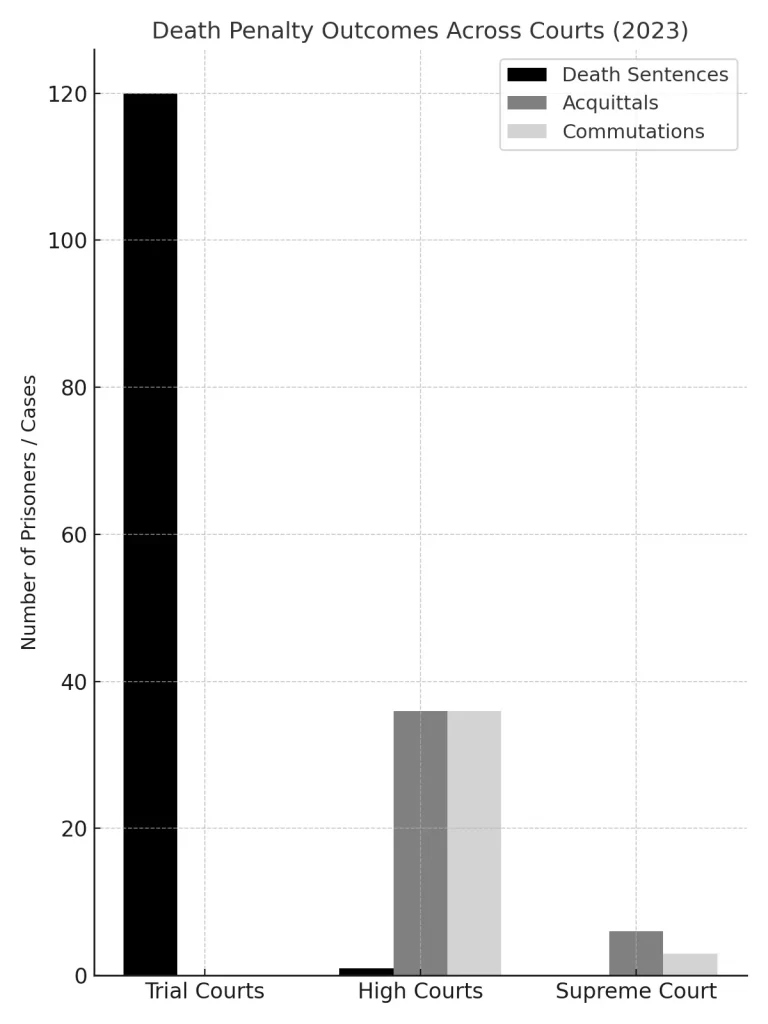
Sexual Offence = Certain Death But Only for Men of our country
More than 53% of death sentences arose from sexual-offence cases mostly homicidal rape of girls under 12. Yet in 86.96% of cases, judges ignored the Supreme Court’s Manoj v. State of MP (2022) mandate for psychological and background reports.
Speed of sentencing: 37% same-day or next-day, 46% within a week and only 17% after a week. When the law decides a man’s death before it understands his life, it ceases to be justice.
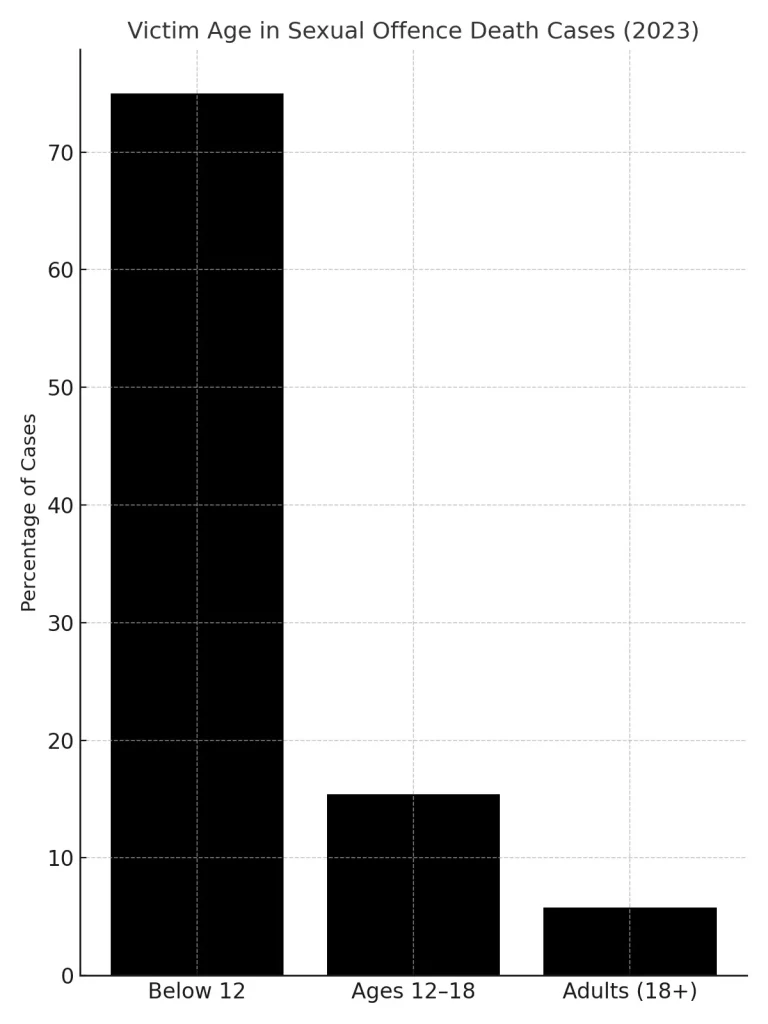
Mitigation Ignored: Judging Without Knowing
Despite legal directions, most courts failed to consider mitigating factors. Few called for probation reports or psychiatric evaluations. Only Kerala and Telangana High Courts have started using mitigation investigators. Men are not only tried for their crimes they’re punished for their silence and social position.
Supreme Court Steps In – To Undo Lower Courts’ Errors
In 2023 the Supreme Court: Confirmed 0 death sentences, Acquitted 6 men in 5 cases and Remanded 2 cases.
Findings of the Supreme Court includes: flawed forensics, coerced confessions, contradictory evidence.
Who Are India’s Condemned Men?
The report shows a class and caste pattern: most death-row prisoners come from poor, marginalized, and low-education backgrounds. They are daily-wage workers, migrants, farm labourers defended by overworked legal-aid lawyers. Justice for them isn’t a right; it’s a luxury.
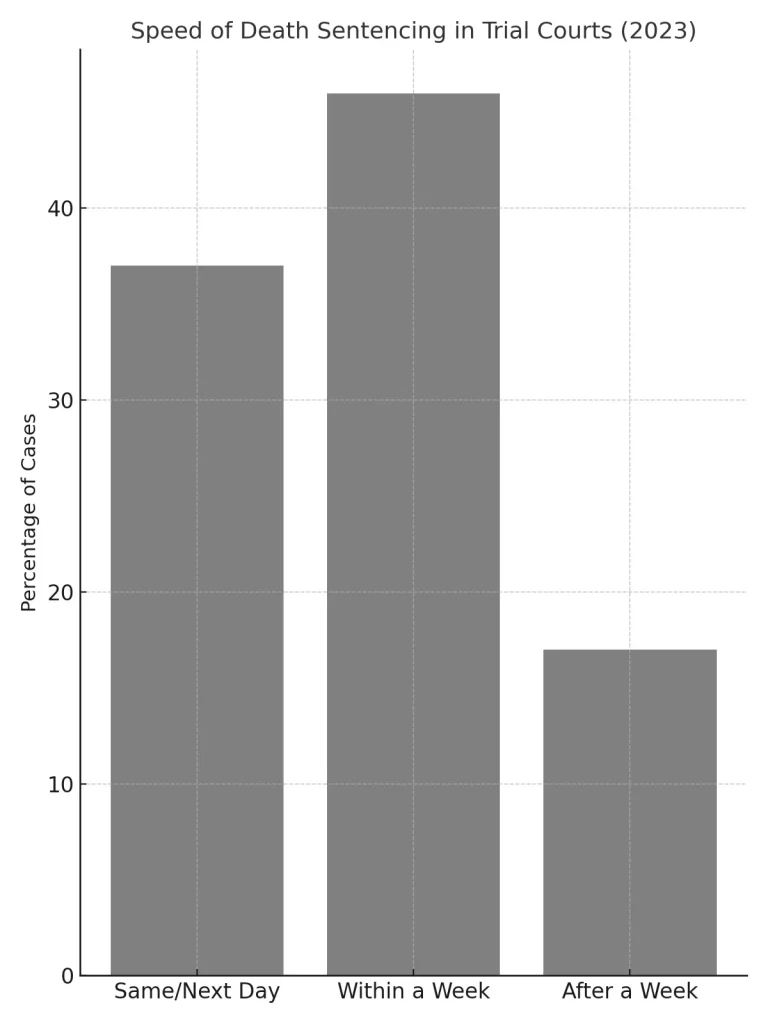
Gender Paradox: Women Kill, Men Hang
India has never executed a woman. Even Renuka Shinde and Seema Gavit convicted for child abductions and murders (2001) had their death sentences commuted in 2022. Every other death-row prisoner since then is male. Our system can imagine a bad man, but never a bad woman. Equality before law turns into compassion by gender.
New Criminal Codes: A Wider Noose, Same Bias
Bharatiya Nyaya Sanhita (BNS) expands death-eligible offences from 12 to 18. Bharatiya Nagarik Suraksha Sanhita (BNSS) & Bharatiya Sakshya Bill (BSB) modernize procedure and evidence, but ignore gender neutrality. BNS codifies mercy petition rules but offers no sentencing reform. India is legislating new ways to hang men, not to understand them.
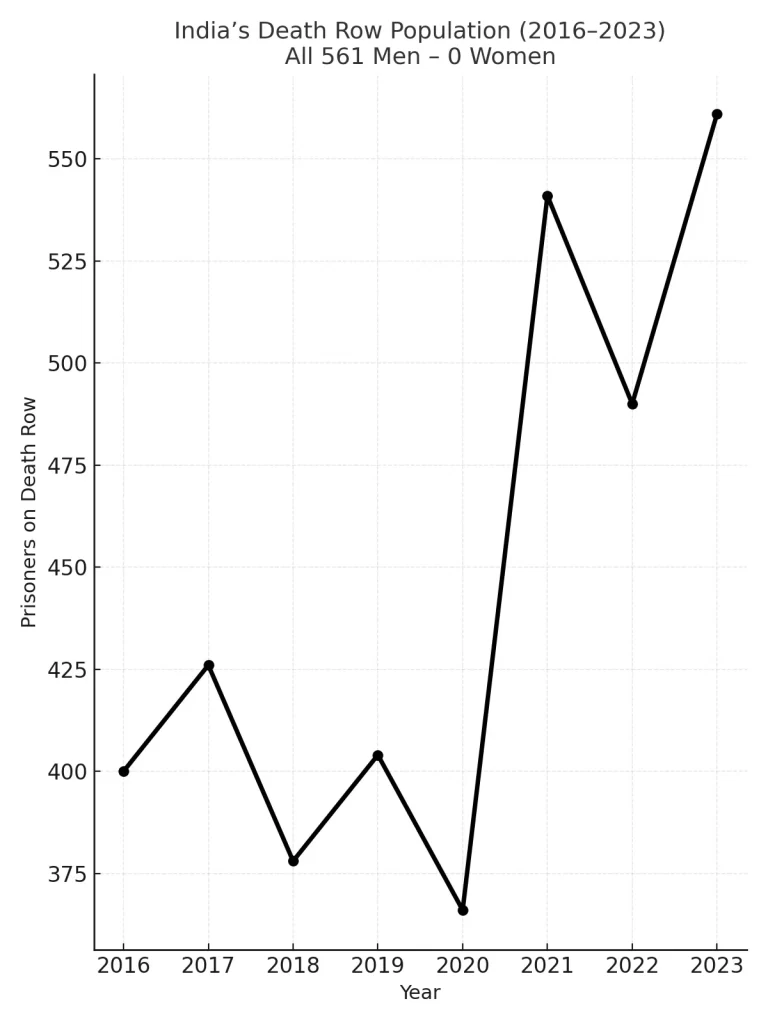
High Courts Drowning in Death
23 High Courts = 303 pending cases / 488 prisoners. Disposal rate down 15%. The pipeline is jammed that is trial courts condemn, High Courts delay, Supreme Court cleans up. Men wait a decade in solitary confinement for the system to notice its mistake.
Life Before Death: Torture by Waiting
Project 39A documents how long-term death-row confinement causes severe psychological damage. Men live in tiny cells, minimal sunlight, no rehabilitation, no certainty. Their punishment starts long before the execution order. India kills its men twice; first in spirit, then in law.”
The Bigger Picture: Justice Without Gender Bias
The report calls for: Mandatory mitigation investigation in every capital case, Judicial training on unconscious gender and class bias, Transparency in death-penalty data and Debate on abolition vs reform based on facts, not fear. But reform begins with admission that men bear the entire burden of the noose.
Conclusion: Men Die, Justice Sleeps
All 561 on death row are men. Their crimes vary, their trials flawed, their fates identical. Courts rush to sentence, delay to review, and forget to reflect. The rope is gender-specific; mercy is gender-exclusive. If equality means shared rights, it must also mean shared punishment. Until then, India’s death row remains the loudest proof that men’s rights end where the gallows begin.
A deep exposé on how India’s 498A IPC and its new BNS versions (Sections 85 & 86) are being weaponized against NRI men. Learn how a law meant to protect women has turned into a global legal nightmare for Indian husbands abroad.
Section 498A IPC: The Law That Changed Indian Marriages Forever
Section 498A of the Indian Penal Code (IPC) was heralded as a historic safeguard for women who were subjected to cruelty and abuse related to dowries when it was first introduced in 1983. However, over time, it has also come to be viewed as a legal trap in certain cases, becoming one of India’s most contentious and allegedly misused laws, particularly affecting NRI husbands and their families
Section 498A IPC states: “Whoever, being the husband or the relative of the husband of a woman, subjects her to cruelty shall be punished with imprisonment for a term which may extend to three years and shall also be liable to fine.” In simple terms, it criminalizes cruelty by a husband or his relatives towards a wife.
What Is ‘Cruelty’ Under 498A?
Both physical and mental harassment are covered by the law’s broad definition of cruelty, which includes:
- Cruelty, either physical or mental: Any act that drives a woman to suicide, or causes grave injury to her life, limb, or mental health.
- Dowry-Related Harassment: Any harassment with a demand for money, property, or valuable security from the woman or her family.
This wide definition was meant to protect women but it has also made it easy to misuse against men and their entire families.
Nature of the Offence:
Cognizable – Police can arrest without a warrant
Non-bailable – Bail is not automatic; must be granted by a court
Non-compoundable – The case cannot be withdrawn once filed (except by court permission)
Applicable to:
Husband and any of his relatives.
The Effects of Section 498A on NRI Men (Now Replaced by Sections 85 & 86 BNS)
Many NRI men had found themselves facing legal ambushes — cases filed in India while they were thousands of miles away, often with little time to respond. Once a complaint under Section 498A IPC was lodged, the legal machinery moved swiftly, usually before any real verification of facts.
For NRIs, this triggered Look-Out Circulars, passport impoundment, and even Interpol notices — often before they were ever heard in court. Section 498A had cross-border ramifications for non-resident Indian husbands that extended well beyond Indian territory.
Typical Outcomes Under 498A
- Instant FIRs: Even if the husband lived overseas, a complaint could still be filed in India.
- Arrest Warrants: To halt travel, courts issued Look-Out Circulars or Non-Bailable Warrants (NBWs).
- Family Dragged In: Without supporting documentation, elderly parents, siblings, or even distant relatives were often named in complaints.
- Property Attachment: During investigations, assets in India were sometimes frozen or seized.
- Social Damage: Reputations were destroyed overnight — long before any guilt was proven.
Intent vs. Reality
Section 498A had originally been created to protect women from cruelty and dowry harassment. However, over the years, its noble intent often clashed with harsh realities. Many cases turned into tools of extortion, revenge, or emotional pressure, leaving countless innocent men and families fighting to prove their innocence in a system that presumed their guilt.
Sections 85 & 86 BNS: The New Avatars of 498A IPC
The Bharatiya Nyaya Sanhita (BNS), 2023, formally went into effect in July 2024, replacing the Indian Penal Code (IPC), which was enacted during the colonial era. Although the goal of this reform was to create a “modernised criminal code,” many of the provisions have only been renumbered and reworded.
Although it now appears under Sections 85 and 86 of the BNS, with nearly the same teeth and the same potential for abuse, the ghost of Section 498A IPC still haunts NRI men.
Section 85 BNS: Cruelty by Husband or His Relatives
Whoever, being the husband or the relative of the husband of a woman, subjects such woman to cruelty shall be punished with imprisonment for a term which may extend to three years and shall also be liable to fine.
BNSS Classification
- Triable by Magistrate of the first class
- Imprisonment for 3 years and fine.
- Cognizable if information relating to the commission of the offence is given to an officer in charge of a police station by the person aggrieved by the offence or by any person related to her by blood, marriage or adoption or if there is no such relative, by any public servant belonging to such class or category as may be notified by the State Government in this behalf.
- Non-bailable
Section 86 BNS: Cruelty defined
Section 86 BNS (Previously Section 498A IPC) deals with cruelty against a woman by her husband or the relatives of her husband.
It has replaced Section 498A of the Indian Penal Code (IPC) while retaining its primary objective of protecting married women from domestic abuse and unlawful demands.
Under Section 86 of Bharatiya Nyaya Sanhita 2023 cruelty includes wilful conduct that may drive a woman to commit suicide, cause grave injury to her physical or mental health or harassment to compel her or her family to meet unlawful demands for property or valuable security.
What is Section 86 BNS?
Cruelty Defined
For the purposes of section 85, “cruelty” means—
(a) any wilful conduct which is of such a nature as is likely to drive the woman to commit suicide or to cause grave injury or danger to life, limb or health (whether mental or physical) of the woman; or
(b) harassment of the woman where such harassment is with a view to coercing her or any person related to her to meet any unlawful demand for any property or valuable security or is on account of failure by her or any person related to her to meet such demand
Judicial Reality: Even the Courts Know
The Indian Supreme Court has acknowledged misuse on numerous occasions: “A large number of such complaints are not bona fide and are filed with oblique motives.” – Preeti Gupta v. State of Jharkhand (2010).
“It has become a matter of serious concern that a law meant to protect women is being used as a weapon rather than a shield.” – Sushil Kumar Sharma v. Union of India (2005)
However, the BNS has essentially rebranded 498A rather than changing or balancing the law, guaranteeing that men, especially NRIs, will still have to deal with the same unfair system under a different name.
The BNS’s Sections 85 and 86 are a continuation of 498A disguised as reforms. The message is clear for NRI men: Different number. Same danger. Greater reach.
False / Misuse Cases Against Men in India (Section 498A & Related) Estimates Till 2025
| Year / Period | Total 498A / Cruelty Cases Registered | Estimated False or Misuse Cases | Conviction Rate | Key Observations |
|---|---|---|---|---|
| 2016 | ~110,000 | ~6,700 | ~12% | Rising awareness of misuse; multiple petitions filed across states. |
| 2018 | ~104,000 | ~13,000 | 13% | NCRB data shows high acquittal and withdrawal rates. |
| 2020 | 1,11,549 | ~21,000 (false or closed due to lack of evidence) | 11–12% | Around one-fifth of registered cases found baseless or withdrawn. |
| 2021 | ~1,09,000 | ~20,000 | 11% | Majority of accused acquitted or cases pending; misuse discussions peaked. |
| 2022 | ~1,07,500 | ~19,000 | 10–11% | Courts emphasize need for pre-arrest scrutiny under 498A. |
| 2023 | ~1,10,000 | ~22,000 | ~10% | Conviction rate continues to fall; pending cases exceed 90%. |
| 2024 | ~1,12,000 | ~24,000 | 9–10% | Misuse debate reignited under new BNS laws (Sections 85 & 86). |
| 2025 | ~1,15,000 | ~25,000+ | 9% | Law rebranded under BNS, but misuse trend persists; NRI men increasingly targeted. |
Weaponizing the Law: How 498A and BNS Are Misused to Target NRI Husbands
Section 498A of the Indian Penal Code was created in 1983 with the intention of serving as a legal weapon and shield against actual cruelty and dowry abuse. However, forty years later, it has become a sword for innumerable Non-Resident Indian (NRI) husbands sharp, unrestrained, and incredibly simple to abuse.
Fairness and balance were intended to be introduced by the new Sections 85 and 86 of the Bharatiya Nyaya Sanhita (BNS). Rather, they have perpetuated the same shortcomings that have made 498A one of India’s most abused criminal provisions, albeit with a more contemporary name and a wider application.
How the Trap Is Set?: The Pattern Most NRI Men Don’t See Coming
Stage 1: The Domestic Rift
Disagreements, emotional distance, or arguments about moving, money, or in-laws are frequently the first signs. Some wives (or their families) start preparing a legal strategy not a reconciliation when an NRI marriage starts to deteriorate. These plans are frequently suggested by “consultants” or local advocates who specialise in 498A cases.
Stage 2: Sudden FIR in India
Section 498A/85 BNS allows for the filing of a First Information Report (FIR) in India, even if the husband is overseas. Because the wife’s allegations of “mental cruelty” or “dowry harassment” are cognisable and not subject to bail, the police file a case right away. There’s often no preliminary investigation the mere statement of the wife is enough to trigger criminal machinery.
Stage 3: The Family Gets Dragged In
The FIR names brothers, sisters, elderly parents, and even distant relatives who are not married. Relatives who reside in different cities or nations are frequently arrested without any supporting documentation. Despite the Supreme Court’s repeated condemnations, there is no real check on this.
Stage 4: The Arrest Threat
Police may issue Look-Out Circulars (LOCs) or Non-Bailable Warrants (NBWs) following the registration of a formal complaint. This means that before their guilt is established, NRIs may be arrested at airports, have their passports cancelled, or receive Interpol Red Corner notices. Sometimes men don’t find out about the FIR until their travel plans or bank accounts are blocked.
Stage 5: Financial Leverage
The “negotiation phase” follows the FIR There is increasing pressure to reach a large financial settlement, not as justice but as a ransom for peace. Many NRI men consent to one-sided settlements in order to preserve their freedom and reputation overseas because they are afraid of criminal proceedings in India.
Why 498A and BNS Are So Easily Misused
A broad definition of cruelty is anything that “hurts feelings” or results in “mental harassment,” as these actions may be construed as crimes.
Automatic Arrest Powers: Although the Supreme Court ordered police not to make automatic arrests in Arnesh Kumar v. State of Bihar, 2014, this is rarely followed, particularly when the complainant is in India and the accused abroad.
Presumption of Guilt: In reality, the law begins with the presumption that the woman is correct, and the man must establish his innocence, frequently abroad.
Slow Judicial Process: Cases drag on for years after the FIR is filed. The punishment is the delay itself. If the man is acquitted at all, it will have destroyed families, careers, and mental health.
The NRI Nightmare: A Global Reach of a Local Complaint
International Arrest Warrants: Indian courts have the authority to ask Interpol for extradition.
Immigration and Visa Issues: Prolonged criminal proceedings may prevent foreign permanent residency or visa renewals.
Professional Damage: When employers find out that an NRI is being charged with a crime in India, many of them quit their jobs or face disciplinary action.
Travel Restrictions: At immigration counters, even a trip to India may result in an arrest.
All of this is possible if there is only a single accusation and no trial or conviction.
What the Judiciary Itself Admits
Even India’s highest court has repeatedly accepted that 498A has been grossly misused:
“The simplest way to harass is to get the husband and his relatives arrested.” – Sushil Kumar Sharma v. Union of India (2005)
“It is a matter of common knowledge that exaggerated versions of incidents are reflected in a large number of complaints.” – Preeti Gupta v. State of Jharkhand (2010)
“Arrest brings humiliation, curtails freedom, and casts scars forever. Police officers must be careful before arresting under Section 498A.” – Arnesh Kumar v. State of Bihar (2014)
The warning is clear for NRI men: One phone call in India can destroy your life abroad.
Knowing your rights, acting early, and preparing legally before a crisis hits isn’t just smart – it’s survival.
The warning is clear for NRI men: One phone call in India can destroy your life abroad.
Knowing your rights, acting early, and preparing legally before a crisis hits isn’t just smart – it’s survival.
How NRI Men Can Legally Protect Themselves: Safeguards, Strategies, and Smart Moves Against 498A & BNS Traps
Damages may start even before the first court date if a man is charged under Section 498A IPC or its new equivalents, Sections 85 and 86 BNS. Therefore, the only effective weapons an NRI husband can use are preparation and prevention.
NRIs have to cope with distance, delays, and diplomatic red tape in contrast to India, where one can walk into a lawyer’s office overnight. They also run the risk of being arrested, humiliated, and having their emotions destroyed. Before, during, and after a case is filed, this section outlines realistic tactics and useful legal protections that every NRI man needs to be aware of.
Before Trouble Starts: Prevention Is the First Line of Défense
Keep your records up to date as if they were essential. Keep all marriage-related documents safe, including travel tickets, chat logs, wedding invitations, and pictures. Save all of your financial records, including joint investments, bank transfers, and property information.
Keep a record of every digital exchange you have with your spouse, including emails, calls, and WhatsApp messages. These are defence exhibits in case something goes wrong, not just memories.
Record All Major Financial Transactions
Mention the reason (household, education, etc.) in messages or transfer notes if you are sending money to your spouse or her family. Steer clear of large cash transfers and instead opt for traceable ones. Steer clear of signing blank checks or “joint loans” without supporting documentation as these could be misrepresented as dowry in the future.
Stay Legally Updated
Even when they are overseas, many NRIs are not aware that they can file a FIR in India. Consult a reputable Indian attorney on a regular basis to see if you have any police complaints or court summonses against you. Don’t wait for the complaint to blow up before discreetly speaking with a legal expert if your marriage is in trouble.
When an FIR or Complaint Is Filed?
Designate an Indian Power of Attorney (PoA) Holder or Give a trusted family member or attorney power of attorney to act on your behalf right away. They can handle paperwork while you’re away, appear before the police, and submit applications for anticipatory bail.
Apply for Anticipatory Bail Immediately
Police have the right to make an arrest without a warrant once a FIR under 498A/85 BNS is filed. To keep you and your family members from being arrested, apply for anticipatory bail (Section 438 CrPC) through your advocate. Since courts now recognise that 498A can be abused, bail is increasingly granted when supported by the appropriate paperwork.
Use Digital Evidence Smartly
Gather any proof of affectionate messages, family vacations, presents, or medical records attesting to the absence of abuse. Present these at bail hearings to demonstrate that the marriage was non-abusive; this frequently undermines the prosecution’s initial argument.
Do Not Panic or Contact the Complainant Directly
Any message, even if emotional, can be misinterpreted as “threat” or “pressure.” Always communicate only through your lawyer once the case begins.
Throughout the Case: Strategic Legal Actions
Engage an Experienced Family or Criminal Lawyer. Many men make the mistake of hiring a local lawyer unfamiliar with NRI procedures. Choose someone skilled in both 498A litigation and international law coordination including passport, LOC, and visa implications.
File Counter-Cases When Necessary
If the accusations are false, men can file:
Section 340 CrPC: for perjury (false statements under oath).
Section 120B IPC / 211 IPC: for criminal conspiracy and false accusation.
Defamation (Section 499 IPC): if reputation damage is evident.
Consider Mediation – But Only Cautiously
Mediation can end long battles, but it often turns into financial blackmail. Go for it only if your lawyer is present and terms are legally recorded. Never sign “settlements” that include open-ended clauses like “all future disputes resolved.”
Prenuptial Agreements
While not fully enforceable in India, a properly notarized prenup abroad can be a persuasive document in Indian courts. It helps demonstrate financial transparency and mutual consent — especially if allegations later arise.
For Men Already Facing False Cases
If you’re already in the legal fire:
- Gather all digital and paper proof of innocence.
- File a quashing petition (Sec. 482 CrPC) in the High Court if evidence of misuse is clear.
- Avoid media interaction or social media posts about your case — they can backfire legally.
- Stay patient – acquittal rates in false 498A cases are rising, and courts are increasingly sympathetic toward victims of legal misuse.
For NRI men, 498A and its new BNS twins (85 & 86) are not just laws they are ticking traps that can detonate anytime. But awareness, documentation, and the right legal strategy can turn that trap into Armor. “The law may not always protect the innocent, but preparation always does.” Every NRI man must treat legal literacy as self-defence because in today’s India, ignorance isn’t just risky, it’s ruinous.
Conclusion: When Protection Becomes Persecution — The Unspoken Truth of 498A and BNS for NRI Men
What started out as a shield for women’s dignity has subtly changed into a sword that hangs over the heads of defenceless men, particularly those who are overseas. The purpose of Section 498A IPC which is now reflected in Sections 85 and 86 of the Bharatiya Nyaya Sanhita—was to prevent cruelty. However, cruelty itself discovered a new cover along the way, appearing in the form of fabricated accusations, emotional blackmail, and legal manipulation.
Thousands of NRI men are brought before Indian courts each year, their reputations damaged, their careers ruined, and their passports confiscated—not because they were guilty, but because they were accused. Furthermore, accusations are sufficient in the eyes of society. 498A assumes rather than merely punishes. It deprives men of protection in addition to protecting women.
Justice is not the only thing it produces; it also produces fear, fear of marriage, fear of trust, and fear of the very institution it was designed to protect. The misuse has begun to be recognised by the Indian judiciary. The Supreme Court has called it “legal terrorism.” Reforms, however, proceed more slowly than the harm being done. Men are still being arrested based on angry words and screenshots from WhatsApp even as laws change.
The conversation needs to change. It’s time for the law to protect both sexes rather than punish one in order to give the other more power. It’s time for society to realise that men can also become victims, albeit not from fists but from lies. “Equality until a woman complains” cannot be interpreted as “equality before the law.” Every NRI man needs to educate himself, get ready, and fight until that balance is restored not out of hatred, but out of survival. The truth rarely speaks for itself in the courtroom of emotions; you have to make it heard.
From Dubai to Delhi, NRI domestic violence cases reveal a tangled web of law, emotion, and cross-border chaos. This deep dive exposes how justice meant to protect can sometimes become a weapon-leaving both men and women fighting unseen battles.
Introduction: The Double-Edged Sword of Domestic Violence Laws for NRI’s
When Protection Becomes a Weapon: The NRI Domestic Trap
Despite being intended to safeguard the weak, laws against domestic violence can occasionally be used as legal weapons in international marriage disputes, particularly when they are directed at non-resident Indians (NRIs). Imagine a scenario in which a minor argument between spouses turns into a multi-jurisdictional legal battle that causes severe emotional distress, threatens careers, and freezes assets overseas all before a court that hasn’t even looked at the facts on merits.
Jurisdiction becomes the first significant obstacle for NRIs. Even if the alleged incident happened thousands of miles away, Indian courts can still have jurisdiction when the complainant lives there. For legitimate victims, this clause rightly guarantees access to justice. However, it also opens the door for abuse, where fabricated or inflated accusations are used to sway custody disputes, postpone divorce agreements, or obtain financial advantage.
Many NRI men are caught up in this intricate system, dealing with problems in their personal, professional, and financial lives. Lookout Circulars could be issued, bank accounts could be frozen, and reputations could be damaged prior to a fair hearing. Despite being designed as a shield, the Protection of Women from Domestic Violence Act, 2005 (PWDVA) is occasionally used as a sword to compel property transfers, secure lopsided custody, or just drag out legal proceedings to exhaust the opposing party. For many men, what begins as a marital disagreement can spiral into a nightmare criminal complaints, Lookout Circulars, and public humiliation long before they even get to tell their side of the story.
Even though these cases are still uncommon, their increasing occurrence highlights how improper use of protective laws can undermine the foundation of the legal system. As a result, there is a legal maze where innocent men fight for justice and real victims fight for protection. For NRIs, defending themselves from overseas becomes a test of fortitude, reputation, and faith in the system in addition to a legal one.
To find out more about the legal process, necessary safety measures, and useful advice on how men can defend themselves in these circumstances while maintaining the fairness of justice for all, continue reading.
Filing Domestic Violence from Abroad comes with chaos
For NRIs, proving abuse is only one aspect of domestic violence litigation; another is negotiating a complicated web of international law, jurisdiction, and logistics. When one party resides abroad, a domestic dispute that might be simple in India frequently becomes a cross-border legal maze.
Where Can the Case Be Filed in Jurisdiction?
Even if the respondent is overseas, Indian courts have the authority to hear cases if the person who was wronged lives in India. For real victims, this guarantees access to justice, but it puts NRIs in a difficult position. There are queries in minds of people that:
- Which court has authority if the abuse occurred abroad?
- How are summons and notices served internationally?
- What happens if the respondent refuses to appear?
The solution is found in procedural law, which can take months or even years to implement and frequently involves letters rogatory, consular channels, or court-appointed advocates.
The First Obstacle is: Serving Notices
It takes more than just putting a paper in the mailbox to serve a respondent who lives abroad with a legal notice. It might call for:
- Coordination with the Indian Ministry of External Affairs
- Assistance from the Indian embassy or consulate
- Compliance with the foreign country’s legal procedures
Even minor mistakes in this process can delay the case indefinitely, sometimes allowing false allegations to gain temporary legal leverage.
Enforcing Orders Across Borders
- Suppose the Indian court grants a protection or maintenance order. Enforcing it abroad is another battle. Not all foreign jurisdictions recognise Indian domestic violence orders.
- Accessing bank accounts, property, or custody arrangements may require foreign court recognition.
- Delays in enforcement can cause emotional, financial, and reputational damage, particularly to NRI men accused without substantial proof.
The Human Toll
Stress is increased by the cross-border nature of these cases.
- NRIs frequently encounter: isolation, being separated from family support by thousands of miles.
- Strain on finances and handling legal fees across several nations.
- Career risk, particularly for well-known people whose reputations may be damaged by allegations.
The Controversial Reality
Although the goal of the legal system is to protect victims, abuse of the law itself can occasionally be made possible by its intricate procedures. Because the respondent is abroad and unable to reply right away, false or inflated claims spread. Concern over this “protection-turned-leverage” situation is growing in NRI domestic conflicts.
Digital Evidence or Digital Deception? The Proof Dilemma
The battleground in NRI domestic violence cases is the evidence, and it is becoming more and more digital. WhatsApp messages, emails, call logs, social media posts, and other electronic documents are frequently accepted as evidence in court. The problem is that, although these tools can be used to defend real victims, they can also be used to falsely accuse foreign responders, putting NRI men at risk of severe legal and reputational consequences.
The Law’s Position:
Section 3, PWDVA (2005): Defines types of abuse courts can consider which are:
- Physical
- Emotional / verbal
- Sexual
- Economic
Section 22, Indian Evidence Act: Courts can admit the following as evidence:
- Medical reports
- Witness statements
- Digital communication (WhatsApp, SMS, email)
- Photos, videos, and bank statements
Submission and Scrutiny of Evidence in NRI Cases
- Filing the Complaint (Section 12, PWDVA): The aggrieved party files in Family Court or Magistrate Court. Must attach proof of domestic relationship, abuse, and digital evidence.
- Serving the Respondent (Section 13, PWDVA): Summons can be sent internationally via diplomatic channels or registered courier. Ex-parte orders may be issued if the respondent doesn’t appear, giving temporary power to the complainant.
- Interim Relief (Section 23, PWDVA): Protection orders, residence rights, and monetary relief can be granted immediately based on prima facie evidence.
- Verification & Cross-Examination: Courts scrutinize digital evidence for authenticity. NRIs should hire advocates familiar with electronic verification or request forensic validation.
Actual Dangers to NRI Men
- Manipulation Risk: Screenshots may be changed, digital accounts compromised, or messages sent out of context.
- Ex-parte Orders: Before the accused is even aware of it, courts may grant protection or residency orders, which may limit their freedom of movement or freeze their assets.
- Delayed Defence: The complainant has a tactical edge because cross-border verification takes time.
A Survival Tip for all NRI men:
Digital evidence has two sides it can be used to establish guilt or establish innocence. For NRI men: Keep all of your documents, call logs, and messages safe. Think about forensic verification of important evidence. Steer clear of emotional responses on digital platforms because anything you post online could be used against you in the future.
Although courts are becoming more conscious of these risks, NRIs need to be proactive, careful, and strategic when it comes to digital proof until the system completely changes.
Digital Traps That Can Ruin Your Life – And How NRI Men Can Fight Back
In the age of WhatsApp, Instagram, and Snapchat, one screenshot or forwarded message can spiral into a full-blown domestic violence case especially if you’re thousands of miles away. For NRI men, digital evidence is not just proof; it can be a weapon in someone else’s hands.
- Stop, Don’t React Online: Never reply to provocative messages or accusations on WhatsApp, social media, or email. Emotional reactions are admissible evidence against you. Screenshots of angry texts can become your worst nightmare.
- Document Everything: Every conversation, call log, email, and receipt. If possible, preserve original files and metadata for forensic validation.
- Protect Your Professional Life: Avoid social media posts about the case – public commentary can be misused.
- Cross-Border Proof Verification: Consider digital forensics for critical WhatsApp, email, or social media evidence. Counter any doctored screenshots or messages with verified copies. Keep a timeline of events with supporting evidence; it’s your strongest defence.
- Treat digital communication like landmines: one wrong step can trigger legal consequences. Think before you type, preserve everything, and fight smart, not fast.
Relief or Leverage? How Legal Provisions Can Be Exploited
The Protection of Women from Domestic Violence Act, 2005 (PWDVA) was designed to give victims of abuse instant protection and assistance. It guarantees remedies like financial aid, custody support, residence rights, and protection orders. For real victims, these provisions are a lifeline, but they can also be used as tools of control or retaliation, especially in NRI marriages where men face particular jurisdictional and logistical difficulties.
One party has a lot of power because Indian courts frequently have the authority to issue orders even when the alleged acts occurred overseas. Due to delayed communication, international procedures, and the inability to physically appear in Indian courts, NRI men frequently experience biassed results long before the case’s merits are even taken into account.
1. Protection Orders (Section 18)
Protection orders, which can even be granted ex-parte based on preliminary claims, give the courts the authority to prevent the respondent from getting in touch with or entering the shared residence. For instant protection, this mechanism is essential, but when abused, it turns into a potent weapon.
Before their voice is heard, NRI men may experience travel restrictions, asset freezes, or damage to their reputation due to delayed notice or lack of representation. Even if the accusations are later proven false, the stigma associated with a “protection order” can affect one’s reputation in the workplace and in the family.
In Suman Dutta v. State of West Bengal (2023), the court emphasised that such orders must be based on verified facts, recognising the risk of long-term damage from untested allegations particularly in cases involving NRIs.
2. Residence Orders (Section 19)
Regardless of ownership, this clause guarantees the resentful party the right to live in the shared household, and the court has the authority to order the respondent to leave the property. Although it protects real victims, men who are abruptly denied access to their homes or properties may experience severe hardship as a result of misuse.
When ex-parte residence orders are issued without hearing their side of the story, NRI husbands in particular may find themselves unable to access their own properties in India or overseas. Men are under tremendous pressure to make financial concessions when these orders are used as negotiating tools in divorce or property settlements.
In Roxann Sharma v. Arun Sharma (2015), the Supreme Court advised caution, noting that residence orders in cross-border disputes should not be issued automatically and must be supported by credible evidence.
3. Monetary Relief and Compensation (Sections 20 & 22)
In order to ensure that a person who has been wronged is not left penniless, financial support is essential to the PWDVA’s mission. Claims that are overstated or founded on insufficient information, however, may place unjustified demands on the respondent.
NRI men frequently receive maintenance or compensation that is insufficient to cover their true financial situation or the cost of living in their foreign country. Courts have occasionally ordered the freezing of foreign bank accounts or properties, which can completely stop a person’s ability to make a living.
The Supreme Court, in Manoj Dhankar v. Neeharika & Ors (2025), emphasised that courts must evaluate the respondent’s global financial status before deciding on maintenance. The judgement reflects growing judicial awareness that financial fairness is essential to true justice, not one-sided liability.
4. Custody and Visitation Orders (Section 21)
Although the goal of custody and visitation orders is to safeguard children during domestic conflicts, in reality, they are frequently impacted by ongoing accusations of domestic abuse. Even in the absence of evidence of wrongdoing, a man may be temporarily denied custody of his child when confronted with an unsubstantiated allegation.
This separation is devastating for fathers who are non-resident Indians. Regular contact is practically impossible in long-distance litigation, and the other party may use custody as leverage to get settlement concessions. Both the father and the child may suffer severe emotional harm until the court confirms the accusations.
The Larger Problem: When Protection Turns to Punishment
In order to give women who are victims of domestic abuse immediate civil remedies and protection, the Protection of Women from Domestic Violence Act, 2005 (PWDVA) was passed. Its goal was remedial, not punitive; it was to give the harmed party their economic security, safety, and dignity back. But as time has gone on, some abuse trends have surfaced, especially when it comes to international marriage disputes involving Non-Resident Indians (NRIs), where the protective framework is occasionally used as collateral.
Even before adjudication, the procedural protections provided by the law may unintentionally act as a kind of punishment for NRI respondents, who are typically men. In a number of instances, the process itself has turned punitive due to jurisdictional reach, ex parte protection orders, and the issuance of Lookout Circulars (LOCs) or Non-Bailable Warrants (NBWs). Respondents are forced to defend themselves internationally, frequently without adequate notice or legal counsel, when the alleged acts took place outside of India but Indian courts have jurisdiction based on the complainant’s residence.
There are several repercussions that follow. Damage to one’s reputation and career frequently comes before any court decision. Procedural disadvantages arise from the inability to physically attend proceedings, and interim orders which are occasionally issued based on unconfirmed statements may lead to asset freezing, home eviction, or parental access restrictions. Despite their protective intent, these policies may become oppressive if the underlying accusations are not proven to be true.
Numerous rulings have demonstrated the judiciary’s concern over this kind of abuse. The Supreme Court emphasised in Rajnesh v. Neha (2020) that fairness must be the guiding principle at every stage of adjudication and that financial information must be disclosed, verified, and made transparent before monetary relief is granted. In a similar vein, the High Court emphasised in Suman Dutta v. State of West Bengal (2023) that protection orders must be founded on an initial evaluation of the evidence and should not be granted automatically. These court rulings demonstrate a growing understanding that procedural excess cannot be justified by the object of protection.
Finding a balance between protecting real victims as quickly as possible and preventing abuse is the bigger problem. The lack of uniform procedural safeguards, particularly when it comes to NRIs, has produced an unfair playing field where protecting one’s rights becomes unduly difficult. Therefore, even though the PWDVA’s statutory intent is still admirable, its implementation must change to comply with the constitutional guarantees of equality, fairness, and due process. The presumption of guilt cannot be used by the law; instead, it must guarantee that the complainant and fair consideration is given to the respondent. True justice is served not merely by protection, but by protection that is lawful, proportionate, and evidence-based.
The Silent Victims: Men Caught in the Crossfire
Although India’s domestic violence laws were created to shield women from abuse, there is growing concern about how these laws are being used against men, especially non-resident Indians. Even before the facts are completely confirmed, men may be exposed to financial, emotional, and reputational harm due to cross-border litigation, ex parte orders, and the difficulty of enforcing laws internationally.
Alleged Violation of the Law
- Ex parte protection and residence orders: On the basis of presumptive evidence, courts frequently provide the harmed party with immediate relief. Temporary orders may be abused as leverage in divorce or property disputes if the respondent, who is frequently an NRI man, is overseas and unable to appear on time.
- Even NRIs who earn money abroad may be subject to maintenance claims under Section 125 CrPC. Although meant to provide evidence, exaggerated statements or untrue accusations can create undue financial burden.
Emotional and Professional Toll
Emotional and Professional Toll
- Being away from their homeland causes them to feel stressed and alone.
- harm to one’s professional reputation, particularly for well-known people whose careers rely on public confidence.
- emotional distress, such as separation from kids as a result of short-term custody or visitation limitations.
- Many men report that false allegations trigger immediate court orders restricting their access to children or assets, even before they have a chance to defend themselves.
Custody Battles and the Gender Bias Debate
- Given that children benefit from having both parents, courts are increasingly giving fathers custody or visitation rights. Well-known decisions, such as Master Ritesh (Delhi HC, 2018), encouraged 50/50 custody sharing and emphasised that a parent cannot be denied access based only on accusations.
- Nevertheless, cross-border disputes provide the party filing in India with a short-term advantage, underscoring the necessity for NRI men to exercise caution and readiness.
False Allegations, Real Consequences: The Cost of Misusing Protection Laws
The Protection of Women from Domestic Violence Act, 2005 (PWDVA) was envisioned as a lifeline for women suffering within the four walls of their homes. However, in recent years, the law has faced criticism for being used not as a shield, but as a sword especially in matrimonial disputes involving Non-Resident Indians (NRIs). While genuine cases of abuse must always be met with firm legal action, false or exaggerated allegations have become a disturbing trend that can destroy reputations, careers, and families long before the truth emerges.
The Legal Reality: One Complaint Can Change a Life
Under PWDVA, the moment a complaint is filed, courts can issue ex-parte protection, residence, or monetary orders even without hearing the respondent. For NRI men living thousands of miles away, this can mean: Frozen bank accounts in India, Seizure of property or residence, Summons issued through embassies, and Immediate reputational harm in both countries. Even if the case is eventually dismissed, the damage is already done both socially and emotionally.
Section 498A IPC & the Domino Effect
The overlap of Section 498A of the Indian Penal Code (cruelty by husband or relatives) with PWDVA creates a double blow for NRI men. A single complaint can lead to: Arrest warrants, Lookout circulars (LOCs), Suspension of passports, and Red notices through Interpol.
Rajesh Sharma v. State of U.P. (2017) 8 SCC 746 – The Supreme Court acknowledged the misuse of Section 498A, directing the formation of Family Welfare Committees to screen complaints before arrests. The Court warned that “law, which is meant to protect the vulnerable, should not be misused to terrorize the innocent.” However, despite these checks, many NRIs still face immediate coercive action before they can even respond.
Judicial Recognition of Misuse in PWDVA
Courts across India have begun recognizing the pattern of false or exaggerated claims under PWDVA. These observations reflect a slow but steady judicial awakening toward balance and fairness.
- Smt. Reshma Begum v. State of Karnataka (2020) – The Karnataka High Court observed that “laws for protection cannot become instruments of personal vendetta.”
- Suman Dutta v. State of West Bengal (2023) – The Calcutta High Court noted that courts must ensure domestic violence petitions are not filed as extensions of property or custody battles, particularly in NRI marriages.
The Collateral Damage: Careers, Families, and Children
False allegations often inflict irreversible harm like mentioned below even when proven baseless:
- Career Collapse: For NRI men working in sensitive sectors (tech, finance, diplomacy), even an unverified complaint can trigger suspensions or visa issues.
- Emotional Fallout: Being branded an “abuser” creates social stigma that isolates men and their families.
- Impact on Children: Many children grow up estranged from their fathers, caught in the emotional tug-of-war between parents.
The Cost of Legal Misuse
False allegations consume judicial time, public money, and emotional energy that could have been spent helping genuine victims. The Supreme Court in Preeti Gupta v. State of Jharkhand (2010) 7 SCC 667 observed that “a serious relook of Section 498A is warranted as its misuse leads to social unrest.” The Court added that false cases trivialize real suffering, undermining the very intent of protection laws.
In NRI contexts, misuse leads to international embarrassment, extradition battles, and broken bilateral trust between nations.
The Road Ahead: Accountability and Legal Reform
- Penalizing False Complaints: Section 211 IPC and Section 250 CrPC allow punishment for false charges, but are rarely invoked. Courts must enforce them more rigorously.
- Gender-Neutral Reforms: The growing demand for gender-neutral domestic violence laws aims to ensure equal protection for all victims—regardless of gender.
- Mediation and Digital Hearings: NRIs should have access to virtual hearings and neutral mediation to prevent procedural abuse.
Rising Numbers, Rising Noise: The Statistics of Domestic Violence Litigation
Over the past ten years, there has been a notable increase in both contested and legitimate domestic violence cases filed with India’s courts. Domestic violence cases under the Protection of Women from Domestic Violence Act, 2005 (PWDVA) have steadily increased by 25–30% annually, according to data from several High Courts and the National Crime Records Bureau (NCRB). Section 498A IPC and PWDVA together received nearly 4.5 lakh complaints of domestic abuse and violence in 2023, a 28% increase from 2018.
The cases involving NRIs and urban districts have increased the most, with many petitions filed from overseas via power of attorney or through Indian relatives. Between 2017 and 2024, the Ministry of External Affairs (MEA) recorded more than 13,000 matrimonial complaints involving NRIs, the majority of which concerned claims of domestic violence, dowry harassment, or maintenance. These figures highlight how domestic conflicts have evolved into cross-border legal hotspots, entangling families and countries in protracted legal proceedings.
The Silent Aspect: The Increase in Male Victimisation
Although statistics on male victims are still underreported, there is a growing body of evidence and judicial recognition that men are also being abused emotionally, physically, and psychologically, often with no specific legal remedy.
According to surveys by the Men Welfare Trust and the Save Indian Family Foundation (SIFF), nearly one in three men in urban India reported having experienced emotional or domestic abuse, but only 3% ever reported it for fear of ridicule or legal consequences. Over 4% of men reported having been victims of spousal violence, according to the National Family Health Survey (NFHS-5), a statistic that is generally thought to be underreported.
Men are particularly vulnerable in NRI disputes because of coercive settlements to “buy peace,” loss of parental rights, and being trapped overseas by false cases filed in India.
Reality Check: A Law Tilted by Fear
India still lacks the following in spite of these trends. A law against domestic abuse that is gender-neutral, systems of shelter or assistance for male victims, and procedures specifically designed to address false complaints. A one-sided narrative has resulted from this imbalance, in which every accusation is taken at face value and every defence seems like an excuse.
The question facing lawmakers becomes more pressing as more NRI men come forward and data keeps growing – “If half of the victims are not visible, can we still call it justice?”
Accused abroad? Why Every NRI Man could be a target and what to do if you are accused
What Men Should Immediately Do If Accused? It can be extremely stressful for any NRI man to deal with a domestic violence accusation, especially if it comes from overseas. To safeguard your freedom, rights, and reputation, you must act quickly, calmly, and legally. Here is a detailed guide for all the NRI men’s:
- Avoid Emotional Reactions and Remain Calm: Avoid reacting hastily to calls, messages, or posts on social media. Emotional responses could be used against you in court if they are misconstrued as abuse or aggression. Even when speaking with friends or family, keep your tone neutral.
- Engage a Competent Lawyer Immediately: Hire an experienced family law attorney who understands both Indian domestic violence laws and NRI-specific cross-border complications. Early legal intervention can prevent ex parte orders and ensure your side is represented before interim decisions are made.
- Consider Filing for Anticipatory Bail: If there is a risk of arrest under 498A IPC or related domestic violence provisions, apply for anticipatory bail proactively. This protects you from sudden detainment and helps maintain stability in your personal and professional life.
- Coordinate with the Indian Embassy or Consulate: Notify your nearest Indian diplomatic mission about the allegations to get procedural guidance and support. Embassies can assist in serving legal notices, verifying documents, and communicating with courts or authorities in India.
- Inform Your Employer Discreetly (If Necessary): If legal proceedings may impact travel, visas, or employment, inform your employer discreetly to avoid sudden career disruption. Keep communications professional and avoid oversharing details that may escalate reputational risk.
- Keep All Records Safe: Save copies of all digital communications that are pertinent to your defence, including emails, messages, financial transactions, and trip logs. Keep backups safe and arrange them chronologically; these documents may be essential for refuting unfounded accusations.
- Seek Psychological and Emotional Assistance: Cross-border legal disputes and false accusations can have a serious negative psychological impact. Use NRI support groups or online counselling services to reduce stress and keep your head clear throughout the process. Your capacity to react rationally and persuasively in court is strengthened by emotional stability.
- Leveraging Technology: Use video calls, digital notarisation, and e-courts to actively participate in proceedings without travelling. Ensure all digital evidence is forensically verified to prevent claims of manipulation.
- Pre-emptive Planning: Appoint a trusted representative Power of Attorney (PoA) in India to act on your behalf for court submissions and appearances. Keep a legal kit ready like affidavits of finances, property, travel, and evidence of good character.
- Understand procedural loopholes: Sometimes minor delays in notice service or embassy communication can be leveraged legally to ensure fair representation.
- Custody and Family Strategy: Keep records of your interactions with your kids, including visits, correspondence with the school, and financial assistance. Respectfully comply when submitting your legal challenge if the other parent is granted temporary custody; hostility or non-compliance may make your case worse.
- Protect Your Money: If there is a chance that your assets could be frozen, let your bank and accountant know. Have documentation of your foreign earnings and outlays on hand so you can prove your financial situation in court. Steer clear of making abrupt large-scale transfers as this could be interpreted as an attempt to circumvent court orders.
- Record-keeping and Preservation of Evidence: Keep track of both digital and physical documents, including financial statements, call logs, emails, WhatsApp messages, travel logs, and property ownership. Important documents should be notarised or embassy-certified to guarantee authenticity. Maintain a daily log of all conversations; in protracted legal disputes, even the smallest details count.
Judicial Trends and Safeguards for Men and NRIs
Although the Protection of Women from Domestic Violence Act, 2005 (PWDVA) is welfare legislation, Indian courts have gradually recognised that the respondent must not suffer substantive or procedural injustice as a result of its implementation. In the last ten years, judicial trends have started to show a growing understanding of the need for balance, making sure that the law protects abuse victims without allowing it to be abused as a tool of harassment or coercion by following ways:
1. Emphasis on Procedural Fairness and Due Process
The judiciary has repeatedly reaffirmed that proper prima facie scrutiny is necessary before granting any protection order or temporary relief. In Suman Dutta v. State of West Bengal (2023), the High Court observed that “the urgency of protection cannot override the necessity of verification.” Similarly, courts have discouraged the mechanical issuance of ex parte orders that may unduly prejudice the respondent, particularly those residing abroad.
In Rajnesh v. Neha (2020), the Supreme Court laid down comprehensive guidelines mandating both parties to disclose their income, assets, and liabilities through affidavits. This ensures transparency and prevents inflated or fabricated claims for maintenance and compensation. The ruling emphasised that fair adjudication must rest on verified data rather than assumption or emotional narrative.
2. Recognition of NRI-Specific Challenges
Courts have also recognised the unique difficulties faced by non-resident Indian respondents who are required to defend themselves in Indian proceedings. Jurisdictional and logistical barriers often put them at a disadvantage, resulting in court orders to adopt new technology and procedures. NRIs can now testify remotely and participate in hearings since several High Courts have permitted participation through video conferencing. For instance, when the respondent shows a genuine desire to participate in proceedings, the Delhi High Court has repeatedly emphasised the importance of permitting virtual appearances and avoiding needless coercive measures.
Additionally, courts have called for the gradual issuance of Lookout Circulars (LOCs) and Non-Bailable Warrants (NBWs), particularly in situations involving marriage or domestic abuse. The judiciary has made it clear that such measures should be viewed as last resorts rather than tools of leverage, especially when the accused or respondent resides lawfully abroad and is willing to cooperate with the process.
3. Shift Toward Gender-Neutral Interpretation
Recent judicial observations and Law Commission discussions have shown growing support for gender-neutral approaches to addressing domestic abuse, despite the PWDVA being a gender-specific statute. The judicial discourse now acknowledges that men can also suffer from emotional, financial, or psychological harm.
In a number of decisions, High Courts have stated that fabricated or overblown allegations damage the reputation of real victims and constitute procedural abuse. This changing viewpoint reflects a significant change in jurisprudence: a move away from a gender-based presumption of victimhood and towards an emphasis on objective facts and evidence.
4. Balancing Welfare and Accountability
The way the judiciary currently operates is an attempt to strike a balance between procedural protections and welfare goals. Before enforcing coercive orders, courts are now demanding documentation, cross-verification, and mediation. In recognition of the harm that false cases cause to both people and the integrity of the legal system, some benches have also suggested costs or penalties for pointless litigation.
These developments represent slow but significant progress, especially for NRI men. The Act’s spirit of protection is maintained while the innocent are protected thanks to the judiciary’s insistence on justice, openness, and proportionality.
Thus, a significant shift from a presumption-based to an evidence-based justice framework is represented by the recent judicial trend. In order to prevent protection from turning into persecution, Indian courts are redefining the way domestic violence cases are handled by placing a strong emphasis on fair procedure, validated documentation, and digital accessibility. In the end, this development is indicative of a developing legal system one that protects the rights of actual victims while also protecting the innocent from unintentional harm.
Conclusion: Justice Without Borders, Fairness Without Bias
The purpose of domestic violence laws was to safeguard the weak. They can occasionally feel like a legal guillotine swinging across continents to NRI men. Before a single fact is even confirmed, a single false accusation has the power to ruin careers, freeze bank accounts, ground passports, and make a tranquil life overseas into a nightmare.
Although the goal of the law is admirable, the reality is harsh: courts have the authority to issue custody, residence, or ex-parte protection orders, leaving men defenceless while the system proceeds at its own speed. Being abroad can render the truth meaningless, and distance turns into a weapon. In the meantime, families are split apart, reputations are destroyed, and severe emotional wounds result. Recent rulings like Rajesh Sharma v. State of U.P. (2017) and Manoj Dhankar v. Neeharika (2025) show that Indian courts are slowly waking up to this imbalance emphasising due process, verified evidence, and mediation. But for many NRI men, the damage is done long before justice can catch up.
It’s time to face reality: laws against domestic abuse cannot be one-sided. Men are also victims, and when the law is used as a weapon, it ruthlessly destroys families, careers, and lives. India requires an evidence-based, gender-neutral system that treats false accusations with the same gravity as abuse. Justice cannot stay at home in a world where marriages take place across oceans. The balance must be in favour of justice rather than fear, regardless of whether the husband is being accused from Dubai or the wife is submitting a claim from India. Because true empowerment is about avoiding destruction before you have a chance to defend yourself, not about winning. Instead of being automatically guilty and subjected to constant harassment, NRI men should be protected, understood, and respected. Laws are failing everyone if they protect one gender while neglecting the other. It’s time the system became what it was intended to be a shield for everyone instead of a sword in the hands of the dishonest.
NRI Men, Take Note: A Power-Packed Guide to Indian Maintenance Laws from Section 125 CrPC to Cross-Border Enforcement. Learn how to safeguard your finances, fight inflated claims, and navigate India’s legal maze from abroad like a pro.
The NRI Man’s Handbook on Maintaining a Marriage While Living Abroad and Fighting at Home
Although being an NRI offers the excitement of international opportunities, it also presents difficulties that most men are unaware of, particularly when it comes to family law issues. Matters such as maintenance for NRI spouses, child maintenance, or financial support—often perceived as simple—can quickly turn into complicated legal minefields due to distance, where each mistake can cost money, time, and peace of mind.
It is imperative that men living abroad comprehend Indian maintenance laws; it is not an option. While laws such as the Hindu Marriage Act and Section 125 of the Criminal Procedure Code (CrPC) offer clear channels for maintenance claims, their cross-border application necessitates planning, accurate documentation, and knowledge of international enforcement procedures. NRIs are required to manage documentation from several nations, negotiate cross-border legal processes, and deal with variations in currency, income reporting, and jurisdictional restrictions.
There is a lot on the queue. NRI men have to strike a balance between safeguarding themselves against abuse, inflated claims, or protracted arguments and making sure their spouse or kids receive fair support. A seamless settlement or a protracted legal battle may depend on maintaining thorough financial records, adhering to court orders, and comprehending the subtleties of cross-border enforcement. In order to protect rights and responsibilities, knowledge, planning, and strategic action serve as more than just tools.
Understanding Your Legal Rights as an NRI: What Every Man Needs to Know
Living overseas can help you advance your career and achieve financial independence, but it also exposes you to the harsh realities of Indian family law. In addition to being a legal requirement, matrimonial maintenance is a minefield where an ignorant NRI man could easily become entangled. Being ignorant costs money; it’s not bliss. To know the loopholes, one must know the laws made that can be exploited:
1. Section 125 of the CrPC: The Two-Sided Sword
Although the Criminal Procedure Code’s (CrPC) Section 125 was designed to safeguard the weak, it can occasionally feel like a double-edged sword to NRI men. If a spouse or child is unable to support themselves, they may be able to claim maintenance under the law. Courts expect complete transparency of your finances, including foreign assets, foreign bank accounts, and offshore income, even though their goal is to deliver justice. The harsh reality is that people may assume you have a lot of money if you don’t disclose even a small asset. This can sometimes lead to harsh or excessive maintenance orders.
2. Hindu Marriage Act: Obligations and Rights
After a divorce or separation, maintenance claims are recognised under the Hindu Marriage Act. The catch is that men are equally susceptible to claims as women because the law is becoming more gender-neutral. Courts take earning potential, income, and lifestyle into account. If you’re not ready, a court in India may assume that an NRI man who is used to a particular standard of living overseas must maintain that lifestyle, legally tying you to heavy obligations.
3. Understanding the Variations in Religion-Based Personal Laws
Maintenance requirements for NRIs governed by Muslim, Parsi, or other minority laws differ greatly. Here, ignorance can be deadly: a claim made under one law might work in a different way than anticipated, taking men by surprise. Legal literacy is essential for survival; it is not optional.
4. Cross-Border Enforcement: The Invisible Trap
In India, winning a case is only the first step. Another battlefield may be enforcement overseas. While some nations respect Indian orders, others view them as advisory and call for new procedures. Due to the intricacy, a man may legitimately prevail in India but find it difficult to enforce it overseas, resulting in months or even years of financial strain and uncertainty.
5. Men Are Not Immune: A Reality Check
Let’s face it: maintenance disputes are increasingly aimed at NRI men. Selective evidence, WhatsApp logs, and digital communications can all be strategically employed. Despite their impartiality, courts mainly rely on documentation. Men who undervalue the system or disregard their legal obligations run the risk of receiving high maintenance orders, facing legal action, or having their reputations harmed. Understanding your rights is essential for survival in a legal system that can be both protective and punitive; it goes beyond simple compliance. A possible legal nightmare is transformed into a manageable risk defence with preparation, awareness, and legal advice.
“Ignorance is costly for NRI men”. In today’s world, digital footprints and international money trails are just as important as legal documents. Knowledge is power, and preparation is protection. The system is cruel to unprepared men, but it is not against men
Filing Maintenance as an NRI: A Step-by-Step Guide to Avoid Legal Traps
It can be like negotiating a legal maze when you file a maintenance petition from overseas. Understanding the process is important for NRI men because it protects their money, reputation, and peace of mind in addition to their rights. Following Indian law precisely guarantees that claims are fairly evaluated, delays are kept to a minimum, and possible disputes are resolved.
- Filing a Petition in India from Abroad
Choose the Appropriate Jurisdiction: In India, maintenance petitions are usually submitted to the claimant’s family or district court. This step is essential for NRIs because submitting to the incorrect court may result in rejection or delays. Courts can receive petitions through designating a reliable agent in India is known as a power of attorney (PoA). Under certain circumstances, certain courts permit filings from overseas as well. - Choose Skilled Legal Advice
A lawyer or PoA holder represents you on the ground, responds to notices and files petitions, attends hearings in court, prevents needless travel by guaranteeing adherence to procedural requirements. - Make use of e-courts and online filing
The e-court system in India enables NRIs to file petitions online, submit documents virtually, attend hearings via video conferencing, reducing travel and ensuring timely proceedings. - Records: Your Legal Protector
NRIs need to keep thorough records to back up their claims. Foreign assets, income, and communication records are being examined by courts more and more.- Important records consist of: Proof of Marriage and Relationship, Marriage certificate, photographs, joint accounts, or property documents, Birth certificates of children if claiming child maintenance.
- Financial Proofs consists of: Salary slips, bank statements, tax returns, business income statements, and property ownership records, Evidence of foreign income, assets, and liabilities.
- Residency and Travel Details includes : Passport copies, visas, proof of foreign residence, Travel records to prove periods of separation or visits related to the marriage.
- Supporting Evidence includes Communication records like emails, messages, call logs, Legal notices, prior agreements, or settlements.
- Medical or educational bills for children if claiming additional support.
- Court Hearings and Virtual Proceedings
Modern Indian courts are NRI-friendly, but preparation is key like Physical appearance may not be required if you have a PoA. Video conferencing is allowed for crucial hearings. Sworn statements, affidavits, and notarised or consular-authenticated evidence may be required. Respondents can cross-examine virtually if abroad. Moreover, Maintenance orders specify the amount, frequency, and mode of payment-bank transfers to India or other agreed methods are commonly used.
Practical Tips for NRI Men
It is completely possible to file a maintenance petition as an NRI, but doing so calls for planning, accuracy, and legal advice. These actions are not merely formalities for men who live overseas; they are calculated precautions to safeguard their money, reputation, and legal status.
- Make sure foreign documents are accepted by Indian courts by notarising and apostilling them.
- Keep Thorough Records: Preserve copies of correspondence, court orders, and correspondence.
- Engage a Skilled NRI Attorney: Expertise minimises errors and safeguards rights.
- First, think about mediation: out-of-court settlements reduce stress, expense, and time.
- Make Use of Technology: Virtual hearings and e-filing expedite the procedure and cut down on travel.
How Maintenance is Calculated—and How NRI Men Can Avoid Being Overcharged
Calculating maintenance for NRI men can be like walking a tightrope because courts try to balance the claimant’s needs with the paying spouse’s financial capability. It’s essential to comprehend how courts determine maintenance in order to safeguard your rights, steer clear of exaggerated claims, and make wise financial plans.
1. Financial Transparency and Earnings
When determining maintenance, Indian courts take into account all sources of income like Salaries, bonuses, and business profits abroad, Foreign real estate, investments, and other assets. Overstated maintenance orders are a risk for NRIs who undervalue the scrutiny of foreign income. Courts require evidence, such as: Contracts of employment, Statements from banks, Returns of foreign taxes. “Transparency isn’t optional it’s your shield”.
2. Claimant’s Needs vs. Paying Spouse’s Capacity
Courts seek to strike a balance between practicality and fairness. They take into account Costs of daily living include utilities, housing, food, and medical care. Additional prerequisites include special medical costs for children or international education. Lifestyle during marriage or your level of living could serve as the standard.
Courts may convert foreign earnings into Indian rupees and compare living standards. Being prepared with detailed records of foreign obligations, mortgages, and dependants ensures claims are reasonable and defensible.
3. Children’s Welfare: A Top Priority
The “child’s best interests” principle is upheld by Indian courts. Included in maintenance are:
Tuition and school fees, Extracurricular activities, Medical care
Keep track of all contributions and receipts, even if you live overseas. In addition to appeasing the court, this shields men from charges of carelessness or underpayment.
4. Methods of Maintenance Payment
Courts can order payments in different forms:
- Periodic Payments: Monthly or quarterly deposits into Indian bank accounts.
- Lump-Sum Payments: One-time settlement for long-term support or relocation abroad.
- Hybrid Approach: A combination of a lump sum for children’s education and periodic payments for a spa combination of expenses.
Understanding these options allows NRIs to plan finances efficiently and avoid surprises or disputes over payment schedules.
Critical Points for NRI Men
Currency Conversion and Banking: It is frequently necessary to exchange foreign earnings into Indian rupees. Courts may factor in exchange rates-prepare for fluctuations.
Detailed Documentation: Keep thorough records of expenses, income, property, and foreign obligations.
Legal Counsel: To make sure that claims are fair, enforceable, and in line with the law, work with a lawyer who has experience with NRI maintenance cases.
Ignorance can be expensive, but courts are fair. NRIs run the risk of excessive maintenance, legal disputes, or reputational harm if they neglect to report foreign income or overcommit without strategic guidance. Not only is preparation advised, but it is necessary for men.
Maintenance for NRI men isn’t about dodging responsibilities-it’s about protecting yourself while fulfilling obligations. Knowledge of the law, careful documentation, and strategic planning are the ultimate tools to ensure fairness, compliance, and peace of mind.
Hidden Dangers: How Maintenance Laws Can Backfire on NRI Men
Maintenance cases can occasionally feel like stepping into a trap for NRI men. Although the law is supposed to protect, men living overseas are often left to negotiate it because of procedural flaws, jurisdictional peculiarities, and distance.
Jurisdictional Loopholes: Traps You Don’t See Coming
Filing in the incorrect family court or district can cause months-long delays. Knowing that NRIs might find it difficult to follow the case from overseas, some claimants take advantage of this gap. A delay can be a calculated tactic to encourage larger claims or settlements; it’s not just a hassle.
Inflated or Misrepresented Claims
Exaggerated costs, selectively presented evidence, and overstated needs are common in cross-border cases. Courts may take these claims at face value in the absence of strong evidence. Not having proper documentation can result in paying much more than you should. Maintain thorough records of all communications, foreign assets, and income. The court may presume it exists if it is not documented.
Currency and Income Reporting Loopholes
Foreign income is complex; your actual financial capacity is impacted by various currencies, tax liabilities, mortgages, and overseas dependents. Courts may assume you have limitless resources and modify maintenance if you underreport your responsibilities or neglect to disclose currency fluctuations. Consult a lawyer versed in the complexities of non-resident aliens (NRIs) and keep certified records of all foreign earnings and liabilities.
Documentation Gaps Can Be Costly
Foreign documents must be notarised, apostille, or certified by a consulate. A legal loophole that courts may use against you is the absence of documentation of your marriage, children, or income. Even valid defences or claims can be rejected without the right documentation.
Cross-Border Enforcement: The Silent Trap
Winning in India does not translate to success overseas. While some nations may completely disregard Indian directives, others may need new procedures. For NRI men, this means that even if you win legally, you may still have to deal with months or years of uncertainty, legal bills, and coerced compliance.
Emotional leverage and legal pressure
The pressure increases with distance. Unfamiliar legal procedures, time zones, and travel restrictions frequently lead to stress, anxiety, and strategic disadvantage. Although courts are impartial, they occasionally take advantage of procedural flaws to compel compromise or raise payments. Being abroad does not provide protection; men can suffer significant financial and emotional costs as a result of ignorance.
Differences in Legal Systems
Indian family law may differ significantly from the legal system of the country where the NRI resides. Foreign courts may require additional compliance steps, such as notarisation, attestation, or filing petitions under local laws to recognise Indian orders.
Cross-Border Legal Complexities
Obtaining a maintenance order in India is often simpler than enforcing it in the country where the NRI resides. Enforcement abroad depends on reciprocal agreements, foreign laws, and local court cooperation.
Scheduling Issues and Time Zones
Delays may arise when arranging court dates and lawyer consultations across time zones.
Restricted Legal Aid Access
It can be difficult to find Indian solicitors with experience in NRI maintenance cases. The timely filing of documents and responses may be impacted by miscommunication caused by distance.
Men in the NRI are treading carefully. Although the law is intended to provide protection, it can be abused, even unintentionally, due to procedural flaws, loopholes, and international issues. Legal strategy, readiness, and awareness are survival tools and cannot be disregarded. Ignorance can cost an NRI man everything, including money and peace of mind. Every email, bank statement, and international commitment counts. Being prepared makes the difference between protection and punishment in today’s legal environment.
Stop Being a Sitting Duck: NRI Men’s Survival Guide Against Legal Loopholes
For NRI men, safeguards are essential defences against legal pitfalls, inflated claims, and procedural pitfalls; they are mandatory. Men can fulfil their responsibilities in a fair manner while safeguarding their rights, money, and peace of mind if they have thorough documentation, strategic representation, and proactive planning.
Being prepared is equivalent to being protected in the NRI legal system. Every record, document, and tactical decision has the power to distinguish between financial vulnerability and equity. The legal environment surrounding maintenance cases can feel like a minefield to NRI men. However, vulnerability can be turned into protection with careful planning, appropriate documentation, and professional advice. Here’s how:
- Keep Thorough Financial Records: Every source of income, property, and foreign asset is examined by the courts. Assumptions of limitless wealth can result from missing details. Save bank statements, tax returns, investment records, and pay stubs from every nation. Record foreign dependents, loans, and mortgages. For use in court calculations, clearly convert foreign income into Indian rupees. Accurate records build credibility and guard against exaggerated claims.
- Make Good Use of Power of Attorney (PoA)
Absence from court does not equate to being abroad. An experienced PoA or attorney can submit responses and petitions on your behalf, Participate in hearings and oversee paperwork., Make sure that deadlines are fulfilled and that there are no gaps in the process.
Pick someone with legal knowledge, experience, and dependability; they are your eyes and ears on the ground. - Make Use of Electronic Filing and Virtual Hearings
Modern Indian courts allow online filing and video conferencing for NRIs. Avoid unnecessary travel and expenses. Participate in hearings without being disadvantaged by distance. Submit affidavits, proofs, and responses securely. - Strategic Document Communication
In court, digital communications are admissible. Incomplete or misconstrued evidence can undermine your case. Save copies of your calls, emails, and WhatsApp conversations. Keep track of any agreements or previous settlements. Whenever possible, communicate in formal writing. This stops deceptive or fraudulent statements. - Consult with Expert NRI Legal Counsel
Cross-border complexities may be beyond the scope of generic family lawyers. An expert NRI attorney is able to give advice on international and Indian law, handle jurisdictional obstacles, foreign obligations, and currency concerns, develop a legal strategy to reduce risk and cost. - Consider Mediation Before Litigation
Court battles are costly, slow, and stressful. Mediation or arbitration can: achieve fair settlements without prolonged disputes, reduce financial burden and maintain privacy and avoid public records that could affect reputation. - Make a Strategic Maintenance Plan
Recognise your options, including hybrid arrangements, lump sums, and periodic payments. Base your negotiations on your foreign financial capability. Make adjustments for children’s needs, exchange rates, and variations in cost of living.
Conclusion: NRI Men Must Take Charge or Pay the Price
Matrimonial maintenance cases are high-stakes battles for NRI men, where ignorance, inadequate documentation, or delay can cost them money, time, and reputation. They are not just legal issues. Although the system is neutral, those who are unprepared may be severely harmed by flaws, exaggerated claims, and cross-border complications.
The key takeaway is straightforward: preparation is your shield, strategy is your weapon, and knowledge is your armour. Keeping thorough financial records, having a power of attorney represent you, participating virtually, and hiring specialised legal counsel are all necessary for your protection.
Distance does not grant immunity in the global arena. If NRI men don’t take proactive measures, they could be caught in a web of misrepresented claims, unclear jurisdiction, or procedural gaps. In addition to fulfilling their responsibilities, people who take charge, remain knowledgeable, and behave strategically also protect their money, freedom, and peace of mind. Depending on your level of readiness, the law can either protect or punish NRI men. Ignore it and you risk losing control; master it and you keep control.
A deep dive into how Indian courts navigate emotional and legal crossfires in NRI child custody disputes where love meets law across continents. Discover key rulings, strategies, and the new shift toward shared parenting and gender-neutral justice.
NRI Child Custody Litigation: Everything You Need to Know
Child custody disputes are more than just legal disputes for NRIs; they are also emotional, cross-continental journeys. Imagine balancing time zones, foreign jurisdictions, visa restrictions, and the intricacies of Indian family law while fighting for the right to raise your own child. Every court order, hearing, and affidavit can seem like a test of forbearance, tenacity, and strategy. NRI parents, who frequently live thousands of miles away, must prove their ability to provide a stable home, high-quality education, and emotional security in addition to their love and ability, unlike in domestic custody disputes. The child’s habitual residence, parental ties, cultural continuity, safety, and the viability of implementing foreign custody or visitation orders are all carefully considered by Indian courts, which operate under the tenet of the child’s best interest. Recent rulings have emphasised that mothers and fathers are not intrinsically inferior; rather, what counts is who can actually guarantee the child’s well-being.
This guide offers insights, strategies, and practical advice by breaking down the complex web of laws, procedures, jurisdictional issues, and landmark cases that NRI parents must deal with. Whether you are a mother negotiating enforcement from overseas, an NRI father pursuing meaningful custody, or a lawyer counselling clients across borders, this resource thoroughly, precisely, and clearly breaks down every aspect of custody litigation.
Types of Custody under Indian Law
The intricate matter of child custody in India is largely governed by the Guardians and Wards Act of 1890, the Hindu Minority and Guardianship Act of 1956, and the Juvenile Justice (Care and Protection of Children) Act of 2015. Courts divide custody into three main categories, each with unique rights, obligations, and ramifications. Since enforcement and actual care arrangements can vary across borders, it is imperative that NRI parents comprehend these differences.
Physical Custody
Physical custody establishes who will provide daily care, supervision, and emotional support for the child as well as where they will live. This can come in two ways;
- One parent has sole physical custody, that is they are in charge of the child’s daily upbringing, education, medical treatment, and emotional health or
- Joint/Shared Physical Custody in which the child follows a set schedule and spends time with both parents.
In Kunal Kapoor v. Priya Kapoor (Delhi HC, 2020), an NRI father was awarded joint physical custody because of a well-thought-out plan that made sure the child’s welfare and education were maintained even though he lived overseas.
Legal Custody
Even if a child lives with one parent most of the time, legal custody gives one parent the power to make important decisions that impact the child’s life like;
- Education: Selecting academic programmes, curricula, and schools.
- Healthcare: Permitting surgery, immunisations, or medical treatment.
- Religion and Cultural Practices: directing the upbringing of the child in terms of religion and culture.
- Travel and Residency: Authorising relocations or travel abroad.
Visitation / Access Rights
The non-custodial parent can continue to have a meaningful relationship with the child through visitation rights considering following attributes:
- Regular and Structured: Courts have the authority to dictate the frequency, length, and mode of visitation (online or in person).
- Depending on the child’s age, safety issues, or parental behaviour, the child may be supervised or left unsupervised.
- Holidays and Special Occasions: These include school breaks, birthdays, festivals, and vacations.
Virtual visits, such as video calls and online school updates, are becoming more and more popular. Courts may permit visitation travel, but they must take into account real-world issues like visa restrictions, airfare, and international school schedules.
Jurisdictional Considerations in NRI Child Custody Disputes
Determining which court has the power to decide child custody becomes the most important and challenging issue when parents reside in different nations. Jurisdiction in NRI disputes affects the outcome of the case and is not merely a formality. Indian courts determine whether they have the authority to consider a custody petition involving a child who lives overseas or one parent who resides outside of India by combining domestic laws, constitutional principles, and international law.
The Basis of Jurisdiction in Law
In India, custody and guardianship issues are mainly controlled by Section 7 of the Guardians and Wards Act, 1890 (GWA) which states that the District or Family Court in the minor’s usual residence has jurisdiction; Section 9, GWA, 1890 which states that the child’s habitual residence, not the parent’s, may be the subject of a petition and Sections 44A and 13 of the Civil Procedure Code, 1908, which regulates the acceptance and implementation of foreign custody orders in India.
The “Habitual Residence” Principle
The child’s “habitual residence,” not the parents’ nationality or citizenship, is the most important factor in determining jurisdiction in custody disputes. A child’s habitual residence is defined as a place where they have lived consistently, regularly, and with a clear purpose not just short-term stays. If an NRI couple lives in the U.S., and the child has been raised and schooled there for years, the “habitual residence” is the U.S., even if both parents are Indian citizens.
Indian Courts vs. Foreign Courts: Parallel Jurisdictions
Both foreign courts, where the child resides, and Indian courts, where the parents are citizens or have filed a case, may concurrently assert jurisdiction in NRI custody disputes. The question of which decree should take precedence becomes crucial as a result of the parallel proceedings. In India, a custody order from another country is not always enforceable. It is convincing but not definitive, particularly if it goes against Indian law or the child’s best interests.
Recognition and Enforcement of Foreign Custody Orders
Under Section 13, CPC, a foreign judgment is conclusive if:
- It is pronounced by a court of competent jurisdiction.
- It was on merit.
- It is not obtained by fraud or in violation of natural justice.
- It does not contravene Indian law or public policy.
Under Section 44A, CPC, foreign decrees from reciprocating territories can be executed in India through local courts. However, Custody orders are dynamic so Indian courts seldom enforce them automatically. Instead, they re-evaluate the case based on the child’s current welfare in India.
When the Indian Courts Take Over
Even after a foreign court has issued an order, Indian courts may still exercise jurisdiction if:
- The child is presently in India.
- The foreign order conflicts with the child’s welfare.
- There is evidence of coercion, manipulation, or abduction.
- The foreign proceedings were ex parte (decided without one parent’s participation)
Practical Guidance for NRI Parents
- Before filing, make sure you are in the jurisdiction where the child resides, not where you do.
- Avert conflicting proceedings in several nations; “forum shopping” is frowned upon by the courts.
- When filing in India, include a certified copy of any existing foreign decrees.
- To support custody claims, NRI fathers should provide proof of stable residency, a valid stay, and a secure environment overseas.
- If the child resides in India, NRI mothers should stress the child’s emotional and cultural continuity.
Principles Governing Custody Decisions in India
This section explores the fundamental theories, court rulings, and seminal cases that influence Indian courts’ decision-making regarding custody, particularly in cross-border or non-resident Indian (NRI) cases where jurisdictional, cultural, and emotional factors come into conflict.
The Paramount Principle: Prioritising the welfare of the child
- There is one fundamental principle that underpins all custody cases: The child’s welfare comes before parental rights, gender, religion, or orders from foreign courts.
- “When appointing a guardian, the court shall be guided by what, consistent with the law to which the minor is subject, appears to be for the minor’s welfare,” states Section 17 of the Guardians and Wards Act, 1890 (GWA).
- “The welfare of the minor shall be the paramount consideration,” states Section 13 of the Hindu Minority and Guardianship Act, 1956 (HMGA).
Welfare is not Self-Sufficiency in Money
In Indian custody law, “welfare” refers to complete physical, moral, emotional, and intellectual well-being. The idea that the wealthier parent is inherently more qualified for custody is rejected by courts.
The Moral, Emotional, and Psychological Welfare of the Child :
Contemporary courts acknowledge that a child’s mental health can be significantly impacted by custody disputes. Therefore, the child’s sense of belonging and emotional stability are frequently deciding factors. The mother was granted custody in Mausami Moitra Ganguli v. Jayant Ganguli (2008) 7 SCC 673 because the child felt emotionally safe with her.
Child’s Preference Doctrine
The child’s wishes are now actively considered by Indian courts, particularly if the child is older than nine or ten and seems capable of making an informed decision. The court still determines whether the child’s preference is in line with their welfare, but it is only advisory and not legally binding.
Ruchi Majoo v. Sanjeev Majoo (2011) 6 SCC 479: The child’s preference to live in India with the mother was respected since the environment was stable and nurturing.
The Welfare of the Child vs. the Doctrine of Comity of Courts
There is a persistent conflict in NRI custody disputes between:
- observing the rulings of foreign courts (comity of courts), and
- ensuring the welfare of the child in accordance with Indian law.
While comity of courts encourages international respect for foreign judgements, Indian courts hold that the welfare of the child prevails if the two conflict.
Environmental Stability and Continuity
Unless there are strong arguments for changing custody, courts give priority to continuity of upbringing, which includes keeping the same carers, school, surroundings, and social circle. This “continuity principle” is especially important in NRI disputes, where moving the child to another country might mean complete cultural displacement.
The Tender Age Doctrine
Children under the age of five are traditionally thought to require the mother’s care the most. Early custody decisions are still based on this doctrine, despite the growing popularity of gender-neutral principles. Section 6(a), HMGA, 1956: Custody of a minor below 5 years should ordinarily be with the mother.
Shared and Joint Parenting Models
Particularly in urban and non-resident Indian (NRI) settings where both parents possess education and ability, contemporary Indian courts are increasingly favouring joint parenting or shared custody. Family Courts in Delhi and Mumbai have implemented Joint Parenting Guidelines encouraging balanced visitation and digital communication for NRIs.
Guardianship vs. Custody — A Subtle but Vital Difference
- Custody is tied to the child’s daily care and upbringing.
- Guardianship refers to legal decision-making rights (education, health, property, etc.).
Courts can award physical custody to one parent but joint guardianship to both, maintaining equality in major life decisions.
The Changing Perspective: “Child Rights” Replaces “Parental Rights”
Indian courts have gradually changed their approach from viewing custody as a dispute over parental property to acknowledging the child’s inherent rights.
- These days, the welfare, voice, and overall development of the child come first.
- In the case of NRIs, this entails striking a balance between cultural identity, emotional stability, and global opportunities.
Procedural Steps for NRI Custody Litigation in India
Non-Resident Indian (NRI) child custody disputes are a jurisdictional, procedural, and diplomatic minefield that involves more than just emotional conflict. Cross-border disputes add a layer of international procedure involving foreign decrees, immigration rules, and mirror orders, even though domestic custody matters are governed by the Guardians and Wards Act, 1890 (GWA) and the Hindu Minority and Guardianship Act, 1956 (HMGA). This part provides step-by-step instructions for foreign-residing parents and NRIs, from filing to execution.
Prior to filing, ascertain jurisdiction:
Finding out which court has the jurisdiction to hear the case is the most important step before going to any court. The court with jurisdiction over the child’s usual residence has the authority to consider the custody petition.
- If the child is in India: File before the Family Court or District Court where the child resides.
- If the child is abroad: The parent in India may file for a declaration of guardianship or welfare
jurisdiction under GWA, but effectiveness depends on whether the foreign country recognises the Indian order.
Filing the Custody Petition:
In order to comply with legal and procedural requirements, the custody petition needs to be properly written. The petition needs to include:
- Complete details about the child, including age, residence, and education.
- The petitioner’s relationship with the child.
- Grounds for requesting guardianship or custody.
- Information about any current foreign court orders (certified copy attached).
- Welfare considerations and evidence of habitual residence.
Documents usually needed:
- The birth certificate of the child
- Copies of the child’s and parents’ passports
- Divorce decree or marriage certificate (if any)
- Evidence of residency
- Current proceedings or orders from foreign courts
Notice to the Opposite Party
The opposing party, the other parent, receives a notice (summons) from the court to appear and reply after the petition is admitted. In foreign situations, notice can be given by:
- Registered mail or email,
- Indian High Commission or Embassy, or
- if the foreign nation is a signatory to the Hague Service Convention.
- The court may proceed ex parte (make a decision without the respondent’s presence) if they decline to appear.
Applications for Temporary Custody and Visitation
Under Section 12, Guardian and the Wards Act,1890 either party may request temporary custody or visitation rights while the main case is pending. The goal is to protect the child’s welfare until the matter is decided. Courts take into account:
- The child’s age and needs
- Who has been the main caretaker?
- Living arrangements and education
- Claims of neglect, abuse, or estrangement
For NRI cases: If one parent resides abroad, courts can allow:
- Virtual visitation (video calls via Zoom/Skype),
- Supervised physical visitation during travel to India,
- Holiday-based temporary custody, ensuring emotional connection remains intact.
Filing Foreign Decrees and Objections
The parent may present an existing foreign custody order to the Indian court.
How to do it?
- A certified copy of the foreign decree should be filed.
- Request recognition under Section 13 CPC, which states that foreign judgements are final unless they violate Indian law.
- The opposing parent, however, may raise an objection by claiming:
- Insufficient authority in a foreign court,
- infringement on natural justice,
- conflict with India’s child welfare system.
Recording of Evidence & Psychological Evaluation
Custody proceedings frequently entail:
- interviews with parents,
- evaluations of the home environment,
- sessions of child counselling, and
- reports from Family Welfare Committees or specialists in psychology.
Final Hearing and Judgment
Both parties submit their final submissions once the reports and evidence are finished.
The final custody order from the court may consist of:
- One parent is granted permanent custody.
- joint parenting model (shared custody).
- Visitation rights in detail.
- Circumstances pertaining to communication, travel, and education.
The court considers the following:
- stability and well-being of the child,
- moral surroundings and emotional attachment,
- continuity of education,
- safety and health,
- the ability of each parent to create a nurturing environment.
Enforcement & Mirror Orders
The enforcement phase is frequently the most challenging for NRIs. If the child lives overseas but custody is awarded in India:
- In order to replicate the Indian decree, the parent must request a mirror order in the foreign court.
- Enforcement outside of India is challenging without it.
The Indian court may still deny repatriation if the child’s welfare requires it, even if the foreign court has granted custody to the other parent and the child is in India.
Proceedings for Contempt and Execution
If a parent disobeys a court order, such as by denying the child or preventing visitation, the person who was wronged may:
- petition for execution pursuant to Order XXI CPC, or
- petition for contempt under the 1971 Contempt of Courts Act.
Courts may also order in NRI cases:
- Confiscation of the offending parent’s passport,
- Look-Out Circulars (LOCs) are issued ,
- Police assistance for child recovery.
Challenges Specific to NRI Parents in Child Custody Litigation
Any parent can experience the agony of child custody disputes, but NRIs face an even greater challenge. In addition to the psychological effects of separation, they must deal with a cross-border legal storm in which two nations, two legal systems, and a plethora of unknowns are involved at every turn. NRI parents frequently find themselves negotiating a labyrinth where regulations vary across borders due to jurisdictional disputes, travel restrictions, enforcement lapses, and skewed perceptions.
Jurisdictional Confusion – “Which Court Has the Right to Decide?”
Whether India or the foreign nation has the power to make the decision is the primary issue in NRI custody cases. Why this matters? Both courts may assert jurisdiction over the case if both parents reside in different nations. International deadlocks, conflicting orders, and parallel proceedings result from this. Indian courts frequently reevaluate cases that have already been decided overseas, placing a higher priority on child welfare than comity of courts (mutual respect for foreign judgements).
Enforcement Issues – Foreign Decrees Have No Automatic Effect
It can be very difficult to get the child back from India, even if an NRI parent is granted custody overseas. The Hague Convention on International Child Abduction (1980), which expedites the return of abducted children to their nation of habitual residence, is not ratified by India.
Therefore, Sections 13 and 44A of the CPC must be followed when issuing foreign custody orders, and Indian courts have the authority to deny enforcement if
- There was no jurisdiction in the foreign court.
- The ruling is against Indian law.
- or the welfare of the child would be jeopardised.
Denial of access and parental alienation
NRI parents particularly fathers frequently face parental alienation, where the custodial parent (usually in India) turns the child against the parent abroad. Due to distance and legal delays:
- Calls go unanswered,
- Video chats are restricted.
- Visitation orders are ignored, and
- The child gradually detaches emotionally.
Since there are no strong enforcement mechanisms for visitation orders, the alienated parent is left with little recourse except filing contempt or modification petitions – which take months.
Cultural and Emotional Disconnect
Children who are born or raised overseas frequently acquire distinct linguistic and cultural identities. They may suffer from identity confusion and emotional upheaval when transported to India in the midst of a custody dispute. Judges are then faced with a choice: should the child return to their Indian roots for emotional stability with extended family, or should they remain in the setting to which they have adapted culturally (abroad)?
Presumptive Preferences and Gender Bias
Many NRI fathers claim systemic bias, especially in early-age custody, where courts “ordinarily” favour the mother despite the fact that Indian law is becoming more gender-neutral. Unless there is compelling evidence of neglect or instability, the mother’s emotional bond is frequently prioritised, even for older children.
Typical Patterns of Bias NRI Fathers Experience:
- Limited emotional involvement is the result of courts taking on financial support.
- Geographical distance makes it difficult to demonstrate active parenting.
- Practical custody is being lost due to enforcement delays.
Prolonged Litigation and Legal Delays
Custody battles in India are emotionally draining and procedurally slow. Even interim orders can take months. For NRIs, every delay means more distance, more alienation, and mounting travel and legal costs.
Why delays happen? :
- Summons not served abroad,
- Repeated adjournments,
- Jurisdictional objections,
- Conflicting foreign orders requiring re-examination.
Insufficient Knowledge of Procedures and Rights
Many NRIs are unaware that they can:
Even while overseas, apply for guardianship or custody in India (using a Power of Attorney).
- Request the right to visit virtually.
- Use Section 13 of the CPC to contest foreign decrees in India.
- Ask for mirror orders to be enforced in foreign courts.
This ignorance frequently results in missed opportunities or improper forum filing, which can damage their case right away.
VII. Safeguarding Men’s Rights in NRI Child Custody Proceedings
For many years, the mother’s position as the primary carer has been emotionally and legally supported in custody disputes, particularly in India. But the discussion has started to change as family structures become more modern and more fathers actively engage in raising their children. The situation is even more difficult for NRI men, who must contend with ingrained gender and caregiving stereotypes in addition to procedural and geographic barriers.
This section examines the strategic measures that non-resident Indian fathers need to take and how Indian and international jurisprudence is developing to defend men’s rights in custody disputes.
The Legal Basis: Parity in Parenting
According to Section 17 of the Guardians and Wards Act, 1890, custody is a court’s responsibility to ensure the child’s welfare rather than a parent’s right. Gender neutrality is implicit in the law, though, as Section 6 of the Hindu Minority and Guardianship Act of 1956 states that both the mother and the father are natural guardians, with the mother being preferred for children under five. In reality, however, courts frequently assume emotional dependency and default to maternal custody.
NRI Fathers: Double Jeopardy of Distance and Bias
NRI fathers often find themselves alienated not by law alone, but by circumstance:
- The child remains in India with the mother.
- Indian courts assume the father’s absence equals neglect.
- Travel and work constraints make physical presence difficult.
Even if the father is emotionally committed, he’s portrayed as “distant”, while the mother’s physical proximity Courts may not automatically favour fathers, but a well-documented pattern of involvement school visits, health decisions, video calls can neutralise distance-based prejudice. Courts may not automatically favour fathers, but a well-documented pattern of involvement school visits, health decisions, video calls can neutralise distance-based prejudice.
Typical Infractions Against Men’s Custodial Rights
- When the custodial parent violates visitation orders, many fathers are completely denied access. Courts frequently take a long time to enforce contempt.
- Some NRI men are trapped in false domestic violence or dowry cases (under Section 498A IPC or DV Act, 2005), often used to gain leverage in custody battles. Such cases, when filed alongside custody petitions, create pressure to concede.
- When mothers unilaterally relocate to India with the child, NRI fathers face parental abduction without remedy, as India has not signed the Hague Convention.
Practical Safeguards and Strategies for NRI Fathers
- If the child is unlawfully retained in India, file a custody petition immediately under the Guardians and Wards Act, Section 9 — before the mother claims jurisdiction based on the child’s “ordinary residence”.
- Keep screenshots, emails, video call logs, and school interactions. Courts value documented involvement over oral assertions.
- File for interim visitation (physical or virtual) during pendency — under Section 12 GWA. Failure to seek interim relief often leads to long-term alienation.
- Ask for video conference interaction to be recorded in court proceedings, preventing allegations of non-interest.
- The Ministry of External Affairs (MEA) has an NRI Grievance Cell and Family Welfare Division that can assist in locating children or facilitating diplomatic mediation.
- Never remove or hide the child, even if the mother acts illegally.
Indian courts severely penalise fathers for “self-help” actions. Always act through lawful petitions.
A Shifting Judicial Attitude — The Emergence of Shared Parenting
As fathers are recognised as co-equal nurturers, Indian courts are progressively shifting towards joint custody arrangements.
- Roxann Sharma v. Arun Sharma (2015) – Recognised both parents’ roles in upbringing.
- Suman Dutta v. State of WB (2023) – The court noted that denying a father equal parenting time was contrary to constitutional equality.
- The Law Commission of India recommended legal reforms for shared parenting and mediation-based solutions in child custody disputes – particularly relevant to NRIs facing prolonged separations.
- Manoj Dhankar vs Neeharika & Ors. (2025) – The Supreme Court upheld the mother’s custody but allowed the father video calls with the child every alternate Sunday, stressing that a child’s welfare and emotional balance must come before parental conflict.
Conclusion: Reimagining Justice for NRIs and Families Across Borders
Love and marriage frequently transcend national boundaries in today’s globalised society, but when they do, the law still lags behind the geography of the heart. Divorce and custody disputes span two continents, two courtrooms, and innumerable sleepless nights for thousands of NRI men and women. According to the data, India’s Family Courts are working harder than ever before, resolving more cases than they are receiving, but the system is still emotionally taxing and moves slowly, particularly when the dispute involves international parties.
Fundamentally, the conflict is human in nature rather than merely legal.
In a world split by jurisdiction and visas, it’s about mothers defending their emotional ties, fathers fighting to maintain contact with their kids, and courts attempting to strike a balance between justice and welfare.
From Y. Narasimha Rao v. Y. Venkata Lakshmi (1991) to Amardeep Singh v. Harveen Kaur (2017), India’s legal system has changed to allow for cross-border custody, mutual consent divorces, and foreign marriages. Yet, without treaties like the Hague Convention and without gender-neutral empathy in custody matters, justice often stops at the border.
Every petition is the result of a child torn between two homes, two parents, and two cultures. The spirit of family law breaks down when maintenance turns into a punishment and custody into a weapon.
The Path Ahead:
- It must become commonplace for foreign decrees to be recognised by reciprocal treaties.
- Mothers shouldn’t be burdened by financial dependence, and fathers shouldn’t be punished for travelling overseas, according to gender-neutral reforms.
- In cross-border families, virtual parenting models and digital hearings can help close the emotional divide.
- Family courts should place more emphasis on shared parenting and mediation than on drawn-out legal battles and estrangement.
The Dawn of Judicial Balance — Protecting Fathers’ Rights in Custody Battles
For decades, the courtroom narrative in custody cases was simple: “Mother equals caregiver.”
But India’s judiciary is now rewriting that story one judgment at a time. Courts have begun to recognize that fathers are not visitors in their children’s lives. They are equal emotional anchors essential to a child’s psychological stability, growth, and moral development. In several landmark rulings the judiciary has emphasized that the paramount consideration is the welfare of the child, not the gender of the parent.
This shift is particularly vital for NRI fathers, who often face the dual challenge of distance and prejudice. Indian courts, acknowledging their plight, have started allowing virtual visitation, shared custody, and travel-based parenting schedules, ensuring the father–child bond survives geographical divides. Recent judgments also highlight that custody battles cannot be weaponized to emotionally or financially punish men. Courts have cautioned against alienation tactics and have increasingly granted joint or physical custody to fathers when proven fit and nurturing. Such judicial sensitivity reflects a quiet revolution one that moves from gender bias to gender balance. “A father’s love is not conditional on proximity and the law must never make it so.”
As India’s family law system modernizes, equal parenting and shared custody are emerging as the cornerstones of justice. The message is clear: protecting men’s rights in custody matters isn’t about diminishing motherhood it’s about restoring fairness, preserving fatherhood, and putting the child’s happiness above all else. “Justice is about making sure the child doesn’t lose a parent, not about who gets custody.”
Now is the moment to make NRI family law genuinely humane, gender-neutral, and worldwide When law catches up with life, borders will no longer separate families — they’ll only define nations.
The article explores how cross-border marriages turn into complex legal battles when love meets the limits of jurisdiction. It uncovers the real data, challenges, and legal maze faced by NRIs seeking justice in India.
Disputes arise when love transcends national boundaries
Indian citizens live, work, and marry overseas, resulting in a mix of cross-cultural unions, making modern marriages more complex and intricated. What was once a strictly domestic institution has become a cross-continental bond as a result of globalisation blurring the lines between relationships. Indian couples are becoming more and more integrated into the global community through destination weddings in Bali and marriages registered in London; however, when these relationships fail, the emotional, social, and legal rifts frequently extend across continents. However, separation/divorce for an NRI (Non-Resident Indian) entails more than just emotional separation; it also entails navigating a complex web of competing legal systems, jurisdictional disputes, and occasionally, gender-based legal abuse. It is much more than just the ending of a marriage; it’s a clash of legal systems, a struggle between jurisdictions, and frequently a test of one’s forbearance and self-identity. In India, where Indian laws, foreign decrees, and individual rights interact in complex ways, what may appear to be a straightforward legal procedure overseas can turn into years of litigation and stress on not only the spouses but also on their child, distant relatives.
Furthermore, a troubling parallel trend has emerged as matrimonial laws have developed to shield women from actual exploitation: the misuse of these same protections based on gender, especially in international marriages. Numerous NRI men have encountered unfounded accusations, exaggerated maintenance claims, and travel restrictions often without the chance to mount a reasonable defence.
This blog examines the complicated landscape of NRI divorce litigation, covering topics such as jurisdiction, maintenance laws, the validity of foreign decrees, and the often overlooked defence of men’s rights in matrimonial disputes.
Who is an NRI and what role does it play in divorce cases?
An Indian citizen who lives outside of India for employment, business, or any other reason indicating an extended stay overseas is known as an NRI (Non-Resident Indian).
In divorce cases, the NRI status becomes significant because it impacts:
- Jurisdiction (which nation’s court has the authority to hear the case),
- Acknowledgement of foreign rulings, and
- Enforcement of custody and maintenance orders.
However, if the marriage was consummated in India, being an NRI does not exempt one from Indian matrimonial laws.
The laws that regulate NRI divorce cases
India’s matrimonial laws are based on personal laws rather than a single, unified code, so the law that applies will vary depending on the religion practiced at the time of the marriage. In NRI divorces, where the couple may be living overseas but their marriage is still formally based in India, this becomes particularly important. The following laws are applicable based on the type of marriage and religion:
For Hindus, Jains, Sikhs, and Buddhists, the Hindu Marriage Act of 1955 (HMA)
It governs:
- The solemnisation of marriages between Hindus;
- The grounds for divorce (such as cruelty, desertion, adultery, or mental disorder);
- Maintenance and alimony provisions under Sections 24 and 25; and
- Custody of children and other matrimonial reliefs.
For civil or interfaith unions, the Special Marriage Act of 1954 (SMA)
For interreligious or civil unions, the SMA offers a secular framework for marriage and divorce. It is applicable when two people of different nationalities or religions get married, usually by registering in front of a marriage officer as opposed to attending a religious ceremony.
It governs:
- Even if a marriage is performed overseas, it still needs to be registered under SMA.
- Similar to HMA, cruelty, desertion, adultery, or mutual consent are grounds for divorce.
- In addition, the SMA clarifies jurisdiction in cases where one spouse is an NRI.
- For Christians, the 1869 Indian Divorce Act
- For Muslims, the 1937 Muslim Personal Law (Shariat) Application Act
Important Legal Principle: The Law Is Determined by the Place of Marriage
NRIs are frequently misunderstand that the location of residence (abroad) does not dictate which law applies; rather, the location and mode of marriage do.
For instance:
- If two Hindus get married in Mumbai and later move to Canada, the Hindu Marriage Act is applicable and it maintains authority over their divorce and marriage.
- If an interfaith couple lives in London but was married in Delhi under the Special Marriage Act, they must still file for divorce under the SMA rather than UK law.
Jurisdiction: Where Can Divorces Be Filed?
When one or both spouses reside outside of India, the issue of “which court has the power to hear a divorce case” becomes extremely complicated. Where a legitimate divorce petition can be filed is determined by what attorneys refer to as a jurisdictional issue.
Section 19 of the Hindu Marriage Act, 1955 (HMA) lays out the jurisdictional rules for Indian marriages in detail. Other matrimonial laws, like the Indian Divorce Act of 1869 and the Special Marriage Act of 1954, contain similar provisions, but the general ideas are the same.
Section 19 of the Hindu Marriage Act: A Brief Overview
A petition for judicial separation, divorce, or the restoration of marital rights may be submitted to the District Court in the local jurisdiction of the following:
- Where the marriage ceremony was performed;
- This refers to the location of the wedding, whether it was performed through a ceremony, registration, or rituals.
- At the residence of the respondent at the moment of filing;
- The term “resides” describes a real, physical place of residence rather than merely a brief visit. In most cases, the petition must be filed in the district where the respondent the spouse being sued resides.
- The last where the parties lived together;
- Given that many couples may have lived in several cities or nations during their marriage, this is a useful clause. Generally speaking, the “last residence together” is the last location where the couple lived together as husband and wife prior to their split.
- If the wife is the petitioner, at the place where she lives;
- The 1976 amendment to the HMA added that if the wife files for divorce, she may do so in the Family Court where she currently resides, even if that is not where she was married or lived in her previous residence, in order to protect women’s rights.
If the respondent lives outside of India?
Section 19 was amended in 2003, giving petitioners more authority in NRI cases. The petitioner may file for divorce in the Indian Family Court where the respondent resides if the respondent is not in India or has not been contacted for seven years or longer. Because it enables Indian citizens to start divorce proceedings without being hindered by restrictions on travel or foreign residency, this is essential for NRI cases.
Is a divorce granted overseas enforceable in India?
The idea that a divorce decreed by a foreign court automatically ends a marriage in India is one of the most common misconceptions among Non-Resident Indians (NRIs). This isn’t always the case, though. In actuality, unless a foreign divorce decree satisfies certain legal requirements outlined in Section 13 of the Code of Civil Procedure (CPC), 1908, it is not automatically valid or enforceable in India.
When a foreign judgment-including a foreign divorce decree-becomes final in India is defined under Section 13 of the CPC. This section states that a foreign judgement is only enforceable if it meets six essential requirements. India will not recognise a divorce decree from another country if:
- According to Indian law, the foreign court lacked jurisdiction:
- Unless the foreign court had appropriate jurisdiction under Indian law, a divorce decree issued by a foreign court will not be enforceable in India.
- Judgement was not based on the case’s merits:
- When both parties were given an equal opportunity to present their case and the court took the evidence into consideration before rendering a decision, the decree is said to be “on merits.” The divorce is not regarded as being “on merits” if it was decided ex parte (without one party present) or by mutual consent under a law that is not recognised in India.
- It was acquired through deceit, fraud, or false representation:
- It is deemed fraudulent if one party obtains a divorce overseas by hiding information, fabricating a domicile, or acting as though both parties gave their consent.
- Violation of Natural Justice
- According to the idea of natural justice, each party must be given an equal chance to argue their position. In India, a divorce decree is void if one spouse was not given the required notice or if the court denied them the opportunity to defend themselves.
- Grounds Not Recognised Under Indian Law
- The grounds for divorce vary by nation. For instance: “Incompatibility” or “irretrievable breakdown of marriage” may be legitimate overseas (such as in the US or the UK), However these are not acceptable grounds under Indian matrimonial statutes. Thus, it is invalid in India.
- Contradiction with Indian Law or Public Policy:
- A foreign decree may still be rejected even if it satisfies all of the aforementioned requirements if it violates Indian law or public policy, such as encouraging polygamy, religious conversion, or other behaviours that are at odds with Indian values.
The Procedures of Indian Divorce Law for Non-Residents Indian
A Non-Resident Indian (NRI) going through a divorce must navigate both Indian matrimonial law and international procedural obstacles, such as serving notices internationally and submitting petitions via power of attorney. A detailed legal explanation of how the procedure works under Indian law, specifically the Hindu Marriage Act, 1955 (HMA) and associated procedural rules, can be found below which will make it easier for you to avoid false allegations, undergoing complex procedures.
Step 1: Divorce petition filing
Filing a divorce petition in the Family Court with jurisdiction under Section 19 of the Hindu Marriage Act, 1955 or personal law is the first step in the process.A divorce petition may be submitted to the Family Court in accordance with Section 19 HMA:
- Where the marriage was solemnised;
- Where the respondent resides;
- Where the parties last resided together; or
- Where the wife is currently residing (if she is the petitioner).
Following verification, the holder of the Power of Attorney is authorised to file, sign, and represent the petitioner in all Family Court procedural matters.
Step 2: Notification/Summons to a Foreign Party
Once the petition is filed, the Family Court issues a notice/summons to the respondent nby the following ways:
- Acknowledged Speed Post or Registered International Post;
- Email service, particularly when approved by the court (since electronic communication is becoming more and more common);
- By means of the Indian Consulate or Embassy abroad; or
- Through coordination with foreign authorities through the Ministry of External Affairs.
Step 3: Evidence, Hearings, and Representation
The court arranges hearings to record evidence, question witnesses, and hear arguments after service. By permitting digital engagement, Indian courts have responded to the realities of international residency and distance for NRIs.
- Online Engagement: Courts permit NRIs to participate in hearings through video conference, particularly when depositions are being recorded and during the conciliation or mediation phase. In State of Maharashtra v. Dr. Praful B. Desai (2003), the Supreme Court acknowledged that testimony is legitimate evidence under Indian law, and the eCourts Project formally supported this.
- Document Submission: Evidence could consist of: digital communications, passport copies, proof of residency, income and tax records, marriage certificates, etc. If the originals are held overseas, these can be turned in as scanned or notarised copies. Courts accept affidavits and notarised documents from NRIs executed before Indian consular authorities.
- Representation through Advocate: An NRI need not appear physically at every hearing. Once authorised, their advocate in India can handle procedural steps, adjournments, and filings.
Step 4: Divorce Decree
Following the conclusion of hearings and the recording of all evidence, the Family Court renders a decision and issues a divorce decree, which may be contested or granted with mutual consent.
Divorce by mutual consent (Hindu Marriage Act, Section 13B)
The easiest and least confrontational way to end a divorce is through mutual consent. It is submitted in accordance with Section 13B HMA, which mandates:
- A joint petition from both spouses certifying that they have been living apart for a minimum of one year;
- Mutual recognition of the dissolution of the marriage;
- Making two appearances in the Family Court—
- First motion: filing the joint petition.
- Second motion: after a mandatory cooling-off period of six months (can be waived by court under Amardeep Singh v. Harveen Kaur, 2017). Typical Duration: 6–18 months depending on court workload and waiver of the six-month period.
Contested divorce
If one party disputes consent or alleges fault (such as cruelty, desertion, adultery, or conversion), a contested divorce is filed under Section 13(1) HMA. This process comprises:
- Submitting and answering a written statement;
- Formulation of the issues;
- Cross-examination and supporting evidence;
- Concluding remarks; and
- Declaration of judgement.
Step 5: Recognition and Enforcement
A certified copy of the divorce decree is issued by the Family Court upon its approval. This order: must be submitted to Indian authorities; may require attestation if utilised overseas; and is final and enforceable unless it is contested on appeal.
Safeguarding Men’s Rights in NRI Divorce Proceedings
Conflicts between Non-Resident Indians (NRIs) and their spouses have become more complicated and cross-border in nature due to the quick globalisation of Indian marriages. Regretfully, a lot of NRI men end up caught in cross-border legal entanglements, where they deal with procedural bias, legal harassment, and emotional distress.
There is no denying the rise in false criminal complaints, exaggerated maintenance claims, and manipulated custody disputes, especially against Indian men who work or settle overseas, even though real cases of domestic violence must be taken seriously. This imbalance often leads to loss of livelihood, reputation, and liberty before any trial or investigation even begins.
Typical Obstacles NRI Men Face
- The use of matrimonial laws as weapons
- False or inflated complaints are made against many NRI husbands under:
Section 498A IPC, Dowry Prohibition Act, 1961, and Domestic Violence Act, 2005 (PWDVA). - False Income Claims and Ex Parte Maintenance:
In Rajnesh v. Neha (2020), the Supreme Court published comprehensive maintenance guidelines that mandated that both parties submit standardised affidavits of income, assets, and expenses. By doing this, numerous, exaggerated, or parallel maintenance claims in various courts are avoided. - Abuse of Criminal Proceedings to Press for Settlement
Sometimes, dowry laws, PWDVA, or criminal complaints under 498A are used as leverage to compel financial settlements in return for the dropping of charges or the consent to divorce. - Abuse of Child Custody
When one parent is overseas, child custody disputes become even more complicated.
In order to limit the father’s visitation rights, mothers occasionally file Habeas Corpus or custody petitions under the Guardians and Wards Act of 1890.
Legal Protections and Remedies for Men
Removing False FIRs in accordance with Section 482 CrPC
Under Section 482 of the Criminal Procedure Code (CrPC), an NRI husband may petition the High Court to have the FIR dismissed if he is the victim of malicious or false criminal charges for the following reasons: Lack of prima facie evidence; Abuse of legal process; or Settlement between parties.
Minimisation of Several Maintenance Claims
In the 2020 case of Rajnesh v. Neha, the Supreme Court ruled that: “A party cannot request maintenance from more than one forum at the same time under different statutes.” In order to prevent duplication, the ruling instructed all courts to confirm pending maintenance orders.
Protection from Look-Out Circulars (LOCs) and Anticipatory Bail
The court has the authority to request passport impoundment or issue a letter of intent if a criminal case is filed while the suspension is overseas. To avoid causing undue hardship: NRIs can apply for anticipatory bail under Section 438 CrPC; Request Look-Out Circulars (LOCs) recall or suspension, citing cooperation with investigation; Submit a written undertaking to appear virtually or through counsel.
Taking part through Virtual Hearings
The inability of NRIs to be physically present is acknowledged by contemporary courts. NRIs can participate in mediation sessions, hearings, and even testify via video conferencing. For working men overseas, this eliminates needless travel, costs, and disruptions to their careers.
Fighting Defamatory International Divorces
The husband may file a counterpetition in India if a spouse receives a foreign divorce decree without their consent or on unrecognised grounds, requesting: Declaration of invalidity under Section 13 CPC, or Declaration of marital status under Section 7 of the Family Courts Act, 1984. This ensures that the marriage remains valid in India and protects against bigamy allegations or remarriage complications.
Useful Tips for Non-Resident Men Before or During Divorce
Even if your marriage was performed overseas, you should still register it under Indian law. This aids in establishing validity and jurisdiction under Indian statutes such as the SMA or HMA.
Keep track of all correspondence, emails, bank transfers, and trip logs as possible proof of behaviour and financial standing.
To prevent missing court dates, execute a Power of Attorney (PoA) for representation in India.
Foreign decrees may be in conflict with Indian law, so you should never sign or agree to divorce or settlement documents overseas without first speaking with an Indian matrimonial attorney.
To prevent LOCs or ex parte orders, notify Indian authorities or embassies right away of any fabricated or inflated claims.
Employ legal counsel with knowledge of both domestic and international legal ramifications who has experience with NRI and extradition cases.
Taking Stock of the Future: Towards Gender-Neutral Justice
Matrimonial Case Statistics: Understanding the Burden on Family Courts
India’s Family Courts have witnessed a steady increase in matrimonial case filings over the last three years, reflecting both rising awareness of legal remedies and the complexities of modern marriages, including those involving NRIs. The number of cases filed rose from 4.97 lakh in 2021 to 7.26 lakh in 2022, reaching 8.25 lakh in 2023. Simultaneously, courts disposed of 5.32 lakh cases in 2021, 7.44 lakh in 2022, and 8.27 lakh in 2023, consistently exceeding new filings each year (≈106.9% in 2021, 102.6% in 2022, and 100.2% in 2023). This proactive disposal helped control the backlog, which stood at 11.73 lakh at the end of 2021, dropped to 11.31 lakh in 2022, and remained at 11.44 lakh by the end of 2023. While disposal rates have slightly stabilized the backlog, delays continue to affect litigants, including men and NRIs navigating cross-border legal proceedings.
According to the Government of India’s Lok Sabha reply dated 9 February 2024, the highest pending cases are concentrated in Kerala, Maharashtra, Bihar, Haryana, and Delhi. For NRIs, this means that even when legal grounds for divorce exist, navigating India’s court system can take considerable time, often requiring careful coordination between foreign judgments and Indian law.
These statistics highlight the importance of efficient case management and legal preparedness, especially for NRIs seeking timely resolution, fair settlement, and protection of rights in matrimonial disputes.
Landmark Judgments
Y. Narasimha Rao v. Y. Venkata Lakshmi (1991)
This is the cornerstone judgment governing the validity of foreign divorces in India. The Supreme Court declared the U.S. decree invalid and unenforceable in India, stating: “A foreign decree of divorce is valid in India only if it is granted on a ground recognised by Indian matrimonial law and both parties participated in the proceedings.”
Satya v. Teja Singh (1975)
The husband falsely claimed to be a U.S. resident and obtained a divorce in Nevada, while the wife continued to live in India. The Supreme Court ruled the decree null and void in India, observing that: “A judgment obtained by playing fraud on the court is a nullity and non-existence in the eyes of law.”
Rajnesh v. Neha (2020), the Supreme Court published comprehensive maintenance guidelines that mandated that both parties submit standardised affidavits of income, assets, and expenses. By doing this, numerous, exaggerated, or parallel maintenance claims in various courts are avoided.
Amardeep Singh v. Harveen Kaur (2017), Supreme Court of India in Amardeep Singh v. Harveen Kaur (2017) clarified that this six-month period is directory and not mandatory. The Court held that in exceptional circumstances, where reconciliation is not possible, the waiting period can be waived to prevent unnecessary prolongation of the parties’ agony.
The Way Forward: Reaching Fair Matrimonial Justice
Indian matrimonial law must adapt to the demands of international relationships as the world grows more interconnected. Transnational justice is necessary for transnational marriages. The law must make sure that men are not unfairly singled out through procedural abuse or false litigation, even as it has rightfully sought to protect women from exploitation and desertion. The future of NRI divorce cases depends on striking a balance between rights and obligations, protection and justice, and compassion and accountability.
Divorce for NRIs is frequently a legal journey spanning several nations, requiring careful adherence to Indian matrimonial law while negotiating foreign jurisdictions. It is not just a personal separation. Every stage, from petition filing to decree recognition, calls for planning, documentation, and good legal advice. In the end, justice in NRI divorces needs to be universal. Whether they live in Delhi or Dubai, Mumbai or Melbourne, every litigant deserves a fair, open, and compassionate process. In the wise words that each divorcing couple ought to keep in mind:
“When handled correctly, divorce is not the end of life but rather the start of legal clarity.”